Dermadrin
Ukraine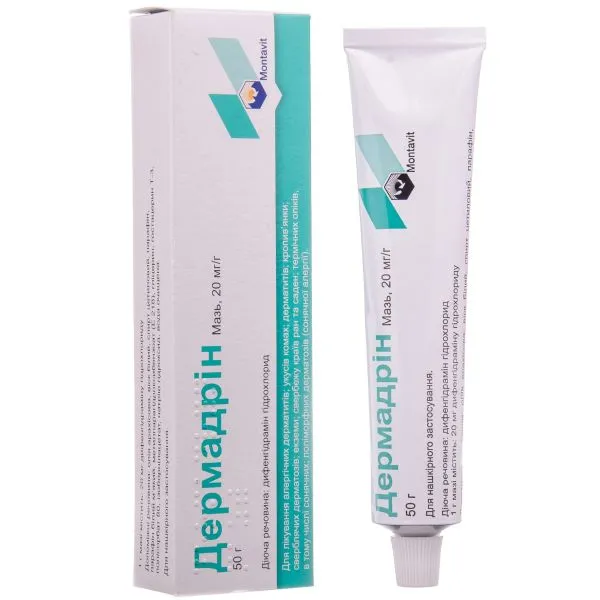
Table of Contents
INSTRUCTIONS FOR MEDICAL USE OF THE MEDICINAL PRODUCT DERMODRIN (DERMODRIN®)
Composition:
Active substance: diphenhydramine hydrochloride
1 g of ointment contains 20 mg of diphenhydramine hydrochloride;
Excipients: peanut oil, white wax, cetyl alcohol, paraffin, white soft paraffin, methylparahydroxybenzoate (E 218), glycerin, Hostacerin T‒3, polysorbate 80, isobutyl acetate, sodium hydroxide, purified water.
Pharmaceutical form. Ointment.
Main physicochemical characteristics: white-colored ointment.
Pharmacotherapeutic group.
Antipruritic agents, including antihistamines, local anesthetics and other agents. Antihistamines for topical use. ATC code D04A A32.
Pharmacological properties.
Dermadrin contains the H1-receptor blocker diphenhydramine, which selectively inhibits H1-receptors of histamine. Diphenhydramine hydrochloride is an effective antihistamine and anti-allergic agent with pronounced anti-pruritic activity. It additionally exerts local anesthetic and analgesic effects. The cream-like base of the ointment does not irritate the skin and ensures easy and uniform application. The ointment base is a water-oil emulsion, which provides a cooling effect. When applied topically, the active ingredient of the ointment penetrates into the skin and subcutaneous layers. Anti-pruritic and analgesic effects occur immediately after application of the ointment and last from 2 to 6 hours.
Clinical Characteristics.
Indications.
For the treatment of itching, local pain, and local hypersensitivity reactions in cases of:
- allergic dermatitis;
- insect bites;
- dermatitis, urticaria, pruritic dermatoses, eczema, wound edge itching, and chafing;
- thermal burns, including sunburns;
- polymorphic dermatoses (solar allergy).
Contraindications.
Hypersensitivity to the active substance or to excipients, to other antihistamines, peanuts, and soy. Contraindicated for use in combination with other products containing diphenhydramine hydrochloride.
Application to open wounds, fractures, or mucous membranes; over large areas of affected skin, especially in chickenpox, measles, and vesicular skin lesions.
Interaction with other medicinal products and other forms of interaction.
Interaction studies have not been conducted. Contraindicated for use in combination with other products containing diphenhydramine hydrochloride. When applying the ointment to large areas of skin, potential interactions cannot be excluded. This particularly concerns treatment with drugs containing diphenhydramine or monoamine oxidase inhibitors (MAO inhibitors). Atropine and tricyclic antidepressants may enhance the anticholinergic effects of diphenhydramine hydrochloride; concomitant use with central nervous system (CNS) depressants, psychotropic agents, opioid analgesics, antihypertensive drugs, and alcohol may unpredictably potentiate their effects.
Special precautions for use
Avoid contact of the medicinal product with the eyes.
Due to the possibility of photosensitivity reactions, exposure of the skin areas treated with the ointment to direct sunlight should be avoided.
H1-histamine receptor antagonists should be used with caution in patients with sleep apnea (or a family history of sudden infant death syndrome).
Use with caution in elderly individuals and in patients with acute illnesses.
Dermadrin contains peanut oil. If you are allergic to peanuts or soy, do not use this medicinal product.
Methylparahydroxybenzoate may cause mild irritation of the skin, eyes, and mucous membranes.
Cetyl alcohol may cause local skin reactions (e.g., contact dermatitis).
Use during pregnancy or breastfeeding
Use of the ointment is not recommended during the first trimester of pregnancy. Epidemiological studies have shown an increased incidence of "cleft palate" in infants whose mothers received diphenhydramine hydrochloride during the first trimester of pregnancy. Reproductive toxicity has been observed in animal studies. Pregnant women should avoid application to large areas of damaged skin. Use is recommended only after an individual dose has been established by a physician and only when the benefit outweighs the potential risk to the fetus. Based on data from other studies in pregnant women, no other adverse effects on pregnancy or fetal or neonatal health have been identified. However, regular use of H1-antagonists during pregnancy is generally not recommended due to the lack of controlled clinical trials and the inability to definitively exclude the risk of retrolental fibroplasia.
Since a small amount of the active substance may pass into breast milk, the medicinal product should not be used during breastfeeding.
Ability to influence reaction speed when driving or operating machinery
The medicinal product does not affect the ability to drive a vehicle or operate other machinery.
Dosage and Administration
Apply the ointment to affected skin areas depending on the size of the lesion:
For adults and children aged 12 years and older, apply an ointment strip 5–15 cm long (corresponding to 18–54 mg of diphenhydramine) 3–4 times daily.
The total daily dose should not exceed 300 mg of diphenhydramine hydrochloride. A dose of 300 mg of diphenhydramine hydrochloride corresponds to 15 g of Dermadrin ointment, which equals 3/4 of a 20 g tube, 1/3 of a 50 g tube, or 1/6 of a 100 g tube of Dermadrin.
For children aged 6 to 12 years, apply an ointment strip 8–10 cm long 3–4 times daily. The total daily dose should not exceed 150 mg of diphenhydramine hydrochloride, which corresponds to an ointment strip 41 cm long.
For children aged 2 to 6 years, apply an ointment strip 3 cm long 2–3 times daily. The total daily dose should not exceed 37 mg of diphenhydramine hydrochloride, which corresponds to an ointment strip 10 cm long.
The duration of treatment depends on the severity of the lesion and the course of the disease and should be determined individually by a physician; however, it should be as short as possible.
For elderly and debilitated patients, as well as patients with severe hepatic or renal insufficiency, the dosage and duration of treatment should be individually adjusted by a physician based on the severity of the condition and therapeutic response.
Children. The drug is indicated for treatment of children aged 2 years and older.
Overdose.
Cases of overdose have not been reported.
With topical application of Dermadrin ointment, the likelihood of overdose is negligible; toxic reactions may occur only if plasma concentrations of diphenhydramine exceed 600 ng/mL.
Treatment of intoxication due to accidental or incorrect use is symptomatic and may include measures such as artificial respiration and intravenous fluid administration. In case of hypotension, vasopressors such as norepinephrine or phenylephrine may be used, but epinephrine should be avoided as it may further reduce blood pressure. If seizures occur, intravenous diazepam is recommended. Do not use any stimulants.
As an antidote in case of diphenhydramine hydrochloride overdose, physostigmine may be administered intravenously at a dose of 0.02–0.06 mg/kg body weight.
Adverse reactions.
If the application regimen is not followed, undesirable side effects may occur.
General disorders and administration site conditions, skin and subcutaneous tissue disorders: skin allergic reactions, contact dermatitis, and skin photosensitivity reactions (avoid direct sunlight) with redness, itching, blistering, swelling of the skin, dry mouth.
Nervous system disorders: with excessive transdermal absorption: hypersensitivity reactions; feeling of fatigue, especially in children; excitability; restlessness; anxiety; and spasms.
Renal and urinary disorders: disturbances in urination.
Shelf life. 3 years.
After first opening of the tube: 12 months.
Storage conditions.
Store in the original packaging to protect from light.
Packaging.
Aluminum tubes of 20 g, 50 g, or 100 g in cardboard packaging.
Availability category. Over-the-counter (without prescription).
Manufacturer.
Pharmazeutische Fabrik Montavit GmbH.
Manufacturer's address and place of business.
Salzburgstrasse 96, 6067 Absam, Austria.