Decostriol
Ukraine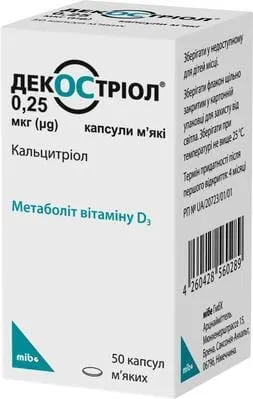
Table of Contents
INSTRUCTIONS FOR MEDICAL USE OF THE MEDICINAL PRODUCT DEKOSTRIOL®
Composition:
Active substance: calcitriol;
1 capsule contains 0.25 mcg of calcitriol;
1 capsule contains 0.5 mcg of calcitriol;
Excipients:
DEKOSTRIOL®, soft capsules 0.25 mcg: peanut oil, refined; butylhydroxyanisole; butylhydroxytoluene; anhydrous ethanol; gelatin, 195 Bloom; glycerin 85 %; sorbitol solution 70 %, non-crystallizing; iron oxide red (E 172); titanium dioxide (E 171);
DEKOSTRIOL®, soft capsules 0.5 mcg: peanut oil, refined; butylhydroxyanisole; butylhydroxytoluene; anhydrous ethanol; gelatin, 160 Bloom; glycerin 85 %; sorbitol solution 70 %, non-crystallizing; iron oxide red (E 172).
Pharmaceutical form. Soft capsules.
Main physicochemical properties:
DEKOSTRIOL®, soft capsules 0.25 mcg: oval soft capsules of pink color.
DEKOSTRIOL®, soft capsules 0.5 mcg: oval soft capsules of red color.
Pharmacotherapeutic group. Vitamin D and analogues. Calcitriol.
ATC code A11CC04.
Pharmacological Properties
Pharmacodynamics
Calcitriol is the most biologically active known metabolite of vitamin D3 for stimulating intestinal calcium transport.
The biological effects of calcitriol are mediated through the vitamin D receptor. This receptor is a nuclear hormone receptor present in most cell types and, upon binding to a specific DNA site, acts as a ligand-activated transcription factor that modulates transcription in the target gene.
Two well-established targets of calcitriol in the body are the intestinal tract and bone.
A calcitriol-binding receptor protein exists in the human intestinal mucosa; furthermore, evidence suggests that calcitriol also acts directly on the kidneys and parathyroid glands.
Patients with renal insufficiency are unable to synthesize sufficient amounts of calcitriol from vitamin D precursors. Hypocalcemia and secondary hyperparathyroidism resulting from this deficiency are the primary causes of metabolic bone disease in renal failure. However, other bone-toxic substances (e.g., aluminum) that accumulate during uremia may also play a contributory role.
The beneficial effect of calcitriol in renal osteodystrophy results from correction of hypocalcemia and secondary hyperparathyroidism. It is not known whether calcitriol exerts additional beneficial effects independently.
Calcitriol (1,25(OH)2D3) is one of the most important active metabolites of vitamin D3. This metabolite is normally produced in the kidneys from its precursor, 25-hydroxycholecalciferol (25(OH)D). Calcitriol promotes intestinal calcium absorption and regulates bone mineralization. The pharmacological effect of a single dose of calcitriol lasts 3–5 days.
In patients with severe renal insufficiency, particularly those on chronic dialysis, endogenous calcitriol production is consistently reduced and may even cease completely. This deficiency plays a significant role in the development of renal osteodystrophy.
In patients with renal osteodystrophy, oral administration of Decostriol® normalizes intestinal calcium absorption and promotes normalization or reduction of elevated serum alkaline phosphatase levels and elevated serum parathyroid hormone concentration. This alleviates bone and muscle pain and corrects histological changes associated with fibrous osteitis and other mineralization disorders.
In patients with postoperative hypoparathyroidism, idiopathic hypoparathyroidism, and pseudohypoparathyroidism, hypocalcemia and its clinical manifestations are reduced with treatment using Decostriol®.
In patients with hereditary hypophosphatemic rickets associated with low plasma calcitriol concentrations, calcitriol therapy reduces phosphate excretion in the renal tubules and promotes normalization of bone development when used in combination with concomitant phosphate therapy.
Pharmacokinetics
Absorption
Following a single oral dose of 0.25–1.0 micrograms of calcitriol, peak serum concentrations are reached within 2–6 hours.
Distribution
During transport in the blood, calcitriol and other vitamin D metabolites bind to specific plasma proteins.
Biotransformation
Calcitriol is hydroxylated and oxidized in the kidneys and liver by the specific cytochrome P450 isoenzyme CYP24A1. Various metabolites of calcitriol have been identified, each exhibiting differing vitamin D activity.
Elimination
The elimination half-life of calcitriol in serum is 3 to 6 hours.
However, the pharmacological effect of a single dose of calcitriol lasts 3 to 5 days.
Calcitriol is excreted via the biliary tract and undergoes enterohepatic circulation.
Special Patient Groups
In patients with nephrotic syndrome or patients undergoing hemodialysis, serum calcium levels are reduced, and the time to reach peak levels is prolonged.
Clinical characteristics
Indications.
Decostriol® is indicated in adults for the treatment of:
- severe or progressive secondary hyperparathyroidism leading to renal osteodystrophy with moderate or severe chronic renal insufficiency;
- hypocalcemia due to hypoparathyroidism (postoperative, idiopathic, and pseudohypoparathyroidism);
- hereditary hypophosphatemic rickets.
Contraindications
- Hypersensitivity to the active substance or to other substances of the same group (vitamin D or its metabolites), to peanut oil, soy, or to any of the excipients listed in the section "Composition".
- All conditions associated with hypercalcemia or hypercalciuria.
- Hereditary hypophosphatemic rickets with hypercalciuria.
- Suspected vitamin D hypervitaminosis.
- Metastatic calcification.
- Nephrocalcinosis.
- Nephrolithiasis.
Interaction with other medicinal products and other forms of interaction.
Concomitant treatment with thiazide diuretics increases the risk of developing hypercalcemia.
For patients receiving digitalis glycosides, the dose of calcitriol should be determined with caution, since hypercalcemia in such patients may provoke cardiac arrhythmias.
There is a functional antagonism between vitamin D analogs, which promote calcium absorption, and corticosteroids, which inhibit it.
Magnesium-containing preparations (e.g., antacids) may cause hypermagnesemia; therefore, patients undergoing chronic renal dialysis should avoid their intake during calcitriol therapy. See also section "Special precautions".
Since calcitriol affects phosphate transport in the intestine, kidneys, and bones, the dose of phosphate-binding agents (e.g., medicinal products containing aluminum hydroxide or aluminum carbonate) should be adjusted according to serum phosphate concentration.
Patients with hereditary hypophosphatemic rickets should continue oral phosphate therapy. However, possible stimulation of intestinal phosphate absorption by calcitriol should be taken into account, as this effect may alter the requirement for dietary phosphate supplements (see section "Special precautions").
The use of enzyme inducers such as phenytoin or phenobarbital may lead to enhanced metabolism and thus reduced serum concentration of calcitriol. Therefore, if these drugs are used concomitantly, higher doses of calcitriol may be required.
Bile acid sequestrants, ion-exchange resins, laxatives, orlistat
Preparations causing impaired fat absorption, such as orlistat, liquid paraffin, cholestyramine, or sevelamer, may reduce intestinal absorption of calcitriol.
Special precautions for use
There is a close relationship between calcitriol treatment and the development of hypercalcaemia.
Hypercalcaemia may lead to generalized vascular calcification, nephrocalcinosis and other soft tissue calcification; therefore, contraindications exist (see section "Contraindications").
As soon as serum calcium levels rise by 1 mg/100 ml (0,25 mmol/l) above normal (9–11 mg/100 ml or 2,25–2,750 mmol/l), calcitriol therapy should be discontinued immediately until normocalcaemia is achieved (see section "Dosage and administration").
During treatment with calcitriol, intake of all other vitamin D compounds and their derivatives, including proprietary formulations or food products that may be "fortified" with vitamin D, should be discontinued.
Since calcitriol is the most potent of the available vitamin D metabolites, other vitamin D preparations (including analogues and metabolites of vitamin D) should not be administered during calcitriol therapy in order to avoid the development of vitamin D intoxication (hypervitaminosis D). If a patient is being switched from a long-acting vitamin D preparation (e.g. ergocalciferol or cholecalciferol) to calcitriol, it may take several months for blood levels of ergocalciferol to return to baseline, increasing the risk of hypercalcaemia (see section "Overdose").
Immobolized patients, for example those who have undergone surgery, are particularly prone to hypercalcaemia. Increased risk of hypercalcaemia also exists in patients with sarcoidosis, those with a history of nephrolithiasis, and patients taking thiazide diuretics.
A sudden increase in calcium intake due to dietary changes (e.g. increased consumption of dairy products) or uncontrolled use of calcium supplements may provoke hypercalcaemia. Patients and their families should be informed that strict adherence to the prescribed diet is mandatory, and should be given instructions on how to recognize symptoms of hypercalcaemia (see sections "Adverse reactions" and "Overdose").
Calcitriol increases serum inorganic phosphate levels. Because of the risk of ectopic calcification, calcitriol should be administered with caution in patients with renal insufficiency, although this is also advisable for patients with hypophosphataemia. In such cases, plasma phosphate levels should be maintained within the normal range by oral administration of appropriate phosphate-binding agents and adherence to a low-phosphate diet. The calcium-phosphate product (Ca × P) should not exceed 70 mg²/dl².
Patients with hereditary hypophosphataemic rickets receiving calcitriol therapy should continue treatment with oral phosphates. However, phosphate requirements may be reduced, as calcitriol stimulates intestinal absorption of phosphate into the blood.
Regular laboratory monitoring should include measurements of serum calcium, phosphate, magnesium, alkaline phosphatase, and urinary excretion of calcium and phosphate. During the stabilization phase of calcitriol therapy, serum calcium levels should be monitored regularly (see section "Dosage and administration").
Patients with normal renal function who are taking calcitriol should avoid dehydration. Adequate fluid intake is recommended.
In patients with normal renal function, chronic hypercalcaemia may be associated with elevated serum creatinine levels. In case of hypercalcaemia, treatment should be discontinued.
Early diagnosis and treatment of magnesium imbalance should be addressed due to its significant role in calcium homeostasis regulation.
Decostriol® contains 0,869 mg of alcohol (ethanol) per soft capsule.
This medicinal product contains a small amount of ethanol (alcohol), less than 100 mg per dose.
Decostriol® contains peanut oil. If the patient is allergic to peanuts or soy, this medicinal product should not be taken.
Decostriol® contains sorbitol. If the patient has been diagnosed with intolerance to certain sugars, consultation with a physician is recommended before taking this medicinal product.
Decostriol® contains glycerol, which may cause headache, gastrointestinal irritation and diarrhoea.
Use during pregnancy or breastfeeding
Pregnancy
Adequate and well-controlled studies in pregnant women have not been conducted.
Animal studies have shown reproductive toxicity with high doses of vitamin D or its derivatives.
Calcitriol should be used during pregnancy only if the potential benefit justifies the potential risk to the fetus.
Overdosage of calcitriol should be avoided during pregnancy, as prolonged hypercalcaemia may result in physical and mental retardation, supravalvular aortic stenosis and retinopathy in the child.
There is no evidence that vitamin D or its derivatives, at therapeutic doses, have teratogenic effects in humans.
During therapy of pregnant women, careful monitoring of serum calcium levels is required and should continue throughout the postpartum period (see section "Indications").
Breastfeeding
It should be assumed that exogenous calcitriol passes into breast milk. Due to the potential risk of hypercalcaemia in the mother and adverse reactions in breastfed infants, breastfeeding during calcitriol treatment is possible only under close monitoring of serum calcium levels in both the mother and the infant.
Fertility
No fertility impairment was observed in animal studies.
Ability to affect reaction speed when driving or operating machinery
Decostriol® has no effect or has a negligible effect on the ability to drive or operate machinery.
No studies have been conducted.
Dosage and Administration
Dosage
The effectiveness of treatment partly depends on adequate daily intake of calcium, which, if necessary, should be supplemented by modifying the diet or taking dietary supplements. It is essential to strictly follow instructions regarding the use of dietary supplements, especially calcium preparations, and to avoid uncontrolled intake of additional calcium-containing products.
For optimal therapy adjustment, treatment should be initiated at the lowest possible dose (0.25 mcg) and gradually increased, with careful monitoring of serum calcium levels.
During treatment, serum and urinary calcium levels must be monitored regularly. If serum calcium increases by 1 mg/100 ml (0.250 mmol/l) above the normal range (9–11 mg/100 ml, or 2.25–2.75 mmol/l), or if serum creatinine rises to >120 \µmol/l, calcitriol therapy must be discontinued immediately until normocalcemia is restored.
Adults
Severe or progressive secondary hyperparathyroidism leading to renal osteodystrophy
Treatment should be initiated at low doses regardless of initial parathyroid hormone concentration, with dose titration based on the parathyroid hormone response to therapy.
The initial daily dose is 0.25 mcg of calcitriol.
Patients with normal or only slightly reduced calcium levels may be adequately treated with 0.25 mcg administered every other day.
If there is no improvement in biochemical parameters and clinical manifestations within 2–4 weeks, the daily dose may be increased by 0.25 mcg every 2–4 weeks. During this period, serum calcium levels should be monitored at least twice weekly.
Most patients respond to treatment at doses of 0.5–1.0 mcg daily. The maximum total weekly dose of 12 mcg/week must not be exceeded.
Hypocalcemia due to hypoparathyroidism
The recommended initial dose is 0.25 mcg/day. If there is no improvement in biochemical parameters and clinical symptoms, the daily dose may be increased by 0.25 mcg every 2–4 weeks. During this period, serum calcium levels should be monitored at least twice weekly.
Hereditary hypophosphatemic rickets
Treatment is initiated at a dose of 0.25 mcg of calcitriol per day, with dose adjustments based on clinical and biochemical response. Ongoing treatment should be guided by laboratory parameters (see sections "Interaction with other medicinal products and other forms of interaction" and "Special warnings and precautions for use").
Children
The safety and efficacy of calcitriol in capsule form have not been sufficiently studied to provide dosage recommendations for children. For children under 6 years of age, there is a risk of choking due to the capsule formulation.
Elderly patients
Elderly patients do not require specific dose adjustments. General recommendations for monitoring serum and urinary calcium levels and serum creatinine should be followed.
Hepatic impairment
Data are lacking.
Administration method
For oral use.
Capsules should be swallowed whole, without chewing, preferably after breakfast, with water.
Increased daily doses should be divided into 2–3 doses per day and taken with meals (i.e., the total daily dose should be split into 2–3 administrations).
Duration of treatment
The duration of calcitriol therapy depends on the severity of the disease and laboratory findings.
Children
The use of Decostriol® is not recommended in children (under 18 years of age).
Overdose
Since calcitriol is a derivative of vitamin D, symptoms of overdose are similar to those of vitamin D intoxication. High doses of calcium and phosphate taken concomitantly with calcitriol may produce similar symptoms. The calcium-phosphate product (Ca × P) should not exceed 70 mg²/dl². A high calcium concentration in the dialysate may promote hypercalcemia.
Acute symptoms of vitamin D intoxication: anorexia, headache, nausea, constipation.
Chronic symptoms of vitamin D intoxication: dystrophy (weakness, weight loss), sensory disturbances, possible fever with thirst, polyuria, dehydration, apathy, growth arrest, and urinary tract infections. Hypercalcemia develops, leading to metastatic calcification of the renal cortex, myocardium, lungs, and pancreas, resulting in organ dysfunction, including hypertension, cardiac arrhythmias, myocardial damage, nausea, vomiting, constipation, and sometimes diarrhea.
Recommended measures for managing accidental overdose:
- Administration of liquid paraffin to promote fecal excretion;
- Repeated measurement of serum calcium levels is recommended;
- If elevated serum calcium levels persist, phosphates and corticosteroids may be administered, and measures should be taken to ensure adequate diuresis.
Hypercalcemia at higher levels (>3.2 mmol/l) may lead to renal failure, especially if serum phosphate levels are normal or elevated due to impaired renal function.
If hypercalcemia develops after prolonged treatment, calcitriol administration should be discontinued until plasma calcium levels return to normal. A low-calcium diet will accelerate normalization. Therapy with calcitriol may then be resumed, starting with a lower dose or using the same dose but with shorter intervals than previously.
For patients undergoing intermittent hemodialysis, a dialysate with low calcium concentration may also be used.
Side effects
The side effects listed below reflect the experience from clinical trials with calcitriol as well as post-marketing experience.
The most frequently reported adverse reaction was hypercalcemia.
| Systems and organs (MedDRA)* |
Frequency of adverse reactions |
||||
| Very common (≥ 1/10) |
Common (≥ 1/100, < 1/10) |
Uncommon (≥ 1/1,000, < 1/100) |
Rare (≥ 1/10,000, < 1/1,000) |
Not known |
|
| Immune system disorders |
severe allergic reactions to peanut oil |
hypersensitivity, urticaria |
|||
| Metabolism and nutrition disorders |
hypercalcaemia |
decreased appetite |
polydipsia, dehydration, weight loss |
||
| Psychiatric disorders |
apathy, psychiatric disorders |
||||
| Nervous system disorders |
headache |
muscle weakness, sensory disturbances, somnolence |
|||
| Cardiac disorders |
cardiac arrhythmias |
||||
| Gastrointestinal disorders |
abdominal pain, nausea |
vomiting |
constipation, paralytic ileus, upper abdominal pain |
||
| Skin and subcutaneous tissue disorders |
rash |
erythema, pruritus |
|||
| Musculoskeletal and connective tissue disorders |
growth retardation |
||||
| Renal and urinary disorders |
urinary tract infections |
polyuria, nocturia |
|||
| General disorders and administration site conditions |
calcinozis, pyrexia, thirst |
||||
| Investigations |
increased blood creatinine levels |
||||
* MedDRA [Medical Dictionary for Regulatory Activities] version 12.0.
Since calcitriol affects vitamin D activity, adverse reactions similar to those observed after excessive intake of vitamin D may occur, such as hypercalcaemia syndrome or calcium intoxication (depending on the severity and duration of hypercalcaemia) (see sections "Dosage and administration", "Special precautions", and "Overdose").
Occasional acute symptoms include decreased appetite, headache, nausea, vomiting, abdominal pain, or abdominal pain and constipation.
Due to the short biological half-life of calcitriol, pharmacokinetic studies have shown normalization of elevated serum calcium levels within a few days after discontinuation of treatment, i.e., much faster than with vitamin D3 preparations.
Chronic reactions may include muscle weakness, weight loss, sensory disturbances, fever, thirst/polydipsia, polyuria, dehydration, apathy, growth retardation, and urinary tract infections.
With concomitant hypercalcaemia and hyperphosphataemia > 6 mg/100 ml, or > 1.9 mmol/l, calcinosis may occur; this may be seen radiographically.
Hypersensitivity reactions, including rash, erythema, pruritus, and urticaria, may occur in predisposed individuals.
Laboratory test abnormalities
In patients with normal renal function, chronic hypercalcaemia may be associated with increased blood creatinine levels. Several cases of abnormal neutrophil count elevation and lymphopenia have been reported.
Post-marketing experience
The number of adverse reactions reported during 15 years of clinical use of calcitriol across all indications is very low, with each individual reaction, including hypercalcaemia, occurring at a frequency of 0.001% or less.
Reporting of adverse reactions
Reporting suspected adverse reactions after medicine authorization is important. It allows continued monitoring of the benefit-risk balance of the medicine. Healthcare professionals, pharmacists, as well as patients or their legal representatives, should report all suspected adverse reactions and lack of efficacy via the Automated Pharmacovigilance Information System at https://aisf.dec.gov.ua.
Shelf life. 36 months. After first opening of the container — 4 months.
Storage conditions. Store the bottle tightly closed in the original cardboard packaging to protect from light. Store at temperatures not exceeding 25°C, in a place protected from light. Keep out of reach of children.
Packaging. 50 or 100 capsules in a bottle; 1 bottle per carton.
Prescription status. Prescription only.
Manufacturer. mibe GmbH & Co. KG.
Manufacturer's address and place of business. Municher Strasse 15, Brehna, Saxony-Anhalt, 06796, Germany.