Bronholitin tab
Ukraine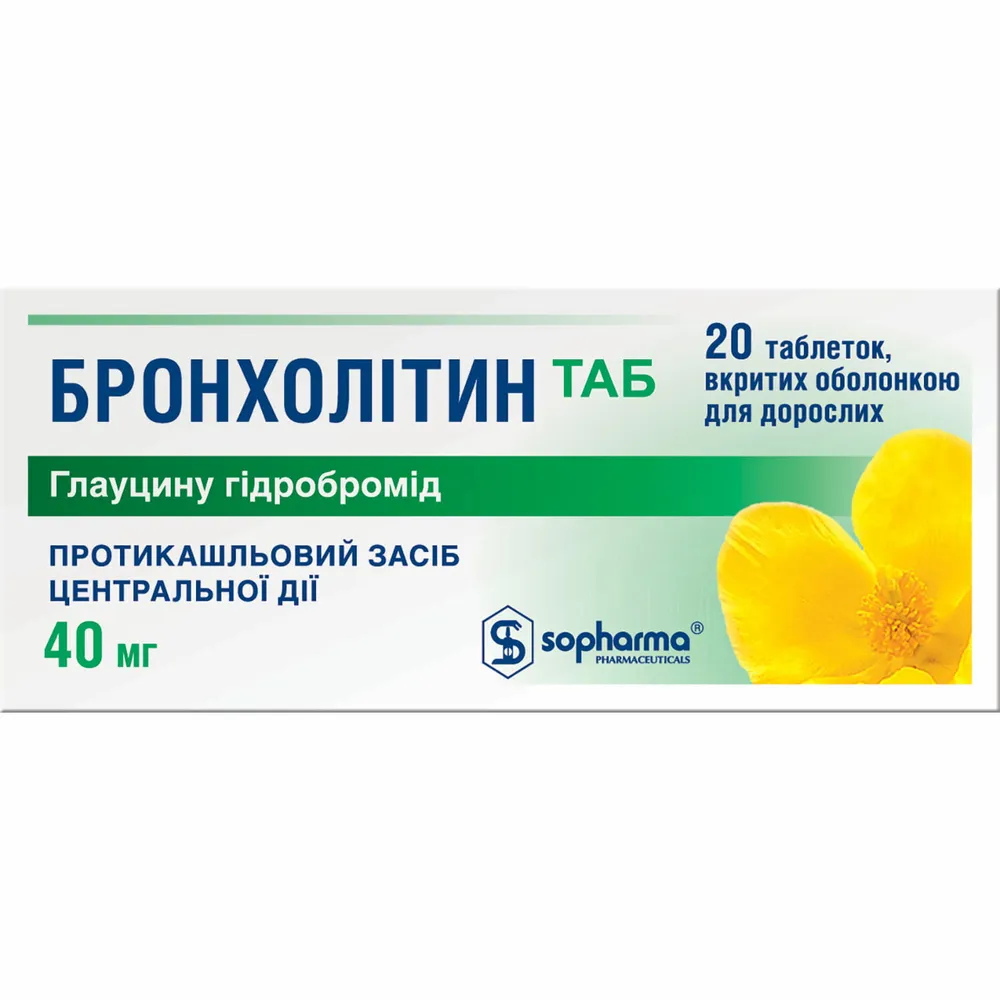
Table of Contents
INSTRUCTION FOR MEDICAL USE OF THE MEDICINAL PRODUCT BRONCHOLYTIN® TAB
Composition:
Active substance: glaucine hydrobromide;
1 coated tablet contains 10 mg or 40 mg of glaucine hydrobromide;
Excipients: wheat starch, sucrose, gelatin, microcrystalline cellulose, talc, stearic acid;
Coating: gelatin, titanium dioxide (E 171), sucrose, acacia, talc, macrogol 6000, glycerin;
for 10 mg: Opalux Pink AS-24825 (sucrose, purified water, titanium dioxide (E 171), carmine (E 120), povidone (E 1201), Ponceau 4R (E 124), sodium benzoate (E 211), indigocarmine (E 132))
or for 40 mg: Opalux Orange AS-23060 (sucrose, purified water, titanium dioxide (E 171), Sunset Yellow FCF (E 110), talc, iron oxide yellow (E 172), povidone (E 1201), sodium benzoate (E 211), indigocarmine (E 132)).
Pharmaceutical form. Coated tablets.
Main physicochemical properties:
10 mg tablets: biconvex, pink-colored, coated tablets of regular round shape with glossy surface;
40 mg tablets: biconvex, orange-colored, coated tablets of regular round shape with glossy surface.
Pharmacotherapeutic group.
Antitussive agents.
ATC code: R05DB.
Pharmacological Properties
Pharmacodynamics
Bronholitin Tab is a centrally-acting antitussive medicinal product. It contains the alkaloid glaucine obtained from the plant Glaucium flavum (yellow horned poppy), which suppresses the cough center. Unlike codeine, glaucine does not affect the respiratory center and does not cause drug dependence. It does not influence intestinal motility, exhibits weak spasmolytic activity, has sympatholytic effects, and may reduce arterial blood pressure. It exerts anti-inflammatory action.
Pharmacokinetics
After oral administration, the drug is rapidly absorbed from the gastrointestinal tract. Time to reach maximum plasma concentration is approximately 1.5 hours after administration. It is metabolized in the liver and primarily excreted with urine.
Clinical characteristics.
Indications.
Symptomatic treatment of dry cough of various etiologies associated with infectious and inflammatory diseases of the upper respiratory tract, including acute and chronic bronchitis, influenza.
Contraindications.
- Hypersensitivity to the active substance or to any of the excipients of the medicinal product;
- arterial hypotension;
- acute myocardial infarction.
Interaction with other medicinal products and other forms of interaction.
There are no data on adverse drug interactions with Broncholytin Tab. It can be used in combination with antibiotics, chemotherapeutic agents, and other medicinal products.
Broncholytin Tab should not be used simultaneously with cough-suppressant drugs, both of central (codeine, codethropin) and peripheral mechanism of action (exalt, libexin). Combination with agents causing reduction of bronchial secretion (e.g., atropine derivatives) is not justified.
Broncholytin Tab can be used concomitantly with bronchodilators, cardiovascular drugs.
The active substance effectively combines with ephedrine, citric acid, basil oil in combined preparations for cough relief in syrup form.
Special precautions for use.
Broncholytin Tab should not be used for productive cough associated with sputum production, as there is a risk of bronchial obstruction due to retention of bronchial secretions.
In patients with labile arterial pressure, medical consultation is required. Broncholytin Tab should be used with caution due to the risk of collapse resulting from the sympatholytic effect of glaucine.
The product contains wheat starch as an excipient, which may contain gluten, but only in negligible amounts; therefore, it is considered safe for individuals with celiac disease.
Patients with allergy to wheat (distinct from celiac disease) should not use this medicinal product.
The product contains sucrose as an excipient in the coating. Broncholytin Tab should not be administered to patients with rare hereditary fructose intolerance, glucose-galactose malabsorption, or sucrase-isomaltase deficiency.
Colourant E 110 or colourant E 124 may cause allergic reactions.
Use during pregnancy or breastfeeding.
Broncholytin Tab should be used with caution in pregnant women and in women who are breastfeeding, only after careful assessment of the benefit-risk ratio.
Ability to influence reaction speed when driving or operating machinery.
If dizziness, headache, drowsiness, weakness, or rapid fatigue occur during treatment with this medicinal product, patients should refrain from driving or operating machinery.
Dosage and Administration.
Bronkholitin Tab should be taken orally. It is recommended to take the medication after meals.
Adults.
The single dose for adults is 40 mg, administered 2–3 times daily. In more severe cases, the single dose may be increased to 80 mg. The maximum daily dose must not exceed 200 mg.
Children aged 4 years and older.
The single dose for children aged 4 years and older is 10 mg, taken 2–3 times daily.
The maximum daily dose must not exceed 40 mg.
Patients with impaired liver or kidney function.
For patients with liver or kidney disorders, the dose should be reduced or the dosing interval prolonged.
The duration of treatment with Bronkholitin Tab should not exceed 5 days.
Prolonged use or use at higher doses is possible only under a physician's prescription and under continuous medical supervision.
Children.
The medication must not be used for the treatment of children under 4 years of age.
Overdose.
Symptoms: dizziness, headache, drowsiness, weakness, rapid fatigue, nausea, vomiting, hypotension.
Treatment: implement standard measures to rapidly eliminate the drug from the body (gastric lavage, administration of activated charcoal, infusion of saline solutions), as well as symptomatic treatment.
Adverse reactions.
The drug is generally well tolerated. Rarely, when a high single dose exceeding 80 mg is administered, dizziness, headache, drowsiness, weakness and rapid fatigue, nausea and vomiting, and decreased arterial pressure may occur. Allergic reactions, including itching and skin rash, are possible.
If any adverse reaction becomes severe, the drug should be discontinued and the physician should be informed immediately.
In case of occurrence of adverse reactions not listed in this instruction, immediate medical advice must be sought.
Shelf life.
3 years.
Storage conditions.
Keep out of reach of children.
Store in the original packaging at a temperature not exceeding 25 °C.
Packaging.
20 film-coated tablets in a blister pack made of PVC film and aluminum foil.
1 blister pack in a cardboard box.
Prescription status.
Over-the-counter.
Manufacturers.
JSC "Sofarma".
JSC "VITAMINS".
Manufacturers' addresses.
JSC "Sofarma"
16 Iliensko Shose Str., Sofia, 1220, Bulgaria.
JSC "VITAMINS"
31 Uspenska Str., Umansk, Cherkasy region, 20300, Ukraine.