Be-stedi
Ukraine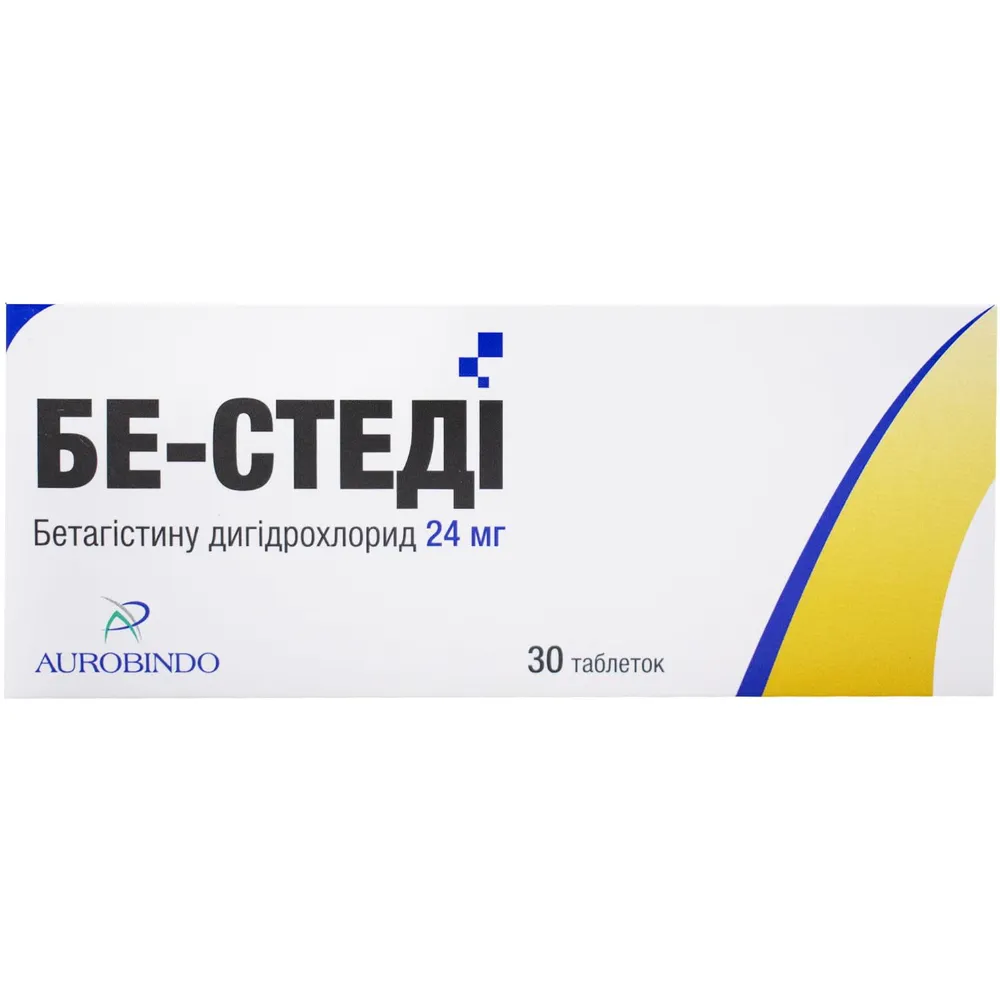
Table of Contents
INSTRUCTIONS FOR MEDICAL USE OF THE MEDICINAL PRODUCT BETAHISTINE (BE-STEDY)
Composition:
Active substance: betahistine;
One tablet contains 8 mg, 16 mg, or 24 mg of betahistine dihydrochloride;
Excipients: microcrystalline cellulose, mannitol (E 421), povidone, crospovidone, anhydrous citric acid, colloidal anhydrous silicon dioxide, talc, stearic acid.
Pharmaceutical form. Tablets.
Main physicochemical properties:
8 mg tablets: white or almost white, round, flat, uncoated tablets, embossed with the symbol "X" on one side and "87" on the other;
16 mg tablets: white or almost white, round, uncoated tablets, embossed with the symbol "X" and a break line on one side and "88" on the other;
24 mg tablets: white or almost white, round, uncoated tablets, embossed with the symbol "X" and a break line on one side and "89" – on the other.
Pharmacotherapeutic group. Agents for the treatment of vestibular disorders. Betahistine. ATC code N07CA01.
Pharmacological Properties
Pharmacodynamics
The mechanism of action of betahistine is only partially understood. Several plausible hypotheses have been supported by data from studies conducted in animals and humans.
Effect of betahistine on the histaminergic system.
Betahistine has been shown to act as a partial agonist at H1-receptors and as an antagonist at H3-receptors of histamine in nervous tissue, with minimal activity at histamine H2-receptors. Betahistine increases histamine turnover and release by blocking presynaptic H3-receptors and inducing down-regulation of these H3-receptors.
Betahistine may increase blood flow in the cochlear region as well as in the entire brain.
Pharmacological studies in animals have demonstrated improved circulation in the vessels of the stria vascularis of the inner ear, possibly due to relaxation of precapillary sphincters in the microcirculatory system of the inner ear. Betahistine has also been shown to increase cerebral blood flow in humans.
Betahistine promotes vestibular compensation.
Betahistine accelerates the recovery of vestibular function after unilateral neurectomy in animals by stimulating and facilitating the process of central vestibular compensation. This effect is characterized by enhanced regulation of histamine turnover and release and is mediated via H3-receptor antagonism. In humans, treatment with betahistine has also been associated with a reduced time for vestibular function recovery after neurectomy.
Betahistine alters neuronal activity in the vestibular nuclei.
It has also been established that betahistine exerts a dose-dependent inhibitory effect on spike generation in neurons of the lateral and medial vestibular nuclei.
The pharmacodynamic properties of betahistine, as demonstrated in animals, may underlie the positive therapeutic effect of the drug on the vestibular system.
The efficacy of betahistine has been demonstrated in clinical studies in patients with vestibular vertigo and Ménière’s disease, as evidenced by a reduction in the severity and frequency of vertigo attacks.
Pharmacokinetics
Absorption.
After oral administration, betahistine is rapidly and almost completely absorbed throughout the gastrointestinal tract. Following absorption, the drug is quickly and almost entirely metabolized to the metabolite 2-pyridylacetic acid. Plasma concentrations of unchanged betahistine are very low. Therefore, all pharmacokinetic analyses are performed by measuring the plasma and urinary concentrations of the metabolite 2-pyridylacetic acid.
When the drug is taken with food, the maximum concentration (Cmax) of the drug is lower than when taken on an empty stomach. However, the total extent of betahistine absorption is identical in both cases, indicating that food intake only delays the absorption process.
Distribution.
The percentage of betahistine bound to plasma proteins is less than 5%.
Biotransformation.
After absorption, betahistine is rapidly and almost completely metabolized to 2-pyridylacetic acid (which has no pharmacological activity).
After oral administration of betahistine, the plasma (and urinary) concentration of 2-pyridylacetic acid reaches its peak within 1 hour and declines with a half-life of approximately 3.5 hours.
Elimination.
2-pyridylacetic acid is rapidly excreted in the urine. After administration of betahistine in doses of 8–48 mg, approximately 85% of the initial dose is recovered in the urine. Renal or fecal excretion of unchanged betahistine is negligible.
Linearity.
The rate of elimination remains constant following oral doses of 8–48 mg, indicating linear pharmacokinetics of betahistine, and suggesting that the metabolic pathway involved is not saturable.
Clinical characteristics.
Indications.
Meniere's disease and Meniere's syndrome, characterized by three main symptoms:
- vertigo, sometimes accompanied by nausea and vomiting;
- hearing loss (deafness);
- tinnitus.
Symptomatic treatment of vestibular vertigo of various origins.
Contraindications.
Hypersensitivity to any component of the drug.
Pheochromocytoma. Since betahistine is a synthetic histamine analogue, it may induce catecholamine release from the tumour, leading to severe hypertension.
Interaction with other medicinal products and other forms of interaction.
In vivo studies on interactions with other medicinal products have not been conducted. Based on in vitro data, inhibition of cytochrome P450 enzyme activity is not expected in vivo.
In vitro data indicate that metabolism of betahistine is inhibited by drugs which inhibit monoamine oxidase (MAO) activity, including MAO subtype B (e.g. selegiline). Caution is recommended when betahistine is used concomitantly with MAO inhibitors (including selective MAO subtype B inhibitors).
Since betahistine is a histamine analogue, interaction between betahistine and antihistamine agents may theoretically affect the efficacy of either agent.
Special precautions for use.
Patients with bronchial asthma and/or a history of peptic ulcer of the stomach and duodenum should be carefully monitored during treatment with this medicinal product.
Use during pregnancy or breast-feeding.
Pregnancy. There are insufficient data on the use of betahistine in pregnant women.
Animal studies have not shown any direct or indirect adverse effects with regard to reproductive toxicity at doses corresponding to those used in clinical practice. Betahistine should not be used during pregnancy except when clearly necessary.
Breast-feeding period. It is unknown whether betahistine passes into human breast milk. Betahistine passes into the milk of rats. The effects observed in offspring in animal studies occurred only at very high doses. The benefit of treatment for the mother should be weighed against the advantages of breast-feeding and the potential risk to the infant.
Fertility. Studies in rats have not shown any effect on fertility.
Ability to affect reaction speed when driving or operating machinery.
Betahistine is indicated for the treatment of Meniere's syndrome, characterized by a triad of main symptoms: vertigo, hearing loss, and tinnitus, as well as for symptomatic treatment of vestibular vertigo. Both conditions may negatively affect the ability to drive a car or operate machinery. According to data from clinical studies investigating the effect of the drug on the ability to drive and operate machinery, betahistine had no effect or only a negligible effect on this ability.
Administration and dosage.
The daily dose for adults is 24–48 mg, evenly divided for administration throughout the day. Tablets should be swallowed with water.
| 8 mg tablets |
16 mg tablets |
24 mg tablets |
| 1-2 tablets 3 times daily |
½-1 tablet 3 times daily |
1 tablet 2 times daily |
The dosage should be individually adjusted according to the response. Improvement in symptoms may sometimes be observed only after two to three weeks of treatment. Optimal results may sometimes be achieved with administration of the drug over several months. Data suggest that initiating treatment at the early stages of the disease may prevent its progression and/or hearing loss at later stages.
BE-STEADY can be administered independently of food intake. During treatment, mild gastrointestinal disturbances (listed in section "Adverse Reactions") may occur, which can be alleviated by taking the drug with food.
Geriatric patients
Although clinical data in this patient group are limited, extensive post-marketing experience suggests that dose adjustment is not required in this population.
Renal impairment
Specific clinical trials have not been conducted in this patient group; however, according to post-marketing experience, dose adjustment is not necessary.
Hepatic impairment
Specific clinical trials have not been conducted in this patient group; however, according to post-marketing experience, dose adjustment is not necessary.
Children
Due to insufficient data on safety and efficacy, BE-STEADY is not recommended for use in children (under 18 years of age).
Overdose
There have been several reported cases of overdose. Mild to moderate symptoms (nausea, somnolence, abdominal pain) were observed in some patients after ingestion of doses up to 640 mg. Other symptoms of betahistine overdose include vomiting, dyspepsia, ataxia, and convulsions. More severe complications (convulsions, cardiopulmonary complications) have been observed following intentional ingestion of high doses of betahistine, particularly in combination with overdose of other medicinal products.
Treatment of overdose
Management of overdose should include standard supportive measures. There is no specific antidote. Gastric lavage and symptomatic treatment are recommended within one hour after ingestion.
Side effects
The following adverse reactions have been observed in patients treated with BE-STEADI during placebo-controlled studies, with the following frequency: very common (≥1/10), common (≥1/100 to <1/10), uncommon (≥1/1,000 to <1/100), rare (≥1/10,000 to <1/1,000), very rare (<1/10,000).
Gastrointestinal disorders
Common: nausea and dyspepsia.
In addition to cases reported during clinical trials, the following adverse reactions have been reported spontaneously during post-marketing use and are known from scientific literature. Based on available data, the frequency cannot be estimated and is therefore classified as unknown.
Immune system disorders
Hypersensitivity reactions, e.g., anaphylaxis.
Gastrointestinal disorders
Reports of mild gastrointestinal disturbances (vomiting, gastrointestinal pain, abdominal distension, and flatulence). These side effects usually resolve when the medication is taken with food or after dose reduction.
Skin and subcutaneous tissue disorders
Skin and subcutaneous tissue hypersensitivity reactions have been observed, including angioneurotic edema, rash, pruritus, and urticaria.
Shelf life. 3 years.
Storage conditions.
Store in a place inaccessible to children, at a temperature not exceeding 25 °C.
Packaging.
8 mg tablets: 10 tablets per blister, 3 blisters per cardboard pack.
16 mg tablets: 10 tablets per blister, 3 blisters per cardboard pack.
24 mg tablets: 10 tablets per blister, 3 blisters per cardboard pack.
Prescription status. Prescription only.
Manufacturer.
Aurobindo Pharma Limited (Unit III), India.
Manufacturer's address and place of business.
Survey No 313, 314, Block I, II, III, IV, Bachupally Village, Quthubullapur Mandal, Ranga Reddy District (A.P), India.