Atenativ 500 mo
Ukraine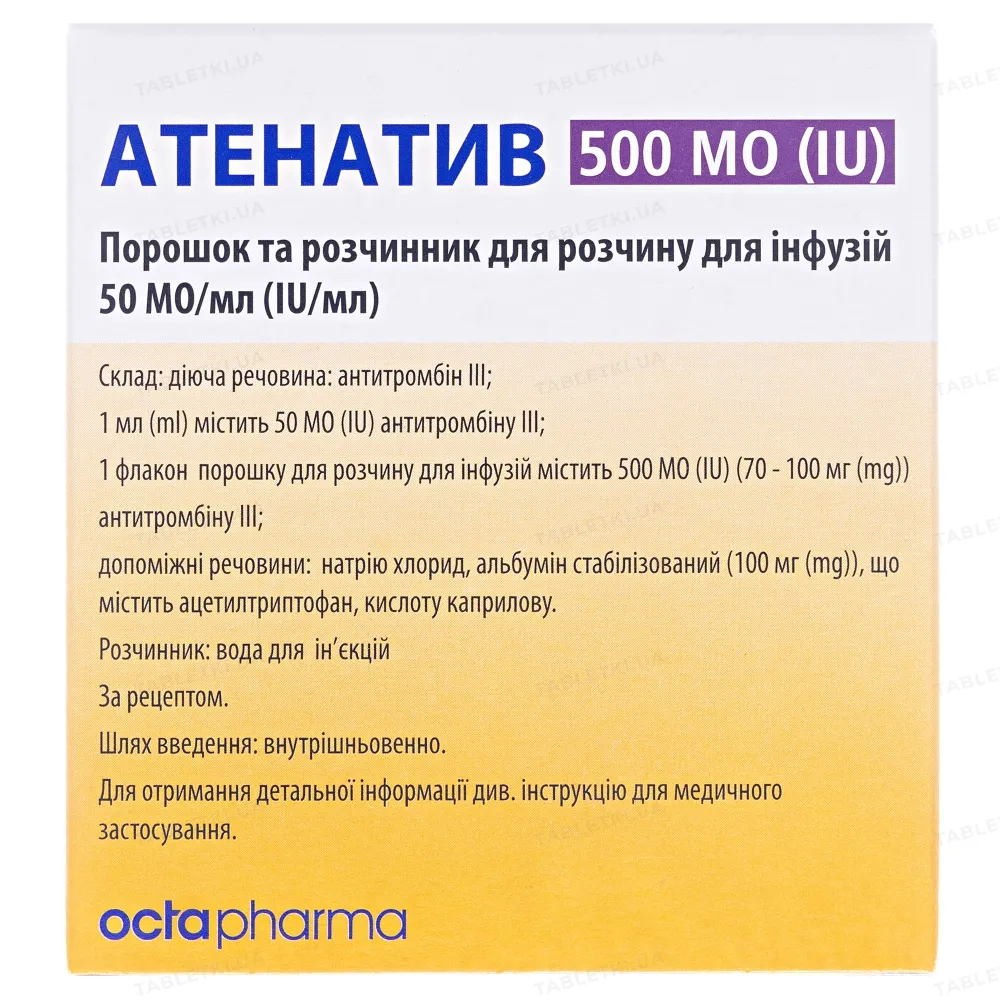
Table of Contents
INSTRUCTIONS FOR MEDICAL USE OF THE MEDICINAL PRODUCT Atenativ 500 MO Atenativ 1000 MO
Composition:
Active substance: antithrombin III;
1 ml contains 50 IU of antithrombin III;
1 vial contains 500 IU (70–100 mg) or 1000 IU (140–200 mg) of antithrombin III;
Excipients: sodium chloride, stabilized albumin (100 mg (500 IU) or 200 mg (1000 IU), containing acetyltryptophan, caprylic acid.
Solvent: water for injections.
Pharmaceutical form. Powder and solvent for solution for infusion.
Main physicochemical properties:
powder: white or almost white, hygroscopic brittle mass or powder;
solvent (water for injections): clear, colorless liquid, free from particles.
Pharmacotherapeutic group. Antithrombotic agents, heparin group. Antithrombin III. ATC code B01AB02.
Pharmacological Properties
Pharmacodynamics
Antithrombin, a molecule with a molecular weight of 58 kDa composed of 432 amino acids, belongs to the serpin subfamily (serine protease inhibitors). It is one of the most important natural inhibitors of blood coagulation. The factors most strongly inhibited are thrombin and factor Xa, as well as contact activation factors of the intrinsic coagulation pathway and the factor VIIa/tissue factor complex. Antithrombin activity is significantly enhanced by heparin, and the anticoagulant effect of heparin depends on the presence of antithrombin. Antithrombin contains two functionally important domains. The first contains the reactive center and enables cleavage by proteases such as thrombin, promoting the formation of a stable protease-inhibitor complex. The second is the glycosaminoglycan-binding domain, responsible for interaction with heparin and related substances that accelerate thrombin inhibition. Coagulation enzyme-inhibitor complexes are cleared by the reticuloendothelial system. Antithrombin activity in adults ranges from 80–120%, while in newborns it is approximately 40–60%.
In congenital antithrombin deficiency, activity is about 50%. The level at which acquired antithrombin deficiency becomes clinically significant may vary depending on etiology. In sepsis, levels < 50–60% are associated with unfavorable outcomes.
There are several studies in conditions such as disseminated intravascular coagulation (DIC), sepsis, pre-eclampsia, L-asparaginase treatment for acute lymphoblastic leukemia, veno-occlusive disease, and cardiopulmonary bypass surgery, where antithrombin administration has shown beneficial effects on coagulation parameters.
However, definitive evidence of benefit on morbidity and mortality has not been established in these settings.
In the KyberSept trial, a randomized, placebo-controlled, double-blind, prospective phase III study, subgroups of septic patients who benefited from high-dose antithrombin concentrate treatment in terms of survival were identified. These included patients with sepsis at high risk of death and patients not receiving concomitant heparin. Patients with disseminated intravascular coagulation (DIC) or at high risk of death who did not receive concomitant heparin showed even greater benefit.
The KyberSept study randomized 2314 septic patients who received either 30,000 IU of antithrombin over 4 days (n = 1157) or placebo (n = 1157). In a subgroup analysis of 698 patients (698/2314) (346 in the placebo group; 352 in the antithrombin group) who did not receive concomitant heparin during the treatment phase (days 1–4), 28-day mortality was lower with antithrombin than with placebo (37.8% vs. 43.6%; absolute reduction: 5.8%; relative risk: 0.860 [95% CI (confidence interval) 0.725–1.019]), with further improvement observed at day 90 (44.9% vs. 52.5%; absolute reduction: 7.6%; relative risk: 0.851 [0.735–0.987]). Within this subgroup, 563 patients (277 in the placebo group; 286 in the antithrombin group) had sufficient data available to diagnose DIC. At baseline, 40.7% of patients (229/563) had DIC. Compared to placebo, patients with DIC treated with antithrombin showed a significant absolute reduction in mortality of 14.6% (p = 0.024) and 16.2% (p = 0.015) at days 28 and 90, respectively. In another subgroup analysis of patients at high risk of death (predicted mortality 30–60%) at study entry (1008/2314; 490 in the antithrombin group; 518 in the placebo group), mortality rates at days 28, 56, and 90 in the antithrombin-treated group compared to the placebo group were 36.9% vs. 40.7% (relative risk [95% CI], 0.907 [0.776–1.059]), 42.0% vs. 48.8% (0.859 [0.750–0.985]), and 45.5% vs. 51.6% (0.883 [0.777–1.005]), respectively. In patients not receiving concomitant heparin (140 in the antithrombin group; 162 in the placebo group), the treatment effect favoring antithrombin was more pronounced than in patients receiving concomitant heparin. Without concomitant heparin, the absolute reduction in mortality in the antithrombin group compared to the placebo group was 8.7% at day 28 [35.7% vs. 44.4% (relative risk 0.804; 95% CI 0.607–1.064)] and 12.3% at day 90 [42.8% vs. 55.1% (relative risk 0.776; 95% CI 0.614–0.986)].
In the KyberSept study, major bleeding events occurred in 5.7% of patients in the placebo group (total n = 1155) compared to 10.0% of patients receiving antithrombin treatment (total n = 1161), relative risk (95% CI) = 1.75 (1.31–2.33). In the subgroup not receiving concomitant heparin, the difference did not reach statistical significance (4.6% in the placebo group (total n = 345) vs. 7.9% in the antithrombin group (total n = 354), relative risk 1.71 (0.95–3.07)). In other studies, the addition (administration) of antithrombin was not associated with an increased risk of bleeding.
Pharmacokinetics
Pharmacokinetic studies of Atenativ showed an average biological half-life of approximately 3 days. The half-life may be reduced to about 1.5 days when administered concurrently with heparin.
The plasma half-life of antithrombin may be shortened to several hours under certain clinical conditions involving significant consumption in acquired antithrombin deficiency, such as severe sepsis and disseminated intravascular coagulation.
Preclinical Safety Data
Atenativ contains very small amounts (trace levels) of chemical substances such as tri-n-butyl phosphate and octoxynol, which are used during manufacturing for viral inactivation. In preclinical studies, effects of these impurities were observed only at concentrations substantially exceeding the maximum possible human dose, indicating their negligible clinical significance.
Clinical characteristics.
Indications.
For patients with congenital antithrombin III deficiency for:
a) prevention of deep vein thrombosis and thromboembolism in clinical risk situations (especially during surgical procedures or in the perinatal period), in combination with heparin, if heparin is prescribed;
b) prevention of progression of deep vein thrombosis and thromboembolism, together with heparin, when indicated.
For patients with acquired antithrombin deficiency.
Atnativ is indicated for use in adults.
Contraindications.
Hypersensitivity to the active substance or to any of the excipients, or to residual substances used in the manufacturing process.
Interaction with other medicinal products and other forms of interaction.
Replacement therapy with antithrombin during administration of heparin at therapeutic doses increases the risk of bleeding. Heparin significantly potentiates the effect of antithrombin. The half-life of antithrombin may be considerably reduced during concomitant treatment with heparin due to accelerated turnover of antithrombin. Therefore, when heparin and antithrombin are used concomitantly in patients with an increased risk of bleeding, clinical and biological monitoring is required.
Special precautions for use
In cases of acquired antithrombin deficiency, a reduced antithrombin level alone (e.g., due to impaired synthesis) should not generally be an indication for replacement therapy if the patient is clinically stable.
The reconstituted solution of the medicinal product Atenativ contains 500 IU or 1000 IU of antithrombin derived from human lyophilized plasma per vial.
The Atenativ preparation contains 50 IU/mL of antithrombin derived from human lyophilized plasma after reconstitution with the solvent provided (water for injections), i.e., 10 mL (500 IU), 20 mL (1000 IU).
Activity (IU) is determined using a chromogenic assay according to the European Pharmacopoeia. The specific activity of Atenativ is approximately 2.8 IU/mg protein.
As with any intravenously administered protein product, allergic-type hypersensitivity reactions may occur. Patients must be closely monitored throughout the entire intravenous infusion period, and any symptoms should be carefully observed.
Patients should be informed about early signs of hypersensitivity reactions, including rash, generalized urticaria, chest tightness, wheezing, hypotension, and anaphylaxis.
If such symptoms occur after administration of the product, patients should seek medical advice.
In the event of shock, standard treatment should be initiated.
Standard measures to prevent infections from medicinal products derived from human blood or plasma include donor selection, screening of individual blood donations and plasma pools for specific infection markers, and inclusion of effective viral inactivation/removal steps in the manufacturing process. Nevertheless, when using medicinal products derived from human blood or plasma, it is not possible to completely exclude the risk of transmission of infections. This also applies to unknown or emerging viruses and other pathogenic agents.
The measures taken are considered effective against enveloped viruses such as human immunodeficiency virus (HIV), hepatitis B virus (HBV), and hepatitis C virus (HCV), as well as against non-enveloped viruses such as hepatitis A virus (HAV). However, the measures may have limitations against non-enveloped viruses such as parvovirus B19. Parvovirus B19 infection may have serious consequences for pregnant women (fetal infection) and individuals with immunodeficiency or increased erythropoiesis (e.g., those with hemolytic anemia).
Appropriate vaccination (hepatitis A and B) should be considered for patients receiving repeated or long-term treatment with antithrombin products derived from human plasma.
It is strongly recommended that the name and batch number of Atenativ be recorded at each administration to allow for traceability between the patient's condition and the product batch.
Clinical and biological monitoring when antithrombin is used concomitantly with heparin:
- To adjust the heparin dose and avoid excessive reduction in blood coagulation, the degree of anticoagulation should be monitored regularly at short intervals (activated partial thromboplastin time [APTT], and anti-factor Xa activity if necessary), particularly in the first minutes/hours after initiating antithrombin therapy.
- Antithrombin levels should be measured daily to adjust the individual dose due to the risk of decreasing antithrombin levels during prolonged treatment with unfractionated heparin.
This medicinal product contains 36 mg (Atenativ 500 IU) or 72 mg (Atenativ 1000 IU) of sodium per vial, equivalent to 1.8% or 3.6% of the WHO recommended maximum daily intake of 2 g sodium for adults.
Clinical trial and systematic review data on the use of antithrombin III for the off-label treatment of respiratory distress syndrome in preterm neonates (IRDS) suggest an increased risk of intracranial hemorrhage and mortality without demonstrated benefit.
Use during pregnancy or breastfeeding
Experience with the safe use of human antithrombin products in pregnant women is limited. Atenativ should be administered to pregnant and breastfeeding women with antithrombin deficiency only when clearly indicated, taking into account that pregnancy increases the risk of thromboembolic complications in these patients.
Pregnancy
Clinical data on the use of antithrombin in pregnant women are limited. Available data do not indicate harmful effects on the mother or child. Animal studies in rats have not shown any harmful effects on parturition, embryonal/fetal, or postnatal development.
Breastfeeding
It is unknown whether antithrombin or its metabolites are excreted in human breast milk. A risk to the breastfed infant cannot be excluded. A decision should be made whether to discontinue breastfeeding or to discontinue/abstain from treatment with Atenativ, taking into account the benefits of breastfeeding for the child and the benefits of treatment for the woman.
Fertility
There is no information available on the potential effect of antithrombin on fertility in men and women.
Ability to affect reaction speed when driving or operating machinery
Atenativ has no effect or a negligible effect on the ability to drive or operate machinery.
Method of Administration and Dosage
Antithrombin should be administered only after consultation with a specialist in blood coagulation.
Treatment should be initiated under the supervision of a physician experienced in managing patients with antithrombin deficiency.
In congenital deficiency, the dose should be individually adjusted for each patient, taking into account family history of thromboembolic complications, existing clinical risk factors, and laboratory test results.
The dosage and duration of replacement therapy in acquired deficiency depend on the plasma antithrombin level, presence of signs of increased consumption, underlying disease, and severity of clinical symptoms. The amount of reconstituted medicinal product to be administered and the frequency of administration must always be determined according to clinical efficacy and assessment of laboratory test results in each individual case.
The prescribed amount of antithrombin is expressed in international units (IU), corresponding to the WHO standard for antithrombin. Antithrombin activity in blood plasma is expressed as a percentage (relative to normal human plasma) or in international units (IU) (according to the international standard for antithrombin in plasma).
One international unit (IU) of antithrombin activity corresponds to the amount of antithrombin present in 1 ml of normal human plasma. The calculation of the required antithrombin dose is based on empirical data showing that 1 international unit (IU) of antithrombin per kg of body weight increases antithrombin activity in plasma by approximately 1% (correction factor).
The initial dose is calculated using the following formula:
Number of units = body weight [kg] × (target level – current antithrombin activity) %
The initial target antithrombin activity depends on the clinical situation. If the indication for antithrombin replacement is clearly established, the dose should be sufficient to achieve the desired antithrombin activity and maintain an effective level. The dose should be determined and monitored based on laboratory measurements of antithrombin activity, which should be performed at least twice daily until a stable concentration is achieved in the patient, then once daily, preferably immediately before the next intravenous administration of the drug. When adjusting the dose, both laboratory signs of increased antithrombin turnover and the clinical course of the disease should be considered. Antithrombin activity should be maintained above 80% throughout the entire treatment period, unless clinical signs require a different effective level.
The usual initial dose in congenital antithrombin III deficiency is 30–50 IU/kg.
Subsequently, the dose, frequency, and duration of treatment should be adjusted according to biological data and the clinical situation.
Patients with renal or hepatic impairment
The safety and efficacy of Atenativ in patients with renal insufficiency or impaired liver function have not been established.
No data are available.
Method of Administration
The powder should be reconstituted with sterile water for injection.
After reconstitution, Atenativ may be mixed with isotonic sodium chloride solution (9 mg/mL) and/or isotonic glucose solution (50 mg/mL) in glass infusion bottles or plastic containers.
Atenativ must not be used after the expiry date stated on the packaging.
The reconstituted solution is usually clear or slightly opalescent. Solutions that are cloudy or contain particulate matter must not be used.
The preparation should be reconstituted within no more than 5 minutes. After reconstitution, the solution should be used as soon as possible and within 12 hours if stored at a temperature between 15 and 25 °C.
Any unused solution must be discarded.
Any unused medicinal product or waste material must be disposed of in accordance with local requirements.
The medicinal product should be administered intravenously.
The infusion rate for adults should not exceed 300 IU/min.
Children
No data are available.
The safety and efficacy of Atenativ in children have not been established.
Overdose
No symptoms of antithrombin overdose have been reported.
Side effects
Rarely, hypersensitivity reactions or allergic reactions have been observed (which may include angioneurotic edema, burning and prickling sensations at the injection site, chills, flushing/hyperemia, generalized urticaria, headache, rash, hypotension, drowsiness/lethargy, nausea, restlessness, tachycardia, dyspnea, tinnitus, vomiting, wheezing), which occasionally may progress to severe anaphylaxis (including shock). Fever has been rarely observed.
For information on viral safety, see section "Special precautions for use".
The adverse reactions identified during use of Atrenativ are listed in the table below. Since reports of adverse reactions in the post-marketing period are voluntary, and derived from a population of uncertain size, the frequency of such adverse reactions is considered unknown (cannot be estimated from the available data).
| System organ classes according to MedDRA (Medical Dictionary for Regulatory Activities) |
Adverse reaction |
| Immune system disorders |
Anaphylactic reaction Anaphylactic shock Anaphylactoid reaction Hypersensitivity |
| Psychiatric disorders |
Anxiety |
| Nervous system disorders |
Dizziness (vertigo) |
| Cardiac disorders |
Tachycardia |
| Vascular disorders |
Bleeding Hypotension |
| Respiratory, thoracic and mediastinal disorders |
Dyspnoea (difficulty breathing) |
| Gastrointestinal disorders |
Abdominal pain Diarrhoea |
| Skin and subcutaneous tissue disorders |
Allergic dermatitis Urticaria |
| Musculoskeletal and connective tissue disorders |
Back pain |
| General disorders and administration site conditions |
Flushing/hyperaemia Fever Injection site reaction Hyperhidrosis |
Reporting of suspected adverse reactions
Reporting suspected adverse reactions after authorization of the medicinal product is important. It allows continuous monitoring of the benefit-risk balance of the medicinal product. Healthcare and pharmaceutical professionals, as well as patients or their legal representatives, should report all cases of suspected adverse reactions and lack of efficacy of the medicinal product via the Automated Pharmacovigilance Information System at: https://aisf.dec.gov.ua.
Shelf life.
Powder: 3 years.
Solvent: 5 years.
Reconstituted solution may be stored for approximately 12 hours at room temperature (from 15 to 25 ºC).
For the reconstituted solution, chemical and physical stability has been demonstrated for up to 48 hours at temperatures from 2 to 30 °C.
From a microbiological standpoint, the product should be used immediately. If not used immediately, the storage time and conditions prior to use are the responsibility of the user. Under normal circumstances, the storage period should not exceed 24 hours at a temperature of 2 to 8 °C, unless reconstitution was performed under controlled and validated aseptic conditions.
Storage conditions.
Store at a temperature of 2 to 8 °C.
Keep in the cardboard package to protect from light.
Keep out of the reach of children.
During the shelf life, the product may be stored at a temperature of up to 25 °C for up to one month without re-cooling during this period; after this time, any unused product must be discarded.
Store the solvent at a temperature of 2 to 25 ºC.
Incompatibilities.
This medicinal product must not be mixed with other medicinal products.
Packaging.
Atenativ 500 IU
Carton box contains 1 vial of powder, 1 vial of solvent (10 ml), and package leaflet.
Atenativ 1000 IU
Carton box contains 1 vial of powder, 1 vial of solvent (20 ml), and package leaflet.
Prescription status.
Prescription only.
Manufacturer.
Octapharma AB.
Manufacturer’s address and place of business. Lars Forssells gata 23, Stockholm, 11275, Sweden.