Apiprost
Ukraine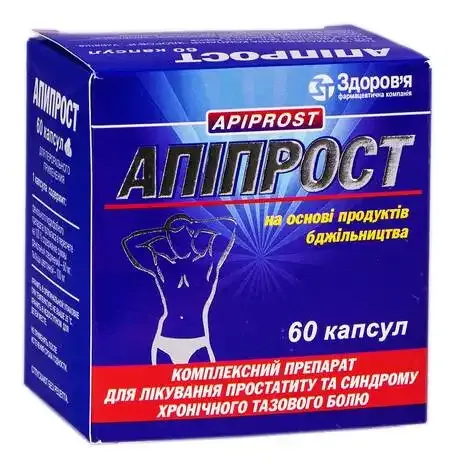
Table of Contents
INSTRUCTION FOR MEDICAL USE OF THE MEDICINAL PRODUCT APIPROST
Composition:
Active substances: phenolic hydrophobic propolis preparation, flower pollen;
1 capsule contains phenolic hydrophobic propolis preparation equivalent to 100% content of total phenolic compounds – 60 mg, flower pollen – 100 mg;
Excipients: silicon dioxide, colloidal anhydrous; microcrystalline cellulose; capsule shell contains erythrosine (E 127), titanium dioxide (E 171), quinoline yellow (E 104), indigo carmine (E 132), gelatin.
Pharmaceutical form. Capsules.
Main physicochemical properties: hard gelatin capsules with yellow opaque body and green opaque cap. Capsule contents – a yellowish-brown powder with specific odor, containing dark and light particles. Presence of particle agglomerates is permissible.
Pharmacotherapeutic group. Medicinal products used in urology. Other agents, including combinations. ATC code G04BX.
Pharmacological Properties.
Pharmacodynamics. A combined preparation based on beekeeping products, containing a phenolic hydrophobic propolis preparation (PHP) and flower pollen. The PHP contains flavonoids (apigenin, luteolin, robidanol), flavonols (quercetin, kaempferol), oxycoumarins, and phenolic carboxylic acids. Flower pollen contains proteins and free amino acids, nucleic acids, lipid components (triglycerides, phospholipids, unsaturated fatty acids), phytosterols, vitamins (β-carotene, E, C, B1, B2, PP), macro- and microelements (potassium, calcium, magnesium, iron, zinc, copper, cobalt, phosphorus, manganese, sulfur, silver, nickel, sodium, chlorine), phenolic compounds (catechins, flavonoids, anthocyanins, leucoanthocyanins, auronones, chalcones, and phenolic acids), phytohormones (brassinoids), carbohydrates (mainly fructose and glucose), and enzymes. The composition of the preparation determines its broad spectrum of pharmacological properties: anti-inflammatory, antioxidant, membrane-protective, analgesic, reparative activity, and regulatory effects on androgen levels. The pharmacological effects of PHP and flower pollen provide an impact on the key pathogenetic mechanisms of prostatitis: promoting regeneration of prostate gland cells, reducing pain sensations, and eliminating inflammation.
The preparation does not exert toxic effects on spermatogenesis. It does not affect cellular and humoral immunity, and has no local irritant, mutagenic, cumulative, or ulcerogenic effects. The preparation does not influence gastric gland secretory activity and does not produce toxic effects on the functions of vital organs and body systems during prolonged use.
Clinical characteristics.
Indications. As part of complex therapy for acute and chronic bacterial prostatitis, chronic nonbacterial prostatitis/chronic pelvic pain syndrome (inflammatory and non-inflammatory), asymptomatic inflammatory prostatitis.
Prevention of acute prostatitis and recurrences of chronic prostatitis.
Contraindications. Hypersensitivity to the components of the drug/beekeeping products.
Interaction with other medicinal products and other forms of interaction. If concomitant use of the drug with other medicinal products containing heavy metals (e.g. antacids) capable of forming complexes with it is necessary, the drugs should be taken at an interval of at least 30 minutes to prevent interaction.
Special precautions for use.
Prior to initiating treatment with the medicinal product, a doctor's consultation is required to rule out the presence of a malignant neoplasm in the prostate.
Use during pregnancy or breastfeeding. Not to be used in women.
Ability to affect reaction rate when driving or operating machinery. Has no effect.
Dosage and Administration.
Take the medication 30 minutes before meals.
For acute bacterial prostatitis: take 2 capsules three times a day for 1 month. If necessary, the treatment course may be prolonged.
For chronic bacterial prostatitis, chronic nonbacterial prostatitis, chronic pelvic pain syndrome (inflammatory and non-inflammatory), and asymptomatic inflammatory prostatitis: take 2 capsules three times a day for 2 months. If necessary, after a 2-week break, the treatment course may be repeated.
For prevention of recurrences of acute and chronic prostatitis: take 1 capsule three times a day for 3–4 weeks, 3–4 times per year.
Children. Not recommended for use in children.
Overdose. A significant increase in dose over prolonged use may cause allergic reactions and nausea.
Treatment is symptomatic.
Side effects.
Nausea and allergic reactions are possible.
Shelf life. 2 years.
Storage conditions. Store in the original packaging at a temperature not exceeding 25°C. Keep out of reach of children.
Packaging. Capsules № 10×3, № 10×6 in blisters in a carton.
Availability. Over-the-counter (without prescription).
Manufacturer: LIMITED LIABILITY COMPANY "CORPORATION "ZDOROV'YA".
Manufacturer's address and place of business. 22, Shevchenka Street, Kharkiv, Kharkiv region, 61013, Ukraine.