Andropharm
Ukraine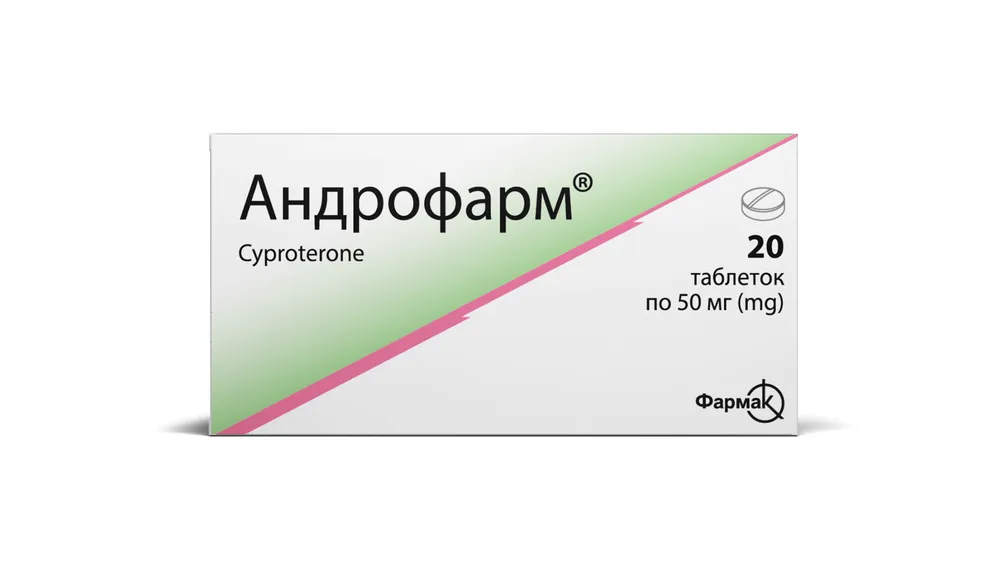
Table of Contents
INSTRUCTIONS FOR MEDICAL USE OF THE MEDICINAL PRODUCT AНDROFARM® (ANDROFARM)
Composition:
Active substance: cyproterone;
1 tablet contains 50 mg or 100 mg of cyproterone acetate calculated as 100% substance;
Excipients: maize starch, lactose monohydrate, colloidal anhydrous silicon dioxide, povidone, magnesium stearate.
Pharmaceutical form. Tablets.
Main physicochemical properties: white or almost white, round tablets with flat surface, scored and bevelled edge. Marbling on the tablet surface is permissible.
Pharmacotherapeutic group. Sex gland hormones and drugs used in pathologies of the genital system. Antiandrogens. ATC code G03HA01.
Pharmacological Properties.
Pharmacodynamics.
Androfam® is a hormonal agent with antiandrogenic activity.
Cyproterone acetate competitively inhibits the effects of androgens on androgen-dependent target organs, for example, it protects the prostate gland from the effects of androgens produced in the gonads and/or the adrenal cortex.
Cyproterone acetate exerts a central inhibitory effect. Its antigonadotropic effect leads to reduced testosterone synthesis in the testes and, consequently, to a decrease in the concentration of this hormone in serum.
In males, administration of Androfam® reduces libido and potency, and also suppresses gonadal function. After discontinuation of the drug, these effects disappear.
The antigonadotropic effect of cyproterone acetate is also evident when it is used in combination with gonadotropin-releasing hormone (GnRH) agonists. The increase in testosterone levels induced by GnRH agonists at the beginning of therapy is reduced due to cyproterone acetate.
With administration of high doses of cyproterone acetate, a slight increase in prolactin levels has occasionally been observed.
Standard repeated-dose toxicity studies of cyproterone acetate do not indicate any specific risk to humans.
Embryotoxicity studies revealed no effects suggesting teratogenic action of Androfam® during organogenesis prior to the development of external genital organs.
However, administration of high doses of cyproterone acetate during the hormone-sensitive phase of fetal male genital differentiation may lead to feminization. Observations of newborn boys who were exposed in utero to cyproterone acetate did not reveal any signs of feminization.
Treatment with Androfam® does not cause damage to spermatozoa that could lead to congenital malformations or reduced fertility in offspring, as demonstrated in studies on male rats.
To date, clinical experience and results of epidemiological studies provide no evidence of increased incidence of liver tumors in humans. Carcinogenicity studies of cyproterone acetate in rodents do not indicate any specific carcinogenic effect. However, it should be noted that sex steroids may promote the growth of existing hormone-dependent tissues and tumors.
In experimental studies, high doses of cyproterone acetate demonstrated corticoid-like effects on the adrenal glands in rats and dogs, suggesting the possibility of similar effects in humans when the highest doses of the drug (300 mg/day) are administered.
Pharmacokinetics.
Cyproterone acetate is completely absorbed after oral administration of various doses. Following a 50 mg dose, the maximum plasma concentration is approximately 140 ng/mL, maintained for about 3 hours. Thereafter, the concentration in serum decreases over 24–120 hours, with a terminal half-life of 43.9 ± 12.8 hours. The clearance of cyproterone acetate is 3.5 ± 1.5 mL/min/kg. It is metabolized via multiple pathways, including hydroxylation and conjugation. The main metabolite in plasma is the 15β-hydroxy derivative. Phase I metabolism is primarily catalyzed by the CYP3A4 isoenzyme of the cytochrome P450 system.
A small portion of the administered dose is excreted unchanged in bile. The majority of the substance is excreted as metabolites in urine and bile in a ratio of 3:7. The elimination half-life of metabolites from plasma is 1.7 days.
Cyproterone acetate is almost completely bound to plasma albumins. Approximately 3.5–4% of the steroid remains unbound. Since protein binding is nonspecific, changes in the level of sex hormone-binding globulin do not affect the pharmacokinetics of cyproterone acetate.
The absolute bioavailability of cyproterone acetate is practically complete (88% of the administered dose).
Clinical characteristics.
Indications.
Tablets 50 mg.
For men
- For palliative treatment of metastatic or locally progressive inoperable prostate cancer:
- when treatment with luteinizing hormone-releasing hormone (LHRH) analogues or surgical intervention has proven insufficient, contraindicated, or oral therapy is preferred;
- to prevent the occurrence of adverse secondary effects and complications that may be caused by an increase in serum testosterone levels at the beginning of treatment with LHRH agonists;
- for treatment of hot flushes occurring during treatment with LHRH agonists or after orchidectomy.
- Reduction of libido in hypersexuality and sexual deviations.
Tablets 100 mg.
For palliative treatment of metastatic or locally progressive inoperable prostate cancer:
- when treatment with luteinizing hormone-releasing hormone (LHRH) analogues or surgical intervention has proven insufficient, contraindicated, or oral therapy is preferred;
- initially, to prevent the occurrence of adverse secondary effects and complications that may be caused by an increase in serum testosterone levels at the beginning of treatment with LHRH agonists;
- for treatment of hot flushes occurring during treatment with LHRH agonists or after orchidectomy.
Contraindications.
For men (for reduction of libido in pathological sexual deviations):
- hypersensitivity to any component of the medicinal product;
- liver disease;
- Dubin-Johnson syndrome, Rotor syndrome;
- liver tumors currently or in medical history;
- meningioma currently or in medical history;
- established malignant diseases or suspicion of their presence;
- severe chronic depression;
- thromboembolic conditions currently or in medical history;
- severe forms of diabetes with vascular complications;
- sickle cell anemia;
- adolescents before completion of the pubertal period and children.
For men (for treatment of inoperable prostate cancer):
- hypersensitivity to any component of the medicinal product;
- liver disease;
- Dubin-Johnson syndrome, Rotor syndrome;
- liver tumors currently or in medical history (only if the tumor is not due to metastases of prostate cancer);
- meningioma currently or in medical history;
- established malignant diseases or suspicion of their presence (except tumors associated with progressive prostate cancer);
- severe chronic depression;
- existing thromboembolic conditions;
- severe forms of diabetes with vascular complications;
- sickle cell anemia;
- adolescents before completion of the pubertal period and children.
Interaction with other medicinal products and other forms of interaction.
Clinical studies on drug interactions of the medicinal product have not been conducted; however, since it is metabolized via the CYP3A4 enzyme, strong inhibitors of CYP3A4 such as ketoconazole, itraconazole, clotrimazole, ritonavir, and others are expected to inhibit the metabolism of cyproterone acetate. On the other hand, inducers of CYP3A4 such as rifampicin, phenytoin, and medicinal products containing St. John's wort may reduce the levels of cyproterone acetate.
Based on in vitro studies, it can be assumed that administration of high therapeutic doses of cyproterone acetate (100 mg three times daily) may possibly inhibit certain cytochrome P450 enzymes, including CYP2C8, 2C9, 2C19, 3A4, and 2D6.
When inhibitors of HMG-CoA reductase (statins) are used concomitantly with high therapeutic doses of cyproterone acetate, the risk of statin-associated myopathy or rhabdomyolysis may increase due to the shared metabolic pathway of these substances.
Special precautions for use.
Liver
Cases of hepatotoxicity, including jaundice, hepatitis, and liver failure, have been reported in patients treated with Androcur®. Fatal cases have been reported with doses of 100 mg and higher. Most fatalities occurred in men with advanced prostate cancer. Toxicity is dose-dependent and usually develops after several months of treatment. Liver function tests should be performed before starting treatment, regularly throughout the treatment period, and whenever symptoms suggestive of hepatotoxicity occur. If hepatotoxicity is diagnosed and no other cause is identified (e.g. metastases), treatment with Androcur® should be discontinued. Treatment may only be continued if the benefit outweighs the potential risk.
Benign, and more rarely malignant, liver tumors have been observed in isolated cases following the use of Androcur®. In some cases, intra-abdominal hemorrhage caused by these tumors has been life-threatening. During treatment with Androcur®, the possibility of liver tumors should be considered in the differential diagnosis in patients presenting with upper abdominal pain, hepatomegaly, or signs of intra-abdominal bleeding. Treatment should be discontinued if necessary.
Meningioma
Cases of meningioma (single or multiple) have been reported in association with long-term use (over several years) of cyproterone acetate at doses of 25 mg per day or higher. If a patient receiving Androcur® is diagnosed with meningioma, treatment with Androcur® should be discontinued.
Thromboembolic events
Thromboembolic events have been reported in patients treated with Androcur®, although a causal relationship with the drug has not been established.
Patients with a history of arterial or venous thrombotic/thromboembolic events (e.g. deep vein thrombosis, pulmonary embolism, myocardial infarction) or cerebrovascular disease, as well as patients with advanced-stage tumors, are considered to be at increased risk of future thromboembolic events.
Particular caution is required when prescribing the drug to patients with inoperable prostate cancer and a history of thromboembolic events, severe forms of diabetes with vascular complications, or sickle cell anemia. In each individual case, the expected benefit of treatment must be weighed against the potential risk.
Anemia
Anemia has been reported during treatment with Androcur®. Therefore, regular blood tests to determine erythrocyte count should be performed throughout the treatment period.
Diabetes mellitus
Increased blood glucose levels have been observed in diabetic patients during treatment with Androcur®. Therefore, diabetic patients require careful medical monitoring during treatment, as the need for oral antidiabetic agents or insulin may change during therapy with Androcur®.
Dyspnea
In isolated cases, dyspnea may occur during treatment with high doses of Androcur®.
If dyspnea occurs during treatment with Androcur®, the known stimulatory effect of progesterone and synthetic progestogens on the respiratory system, leading to hypocapnia and compensatory respiratory alkalosis, should be considered in the differential diagnosis. Such conditions are generally considered not to require treatment.
Adrenal cortex function
Adrenal cortex function should be monitored regularly throughout the treatment period, as preclinical data suggest possible suppression due to the corticoid-like effect of Androcur®.
Lactose
Androcur® contains lactose and should therefore not be administered to patients with rare hereditary conditions of galactose intolerance, Lapp lactase deficiency, or glucose-galactose malabsorption.
Other conditions
When prescribing Androcur® for the treatment of pathological deviations in sexual behavior, it should be remembered that alcohol may neutralize the drug's effect on reducing libido.
Genital organs and changes in mammary glands
Cyproterone acetate, due to its antiandrogenic and antigonadotropic effects, suppresses spermatogenesis within several weeks of treatment. Ejaculate volume also decreases. After discontinuation of treatment, spermatogenesis gradually recovers, which may be associated with temporary infertility. Spermatogenesis usually returns to the pre-treatment state within several months, sometimes up to 20 months after therapy ends. The effect on ejaculate is fully reversible. Marked reduction in libido and impotence occur very frequently. Men of reproductive age for whom fertility is important should undergo at least one control spermatogram after treatment ends. A baseline spermatogram before starting treatment is recommended to rule out unjustified future claims of infertility resulting from antiandrogenic therapy.
During treatment, gynecomastia commonly develops in men; this usually resolves after treatment ends or the dose is reduced.
Treatment of hypersexuality and sexual deviations
Sexual behavior disorders require treatment only in severe cases. A prerequisite for treatment is the patient's willingness to undergo therapy.
Suppression of androgenic activity does not always coincide with suppression of libido.
Psychiatric, psychotherapeutic, and sociotherapeutic approaches should generally be used. When these methods are applied, suppression of sexuality with cyproterone acetate tablets may be effective.
Patients with organic brain lesions, mental disorders, or sexual deviations generally do not respond well to treatment.
Due to possible impairment of reproductive function, a spermatogram is recommended before starting treatment.
Use during pregnancy or breastfeeding
The drug is contraindicated during pregnancy and breastfeeding.
Ability to affect reaction speed when driving or operating machinery
Patients whose activities require high levels of attention (e.g. machine operators, drivers, etc.) should be aware that treatment with Androcur® may cause fatigue, reduced activity, and impaired concentration.
Method of Administration and Dosage
Administer orally. The tablets should be taken after meals, with a small amount of liquid. The maximum daily dose is 300 mg.
For reducing sexual desire in hypersexuality and sexual deviations.
The tablets should be taken after meals, with a small amount of liquid.
The duration of treatment is determined individually. Therapeutic effect may appear after several weeks, and in some cases, treatment success may only be observed after several months. The initial dose is generally 50 mg of the drug twice daily. If necessary, the dose may be increased to 100 mg twice daily (200 mg) or, for a short period, to 100 mg three times daily (300 mg). After achieving a satisfactory treatment response, the therapeutic effect should be maintained using the minimal effective dose. In most cases, a dose of 25 mg twice daily (50 mg daily) is sufficient. Maintenance doses should be prescribed or the drug discontinued gradually. To achieve this, the daily dose should be reduced by 50 mg at intervals of several weeks, or preferably by 25 mg. To stabilize the therapeutic effect, long-term administration of the drug is necessary, preferably combined with psychotherapy.
For the treatment of inoperable prostate cancer.
- Palliative therapy of metastatic or locally progressive inoperable prostate cancer without orchidectomy or treatment with LHRH agonists: take 100 mg of the drug 2–3 times daily (daily dose – 200–300 mg). The tablets should be taken after meals, with a small amount of liquid. Even if the patient's condition improves or remission occurs, the prescribed dose should not be reduced or treatment interrupted.
- Initially, to prevent adverse secondary effects and complications that may be caused by a rise in serum testosterone levels at the beginning of treatment with LHRH agonists: initially conduct monotherapy with Andrarfarm®: 100 mg twice daily (200 mg) for 5–7 days. After this, administer 100 mg of Andrarfarm® twice daily (200 mg) in combination with an LHRH agonist at the recommended dose for 3–4 weeks.
When treating with LHRH agonists, follow the instructions for use of the respective drug.
- For relief of hot flashes in patients during treatment with LHRH agonists or after orchidectomy: 50–150 mg of Andrarfarm® daily, increasing the dose if necessary up to 100 mg three times daily (300 mg).
Elderly patients
There are no data indicating the need for dose adjustment in elderly patients.
Patients with hepatic impairment
Andrarfarm® is contraindicated in patients with liver disease (until liver function parameters return to normal).
Patients with renal impairment
There are no data indicating the need for dose adjustment in patients with renal impairment.
Children
Andrarfarm® should not be used in children and adolescent males (under 18 years of age), as there are no data on efficacy and safety in this age group.
In male patients, Andrarfarm® should not be used before completion of the pubertal period, as an adverse effect on growth and endocrine system function cannot be excluded.
Overdose
Acute toxicity studies following single-dose administration indicate that cyproterone acetate – is practically non-toxic. After a single accidental intake of a dose several times higher than the therapeutic dose, no risk of acute intoxication is expected.
Adverse Reactions
The most serious adverse reactions observed in patients receiving Andrarfarm® include hepatic toxicity, benign and malignant liver tumors (which may lead to intra-abdominal hemorrhage), and thromboembolic events.
The most commonly observed adverse reactions in patients receiving Andrarfarm® include decreased libido, erectile dysfunction, and reversible suppression of spermatogenesis.
Benign, malignant, and unspecified neoplasms (including cysts and polyps): benign and malignant liver tumors*, meningiomas§*;
Blood hormone investigations: slightly increased prolactin levels, decreased cortisol levels;
Hematopoietic and lymphatic system disorders: anemia*;
Respiratory, thoracic and mediastinal disorders: dyspnea*;
Skin and subcutaneous tissue disorders: rash, dry skin;
Musculoskeletal and connective tissue disorders: osteoporosis;
Metabolism and nutrition disorders: weight gain or weight loss; increased blood glucose levels in diabetics*;
Vascular disorders: thromboembolic events*;
General disorders and administration site conditions: fatigue, hot flushes;
Immune system disorders: hypersensitivity reactions;
Hepatobiliary disorders: hepatotoxic reactions, such as jaundice, hepatitis, and hepatic failure*;
Reproductive system and breast disorders: reversible suppression of spermatogenesis, gynecomastia, nipple tenderness;
Psychiatric disorders: decreased libido, erectile dysfunction, depressed mood, transient anxiety, decreased sexual desire;
Gastrointestinal disorders: intra-abdominal hemorrhage*.
§ See section "Contraindications".
* See section "Special precautions".
Cases of multiple meningiomas have been reported in association with long-term (over several years) use of cyproterone acetate at doses of 25 mg per day and higher.
During treatment with high doses of cyproterone acetate, isolated cases of anemia and reduced endogenous cortisol production have been observed.
Treatment with Andrarfarm® in males leads to decreased sexual desire and potency, and suppression of gonadal function. These effects resolve after discontinuation of treatment.
Due to the antiandrogenic and antigonadotropic effects of the drug, spermatogenesis is suppressed within several weeks of treatment in males. After treatment is stopped, spermatogenesis gradually recovers over several months.
The use of the drug in males may lead to gynecomastia. Sometimes this is associated with increased tactile sensitivity of the nipples upon touch, which usually resolves after discontinuation of the drug.
As with other antiandrogenic drugs, very rarely prolonged use of Andrarfarm® may lead to the development of osteoporosis.
At the beginning of treatment with Andrarfarm®, nitrogen balance is disturbed, but it recovers during continued use. Due to this catabolic effect, Andrarfarm® should not be used in patients with established malignant diseases or suspected malignancy (except prostate cancer).
Occasionally, slight elevation of prolactin levels has been observed during high-dose cyproterone acetate therapy.
Reduced sebaceous gland secretion may lead to dry skin.
Shelf life. 3 years.
Do not use the medicinal product after the expiry date stated on the packaging.
Storage conditions.
Store in the original packaging at a temperature not exceeding 25 °C.
Keep out of the reach of children.
Packaging.
10 tablets of 50 mg in a blister, 2 or 5 blisters per carton.
10 tablets of 100 mg in a blister, 3 or 6 blisters per carton.
Prescription category. Prescription only.
Manufacturer. JSC "Farmak".
Manufacturer's address and place of business.
74 Kyrylivska Street, Kyiv, 04080, Ukraine.