Aminocaproic acid
Ukraine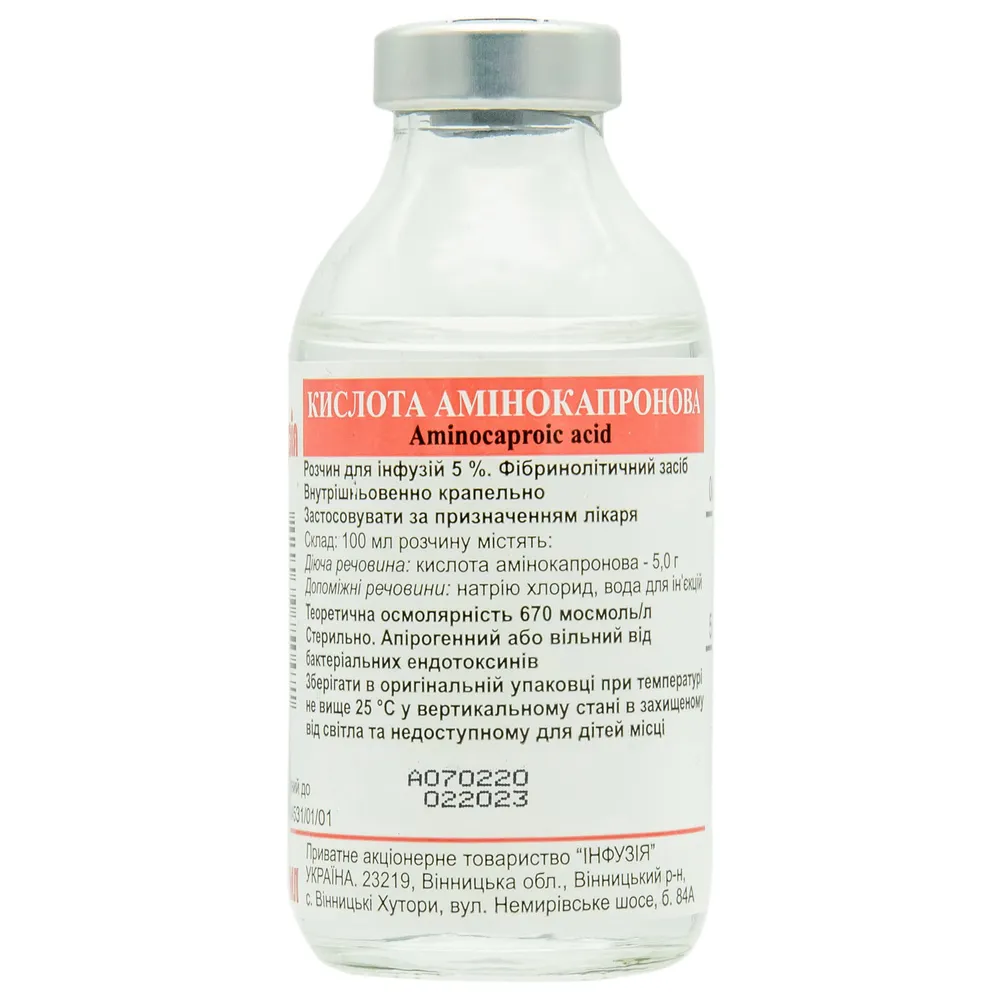
Table of Contents
INSTRUCTION FOR MEDICAL USE OF THE MEDICINAL PRODUCT AMINOCAPROIC ACID (Aminocaproic acid)
Composition:
active substance: aminocaproic acid;
100 ml of solution contain 5 g of aminocaproic acid;
excipients: sodium chloride, water for injections.
Pharmaceutical form. Infusion solution.
Main physicochemical properties: clear colorless liquid; theoretical osmolarity approximately 670 mosmol/L.
Pharmacotherapeutic group. Antihemorrhagic agents. Fibrinolysis inhibitors.
ATC code B02A A01.
Pharmacological properties.
Pharmacodynamics.
By blocking plasminogen activators and partially inhibiting the action of plasmin, aminocaproic acid provides a specific hemostatic effect in bleeding associated with increased fibrinolysis. The drug also inhibits the activity of biogenic polypeptides—kinins—exerts antiallergic activity, and stimulates the liver's antitoxic function.
Pharmacokinetics.
After intravenous administration, the effect develops within 15–20 minutes. The drug is rapidly excreted by the kidneys (40–60% of the administered dose appears in urine within 4 hours). In case of impaired renal excretory function, the blood concentration of aminocaproic acid increases significantly.
Clinical characteristics.
Indications.
Surgical operations and pathological processes accompanied by increased fibrinolytic activity of blood and tissues.
Also indicated for prevention of secondary hypofibrinogenemia during massive transfusions of preserved blood.
Contraindications.
Thromboembolism, coagulopathies due to disseminated intravascular coagulation, renal failure, labor, pregnancy and breastfeeding, cerebrovascular disorders, predisposition to thrombosis and thromboembolic diseases, hematuria, severe form of ischemic heart disease, hypersensitivity to components of the drug, kidney diseases with impaired renal function.
Interaction with other medicinal products and other forms of interaction.
The effect of the drug is reduced by anticoagulants and direct or indirect-acting antiplatelet agents. Concomitant use with estrogen-containing contraceptives and coagulation factor IX increases the risk of thromboembolism. Use with caution in patients taking retinoids (including tretinoin).
Special precautions for use.
Use with caution in patients with heart diseases. If it is necessary to administer the medicinal product to patients with cardiac disorders, monitoring of plasma creatine phosphokinase levels is recommended. Administration of the medicinal product requires control of coagulogram, especially in ischemic heart disease, after myocardial infarction, and in hepatic pathological processes. The drug is contraindicated in cases of hematuria due to the risk of developing acute renal failure. It is recommended to avoid fatty foods during treatment with this drug.
Do not use any remaining medicinal product.
This medicinal product contains 15.4 mmol (354 mg) of sodium per 100 ml of solution. Caution is advised when administering to patients on a sodium-restricted diet.
Use during pregnancy or breastfeeding.
The medicinal product is contraindicated during pregnancy.
Prophylactic use in women to prevent excessive blood loss during childbirth is not recommended due to the possible risk of thromboembolic complications.
If use is necessary, breastfeeding should be discontinued.
Ability to influence reaction speed when driving or operating machinery.
Data are lacking, as the medicinal product should be administered under hospital conditions.
Method of Administration and Dosage.
The medicinal product is administered intravenously. If a rapid effect is required (acute hypofibrinogenemia), adults should receive an intravenous infusion of no more than 100 ml of solution (5 g of aminocaproic acid) at a rate of 50–60 drops per minute over 15–30 minutes. During the first hour, administer 4–5 g, and for prolonged bleeding – until complete cessation of bleeding – administer 1 g hourly, but not exceeding 8 g in total. In case of recurrent bleeding, repeat administration of the medicinal product at 4-hour intervals, but not more than 8 hours.
Children.
For moderate increase in fibrinolytic activity, administer aminocaproic acid once daily at a dose of 0.05 g/kg body weight per day. The dosage for children depending on age is as follows: under 1 year: single dose – up to 2.5 ml, daily dose – 15 ml; 2 to 6 years: single dose – 2.5–5 ml, daily dose – 15–30 ml; 7 to 10 years: single dose – 5–7 ml, daily dose – 30–45 ml; 11 to 18 years: single dose – 7–14 ml, daily dose – 45–90 ml.
For acute bleeding episodes, pediatric doses are as follows: under 1 year: single dose – 5 ml, daily dose – 30 ml; 2 to 4 years: single dose – 5–7.5 ml, daily dose – 30–45 ml; 5 to 8 years: single dose – 7.5–10 ml, daily dose – 45–60 ml; 9 to 10 years: single dose – 15 ml, daily dose – 90 ml; 11 to 14 years: single dose – 20 ml, daily dose – 120 ml; 15 to 18 years: single dose – 28 ml, daily dose – 160 ml.
Treatment duration: 3 to 14 days.
Children. The medicinal product may be used in children.
Overdose.
Sudden decrease in blood fibrinolytic activity. Pronounced symptoms of adverse effects: dizziness, nausea, diarrhea, skin rash, orthostatic hypotension, seizures, headache, nasal congestion, acute renal failure, rhabdomyolysis, myoglobinuria. Exacerbation of adverse reactions, thrombus formation, embolism. Hemorrhages may occur with prolonged use (more than 6 days) of high doses (in adults – more than 24 g per day).
Treatment. In case of overdose, discontinue administration of the medicinal product and provide appropriate symptomatic therapy.
Adverse reactions.
Immune system side effects: hypersensitivity reactions, including allergic reactions, rash.
Cardiovascular system side effects: orthostatic hypotension, bradycardia, arrhythmias, subendocardial hemorrhage.
Blood coagulation system side effects: coagulation disorders; with prolonged use (more than 6 days) of high doses (in adults – more than 24 g per day) – hemorrhages.
Nervous system side effects: dizziness, headache, seizures, tinnitus.
Respiratory system, thoracic organs and mediastinum side effects: nasal congestion, catarrhal symptoms of the upper respiratory tract.
Gastrointestinal system side effects: vomiting, nausea, diarrhea.
Urinary system side effects: acute renal failure, myoglobinuria.
General disorders: local reactions at the site of administration.
Other: rhabdomyolysis. If the infusion rate is exceeded, bradycardia, extrasystoles, chills, and increased body temperature may occur.
Shelf life. 3 years.
Storage conditions. Store in the original packaging at a temperature not exceeding 25 °C. Keep out of reach of children. Store bottles in an upright position (with the cap facing upwards).
Incompatibility. When administered intravenously, do not mix in the same container with other infusion solutions.
Packaging. 100 ml in bottles.
Prescription category. Prescription only.
Manufacturer. Limited liability company "Novofarm-Biosyntez".
Manufacturer's address and place of business.
Ukraine, 11700, Zhytomyr Oblast, Zvyagel Raion, city of Zvyagel, Zhитомирська St., 38.