Amixin® ic
Ukraine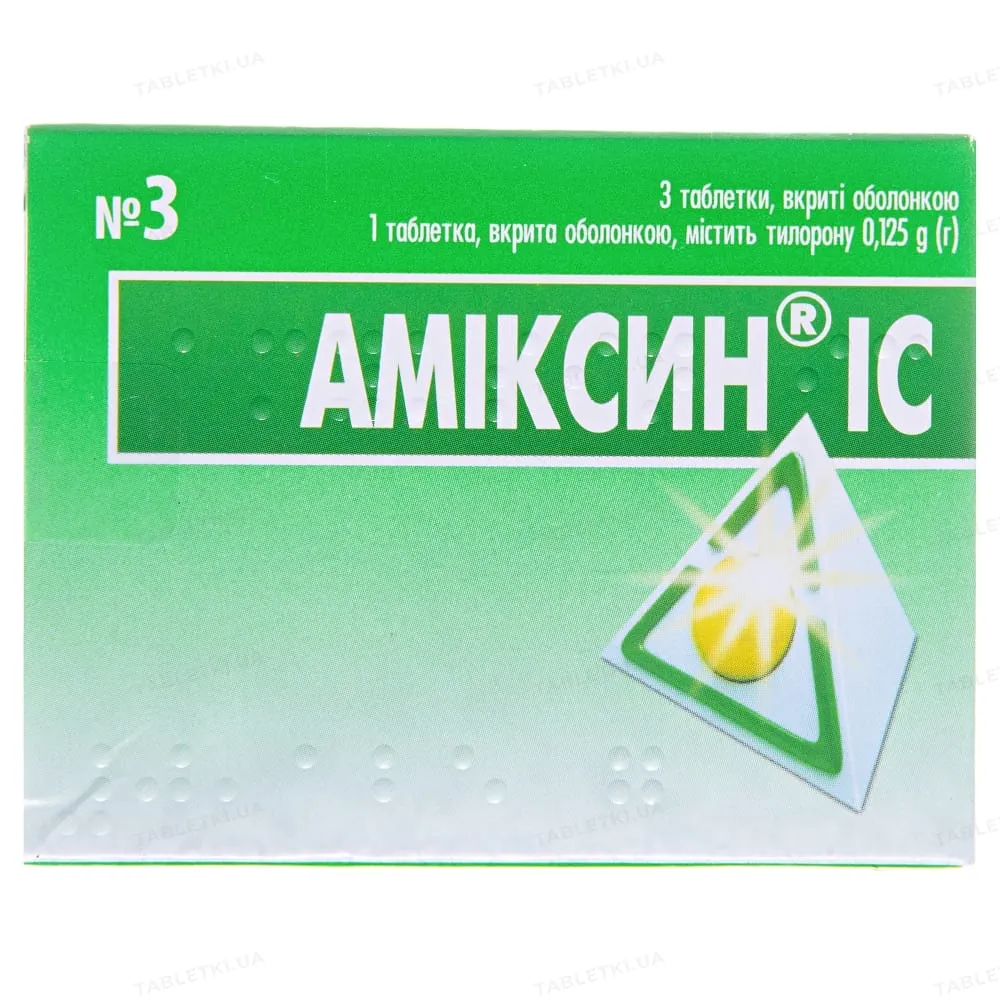
Table of Contents
INSTRUCTION for medical use of the medicinal product AMIXIN® IS (AMIXIN® IS)
Composition:
Active substance: tilorone;
1 tablet contains tilorone 0.06 g (60 mg) or 0.125 g (125 mg);
Excipients:
tablets of 60 mg: calcium hydrogen phosphate dihydrate, hypromellose (hydroxypropylmethylcellulose), microcrystalline cellulose, povidone, sodium croscarmellose, potato starch, polyethylene glycol (macrogol), talc, colloidal anhydrous silicon dioxide, calcium stearate, titanium dioxide (E 171), candurin (titanium dioxide (E 171), potassium aluminosilicate (E 555)), synthetic mixed red dye (hypromellose (hydroxypropylmethylcellulose), microcrystalline cellulose, titanium dioxide (E 171), dye Ponceau 4R (E 124), dye indigo carmine (E 132), dye yellow dye West FCF (E 110));
tablets of 125 mg: calcium hydrogen phosphate dihydrate, hypromellose (hydroxypropylmethylcellulose), microcrystalline cellulose, povidone, sodium croscarmellose, potato starch, polyethylene glycol (macrogol), talc, colloidal anhydrous silicon dioxide, calcium stearate, titanium dioxide (E 171), candurin (titanium dioxide (E 171), potassium aluminosilicate (E 555)), yellow dye West FCF (E 110).
Pharmaceutical form. Film-coated tablets.
Main physicochemical properties: round, biconvex film-coated tablets, dark pink (60 mg dosage) and orange (125 mg dosage) in color; two layers are visible upon breaking.
Pharmacotherapeutic group.
Antiviral agents for systemic use. Direct-acting antiviral agents. Tilorone. ATC code J05AX19.
Pharmacological Properties.
Pharmacodynamics.
Amixin® IS (tilorone) is an immunomodulatory and antiviral agent. It stimulates the production of α, β, γ-interferons in the body. The main producers of interferon in response to administration of the drug are intestinal epithelial cells, hepatocytes, T-lymphocytes, and granulocytes. After oral administration, maximum interferon production is observed in the sequence "intestine – liver – blood" within 4–24 hours. The drug stimulates bone marrow stem cells, enhances antibody production in a dose-dependent manner, reduces the degree of immunosuppression, and restores the T-suppressor/T-helper ratio. It is effective against a broad range of viral infections, including influenza viruses, other acute respiratory viral infections, hepatitis A, B, C, and herpesviruses. The mechanism of antiviral action is associated with inhibition of translation of virus-specific proteins in infected cells, thereby suppressing viral replication.
In animal studies (on chicken and duck embryos), high antiviral activity of the drug against the causative agent of highly pathogenic avian influenza (HPAI) strain H5N1 has been demonstrated, as well as significant immunostimulatory and adjuvant activity with respect to HPAI antigens (in experiments on chickens).
Pharmacokinetics.
After oral administration, tilorone is rapidly absorbed from the gastrointestinal tract. Bioavailability is 60%. Approximately 80% of the drug is bound to plasma proteins.
The drug undergoes no biotransformation and does not accumulate in the body. It is excreted almost unchanged in feces and urine in a ratio of 7:1. The half-life elimination period is 48 hours.
Clinical characteristics.
Indications.
Adults
Treatment and prevention of influenza and acute respiratory viral infections, treatment of viral hepatitis A, B, C, herpes virus infections, cytomegalovirus infection; as part of combination therapy for infectious-allergic and viral encephalomyelitis (multiple sclerosis, leukoencephalitis, uveoencephalitis, and meningoencephalitis), urogenital and respiratory chlamydiosis.
To reduce the degree of immunosuppression as part of combination therapy for diseases associated with secondary induced immunodeficiencies (caused by exposure to X-ray radiation, cytostatics, surgical interventions, etc.) requiring immunomodulatory correction.
Children aged 7 to 18 years
Treatment of influenza and acute respiratory viral infections.
Contraindications.
Hypersensitivity to the active substance or to any component of the medicinal product. Pregnancy and lactation. Children under 7 years of age.
Interaction with other medicinal products and other forms of interactions.
The medicinal product Amixin® IS is compatible with antibiotics and conventional treatments for viral and bacterial diseases.
Special precautions.
The medicinal product contains dyes which may cause allergic reactions.
Use during pregnancy or breastfeeding.
There is no experience with the use of the medicinal product during pregnancy and breastfeeding; therefore, it is contraindicated in these periods.
Ability to affect reaction rate while driving or operating machinery.
No effect.
Administration and Dosage
The medicinal product is taken orally, after meals.
Adults
For treatment of influenza and acute respiratory viral infections: during the first 2 days of treatment – 125 mg daily, then 125 mg every 48 hours. Total course dose – 750 mg.
For prophylaxis of influenza and acute respiratory viral infections: 125 mg once weekly for 6 weeks.
Treatment of viral hepatitis A: on day 1 of treatment – 125 mg twice, then 125 mg every 48 hours. Total course dose – 1.25 g.
Prophylaxis of viral hepatitis A: 125 mg once weekly for 6 weeks.
Treatment of acute hepatitis B: during the first 2 days of treatment – 125 mg daily, then 125 mg every 48 hours. Total course dose – 2 g. In prolonged course of the disease, the total dose may be increased up to 2.5 g.
Chronic hepatitis B: during the first 2 days of treatment – 250 mg daily, then 125 mg every 48 hours. Initial course dose – 2.5 g. Afterwards, the medicinal product is taken at a dose of 125 mg weekly. The total course dose ranges from 3.75 g to 5 g.
Acute hepatitis C: during the first 2 days of treatment – 125 mg daily, then 125 mg every 48 hours. Total course dose – 2.5 g.
Chronic hepatitis C: during the first 2 days of treatment – 250 mg daily, then 125 mg every 48 hours. Initial course dose – 2.5 g. Afterwards, the medicinal product is taken at a dose of 125 mg weekly. The total course dose is 5 g.
Treatment of herpes and cytomegalovirus infections: during the first 2 days of treatment – 125 mg daily, then 125 mg every 48 hours. Total course dose – 2.5 g.
As part of combination therapy for neuroviral infections – infectious-allergic and viral encephalomyelitis (multiple sclerosis, leukoencephalitis, uveoencephalitis, and meningoencephalitis): during the first 2 days of treatment – 125 mg daily, then 125 mg every 48 hours. Total course dose – from 1.5 to 1.75 g.
As part of combination therapy for urogenital and respiratory chlamydiosis: during the first 2 days of treatment – 125 mg daily, then 125 mg every 48 hours. Total course dose – 1.25 g.
For reduction of immunosuppression as part of combination therapy in diseases associated with secondary induced immunodeficiencies requiring immunomodulation: 125–250 mg weekly for 6 weeks. Maximum total course dose – 1.5 g. Depending on immunological parameters and disease course, the treatment course may be repeated with a 4-week interval between courses.
Children aged 7 to 18 years
For uncomplicated forms of influenza or acute respiratory viral infections: 60 mg once daily on days 1, 2, 4 from the start of treatment. Total course dose – 180 mg.
For complicated forms of influenza or acute respiratory viral infections: 60 mg once daily on days 1, 2, 4, and 6 from the start of treatment. Total course dose – 240 mg.
Children
The medicinal product is not administered to children under 7 years of age.
Overdose
Cases of overdose with the medicinal product Amixin® IS are unknown.
Side effects.
Skin and subcutaneous tissue disorders: allergic reactions, including angioneurotic edema, rash (including urticaria), skin hyperemia, dry skin, pruritus.
Gastrointestinal disorders: bitter taste in mouth, dyspeptic symptoms (including epigastric pain, nausea, heartburn), diarrhea.
General disorders: general weakness, lethargy, decreased appetite, transient fever.
Shelf life. 5 years.
Storage conditions.
Store in the original packaging at a temperature not exceeding 25 °C.
Keep out of reach of children.
Packaging.
3 tablets in a blister; 1, 2 or 3 blisters per carton.
5 tablets in a blister; 2 blisters per carton.
Availability. Over-the-counter (without prescription).
Manufacturer.
Limited liability company "INTERCHEM".
Manufacturer's address and place of business.
40-A, 21st km, Starokyivska Road, Odesa, Ukraine, 65025.