Amigren
Ukraine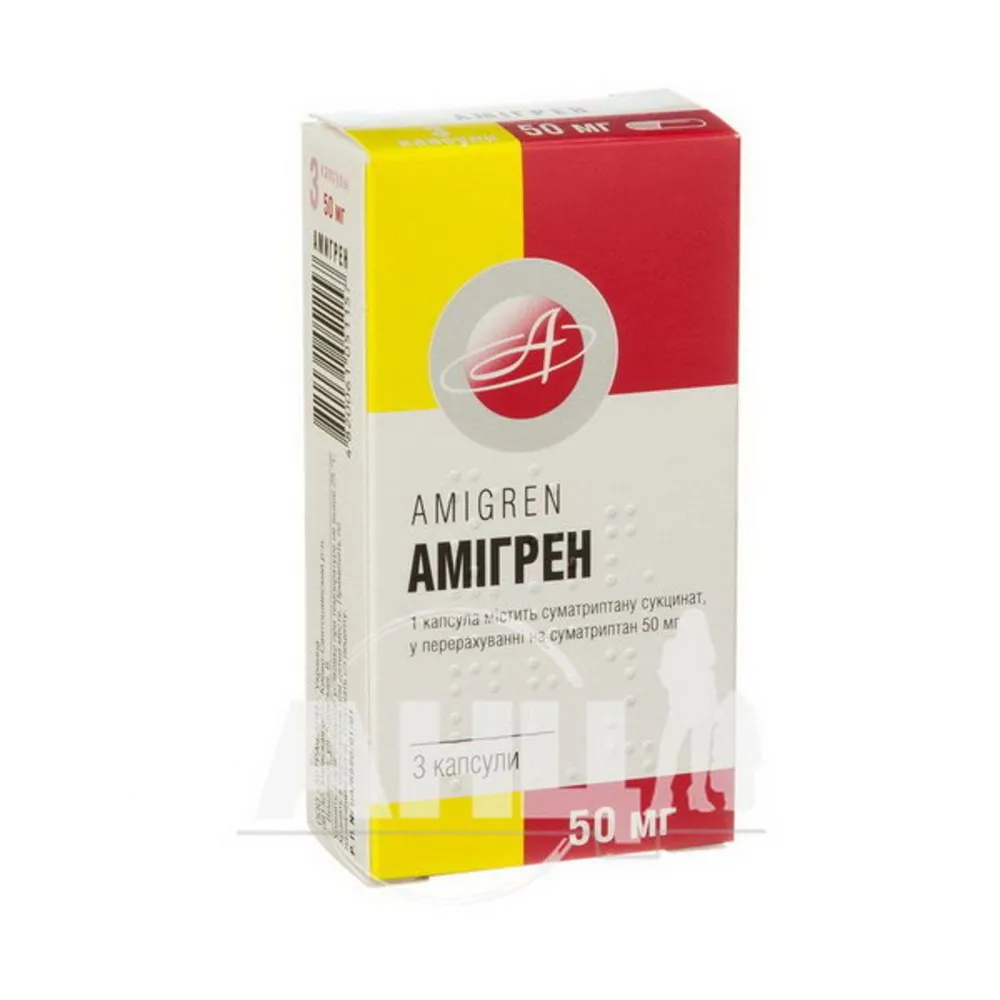
Table of Contents
INSTRUCTIONS FOR MEDICAL USE OF THE MEDICINAL PRODUCT AMIGREN (AMIGREN)
Composition:
Active substance: sumatriptan;
1 capsule contains 50 mg or 100 mg of sumatriptan, calculated as sumatriptan succinate;
Excipients: lactose monohydrate; microcrystalline cellulose; sodium croscarmellose; magnesium stearate;
Capsule shell composition: gelatin, titanium dioxide (E 171), Ponceau 4R (E 124).
Pharmaceutical form. Capsules.
Main physicochemical properties: hard gelatin capsules size №1, cylindrical in shape with hemispherical ends; body – white, cap – red.
The contents of the capsules – odorless white or almost white powder.
Pharmacotherapeutic group.
Selective 5HT1-serotonin receptor agonist. Medicinal products used for the treatment of migraine. ATC code N02C C01.
Pharmacological properties.
Pharmacodynamics.
Sumatriptan is a selective agonist of 5-HT1 receptors, with no effect on other 5-HT receptors. These receptors are primarily located in cerebral blood vessels. Studies have shown that sumatriptan exerts a selective vasoconstrictive effect on vessels within the carotid arterial system, without affecting cerebral blood flow. The carotid arterial system supplies blood to extracranial and intracranial tissues, such as the meninges. Dilation of these vessels leads to migraine. Additionally, experimental data have demonstrated that sumatriptan inhibits the activity of the trigeminal nerve. These two mechanisms are considered responsible for the antimigraine activity of sumatriptan.
Clinical effect is observed within 30 minutes after oral administration of 100 mg of the drug.
Pharmacokinetics.
After oral administration, sumatriptan is rapidly absorbed, reaching 70% of its maximum concentration within 45 minutes. Following a 100 mg dose, the mean peak plasma concentration is 45 ng/mL. The oral bioavailability is 14%, partly due to presystemic metabolism and partly due to incomplete absorption. Plasma protein binding is low (14–21%), and the mean volume of distribution is 17 L. The mean total plasma clearance is approximately 1160 mL/min, and the mean renal clearance is approximately 260 mL/min. Non-renal clearance accounts for approximately 80% of total clearance, indicating that sumatriptan is primarily eliminated in the form of metabolites. The main metabolite, an indole acetic acid analogue of sumatriptan, is excreted in urine as free acid and as glucuronide conjugate. This metabolite lacks 5-HT1 and 5-HT2 activity. Other metabolites have not been identified. The pharmacokinetics of oral sumatriptan are not significantly altered during a migraine attack.
Clinical characteristics.
Indications.
For rapid relief of symptoms during migraine attacks, with or without aura.
Contraindications.
Hypersensitivity to any component of the drug.
History of myocardial infarction, ischemic heart disease, Prinzmetal's angina, peripheral vascular disease, or symptoms indicative of ischemic heart disease.
History of stroke or transient ischemic attack (TIA).
Moderate or severe arterial hypertension and mild uncontrolled arterial hypertension.
Severe hepatic impairment.
Concomitant use of ergotamine or its derivatives (including methysergide) (see section "Interaction with other medicinal products and other types of interactions").
Concomitant use of any triptan/5-hydroxytryptamine receptor agonist (5-HT1) (see section "Interaction with other medicinal products and other types of interactions").
Concurrent administration of monoamine oxidase inhibitors (MAOIs) and Amigren. Amigren must not be used within 2 weeks after discontinuation of MAO inhibitors.
Interaction with other medicinal products and other types of interactions.
There are no data on interactions with propranolol, flunarizine, pizotifen, or alcohol.
Data on concomitant use with medicinal products containing ergotamine or other triptan/5-HT1 receptor agonists are limited. Prolonged vasospastic reactions are theoretically possible; therefore, such concomitant use is contraindicated (see section "Contraindications").
The required time interval between administration of sumatriptan and medicinal products containing ergotamine or other triptan/5-HT1 receptor agonists is unknown. It depends on the doses and types of medicinal products used. Since these effects may be potentiated by Amigren, a 24-hour interval should be maintained between administration of ergotamine-containing products and other triptan/5-HT1 receptor agonists and administration of Amigren. Accordingly, products containing ergotamine or other triptan/5-HT1 receptor agonists must not be used within 6 hours after taking Amigren.
Interaction may occur between sumatriptan and MAO inhibitors; therefore, their concomitant use is contraindicated (see section "Contraindications").
There have been isolated reports of serotonin syndrome (including altered mental status, visceral instability, neuromuscular disturbances) in patients receiving selective serotonin reuptake inhibitors (SSRIs) and sumatriptan. Cases of serotonin syndrome have also been reported with concomitant use of triptans and serotonin-norepinephrine reuptake inhibitors (SNRIs) (see section "Special precautions for use").
Special precautions for use.
Amigren capsules should be used only when migraine has been clearly diagnosed.
Amigren is not indicated for the treatment of hemiplegic, basilar, or ophthalmoplegic migraine.
As with other drugs used to treat migraine attacks, in patients with no previously established diagnosis of migraine and in patients with a confirmed diagnosis but atypical symptoms, a serious neurological disorder should be ruled out before initiating sumatriptan therapy. It should be noted that patients with migraine have an increased risk of cerebrovascular disorders (stroke, transient ischemic attack).
Sumatriptan use may cause transient symptoms such as pain and sensations of tightness in the chest, which may be intense and radiate to the throat (see section "Adverse reactions"). If such symptoms suggest ischemic heart disease, appropriate cardiological evaluation should be performed.
Sumatriptan must not be administered to patients with suspected heart disease without prior evaluation for cardiovascular pathology. This group includes postmenopausal women, men aged 40 years and older, and patients with risk factors for ischemic heart disease. However, such evaluation does not always detect underlying heart disease, and severe cardiovascular complications have been reported in isolated cases in patients with undiagnosed heart conditions. Amigren should be used with caution in patients under medical supervision for arterial hypertension, as transient increases in blood pressure and peripheral vascular resistance may occur in a small number of patients.
There have been isolated reports of serotonin syndrome (including altered mental status, autonomic instability, and neuromuscular abnormalities) occurring after concomitant use of selective serotonin reuptake inhibitors (SSRIs) and sumatriptan. Cases of serotonin syndrome have also been reported with concomitant administration of triptans and serotonin-norepinephrine reuptake inhibitors (SNRIs). If concomitant use of Amigren and SSRIs/SNRIs is clinically justified, prior patient evaluation is advisable (see section "Interaction with other medicinal products and other forms of interaction").
Concomitant use of sumatriptan with any other triptan/5-HT1-agonist is not recommended.
Amigren should be used with caution in patients with significant impairment in drug absorption, metabolism, or excretion, such as in renal or hepatic insufficiency.
Amigren should be used with caution in patients with a history of seizures or with risk factors for reduced seizure threshold.
Allergic reactions may occur in patients with hypersensitivity to sulfonamides after administration of Amigren. Reactions may range from skin hypersensitivity to anaphylaxis. Cross-sensitivity is limited, but caution should be exercised when prescribing the drug to such patients.
The recommended doses of Amigren must not be exceeded.
Intensive treatment of acute migraine attacks may be associated with worsening of headache (medication-overuse headache) in susceptible patients. Discontinuation of treatment may become necessary.
Adverse reactions may occur more frequently during concomitant use of triptans and medicinal products containing St. John's wort (Hypericum perforatum).
Prolonged use of any analgesic medicinal product may exacerbate headache. If such symptoms occur or are suspected, medical advice should be sought and treatment discontinued. Patients who experience frequent or daily headaches due to regular use of headache medications may be diagnosed with medication-overuse headache.
The product contains lactose; therefore, patients with rare hereditary forms of galactose intolerance, lactase deficiency, or glucose-galactose malabsorption should not take this medicine.
Use during pregnancy or breastfeeding.
Amigren is not recommended during pregnancy. If use is necessary, the benefit to the mother should be weighed against the potential risk to the fetus.
Use with caution during breastfeeding. Breastfeeding should be avoided for 24 hours after administration of the drug.
Effect on ability to drive and use machines.
Somnolence may result from either migraine itself or its treatment with Amigren. Therefore, driving or operating machinery should be avoided during an attack of migraine and while taking this medicine.
Method of administration and dosage.
Amigren capsules must not be used for the prevention of migraine attacks.
Amigren is recommended to be taken as early as possible after the onset of a migraine attack, although it is equally effective at any stage of the attack.
The recommended dose of Amigren for adults is 50 mg (1 capsule). In individual cases, the dose may be increased to 100 mg (2 capsules).
Amigren may be used for new migraine attacks; however, if the first dose is ineffective, the drug should not be administered again during the same attack.
If the patient responds to the first dose but symptoms recur, a second dose may be administered within the following 24 hours, provided that the total daily dose does not exceed 300 mg.
Capsules should be swallowed whole with water.
Elderly patients (aged 65 years and older)
Experience with the use of sumatriptan in patients aged 65 years and older is limited. Although the pharmacokinetics of the drug are not different from those in younger individuals, until additional clinical data are available, the use of Amigren in elderly patients is not recommended.
Children
The efficacy and safety of sumatriptan in children have not been established. Therefore, Amigren is not recommended for use in this patient population.
Overdose
Doses exceeding 400 mg (orally) have not caused any adverse effects other than those listed below.
Treatment: supportive therapy and monitoring of the patient for at least 10 hours.
The effect of hemodialysis or peritoneal dialysis on plasma levels of Amigren has not been established.
Adverse Reactions.
Immune system side effects: hypersensitivity reactions – from skin hypersensitivity to cases of anaphylaxis.
Nervous system side effects: dizziness; drowsiness; sensory disturbances, including paresthesia and hypesthesia; seizures. Although some of these cases were observed in patients with a history of seizures or conditions that may predispose to them, there have been cases of seizures developing in patients with no such predisposition; tremor, dystonia, nystagmus, scotoma.
Psychiatric side effects: excitement.
Cardiovascular system side effects: transient increase in arterial pressure immediately after taking the drug, flushing, bradycardia, tachycardia, palpitations, arrhythmias, transient ischemic changes on ECG, coronary artery spasm, angina pectoris, myocardial infarction, arterial hypotension, Raynaud's disease.
Respiratory system side effects: dyspnea.
Gastrointestinal side effects: nausea and vomiting occurring in some patients, although their association with sumatriptan use has not been fully established; ischemic colitis, diarrhea; dysphagia.
Musculoskeletal system side effects: sensations of heaviness, myalgia. These symptoms are usually transient, may be intense, and may affect any part of the body, including the chest and throat; neck muscle rigidity, arthralgia.
Eye-related side effects: flickering, diplopia, decreased visual acuity, vision loss (usually transient). However, visual disturbances may also be due to the migraine attack itself.
Skin side effects: hyperhidrosis.
General disorders: pain, sensations of heat or cold, tightness or pressure (these symptoms are usually transient, may be intense, and may affect any part of the body, including the chest and throat); feelings of weakness, fatigue (these symptoms are mostly mild or moderate and transient).
Increased pain after injuries, increased pain during inflammation.
Laboratory findings: minor changes in liver function tests have been observed.
Shelf life.
3 years.
Storage conditions.
Store in the original packaging at a temperature not exceeding 25 °C.
Keep out of reach of children.
Packaging.
1 capsule in a blister; 1, 3, or 6 blisters per carton.
6 capsules in 1 blister; 1 blister per carton.
10 capsules in a blister; 1 blister per carton.
Prescription status.
Prescription only.
Manufacturer.
ASTRAFARM LLC, Ukraine
Manufacturer's address and place of business.
6 Kyivska St., Vyshneve, Kyiv-Sviatoshyn District, Kyiv Region, 08132, Ukraine