Altemix broncho
Ukraine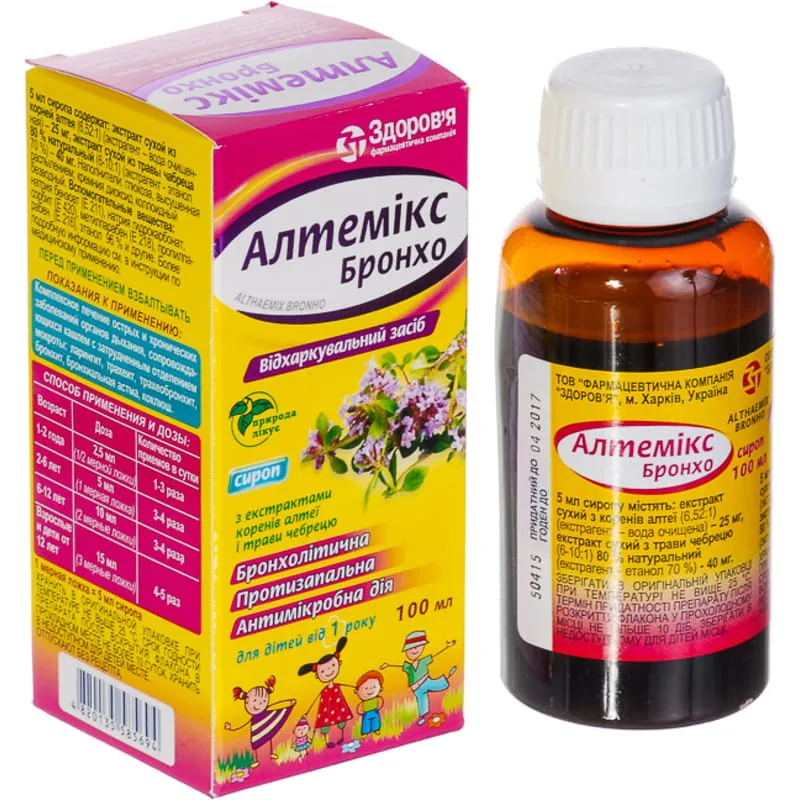
Table of Contents
INSTRUCTIONS FOR MEDICAL USE OF THE MEDICINAL PRODUCT ALTHEMIX BRONCHO (ALTHAEMIX BRONHO)
Composition:
Active substances: 5 ml of syrup contains|contains| dry extract from the roots of marshmallow (Althaeae radix) (6.52:1) (extraction solvent – purified water) – 25 mg; dry extract from thyme herb (Thymi herba) 80% natural (6–10:1) (extraction solvent – 70% ethanol) (excipients: glucose, spray-dried; colloidal anhydrous silicon dioxide) – 40 mg;
Excipients: ammonium glycyrrhizinate, sodium benzoate (E 211), sodium bicarbonate, ammonium chloride, anise oil, sorbitol (E 420), methylparaben (E 218), propylparaben (E 216), ethanol 96%, purified water.
Pharmaceutical form. Syrup.
Main physicochemical properties: liquid, ranging in color from brown|light brown| to brown with a greenish tint, with a characteristic anise odor. Sediment formation may occur.
Pharmacotherapeutic group. Agents used for cough and colds. Expectorants. Combinations. ATC code R05C A10.
Pharmacological properties.
Pharmacodynamics. A complex herbal preparation; a direct-acting expectorant that exerts demulcent, softening, secretolytic, broncholytic, anti-inflammatory, and antimicrobial effects.
The root of marshmallow (Althaea) contains plant polysaccharide mucilage (up to 35%), as well as asparagine, betaine, pectin substances, starch, etc.
The mechanism of action is due to stimulation of gastric receptors and reflexive stimulation of neurons in the vomiting, respiratory, and cough centers, which enhances bronchiolar peristalsis and increases the activity of bronchial ciliated epithelium (direct expectorant effect). In addition, the preparation enhances the function of bronchial glands, causing liquefaction of sputum, reduction of its viscosity, and increase in volume (resorptive secretolytic effect).
Plant mucilages cover mucous membranes with a thin layer that persists for a long time on their surface and prevents irritation. As a result, the inflammatory process is reduced and tissue regeneration is facilitated. The protective effect of the film formed from plant mucilage on the gastric mucosa is the longer-lasting, the higher the acidity of gastric juice (the viscosity of plant mucilage increases upon interaction with hydrochloric acid in gastric juice).
Thyme extract contains phytoncides, phenols (thymol and carvacrol), flavonoids (apigenin, luteolin), saponins, and others, which exhibit expectorant, broncholytic, and antimicrobial effects, normalize rheological properties of tracheobronchial secretions, facilitate their expectoration, exert moderate broncholytic action, and inhibit the growth and proliferation of microorganisms. The expectorant action of thyme components is due to enzymatic breakdown of viscous secretions, reducing their viscosity, as well as activation of ciliary movement in bronchial epithelium. The broncholytic effect of thyme, caused by inhibition of contractility of smooth muscles of the trachea and bronchi through reduction of intracellular Ca2+ levels, provides moderate bronchodilation, eases respiration, and reduces expiratory dyspnea. Phenolic compounds of thyme exhibit antimicrobial activity against Salmonella typhimurium, Staphylococcus aureus, Escherichia coli, and other bacterial species, as well as against fungi, including Cryptococcus neoformans, Aspergillus, Saprolegnia, Zygorhynchus.
Clinical characteristics.
Indications. As a remedy for relief of dry cough and soothing of irritated mucous membranes of the mouth and pharynx.
For complex treatment of acute and chronic respiratory diseases accompanied by cough with difficult expectoration: laryngitis, tracheitis, tracheobronchitis, bronchitis, bronchial asthma, whooping cough.
Contraindications. Hypersensitivity to the components of the medicinal product or to other plants of the Lamiaceae family, as well as sensitivity to celery and birch pollen (cross-reactivity possible); children under 4 years of age.
Interaction with other medicinal products and other types of interactions. When used concomitantly with anti-inflammatory agents, the drug prolongs their effect, enhances efficacy, and reduces adverse effects.
As an expectorant, it can be combined with sodium bicarbonate.
When used concomitantly with antitussive agents, accumulation of mucus in the respiratory tract may occur; when used with antibiotics, increased concentration of antibiotics in the respiratory tract may occur.
Special precautions for use.
The drug should be used according to the physician's recommendations. If symptoms worsen and/or dyspnea, fever, or purulent sputum occur during treatment, consult a physician. If symptoms persist for more than one week, consult a physician.
The formation of a film of plant-derived mucus on the surface of the mucous membrane of the upper respiratory tract exerts a pronounced therapeutic effect and also promotes a longer local action of other medicinal agents.
The preparation should be shaken before use.
5 ml of syrup (1 measuring spoon) contains 6.8 mg of glucose or 0.00057 bread units, which should be taken into account by patients with diabetes mellitus.
This medicinal product contains 2.83 mmol (or 65 mg) of sodium per 15 ml syrup dose. Caution is advised when administering to patients on a sodium-restricted diet.
This medicinal product contains 1.98 vol.% ethanol (alcohol), i.e. 240 mg per 15 ml syrup dose. Caution is advised when administering to children, patients with liver disease, and patients with epilepsy.
If a patient has known intolerance to certain sugars, consult a physician before taking this medicinal product.
Due to the presence of glucose, the product may be harmful to teeth.
The presence of methylparaben (E 218) and propylparaben (E 216) in the formulation may cause allergic reactions (possibly delayed).
Use during pregnancy or breastfeeding. Due to insufficient data, the use of this drug is not recommended during pregnancy or breastfeeding. If use is necessary, breastfeeding should be discontinued.
Ability to affect reaction speed when driving or operating machinery. The use of this drug generally does not affect reaction speed; however, it should be noted that one measuring spoon of syrup (5 ml) contains 0.1 ml of ethanol (96%).
Children. This drug is indicated for use in children aged 4 years and older.
Method of administration and dosage. Take orally after meals. Adults and children aged 12 years and older: 15 ml of syrup (3 measuring spoons). Children aged 6–12 years: 10 ml of syrup (2 measuring spoons); children aged 4–6 years: 5 ml of syrup (1 measuring spoon). Frequency of administration: 4–5 times daily for adults and children aged 12 years and older; 3–4 times daily for children aged 4–12 years.
For children aged 4–6 years, the dose of the drug (5 ml) should be diluted in one tablespoon of boiled water before administration.
The duration of treatment is determined individually by the physician depending on treatment efficacy. Typically, treatment lasts 7–14 days. If indicated, the physician may prescribe repeated or longer treatment courses.
Overdose.
Symptoms: nausea, vomiting, headache.
Treatment: discontinue the drug, gastric lavage.
Side effects.
Allergic reactions (including skin rash, itching), gastrointestinal disorders (including nausea, vomiting, diarrhea) are possible. If any adverse reactions occur, discontinue use of the medicinal product and consult a physician.
Shelf life. 2 years.
Storage conditions. Store in the original packaging at a temperature not exceeding 25 °C.
The shelf life of the product after opening the bottle is no more than 10 days when stored in a cool place.
Keep out of reach of children.
Packaging. 50 ml or 100 ml in a bottle; 1 bottle with a measuring spoon in a cardboard box.
Pharmaceutical category. Over-the-counter.
Manufacturer. LIMITED LIABILITY COMPANY "CORPORATION "ZDOROVIYA".
Manufacturer's address and place of business. Ukraine, 61013, Kharkiv region, city of Kharkiv, Shevchenko Street, building 22.