Airtex
Ukraine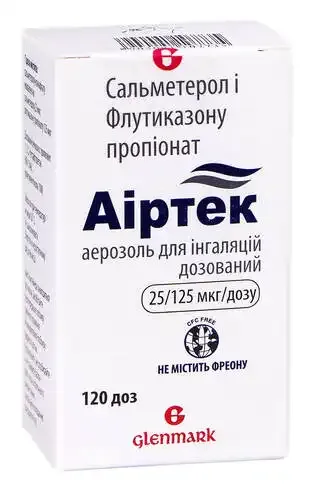
Table of Contents
INSTRUCTIONS FOR MEDICAL USE OF THE MEDICINAL PRODUCT AIRTEC (AIRTEC)
Composition:
Active substances: salmeterol (as salmeterol xinafoate) and fluticasone propionate;
One dose contains salmeterol xinafoate equivalent to salmeterol 25 mcg and fluticasone propionate 50, 125 or 250 mcg;
Excipients: propellant 1,1,1,2-tetrafluoroethane (HFA 134a), polyethylene glycol 1000.
Pharmaceutical form. Pressurized metered-dose inhalation aerosol.
Main physicochemical characteristics: white or almost white suspension.
Pharmacotherapeutic group.
Antiasthmatics. Adrenergic agents for inhalation. Adrenergic agents in combination with corticosteroids or other agents, excluding anticholinergic agents. Salmeterol and fluticasone. ATC code R03AK06.
Pharmacological properties.
Pharmacodynamics.
Aerthek contains salmeterol and fluticasone propionate, which have different mechanisms of action.
Salmeterol
Salmeterol is a selective long-acting (12 hours) β2-adrenoceptor agonist with a long side chain attached to the external domain of the receptor.
Salmeterol provides more prolonged bronchodilation (not less than 12 hours) compared to recommended doses of traditional short-acting β2-adrenoceptor agonists.
Fluticasone propionate
When inhaled at recommended doses, fluticasone propionate exerts a pronounced glucocorticoid anti-inflammatory effect in the lungs, resulting in reduction of clinical symptoms and frequency of exacerbations of bronchial asthma, without causing adverse reactions observed with systemic administration of corticosteroids.
Pharmacokinetics.
When salmeterol and fluticasone propionate are used in combination by inhalation, the pharmacokinetics of each component remains the same as when these components are used separately; therefore, their pharmacokinetics are described separately.
Salmeterol
Salmeterol acts locally in lung tissue, so its plasma concentration does not correlate with therapeutic effect. In addition, pharmacokinetic data for salmeterol are limited due to technical difficulties in measuring very low plasma concentrations of the drug (approximately 200 pg/mL or less) following inhaled administration at therapeutic doses.
Fluticasone propionate
Absolute bioavailability of fluticasone propionate after inhalation in healthy volunteers is approximately 5–11% of the nominal dose, depending on the inhalation device used. Lower systemic exposure levels are observed in patients with bronchial asthma following inhaled administration of fluticasone propionate. Systemic absorption occurs primarily in the lungs, initially rapidly, then slowing down. Part of the inhaled dose may be swallowed, but its systemic effect is minimal due to the low water solubility of fluticasone propionate and extensive first-pass metabolism in the liver. Bioavailability of fluticasone propionate following absorption from the gastrointestinal tract is less than 1%. A linear increase in plasma concentration of fluticasone propionate is observed with increasing inhaled dose. Distribution of fluticasone propionate is characterized by high plasma clearance (1150 mL/min), large volume of distribution (approximately 300 L), and terminal half-life of approximately 8 hours. Plasma protein binding is relatively high (91%). Fluticasone propionate is rapidly eliminated from systemic circulation, primarily via metabolism to an inactive carboxylic acid metabolite by the CYP3A4 enzyme of the cytochrome P450 system. Other unidentified metabolites are excreted in feces. Renal clearance of fluticasone propionate is negligible; less than 5% of the dose is excreted in urine, mainly as metabolites. The majority of the dose is excreted in feces as metabolites and unchanged drug.
Clinical Characteristics.
Indications.
Regular treatment of bronchial asthma in patients who require combination therapy with long-acting β2-agonists and inhaled corticosteroids:
- when asthma control is inadequate on inhaled corticosteroids and short-acting β2-agonists as needed;
- when asthma is adequately controlled on inhaled corticosteroids and long-acting β2-agonists administered via separate inhalers.
Contraindications.
Hypersensitivity to the active substances or any of the excipients of the medicinal product.
Special precautions.
The container is pressurized. Avoid exposure to direct sunlight. Do not use near open flame. Do not puncture, disassemble, or incinerate, even after complete use. Avoid contact of the medication with the eyes.
Interaction with other medicinal products and other forms of interaction.
β-Adrenergic blockers may reduce or abolish the effect of salmeterol. The use of non-selective and selective β-blockers should be avoided in patients with asthma, except when strongly indicated. Use of β2-agonists may cause potentially dangerous hypokalaemia. The medicinal product should be used with particular caution in patients with acute severe asthma, as concomitant use of xanthine derivatives, corticosteroids, and diuretics may potentiate adverse reactions.
Concomitant use with medicinal products containing other β-adrenergic agents may have a potential additive effect.
Salmetrol
Potent CYP3A4 inhibitors
Concomitant administration of ketoconazole (400 mg orally once daily) and salmeterol (50 mcg inhaled twice daily) for 7 days in 15 healthy volunteers resulted in a significant increase in plasma exposure to salmeterol (1.4-fold increase in Cmax and 15-fold increase in AUC). This may lead to an increased incidence of other systemic effects of salmeterol treatment (e.g., QT interval prolongation and enhanced heart rate) compared to administration of salmeterol or ketoconazole alone (see section "Special warnings and precautions for use").
No significant clinical effects on blood pressure, heart rate, blood glucose, or serum potassium levels were observed. Concomitant use with ketoconazole did not increase the elimination half-life or accumulation of salmeterol with repeated dosing.
Concomitant use with ketoconazole should be avoided unless the benefit outweighs the potential risk of systemic adverse reactions associated with salmeterol therapy. A similar risk of interaction exists with other potent CYP3A4 inhibitors (e.g., itraconazole, telithromycin, ritonavir).
Moderate CYP3A4 inhibitors
Concomitant administration of erythromycin (500 mg orally three times daily) and salmeterol (50 mcg inhaled twice daily) for 6 days in 15 healthy volunteers resulted in a slight and statistically non-significant increase in plasma exposure to salmeterol (1.4-fold increase in Cmax and 1.2-fold increase in AUC). Concomitant use with erythromycin was not associated with any adverse effects.
Fluticasone propionate
Under normal circumstances, inhaled fluticasone propionate results in low plasma concentrations due to extensive first-pass metabolism and high systemic clearance mediated by the CYP3A4 isoenzyme of the cytochrome P450 system in the gut and liver. Therefore, clinically significant interactions involving fluticasone propionate are unlikely.
Ritonavir, as a potent inhibitor of CYP3A4, may cause a sudden increase in plasma concentrations of fluticasone propionate, leading to a marked reduction in serum cortisol levels.
Although specific data on inhaled fluticasone propionate are limited, a significant increase in serum fluticasone propionate levels is expected.
Concomitant use with ritonavir has been associated with adverse effects such as Cushing's syndrome and adrenal suppression. Therefore, concomitant use of fluticasone propionate and ritonavir should be avoided, except when the potential benefit to the patient outweighs the risk of systemic glucocorticoid side effects.
In a small study in healthy volunteers using the moderately potent CYP3A inhibitor ketoconazole, fluticasone propionate exposure after the first inhalation increased by 150%, resulting in a greater reduction in plasma cortisol levels compared to fluticasone propionate alone. Concomitant use with other potent CYP3A inhibitors (e.g., itraconazole, cobicistat-containing products) and moderate CYP3A inhibitors (e.g., erythromycin) is expected to increase systemic exposure to fluticasone propionate and the risk of systemic adverse effects.
Such combinations should be avoided unless the expected benefit outweighs the potential increased risk of systemic corticosteroid side effects. In such cases, patients should be monitored for the development of systemic adverse effects.
Xanthine derivatives, glucocorticosteroids, and diuretics may increase the risk of hypokalaemia (especially in patients with acute exacerbation of bronchial asthma and hypoxia). Monoamine oxidase inhibitors and tricyclic antidepressants increase the risk of cardiovascular side effects. Compatible with sodium cromoglicate.
Special precautions for use.
Airtrek is not a medication for the relief of acute symptoms requiring the use of fast-acting, short-duration bronchodilators (e.g., salbutamol). Patients should be advised to always carry a reliever medication for symptom management.
Treatment with Airtrek should not be initiated during an acute exacerbation of disease, or in cases of significant or acute deterioration in the patient's condition.
Serious asthma-related adverse events and exacerbations may occur during treatment. Patients should be advised to continue therapy but to seek medical advice if symptoms remain uncontrolled or worsen after initiation of treatment.
An increased need for short-acting bronchodilators to relieve symptoms of bronchial asthma indicates worsening asthma control and the need for medical evaluation. Rapid and progressive deterioration in asthma control is potentially life-threatening and requires immediate medical attention. Consideration should be given to increasing corticosteroid dosage. Patients should also be evaluated by a physician if the prescribed dose of Airtrek fails to provide adequate symptom control.
Once asthma symptoms are under control, the dose of the medication should be gradually reduced. Regular monitoring of the patient is essential during dose reduction. The lowest effective dose should be used (see section "Dosage and administration").
Treatment with Airtrek must not be discontinued abruptly due to the risk of disease exacerbation. Dose reduction should be performed gradually under medical supervision.
As with all inhaled corticosteroid-containing medications, Airtrek should be used with caution in patients with active or latent pulmonary tuberculosis, fungal, viral, or other respiratory tract infections. In such cases, appropriate treatment should be initiated promptly if necessary.
Cardiovascular effects such as increased systolic blood pressure and heart rate may occur with all sympathomimetic agents, particularly at high doses. Therefore, the drug should be used cautiously in patients with cardiovascular disorders.
Airtrek, when used at high therapeutic doses, may cause cardiac rhythm disturbances such as supraventricular tachycardia, extrasystoles, or atrial fibrillation, and mild transient reduction in serum potassium levels. Therefore, the drug should be used with caution in patients with cardiovascular disorders, cardiac arrhythmias, diabetes mellitus, thyrotoxicosis, uncorrected hypokalemia, or those predisposed to low serum potassium levels.
There have been very rare reports of increased blood glucose levels (see section "Adverse reactions"), which should be considered when prescribing the drug to patients with a history of diabetes mellitus.
As with other inhaled medications, paradoxical bronchospasm with immediate increase in wheezing may occur after inhalation. Immediate treatment with a short-acting inhaled bronchodilator should be administered. The drug should be discontinued immediately, the patient evaluated, and alternative therapy considered if necessary.
Adverse pharmacological effects associated with β2-agonists such as tremor, palpitations, and headache have been reported, but these are transient and tend to diminish with regular use (see section "Adverse reactions").
Systemic effects may occur with inhaled corticosteroids, especially when used at high doses over prolonged periods. These effects are less likely than with oral corticosteroids (see section "Overdose"). Possible systemic effects include Cushing's syndrome, Cushingoid features, adrenal suppression, growth retardation in children and adolescents, decreased bone mineralization, cataracts, and glaucoma, as well as less frequently, a range of physiological and behavioral effects including psychomotor hyperactivity, sleep disturbances, anxiety, depression, and aggression (particularly in children). Therefore, it is important to regularly review the patient's condition and reduce the inhaled corticosteroid dose to the lowest effective level that controls bronchial asthma symptoms.
Prolonged treatment with high doses of inhaled corticosteroids may lead to adrenal suppression and acute adrenal crisis. Isolated cases of adrenal suppression and acute adrenal crisis have been reported with fluticasone propionate doses between 500 mcg and 1000 mcg daily. Situations that may potentially trigger acute adrenal crisis include trauma, surgery, infections, or any rapid dose reduction. Symptoms are often nonspecific and may include anorexia, abdominal pain, weight loss, fatigue, headache, nausea, vomiting, hypotension, decreased level of consciousness, hypoglycemia, and seizures. During periods of stress or surgical procedures, consideration should be given to the need for additional systemic corticosteroids due to possible adrenal impairment.
Systemic absorption of salmeterol and fluticasone propionate occurs primarily via the lungs. Using a spacer with the inhaler may increase drug delivery to the lungs, which should be considered, as this increases the risk of systemic adverse effects.
Inhaled fluticasone propionate should minimize the need for oral steroid therapy; however, patients transitioning from oral steroids may remain at risk of adrenal reserve impairment for some time. Such patients should be managed with particular care and regular monitoring of adrenal cortex function. Patients who have previously received high-dose corticosteroids as emergency treatment also carry this risk. The possibility of residual adrenal insufficiency should always be considered in emergency situations and other stress conditions, and the need for corticosteroid therapy should be evaluated (see section "Overdose"). Special consultation may be required before certain procedures to assess the degree of adrenal insufficiency.
Due to the potential for adrenal suppression, patients should be transferred from oral corticosteroid therapy to Airtrek treatment with particular caution.
When initiating inhaled fluticasone propionate, withdrawal from systemic therapy should be gradual. Patients should be advised to carry a steroid alert card indicating the potential need for additional therapy during stressful situations.
Ritonavir may significantly increase plasma concentrations of fluticasone propionate. Therefore, concomitant use should be avoided unless the potential benefit outweighs the risk of systemic corticosteroid side effects. The risk of systemic adverse effects is also increased when fluticasone propionate is used concomitantly with other potent CYP3A inhibitors (see section "Interaction with other medicinal products and other forms of interaction").
In a three-year clinical study in patients with chronic obstructive pulmonary disease (COPD), an increased incidence of lower respiratory tract infections (primarily pneumonia and bronchitis) was observed with Airtrek compared to placebo. In the three-year COPD study, older patients, those with low body mass index (<25 kg/m²), and those with very severe disease (FEV1 <30% predicted) had a higher risk of pneumonia regardless of treatment. Physicians should consider the possibility of pneumonia or other lower respiratory tract infections in these patients, as clinical symptoms of pneumonia and COPD exacerbation often overlap. If pneumonia occurs in patients with severe COPD, Airtrek treatment should be re-evaluated. The safety and efficacy of Airtrek in patients with COPD have not been established; therefore, Airtrek is not indicated for use in patients with COPD.
Concomitant use with systemic ketoconazole significantly increases systemic exposure to salmeterol, potentially increasing the risk of systemic effects (e.g., QT interval prolongation and increased heart rate). Therefore, concomitant use with ketoconazole and other potent CYP3A inhibitors should be avoided unless the benefit outweighs the potential increased risk of systemic adverse effects from salmeterol treatment (see section "Interaction with other medicinal products and other forms of interaction").
Visual disturbances
Visual disturbances may occur with systemic and topical use of corticosteroids. If a patient experiences symptoms such as blurred vision or other visual disturbances, they should be referred to an ophthalmologist to evaluate possible causes, including cataract, glaucoma, or rare conditions such as central serous chorioretinopathy, which has been reported after systemic and topical corticosteroid use.
Children
Children and adolescents under 16 years of age receiving high doses of fluticasone propionate (usually ≥1000 mcg/day) are at particular risk of systemic effects. These effects are typically associated with long-term, high-dose treatment. Possible systemic effects include Cushing's syndrome, Cushingoid features, adrenal suppression, acute adrenal crisis, growth retardation, decreased bone mineralization, cataracts, glaucoma, and less frequently, psychiatric disorders and behavioral changes such as psychomotor hyperactivity, sleep disturbances, agitation, depression, or aggression.
Regular monitoring of growth in children receiving long-term inhaled corticosteroid therapy is recommended. The dose of inhaled corticosteroid should be reduced to the lowest effective dose required to control asthma symptoms.
Use during pregnancy or breastfeeding.
Pregnancy
Extensive data from use of salmeterol xinafoate and fluticasone propionate in pregnant women (over 1000 cases) have shown no evidence of embryotoxic or fetotoxic effects.
Results of retrospective epidemiological studies have not shown an increased risk of major congenital malformations after exposure to fluticasone propionate during the first trimester of pregnancy compared to other inhaled corticosteroids.
Reproductive toxicity has been observed in animal studies following administration of β2-adrenergic agonists and glucocorticosteroids.
Airtrek should be used during pregnancy only if the expected benefit to the mother outweighs any potential risk to the fetus. The lowest effective dose of fluticasone propionate should be prescribed to maintain adequate asthma control.
Breastfeeding period
There are no data on drug concentrations in human breast milk. Airtrek should be used during breastfeeding only if the expected benefit to the mother outweighs any potential risk to the infant.
Animal studies in rats have shown that salmeterol, fluticasone propionate, and their metabolites are excreted in milk. Therefore, a risk to the infant cannot be excluded during breastfeeding while the mother is receiving this medication. The decision whether to discontinue breastfeeding or to discontinue Airtrek therapy should be based on the benefits of breastfeeding to the child and the expected benefits of treatment to the mother.
Fertility
There are no data on effects on human fertility. Animal studies have not shown effects of salmeterol or fluticasone propionate on fertility.
Ability to influence reaction speed when driving or operating machinery.
Airtrek has no effect or a negligible effect on the ability to drive or operate machinery.
Method of Administration and Dosage
The medication is intended for inhalation use only.
Patients should understand that AirTec must be used regularly, even during periods when there are no asthma attacks.
Patients should undergo regular medical examinations to ensure that their prescribed dose remains optimally effective. Only a physician may adjust the dose. The dose should be titrated to the lowest effective dose that maintains control of disease symptoms. If adequate symptom control is achieved with the lowest effective dose administered twice daily, the next step may be transitioning the patient to a single inhaled corticosteroid. As an alternative for patients requiring long-acting β2-agonists, the dose of AirTec may be reduced to once daily if, in the physician’s opinion, adequate symptom control can be maintained. If the patient has a history of nocturnal asthma attacks, this single daily dose should be taken at bedtime; if daytime symptoms predominate, the dose should be taken in the morning.
The amount of fluticasone propionate in the selected AirTec formulation should correspond to the severity of the disease.
Note: AirTec at a dose of 25 mcg/50 mcg is not suitable for the treatment of adults and children with severe asthma. If an individual patient requires doses outside the recommended regimen, appropriate doses of a β2-agonist and/or corticosteroid should be prescribed.
Recommended Doses
Adults and children aged 12 years and older: 2 inhalations of 25 mcg salmeterol/50 mcg fluticasone propionate twice daily, or 2 inhalations of 25 mcg salmeterol/125 mcg fluticasone propionate twice daily, or 2 inhalations of 25 mcg salmeterol/250 mcg fluticasone propionate twice daily.
Children aged 4–12 years: 2 inhalations of 25 mcg salmeterol and 50 mcg fluticasone propionate twice daily. The maximum daily dose of fluticasone propionate is 100 mcg twice daily.
There are no data on the use of the medication in children under 4 years of age.
For the treatment of adults and adolescents with moderate persistent asthma (daily symptoms, daily use of reliever medications, and moderate to severe airflow limitation), AirTec may be used as initial maintenance therapy when rapid symptom control is required. In such cases, the recommended starting dose is 2 inhalations of 25 mcg salmeterol/50 mcg fluticasone propionate twice daily. After achieving asthma symptom control, therapy should be reviewed and consideration given to transitioning the patient to inhaled corticosteroid monotherapy. Functional status should be regularly assessed during therapy review.
When one or two severity criteria are not clearly present, no clear advantage of using combined inhaled medications over inhaled fluticasone propionate alone as initial maintenance therapy has been demonstrated. In general, inhaled corticosteroids remain first-line therapy for most patients. AirTec is not indicated for initial treatment of mild asthma. AirTec 25 mcg/50 mcg is not indicated for the treatment of adults and children with severe asthma. For patients with severe asthma, it is recommended to first establish an appropriate dose of inhaled corticosteroid before initiating any fixed-dose combination.
Special Patient Groups: No dose adjustment is required for elderly patients or those with renal impairment. Data on the use of the medication in patients with hepatic impairment are lacking.
Inhaler Use Instructions
Checking the Inhaler
Shake the inhaler well before each use.
Before the first use or if the inhaler has not been used for more than 2 days, perform a test spray. Release 1–2 sprays into the air to ensure proper functioning.
Using the Inhaler
- Remove the protective cap from the mouthpiece. The mouthpiece should remain firmly attached to the aluminum canister. If the inhaler has been stored without the protective cap, inspect the mouthpiece for contamination.
- Hold the inhaler vertically with the mouthpiece down, supporting it from below with the thumb and from above with the index or index and middle fingers.
- Breathe out fully, then place the mouthpiece between your teeth and close your lips tightly around it without biting.
- Tilt your head slightly backward and begin to inhale slowly and deeply through your mouth, simultaneously pressing down on the top of the inhaler. Continue inhaling slowly and deeply. One actuation delivers one dose.
- Hold your breath for several seconds. Remove the mouthpiece from your mouth while continuing to hold your breath as long as possible. Then breathe out slowly.
- If additional inhalations are needed, wait approximately 1 minute, keeping the inhaler upright. Then repeat the inhalation process starting from step 3.
- After use, replace the protective cap over the mouthpiece.
Note
After each inhalation, it is recommended to rinse your mouth and throat with water. This helps reduce dryness associated with the medication.
The first few inhalations should be performed while observing yourself in a mirror. If you see medication escaping through your mouth or from the gap between the mouthpiece and the aluminum canister, this indicates incorrect inhalation technique.
Children should use the inhaler under adult supervision.
Cleaning the Inhaler
The inhaler should be cleaned at least once a week.
- Carefully remove the aluminum canister from the plastic holder. Remove the protective cap from the mouthpiece.
- Rinse the plastic holder and protective cap under warm running water. Do not allow water to enter the aluminum canister.
- Thoroughly wipe the outer and inner surfaces of the mouthpiece cap and plastic holder with a clean, dry cloth.
- Reassemble the inhaler.
Children
There is insufficient clinical experience with the use of this medication in children under 4 years of age; therefore, it should not be used in this age group.
Overdose
Signs and symptoms expected in salmeterol overdose are typical of excessive β2-agonist stimulation and may include dizziness, tremor, headache, tachycardia, and increased systolic blood pressure. If treatment with the medication must be discontinued due to β2-agonist overdose, appropriate steroid replacement therapy should be initiated. Hypokalemia may also occur; therefore, serum potassium levels should be monitored and potassium supplementation considered if necessary.
Acute Overdose
Inhalation of fluticasone propionate in doses exceeding the recommended amount may cause temporary suppression of adrenal function. This does not require emergency intervention, as adrenal function recovers within a few days, which can be confirmed by measuring plasma cortisol levels.
Chronic Overdose
There is a risk of adrenal suppression when higher-than-approved doses of the medication are used over a prolonged period.
Very rarely, acute adrenal crises have been reported, primarily in children who received doses higher than recommended for prolonged periods (several months or years). Hypoglycemia associated with confusion and convulsions has been observed. Situations that may potentially trigger an acute adrenal crisis include trauma, surgery, infection, or any rapid reduction in the dose of inhaled fluticasone propionate.
Monitoring of adrenal reserve function is recommended. In cases of fluticasone propionate overdose during AirTec use, therapy may be continued at appropriate doses that maintain symptom control.
There is no specific antidote for overdose with salmeterol and fluticasone propionate; supportive therapy with close patient monitoring should be administered.
Adverse reactions
Since Airtec contains salmeterol and fluticasone propionate, adverse reactions typical in type and severity for each component may be expected. Additional adverse effects due to concomitant use of the two components are not observed.
Adverse effects associated with the use of salmeterol/fluticasone propionate are listed below and classified by organ systems and frequency of occurrence. Frequency is defined as very common (≥ 1/10), common (≥ 1/100 to < 1/10), uncommon (≥ 1/1000 to < 1/100), rare (≥ 1/10,000 to < 1/1000), and frequency not known (cannot be estimated from available data).
| Organs and systems |
Adverse reaction |
Frequency |
| Infections and infestations |
Oral and pharyngeal candidiasis Pneumonia Bronchitis Oesophageal candidiasis |
Common Common1,3 Common1,3 Rare |
| Immune system disorders |
Hypersensitivity reactions: skin hypersensitivity reactions, rash, angioedema (mainly of the face and oropharynx), respiratory symptoms (dyspnoea), respiratory symptoms (bronchospasm), anaphylactic reactions, including anaphylactic shock |
Uncommon Rare Uncommon Rare Rare |
| Endocrine system disorders |
Cushing's syndrome, cushingoid symptoms, adrenal suppression, growth retardation in children and adolescents, decreased bone mineralization |
Rare4 |
| Metabolism and digestive disorders |
Hypokalaemia Hyperglycaemia |
Common3,4 Uncommon |
| Gastrointestinal disorders |
Dyspepsia, nausea |
Very rare |
| Psychiatric disorders |
Nervousness Insomnia Anxiety, sleep disturbances Behavioural changes including hyperactivity and agitation (mainly in children) Depression, aggression (mainly in children) |
Uncommon Rare Uncommon Rare Frequency not known |
| Nervous system disorders |
Headache Tremor |
Very common1 Uncommon |
| Eye disorders |
Cataract Glaucoma Blurred vision |
Uncommon Rare4 Frequency not known4 |
| Cardiac disorders |
Pounding heartbeat Tachycardia Cardiac arrhythmia (including supraventricular tachycardia and extrasystoles) Atrial fibrillation Angina pectoris |
Uncommon Uncommon Rare Uncommon Uncommon |
| Respiratory system disorders |
Nasopharyngitis Throat irritation Hoarseness/dysphonia Sinusitis Paradoxical bronchospasm |
Very common2,3 Common Common Common1,3 Rare4 |
| Skin and subcutaneous tissue disorders |
Contusions Ecchymoses |
Common Common1,3 |
| Musculoskeletal and connective tissue disorders |
Muscle spasms Fractures Arthralgia Myalgia |
Common Common Common Common |
| General disorders |
Non-specific chest pain |
Rare |
1Reported as "common" in the placebo group.
2Reported as "very common" in the placebo group.
3Observed over 3 years during the COPD study.
4See section "Special warnings and precautions for use".
Description of some adverse reactions
Pharmacologically expected adverse effects of β2-agonist therapy such as tremor, subjective palpitations, and headache have been reported, but these are usually transient and tend to diminish with regular use.
As with other inhaled medications, paradoxical bronchospasm may occur after inhalation, with a rapid increase in wheezing and breathlessness. Paradoxical bronchospasm is responsive to fast-acting bronchodilators, and treatment should be initiated immediately. In such cases, AirTec should be discontinued immediately, the patient should be examined, and alternative therapy should be considered if necessary.
Due to the presence of fluticasone propionate in the formulation, some patients may experience hoarseness and oropharyngeal candidiasis, and rarely, esophageal candidiasis. The incidence of hoarseness and candidiasis may be reduced by rinsing the mouth and throat with water and/or brushing teeth after using the inhaler. Symptomatic candidiasis can be treated with local antifungal agents without discontinuing the use of AirTec.
In children and adolescents, systemic effects including Cushing's syndrome, Cushingoid features, adrenal suppression, and growth retardation may occur. In children, anxiety, sleep disturbances, and behavioral changes including hyperkinesis and agitation may also occur.
Shelf life.
2 years.
Storage conditions.
Store at temperatures not exceeding 30 °C. Do not freeze.
Keep out of reach of children.
Packaging.
120 doses in an aluminium container with a metering valve, spray nozzle, and protective cap, in a cardboard box.
Prescription category.
Prescription only.
Manufacturer.
Glenmark Pharmaceuticals Ltd./Glenmark Pharmaceuticals Ltd.
Manufacturer's address and location of operations.
Unit III, Village Kishanpura, Baddi-Nalagarh Road, Tehsil Baddi, Distt. Solan (H.P.) 173 205, India/
Unit III, Village Kishanpura, Baddi-Nalagarh Road, Tehsil Baddi, Distt. Solan (H.P.) 173 205, India.