Juvit c
Poland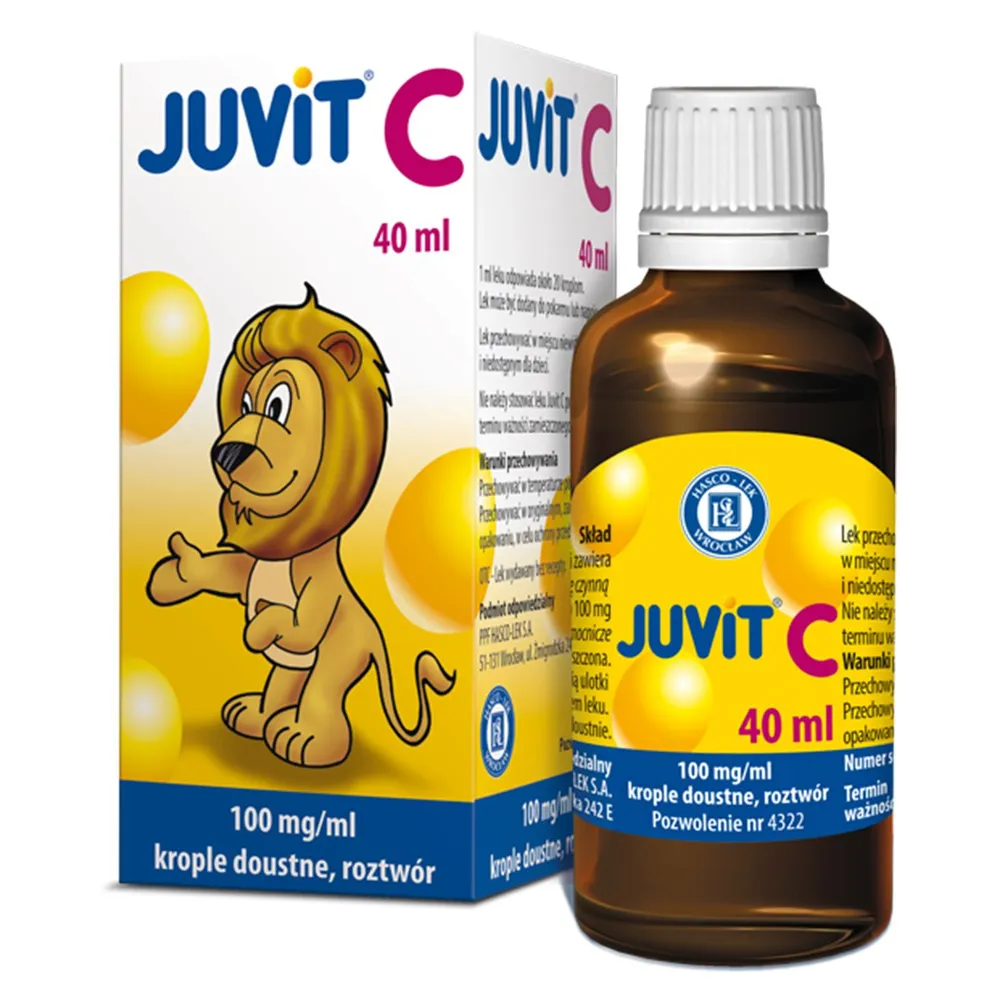
Table of Contents
Package leaflet: Information for the user
JUVIT C
100 mg/ml, oral drops, solution
Please read all of this leaflet carefully before taking this medicine, because it contains
important information for you.
This medicine should always be used exactly as described in this patient leaflet or as directed by your doctor, pharmacist, or nurse.
- Keep this leaflet. You may need to read it again.
- If you need advice or further information, please contact your pharmacist.
- If you experience any adverse effects, including any possible adverse effects not listed in this leaflet, please inform your doctor, pharmacist, or nurse. See section 4.
Contents of the leaflet
- What Juvit C is and what it is used for
- Important information before taking Juvit C
- How to take Juvit C
- Possible side effects
- How to store Juvit C
- Contents of the packaging and other information
1. What Juvit C is and what it is used for
Vitamin C participates in oxidative and reductive metabolic processes occurring in cells, e.g. in cellular respiration. It is essential for the formation of collagen, elastin, and intercellular substances, thus contributing to the proper development of cartilage, bones, teeth, wound healing, and increasing capillary elasticity. It influences the production of immune bodies in the body (it is believed to participate in the production of immunoglobulins and interferon) and facilitates iron absorption in the intestines. It is essential for the synthesis of adrenal steroids, catecholamines, insulin, and participates in the metabolism of aromatic amino acids and tyroxine metabolism.
Juvit C oral drops are intended for the treatment of vitamin C deficiency states and for the prevention of diseases caused by vitamin C deficiency, primarily scurvy and its early symptoms, Moeller-Barlow disease, during convalescence, and in cases of diet poor in vitamin C, especially in artificially fed infants.
The medicine is particularly recommended for children.
2. Important information before using Juvit C
When not to use Juvit C:
- if the patient is allergic to ascorbic acid or any of the other ingredients of this medicine (listed in section 6);
- if the patient has oxalate kidney stones. Do not administer high doses to individuals with excessive intestinal iron absorption.
Warnings and precautions
In patients with glucose-6-phosphate dehydrogenase deficiency, the medicine may cause hemolysis of red blood cells.
When administered in high doses, the medicine may affect laboratory test results, especially those performed by redox methods (false positive urine glucose test, false negative fecal occult blood test, reduced results in assays of activity of certain enzymes). Depending on the method used, it may either increase or decrease measured serum bilirubin levels.
Before starting treatment with Juvit C, consult a physician, pharmacist, or nurse.
Juvit C and other medicines
Inform your doctor or pharmacist about all medicines currently used or recently used, as well as any medicines planned for future use.
Concomitant administration of vitamin C with sulfonamides may lead to precipitation of sulfonamide crystals in urine. Vitamin C:
- enhances iron absorption;
- prolongs the half-life of paracetamol in blood;
- acts synergistically with flavonoid glycosides;
- may increase serum concentrations of concurrently administered estrogens.
Tetracyclines, oral contraceptives, barbiturates, and high doses of acetylsalicylic acid reduce blood levels of ascorbic acid.
Juvit C with food and drink
The medicine may be given to infants and young children mixed with food or drink.
Pregnancy and breastfeeding
If the patient is pregnant or breastfeeding, suspects she may be pregnant, or is planning to have a child, she should consult a doctor or pharmacist before using this medicine.
The medicine may be used during pregnancy and breastfeeding; however, caution should be exercised with high doses (do not exceed recommended doses) due to the risk of vitamin C deficiency in the infant.
Driving and operating machinery
The medicine has no effect on the ability to drive or operate machinery.
3. How to use Juvit C
This medicine should always be used exactly as described in this patient leaflet or as directed by a doctor, pharmacist, or nurse. If in doubt, consult a doctor, pharmacist, or nurse.
Recommended dose (unless otherwise advised by a doctor):
- Infants and young children (from day 28 of life up to 24 months of age): 5–8 drops once daily, added to food or drink.
- Children (from 3 years to 11 years of age): 10 drops once daily.
- Adolescents (from 12 years of age) and adults: 15–20 drops once daily (in cases of higher demand or deficiency, the dose may be doubled and taken twice daily).
The medicine may be added to food or drink.
1 ml of the medicine corresponds to approximately 20 drops.
Due to the risk of overdose, the medicine should not be administered directly from the bottle into the child's mouth.
Use of a higher than recommended dose of Juvit C
If more than the recommended dose has been taken, consult a doctor, pharmacist, or nurse immediately.
Missed dose of Juvit C
Do not use a double dose to make up for a missed dose.
If you have any further doubts regarding the use of this medicine, consult your doctor, pharmacist, or nurse.
2/4
4. Possible adverse reactions
Like any medicinal product, this medicine may cause adverse reactions, although not in everyone.
Vitamin C is generally well tolerated. High doses, especially when used long-term, may
occasionally cause headaches, skin flushing, diuretic effects, and may lead to deposition of calcium
oxalate and urate crystals in the urinary tract.
Tolerance development has also been observed, with symptoms of deficiency appearing after
discontinuation (scurvy), and even dependence with headaches.
Reporting of adverse reactions
If any adverse reactions occur, including any possible adverse reactions not listed in this leaflet,
inform a doctor or pharmacist. Adverse reactions can also be reported directly to the Department of
Monitoring Adverse Drug Reactions of the Office for Registration of Medicinal Products, Medical
Devices and Biocidal Products {current address, telephone and fax number of the Department},
e-mail: [email protected].
5. How to store Juvit C
Store below 25°C.
Keep in the original, tightly closed packaging to protect from light.
Keep out of sight and reach of children.
Do not use this medicine after the expiry date stated on the carton.
The expiry date refers to the last day of the stated month.
Medicines must not be disposed of via wastewater or household waste. Ask your pharmacist how to dispose of medicines no longer required. Such action helps protect the environment.
6. Contents of the package and other information
What Juvit C contains
- The active substance is ascorbic acid, 100 mg per 1 ml of drops.
- The other ingredients (excipients) are: glycerol, purified water.
What Juvit C looks like and contents of the pack
Juvit C is a solution. 1 ml of solution corresponds to approximately 20 drops.
One pack contains 40 ml.
Marketing Authorisation Holder and Manufacturer
"PRZEDSIĘBIORSTWO PRODUKCJI FARMACEUTYCZNEJ HASCO-LEK" S.A.
51-131 Wrocław, ul. Żmigrodzka 242 E
Medicine information
tel. +48 22 742 00 22
e-mail: [email protected]
3/4
4/4