Vitaminum c teva
Poland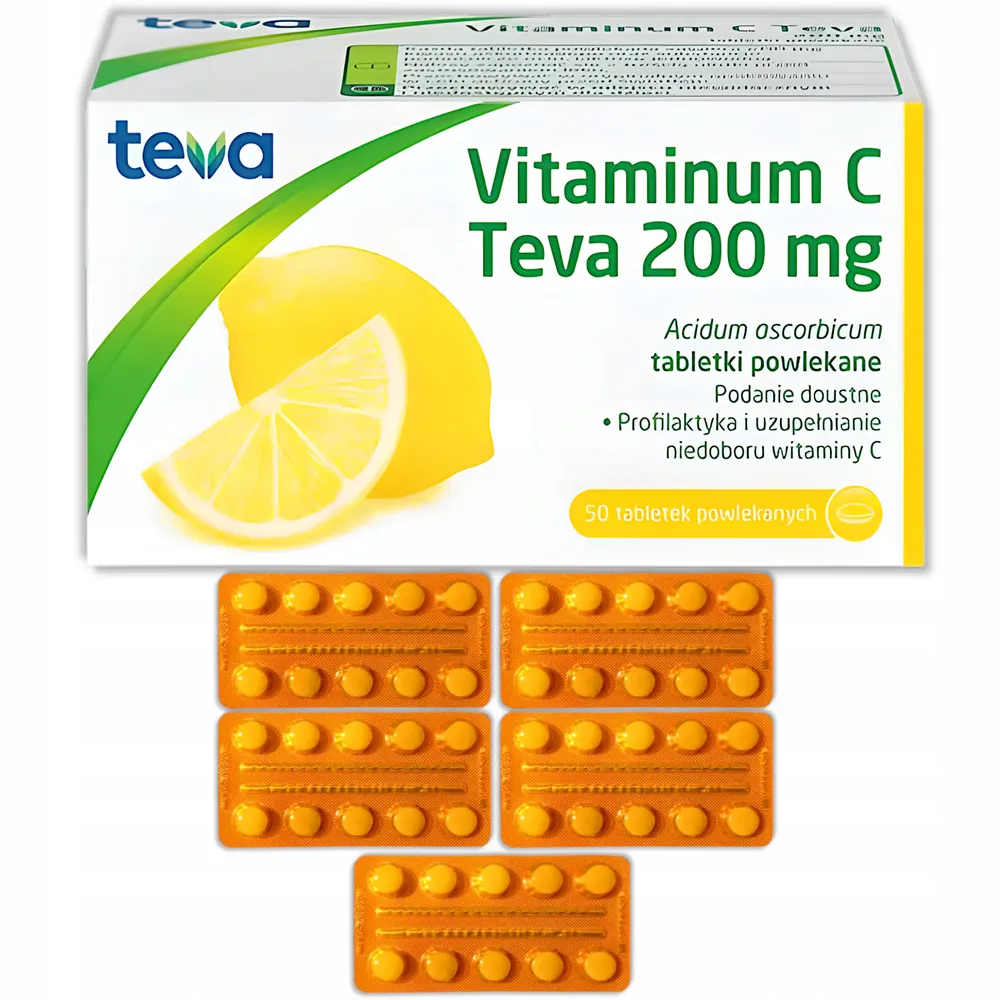
Table of Contents
Patient Information Leaflet
VITAMINUM C TEVA 200 mg, coated tablets
Acidum ascorbicum
Please read all of this leaflet carefully before taking this medicine, as it contains important information for you.
This medicine should always be used exactly as described in this patient leaflet or as directed by your doctor, pharmacist, or nurse.
- Keep this leaflet so that you can read it again if necessary.
- If you need advice or further information, consult your pharmacist.
- If you experience any side effects, including any that are not listed in this leaflet, inform your doctor, pharmacist, or nurse. See section 4.
- If your symptoms do not improve or if you feel worse, contact your doctor.
Table of contents:
- What Vitaminum C Teva 200 mg is and what it is used for
- Important information before taking Vitaminum C Teva 200 mg
- How to take Vitaminum C Teva 200 mg
- Possible side effects
- How to store Vitaminum C Teva 200 mg
- Contents of the pack and other information
1. What Vitaminum C Teva 200 mg is and what it is used for
Vitaminum C Teva coated tablets contain 200 mg of ascorbic acid (vitamin C).
Vitamin C participates in oxidation and reduction processes in the body, contributes to collagen formation, influences the elasticity of capillaries, and is essential for proper cartilage and bone development and for normal wound healing. It stimulates the production of prostacyclin, which has a protective effect on blood vessels, and inhibits the formation of thromboxane, which promotes vasoconstriction and vascular thrombosis. It exhibits antioxidant properties, inhibits the formation of lipid peroxides and neutralizes free radical superoxides. It is essential for adrenal hormone metabolism. Indirectly, it participates in the metabolism of phenylalanine, tyrosine, noradrenaline, histamine, folic acid, as well as lipids, proteins, and carnitine. In the gastrointestinal tract, it enhances iron absorption.
Signs of vitamin C deficiency include: general malaise, irritability, joint pain, excessive keratinization of hair follicles, bleeding gums and nosebleeds, and petechiae.
Vitaminum C Teva 200 mg is indicated for the prevention and correction of vitamin C deficiency in the body during convalescence from infectious diseases, wound healing after burns, and in cigarette smokers.
The medicine may be used as an adjunct in the treatment of iron-deficiency anemia, and in inflammatory conditions of the skin and mucous membranes of the respiratory, gastrointestinal, and urinary systems.
2. Information before using Vitaminum C Teva 200 mg
When not to use Vitaminum C Teva 200 mg
Do not use if the patient has a known hypersensitivity (allergy) to the active substance or to any of the other ingredients of Vitaminum C Teva 200 mg.
Large doses (over 1 g per day) should not be administered to patients with urinary tract stones or excessive renal excretion of oxalates.
Warnings and precautions
Caution is required in patients diagnosed with hemochromatosis, sideroblastic anemia, or thalassemia (conditions associated with iron metabolism disorders), because ascorbic acid enhances iron absorption.
In individuals with glucose-6-phosphate dehydrogenase deficiency (a genetically determined lack of this enzyme in red blood cells), prolonged administration may cause hemolytic anemia.
Long-term administration of high doses of ascorbic acid in patients with urinary tract stones may lead to formation and deposition of deposits in the kidneys.
Ascorbic acid participates in oxidation-reduction reactions; high doses of the drug may affect the results of chemical oxidation and reduction tests. Therefore, patients should be advised not to take medications containing ascorbic acid for at least 1 day before blood and urine tests. This will help avoid possible diagnostic errors (e.g. masking of occult blood in stool, increased bilirubin concentration in blood serum, presence of glucose in urine, decreased activity in blood serum of enzymes such as AlAT, AspAT, LDH; decreased urine pH).
Results of glucose testing in urine of diabetic patients may be falsified when high doses of vitamin C are taken.
Patients with renal insufficiency should consult a physician before using the drug.
Long-term administration of high doses of ascorbic acid may cause symptoms of poisoning. Diagnosis is based on laboratory findings and clinical symptoms such as difficult and painful urination and hematuria.
Interaction of Vitaminum C Teva 200 mg with other medicines
Inform your doctor about all medicines you are currently taking, including those obtained without a prescription.
Ascorbic acid enhances the absorption of iron compounds taken simultaneously.
When acetylsalicylic acid and ascorbic acid are administered together, increased excretion of ascorbic acid and reduced excretion of acetylsalicylic acid are observed.
Ascorbic acid increases the elimination rate of tricyclic antidepressants and amphetamine from the body, reduces the effectiveness of phenothiazine derivatives (antiallergic and psychiatric drugs), aminoglycoside antibiotics (e.g. gentamicin, amikacin), and increases estrogen concentration in blood serum (female hormones, including those contained in oral contraceptives).
Taking Vitaminum C Teva 200 mg with food and drink
The medicine should be taken during a meal.
Pregnancy, breastfeeding, and fertility
Pregnancy
If the patient is pregnant or breastfeeding, suspects she may be pregnant, or is planning to have a child, she should consult a doctor or pharmacist before using this medicine.
Consult a doctor or pharmacist before using any medicine.
Ascorbic acid crosses the placenta.
The use of high doses of ascorbic acid in pregnant women is not recommended due to the risk of vitamin C deficiency symptoms in newborns after cessation of supply through the placenta.
Breastfeeding
Consult a doctor or pharmacist before using any medicine.
Ascorbic acid passes into breast milk.
Caution is advised; high doses should not be used without medical advice.
Driving and operating machinery
No influence on the ability to drive motor vehicles or operate mechanical equipment.
Vitaminum C Teva 200 mg contains lactose
If the patient has previously been diagnosed with intolerance to certain sugars, the patient should consult a doctor before taking this medicine.
3. How to use Vitaminum C Teva 200 mg
This medicine should always be used according to the instructions given by your doctor or pharmacist. If in doubt,
consult your doctor or pharmacist.
Oral administration.
Adults
prophylactically: 100 mg per day;
as an adjunct in treatment: 100 mg to 500 mg per day.
Children over 5 years of age
as an adjunct in treatment: 100 mg to 200 mg per day.
The medicine should be taken during a meal.
To achieve a daily dose of 100 mg, 300 mg, 500 mg: oral dosage forms of 100 mg strength are available.
Administration of a higher than recommended dose of Vitaminum C Teva 200 mg
If a significantly higher than recommended dose of the medicine is taken, consult your doctor or
pharmacist. If in doubt regarding the use of the medicine, consult your doctor or
pharmacist.
4. Possible adverse reactions
Like all medicines, this medicine can cause adverse reactions, although not everybody will experience them.
The medicine is generally well tolerated. However, taking high doses of ascorbic acid (above 1 g per day) may cause adverse reactions such as: nausea, vomiting, diarrhoea, heartburn, skin rashes, headache, increased urination.
Long-term use of vitamin C in doses exceeding 1 g per day leads to increased excretion of oxalates in urine and may also cause formation of uric acid and cystine stones, particularly in patients with urinary tract stones or undergoing haemodialysis.
If any of the adverse reactions worsen or if any adverse reactions not listed in this leaflet occur, inform your doctor or pharmacist.
Reporting of adverse reactions
If any adverse reactions occur, including those not listed in this leaflet, inform your doctor or pharmacist.
Adverse reactions can be reported directly to the Department of Monitoring Adverse Drug Reactions of the Office for Registration of Medicinal Products, Medical Devices and Biocidal Products, Al. Jerozolimskie 181C, 02-222 Warsaw, Tel.: +48 22 49 21 301, Fax: +48 22 49 21 309, e-mail: [email protected].
Adverse reactions can also be reported to the marketing authorization holder.
Reporting adverse reactions helps to provide more information on the safety of the medicine.
5. How to store Vitaminum C Teva 200 mg
Keep the medicine out of sight and reach of children.
Store in the original packaging to protect from light.
Do not use this medicine after the expiry date stated on the packaging.
The expiry date refers to the last day of the specified month.
Medicines must not be disposed of via wastewater or household waste. Ask your pharmacist
what to do with medicines no longer required. This will help protect the environment.
6. Contents of the packaging and other information
What Vitaminum C Teva 200 mg contains
- The active substance is ascorbic acid.
- Other ingredients of the medicine are: monohydrate lactose, povidone, talc, magnesium stearate, potato starch. Coating: hypromellose, titanium dioxide (E 171), glycerol, magnesium stearate, polysorbate 80, xylitol, lemon flavour, quinoline yellow lake (E 104).
What Vitaminum C Teva 200 mg looks like and contents of the pack
Film-coated tablets.
2 blisters with 10 tablets (20 tablets) in a cardboard box;
3 blisters with 10 tablets (30 tablets) in a cardboard box;
5 blisters with 10 tablets (50 tablets) in a cardboard box.
Marketing Authorisation Holder and Manufacturer
Marketing Authorisation Holder
Teva Pharmaceuticals Polska Sp. z o.o., ul. Emilii Plater 53, 00-113 Warsaw, Poland
Manufacturer
Teva Operations Poland Sp. z o.o., ul. Mogilska 80, 31-546 Kraków, Poland