Ventolin
Poland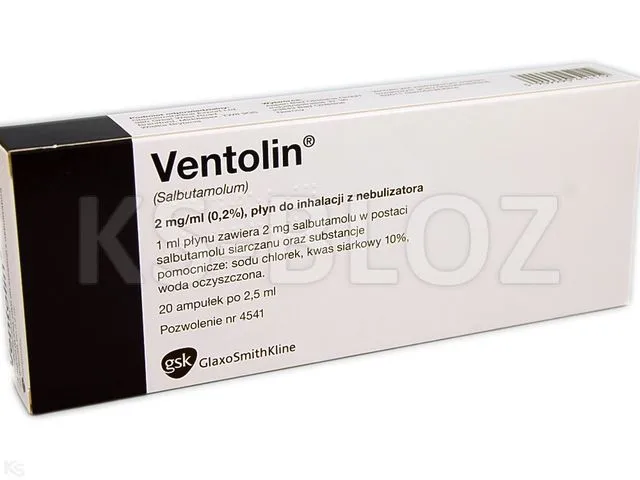
Table of Contents
Package leaflet: Information for the patient
Ventolin, 1 mg/ml (0.1%), solution for nebulisation
Ventolin, 2 mg/ml (0.2%), solution for nebulisation
Salbutamol
Please read this leaflet carefully before using this medicine because it contains important information for you.
- Keep this leaflet as you may need to read it again.
- If you have any further questions, please ask your doctor or pharmacist.
- This medicine has been prescribed for a specific individual. Do not pass it on to others.
- It may harm someone else, even if their symptoms are the same as yours.
- If you experience any side effects, including any not listed in this leaflet, tell your doctor or pharmacist. See section 4.
Contents of the leaflet:
- What Ventolin, solution for nebulisation is and what it is used for
- Important information before using Ventolin, solution for nebulisation
- How to use Ventolin, solution for nebulisation
- Possible side effects
- How to store Ventolin, solution for nebulisation
- Contents of the pack and other information
1. What Ventolin, solution for nebulisation is and what it is used for
Ventolin, solution for nebulisation, contains a medicine called salbutamol. It belongs to a group of medicines known as fast-acting bronchodilators.
Bronchodilators:
- Help keep the airways open, making breathing easier.
- Help reduce chest tightness, wheezing and coughing associated with asthma.
Ventolin, solution for nebulisation is indicated for use in adults, adolescents and children aged 4 years and older, for chronic obstructive airway conditions unresponsive to conventional therapy, and in the treatment of acute, severe asthma attacks. Use in infants and children under 4 years of age, see section 3 of this leaflet.
Ventolin, solution for nebulisation is intended for inhalation use only and must not be administered intravenously or orally.
Ventolin, solution for nebulisation, contained in a plastic ampoule, is intended for inhalation via a suitable nebuliser, as directed by your doctor.
2. Important information before using Ventolin, solution for nebulisation
When not to use Ventolin, solution for nebulisation
- If you are allergic to salbutamol sulphate or any of the other ingredients of this medicine (listed in section 6),
- In threatened abortion,
- For prevention of premature labour.
Warnings and precautions
Before starting treatment with Ventolin, solution for nebulisation, consult your doctor if you:
- Have poorly controlled asthma (e.g. frequent asthma symptoms or exacerbations, or reduced physical performance). Your doctor may recommend starting or increasing the dose of another medicine, such as an inhaled corticosteroid, to achieve better disease control.
- Have high blood pressure,
- Have diabetes,
- Have hyperthyroidism,
- Have previously had heart problems, such as irregular or rapid heartbeat or chest pain,
- Have low blood potassium levels,
- Are taking xanthine derivatives (e.g. theophylline) or steroids for asthma treatment,
- Are taking diuretics (water tablets), sometimes used to treat high blood pressure or heart disease,
- Are using other nebulised medicines in addition to salbutamol, such as ipratropium bromide. Combined therapy should be used with caution. Avoid contact with the eyes.
- Are taking medicines such as ephedrine or pseudoephedrine for nasal congestion, or other medicines used to treat asthma.
If you are taking any of the medicines listed above, your doctor may recommend monitoring your blood potassium levels.
Please consult your doctor to determine whether any of the above conditions apply to you.
Symptoms to watch for
Using high doses of Ventolin, solution for nebulisation, may very rarely lead to a condition called lactic acidosis. You should be aware of certain symptoms while using Ventolin, solution for nebulisation, to reduce the risk of complications. See also “Symptoms to watch for” in section 4 of this leaflet.
Patients using Ventolin, solution for nebulisation at home should seek immediate medical advice if their response to the usual dose diminishes or if the duration of effect shortens. Increasing the dose or frequency of administration, due to increased risk of side effects, is only permitted under medical supervision.
Ventolin and other medicines
Tell your doctor about all medicines you are currently taking, have recently taken, or plan to take, including those obtained without a prescription.
Some medicines may affect the action of Ventolin, solution for nebulisation, or increase the risk of side effects. These include:
- Beta-blocking agents such as propranolol, used to treat high blood pressure or other heart conditions.
Your doctor will decide whether you can use Ventolin, solution for nebulisation, with these medicines.
Using Ventolin, solution for nebulisation with food and drink
Ventolin, solution for nebulisation can be used at any time, regardless of meals.
Pregnancy and breastfeeding
Ventolin, solution for nebulisation is generally not recommended during pregnancy. If you are pregnant, breastfeeding, think you may be pregnant, or are planning to have a baby, consult your doctor before using this medicine. Your doctor will assess whether you can use Ventolin during this period.
Driving and operating machinery
No effects on the ability to drive or operate machinery have been reported.
3. How to use Ventolin, solution for nebulisation
Always use Ventolin, solution for nebulisation exactly as prescribed by your doctor. If in doubt, consult your doctor.
Ventolin, solution for nebulisation should be used as needed, not regularly.
If your asthma is active (e.g. frequent symptoms or exacerbations such as breathlessness interfering with speaking, eating or sleeping, coughing, wheezing, chest tightness or reduced physical performance), you should inform your doctor immediately. Your doctor may start or increase treatment with a medicine that helps maintain asthma control, such as an inhaled corticosteroid.
If you feel the medicine is not working as well as usual, inform your doctor as soon as possible (e.g. you need higher doses to relieve breathing difficulties, or asthma symptoms do not improve within at least 3 hours after using the nebuliser), as your asthma may be worsening and alternative treatment may be required.
If you use Ventolin, solution for nebulisation more than twice a week to relieve asthma symptoms, excluding prophylactic use before physical exertion, this indicates poorly controlled asthma and increases the risk of severe asthma attacks (asthma exacerbations), which may lead to serious complications, life-threatening situations, or even death. Contact your doctor promptly to review your asthma treatment.
If you are taking a daily anti-inflammatory medicine for the lungs, such as an “inhaled corticosteroid”, it is important to continue using it regularly, even if you feel better.
Adults
Adults (including elderly): 2.5 mg to 5 mg salbutamol up to four times daily.
Doses up to 40 mg daily may be used in hospital settings under strict medical supervision.
Children and adolescents
Children aged 12 years and older: dosage as for adults.
Children aged 4 to 11 years: 2.5 mg to 5 mg up to four times daily.
The efficacy of nebulised salbutamol in infants and children under 18 months has not been fully established.
In children under 4 years of age, other formulations of the medicine may be more appropriate.
Method of administration
Ventolin, solution for nebulisation is intended for inhalation use only via the mouth, under medical supervision, using a suitable nebuliser.
The solution must not be administered intravenously or orally.
After cutting the foil blister with scissors, remove the connected ampoules and separate one.
Twist the ampoule along its axis to open it.
Ventolin, solution for nebulisation is intended for use without dilution. However, if a longer administration time is required (longer than 10 minutes), the solution may be diluted with sterile 0.9% sodium chloride solution.
Any unused solution must be discarded from the nebuliser.
The solution in the nebuliser should be replaced daily.
Many nebulisers operate on a continuous flow principle, so some of the medicine may escape from the device. Therefore, nebuliser inhalation should be performed in a well-ventilated area, especially in hospital wards where several patients may be using nebulisers simultaneously.
If you feel the effect of Ventolin, solution for nebulisation is too strong or too weak, consult your doctor.
Use of more than the recommended dose of Ventolin, solution for nebulisation
If you use more Ventolin than recommended, contact your doctor or pharmacist immediately for advice. Keep the carton packaging with you to show the doctor.
The following symptoms may occur:
- Faster than normal heartbeat,
- Tremors,
- Excessive excitability. These symptoms usually resolve within a few hours. Additionally, the following may occur:
- Decreased blood potassium levels (hypokalaemia),
- Abdominal pain, increased lung ventilation (rapid breathing), shortened breathing despite reduced wheezing, cold hands and feet, irregular heartbeat, thirst (symptoms suggesting lactic acidosis).
Missed dose of Ventolin, solution for nebulisation
If you miss a dose of Ventolin, solution for nebulisation, take it as soon as possible, then continue treatment as directed by your doctor. Do not take a double dose to make up for a missed dose.
If you have any further questions about the use of this medicine, consult your doctor or pharmacist.
4. Possible adverse reactions
If breathing worsens or wheezing increases immediately after taking this medicine, stop using the medicine immediately and contact a doctor at once.
Like all medicines, Ventolin can cause adverse reactions, although not everyone experiences them.
Below are the adverse reactions observed in patients using Ventolin, solution for nebulization.
Reactions to watch for
Allergic reactions: Very rare (occurring in less than 1 in 10,000 patients treated). Symptoms include:
- skin rash (urticaria) or redness,
- swelling, mainly of the face, lips, tongue or throat (angioedema),
- increased wheezing in the airways, cough or difficulty breathing,
- sudden feeling of weakness or dizziness (which may lead to falling or loss of consciousness).
Contact a doctor immediately if any of the above symptoms occur. Discontinue use of Ventolin, solution for nebulization.
Contact a doctor promptly if the patient experiences:
- sensation of faster or stronger heartbeat than usual (palpitations). Usually this is not dangerous and resolves soon after taking the medicine,
- sensation of irregular heartbeat. Do not discontinue use of Ventolin, solution for nebulization, unless otherwise advised by a doctor.
Common adverse reactions (occurring in less than 1 in 10 patients, but more than 1 in 100 patients using the medicine):
- tremor,
- headache,
- increased heart rate.
Uncommon adverse reactions (occurring in less than 1 in 100 patients, but more than 1 in 1,000 patients using the medicine):
- palpitations,
- irritation of the oral and pharyngeal mucosa,
- muscle cramps.
Rare adverse reactions (occurring in less than 1 in 1,000 patients, but more than 1 in 10,000 patients using the medicine):
- peripheral vasodilation,
- decreased potassium levels in blood.
Very rare adverse reactions (occurring in less than 1 in 10,000 patients using the medicine):
- allergic reactions (see above),
- excessive excitability,
- cardiac arrhythmias,
- paradoxical bronchospasm. As with other inhaled medicines, paradoxical bronchospasm may occur, characterized by wheezing immediately after taking the medicine. In such a case, stop administration of Ventolin, solution for nebulization immediately and contact a doctor. The doctor will assess the patient's condition and, if necessary, recommend alternative treatment.
- abdominal pain, hyperventilation (increased lung ventilation), shortness of breath despite reduced wheezing in the airways, cold hands and feet, irregular heartbeat, thirst (symptoms suggestive of a condition called lactic acidosis).
Adverse reactions with unknown frequency
- myocardial ischemia, which may manifest as, for example, chest pain.
If any of the adverse reactions worsen or if any adverse reactions not listed in this leaflet occur, inform your doctor or pharmacist.
Reporting of adverse reactions
If any adverse reactions occur, including those not listed in this leaflet, inform your doctor or pharmacist. Adverse reactions can be reported directly to the Department of Monitoring of Adverse Drug Reactions of the Office for Registration of Medicinal Products, Medical Devices and Biocidal Products, Al. Jerozolimskie 181C, 02-222 Warsaw, Tel.: + 48 22 49 21 301, Fax: + 48 22 49 21 309, website:
Adverse reactions can also be reported to the marketing authorization holder.
Reporting adverse reactions helps to collect more information on the safety of the medicine.
5. How to store Ventolin, solution for nebulization
- Keep the medicine out of the sight and reach of children.
- Do not use this medicine after the expiry date stated on the label or cardboard box. The expiry date refers to the last day of the month.
- Store below 30°C. After opening the foil blister pack, the product in plastic ampoules, protected from light, remains suitable for use within 3 months. Unused solution for nebulization should be discarded from the nebulizer.
Medicines must not be disposed of via wastewater or household waste. Ask your pharmacist how to dispose of medicines no longer in use. This will help protect the environment.
6. Contents of the package and other information
What Ventolin, solution for nebulisation contains
- The active substance is salbutamol in the form of salbutamol sulfate. 1 ml of solution for nebulisation contains either 1 mg or 2 mg of salbutamol as salbutamol sulfate.
- Other ingredients: sodium chloride, sulfuric acid 10%, water for injections.
What Ventolin looks like and contents of the pack
Ventolin 1 mg/ml, solution for nebulisation – 20 plastic ampoules (LDPE) of 2.5 ml
containing 2.5 mg salbutamol, in a cardboard box.
Ventolin 2 mg/ml, solution for nebulisation – 20 plastic ampoules (LDPE) of 2.5 ml
containing 5 mg salbutamol, in a cardboard box.
Marketing Authorisation Holder: Manufacturer:
GlaxoSmithKline Trading Services Limited Aspen Bad Oldesloe GmbH
12 Riverwalk Industriestrasse 32-36
Citywest Business Campus 23843 Bad Oldesloe
Dublin 24 Germany
D24 YK11
Ireland
For further information, contact the representative of the Marketing Authorisation Holder:
GSK Services Sp. z o.o.
ul. Rzymowskiego 53
02-697 Warsaw
tel. (22) 576-90-00