Uroflow 2
Poland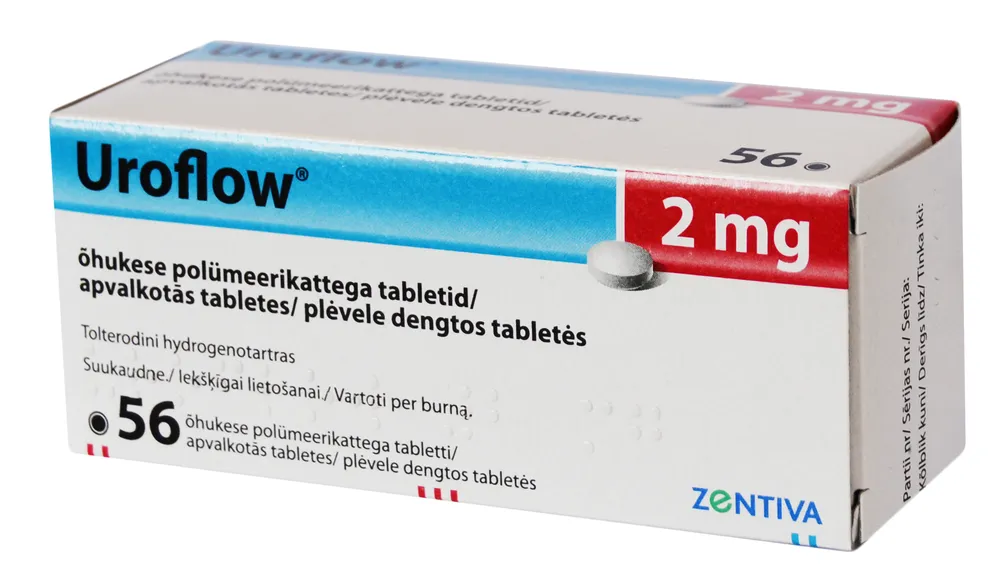
Table of Contents
Patient Information Leaflet: Information for the User
UROFLOW 1, 1 mg, film-coated tablets
UROFLOW 2, 2 mg, film-coated tablets
Tolterodini hydrogenotartras
Please read carefully the entire leaflet before taking this medicine, as it contains
important information for the patient.
- Keep this leaflet, as you may need to read it again.
- If you have any questions, please consult your doctor or pharmacist.
- This medicine has been prescribed for a specific individual. Do not share it with others. This medicine may harm other people, even if their symptoms are the same.
- If you experience any adverse reactions, including any adverse reactions not listed in this leaflet, inform your doctor or pharmacist. See section 4.
Table of contents of the leaflet
- What Uroflow is and what it is used for
- Important information before taking Uroflow
- How to take Uroflow
- Possible side effects
- How to store Uroflow
- Contents of the pack and other information
1. What Uroflow is and what it is used for
Uroflow belongs to a group of medicines that reduce the tone of the bladder muscles.
Uroflow is used to treat symptoms of overactive bladder, such as sudden urge to urinate,
frequent urination, or urge incontinence.
This medicine is intended for use in adults.
2. Information before using Uroflow
When not to use Uroflow:
- if the patient is allergic to tolterodine or any of the other ingredients of this medicine (listed in section 6),
- if the patient has reduced ability to empty the bladder,
- if the patient has difficult-to-treat glaucoma (high pressure in the eyeball and eye pain),
- if the patient has myasthenia (neuromuscular disorders with muscle weakness),
- if the patient has severe ulcerative colitis (intestinal inflammation with ulcers and bloody diarrhoea) or toxic megacolon (a life-threatening complication of ulcerative colitis or other intestinal diseases).
Warnings and precautions
Before starting treatment with Uroflow, discuss the following with your doctor or pharmacist:
- if the patient has difficulty passing urine or a weak urine stream,
- if the patient has acute painful abdominal distension affecting digestion and movement of food through the gut, or has had or currently has severe constipation,
- if the patient has kidney or liver problems. In such cases, the doctor will usually reduce the dose,
- if the patient has autonomic neuropathy (a nerve disorder, sometimes associated with diabetes, which may lead to diarrhoea, erectile dysfunction or low blood pressure),
- if the patient has a hiatal hernia (a condition where part of the stomach moves from the abdominal cavity into the chest through the diaphragm),
- if the patient has heart problems such as:
- abnormal ECG findings,
- slow heart rate (bradycardia), or if the patient is taking any medicines known to affect heart rhythm,
- significant pre-existing heart disease, such as:
- cardiomyopathy (weakened heart muscle);
- myocardial ischaemia (reduced blood flow to the heart);
- arrhythmias (irregular heart rhythm);
- heart failure.
- if the patient has low levels of potassium (hypokalaemia), calcium (hypocalcaemia), or magnesium (hypomagnesaemia) in the blood.
Uroflow with other medicines
Tell your doctor or pharmacist about all medicines the patient is currently taking, has recently taken, or plans to take.
Some medicines may interact with Uroflow and increase its effects:
- antibiotics containing erythromycin and clarithromycin,
- medicines used to treat fungal infections,
- medicines used to treat HIV infections,
- medicines used to treat irregular heart rhythm (containing e.g. amiodarone, sotalol, quinidine, procainamide),
- other medicines with effects similar to Uroflow (antimuscarinic properties) or medicines with opposite effects to Uroflow (cholinergic properties).
Uroflow may reduce the effect of medicines that stimulate gastrointestinal motility (medicines containing metoclopramide or cisapride). If the patient is unsure whether this applies, they should consult their doctor.
Uroflow with food and drink
This medicine can be taken independently of meals, with water.
Pregnancy and breastfeeding
If the patient is pregnant or breastfeeding, suspects she may be pregnant, or is planning to have a baby, she should consult her doctor or pharmacist before using this medicine.
The use of Uroflow is not recommended during pregnancy.
Breastfeeding women should avoid using this medicine.
Driving and operating machinery
Uroflow may cause blurred vision and reduce reaction ability. The patient should always consult their doctor if planning to drive or operate machinery.
Uroflow contains sodium
This medicine contains less than 1 mmol (23 mg) of sodium per tablet, meaning the medicine is considered "sodium-free".
3. How to use Uroflow
This medicine should always be taken exactly as directed by your doctor or pharmacist. If in doubt,
consult your doctor or pharmacist.
Adults (including elderly patients)
The recommended dose is 2 mg (1 tablet of Uroflow 2) twice daily. The tablet should be swallowed
whole.
Patients with impaired kidney or liver function
The recommended dose is 1 mg (1 tablet of Uroflow 1) twice daily.
After 2 or 3 months, treatment effectiveness should be re-evaluated.
Use in children and adolescents
Uroflow is not recommended for use in children and adolescents.
Taking more Uroflow than recommended
Do not take more tablets than prescribed by your doctor. If you accidentally take more tablets than
recommended, seek medical advice immediately from your doctor or the nearest hospital. If a child
accidentally takes this medicine, contact a doctor immediately.
If you forget to take Uroflow
If you forget to take a tablet at your usual time, take it as soon as you remember, unless it is almost
time for your next dose.
Do not take a double dose to make up for a missed dose.
Stopping Uroflow treatment
Do not stop treatment prematurely.
Your doctor will inform you about the duration of treatment with Uroflow.
If you have any further questions regarding the use of this medicine, consult your doctor or
pharmacist.
4. Possible adverse reactions
Like all medicines, this medicine can cause adverse reactions, although not everyone will experience them.
Treatment must be stopped immediately and a doctor should be contacted if the patient
experiences any of the following adverse reactions with unknown frequency:
- allergic reaction with skin rash, facial swelling or breathing difficulties (angioedema);
- urticaria, sudden swelling around the eyes, feeling of pressure on the chest with breathing or swallowing difficulties, bluish skin colour, low blood pressure (anaphylactoid reaction).
The following adverse reactions may occur during treatment with tolterodine (the active substance in Uroflow), listed according to their frequency of occurrence. If any of these adverse reactions become troublesome, contact your doctor, who may reduce the dose of the medicine.
Very common (may occur in more than 1 out of 10 patients):
- dry mouth,
- headache.
Common (may occur in no more than 1 out of 10 patients):
- bronchitis,
- central dizziness, drowsiness, sensory disturbances – tingling sensation in fingers and toes (paresthesia),
- dry eyes, visual disturbances (blurred vision),
- peripheral (vestibular) dizziness,
- palpitations,
- gastric discomfort after meals (dyspepsia), constipation, abdominal pain, bloating, vomiting, diarrhoea,
- painful or difficult urination, urinary retention,
- dry skin,
- fatigue, chest pain, fluid retention causing oedema (e.g. in ankles),
- weight gain.
Uncommon (may occur in no more than 1 out of 100 patients):
- hypersensitivity (allergic) reactions,
- nervousness,
- increased heart rate, heart failure, irregular heartbeat,
- heartburn,
- memory disturbances.
Unknown (frequency cannot be estimated from available data):
- confusion, hallucinations and disorientation,
- skin redness,
- in patients treated for dementia, worsening of symptoms of this disease has also been reported.
Reporting of adverse reactions
If any adverse reactions occur, including any adverse reactions not listed in this leaflet, inform your doctor, pharmacist or nurse. Adverse reactions can be reported directly to the Department of Monitoring of Adverse Drug Reactions at the Office for Registration of Medicinal Products, Medical Devices and Biocidal Products.
Al. Jerozolimskie 181 C
02-222 Warsaw
Tel.: +48 22 49 21 301
Fax: +48 22 49 21 309
Website: https://smz.ezdrowie.gov.pl
Reporting adverse reactions helps to provide more information on the safety of the medicine.
Adverse reactions can also be reported to the marketing authorisation holder or its representative in Poland.
5. How to store Uroflow 1
Keep the medicine out of the sight and reach of children.
Do not use this medicine after the expiry date stated on the carton and blister pack following "EXP".
The expiry date refers to the last day of the stated month.
Store in the original packaging to protect from moisture.
Medicines must not be disposed of via wastewater or household waste. Ask your pharmacist how to dispose of medicines no longer required. Such measures help protect the environment.
6. Contents of the pack and other information
What Uroflow contains
The active substance is tolterodine tartrate. Each coated tablet contains 1 mg or 2 mg of
tolterodine tartrate.
Other components are:
Tablet core: microcrystalline cellulose, sodium carboxymethyl starch (type A), colloidal anhydrous silica, sodium stearyl fumarate.
Tablet coating:
Uroflow 1: hypromellose 2910/5, macrogol 6000, titanium dioxide (E171), iron oxide yellow (E172), talc.
Uroflow 2: hypromellose 2910/5, macrogol 6000, titanium dioxide (E171), talc.
What Uroflow looks like and contents of the pack
Uroflow 1: yellow, round, biconvex coated tablets.
Uroflow 2: white, round, biconvex coated tablets.
Pack sizes: 28 or 56 coated tablets.
Not all pack sizes may be marketed.
Marketing Authorisation Holder
Zentiva, k.s., U kabelovny 130, Dolni Měcholupy, 10237 Praha 10, Czech Republic
Manufacturer
Zentiva, k.s., U kabelovny 130, Dolni Měcholupy, 10237 Praha 10, Czech Republic
For further information about the medicinal product and its names in the countries of the European Economic Area, please contact:
Zentiva Polska Sp. z o.o.
ul. Bonifraterska 17
00-203 Warsaw
tel.: +48 22 375 92 00