Sufentanil hameln
Poland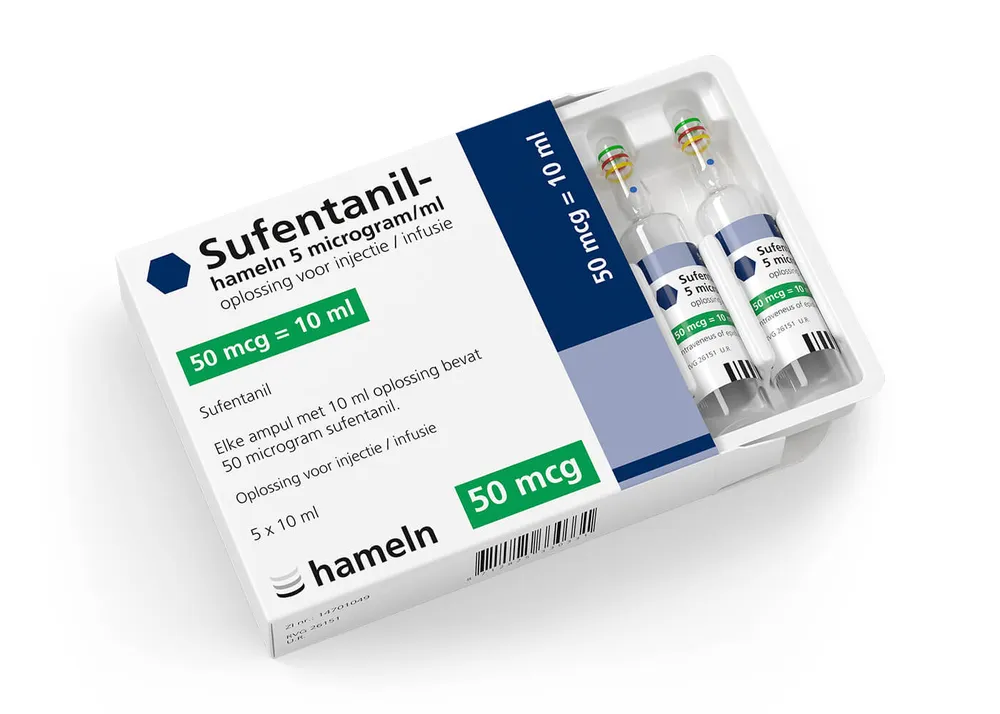
Table of Contents
- Package leaflet: Information for the user
- 1. What Sufentanil hameln is and what it is used for
- 2. Important information before using Sufentanil hameln
- 3. How to use Sufentanil hameln
- 4. Possible side effects
- 5. How to store Sufentanil hameln
- 6. Contents of the package and other information
- Information intended exclusively for medical professionals:
Package leaflet: Information for the user
Sufentanil hameln, 5 micrograms/ml, solution for injection/infusion
Sufentanil hameln, 50 micrograms/ml, solution for injection/infusion
Sufentanilum
Please read all of this leaflet carefully before this medicine is administered, because it contains
important information for the patient.
- Keep this leaflet, so that you can read it again if necessary.
- If you have any further questions, please consult your doctor or pharmacist.
- If you experience any adverse reactions, including any not listed in this leaflet, inform your doctor or nurse. See section 4.
Contents of the leaflet
- What Sufentanil hameln is and what it is used for
- Important information before administration of Sufentanil hameln
- How to use Sufentanil hameln
- Possible side effects
- How to store Sufentanil hameln
- Contents of the pack and other information
1. What Sufentanil hameln is and what it is used for
Sufentanil hameln belongs to a group of medicines called opioid anaesthetics, which relieve or prevent pain during or after anaesthesia. Sufentanil hameln is administered intravenously during and after major surgical procedures with assisted ventilation.
Sufentanil hameln administered intravenously is used for:
Adults
- prevention of pain during induction and maintenance of general anaesthesia in combination with other anaesthetic medicines
- as an anaesthetic agent for induction and/or maintenance of anaesthesia during major surgery.
Children
Intravenous sufentanil is indicated as an analgesic agent during induction and/or maintenance of general anaesthesia in children over 1 month of age.
Sufentanil hameln administered epidurally is used for:
Adults
- prevention of postoperative pain, including after caesarean section
- management of pain during labour and vaginal delivery.
Children
Epidural sufentanil is indicated in children over 1 year of age for treatment of postoperative pain following general surgery, thoracic surgery, or orthopaedic procedures.
2. Important information before using Sufentanil hameln
When not to use Sufentanil hameln
- intravenously:
- if the patient is allergic to sufentanil or to other morphine-like medicines or to any of the other ingredients of this medicine (listed in section 6),
- if the patient has diseases causing breathing difficulties, e.g. asthma or chronic bronchitis,
- if the patient is taking any antidepressant medicines known as monoamine oxidase inhibitors (MAOIs). Treatment with MAOIs should be discontinued 2 weeks before surgery,
- if the patient suffers from a liver enzyme disorder called acute hepatic porphyria,
- if the patient is taking or has recently taken other strong painkillers such as nalbuphine, buprenorphine, pentazocine,
- if the patient is in labour or prior to clamping of the umbilical cord during caesarean section.
- epidurally (extradurally):
- if the patient has severe bleeding or shock,
- if the patient has a severe infection,
- if the patient has impaired wound healing,
- if the patient has an infection at the site of administration,
- if the patient has blood cell count abnormalities or is being treated with medicines that inhibit blood clotting (anticoagulants).
Warnings and precautions
Before starting treatment with Sufentanil hameln, discuss this with your doctor or pharmacist if:
- the patient has abnormally slowed intestinal peristalsis,
- the patient has diseases of the gallbladder or pancreas,
- the patient or any of their relatives has ever abused alcohol, prescription medicines or drugs (‘addiction’),
- the patient smokes tobacco,
- the patient has ever had mood problems (depression, anxiety or personality disorder) or has been treated by a psychiatrist for other mental illnesses. This medicine contains sufentanil, which is an opioid medicine. Repeated use of opioid painkillers may result in reduced effectiveness (the patient becomes tolerant). It may also lead to dependence and misuse of the medicine, which could result in life-threatening overdose. If the patient is concerned about the possibility of becoming addicted to Sufentanil hameln, it is important to consult a doctor.
- Sufentanil hameln should only be administered by trained anaesthesiologists in hospitals or other facilities equipped with assisted ventilation and postoperative monitoring equipment.
- As with all strong painkillers of this type, dose-dependent reduction in respiratory rate may occur. This may persist into the recovery period or recur during this time. Therefore, careful monitoring of patients in the postoperative period is essential.
- Sufentanil hameln may cause sleep-related breathing disorders such as sleep apnoea (pauses in breathing during sleep) and sleep-related hypoxaemia (low blood oxygen levels). Symptoms may include pauses in breathing during sleep, nocturnal awakenings due to breathlessness, difficulty maintaining sleep or excessive daytime sleepiness. If these symptoms occur, contact your doctor. The doctor may consider reducing the dose.
- Sufentanil hameln should be used with particular caution in patients with lung, liver, kidney or thyroid diseases, and in patients with alcoholism.
- Sufentanil hameln should be used cautiously in patients with increased intracranial pressure or in patients with brain or skull injuries.
- In patients suffering from reduced blood volume (hypotension), administration of Sufentanil hameln may cause low blood pressure and slow heart rate.
- Involuntary muscle contractions may occur.
Consult your doctor during treatment with Sufentanil hameln in the following cases:
- the patient experiences pain or increased sensitivity to pain (hyperalgesia) that does not respond to a higher dose prescribed by the doctor.
Newborns and (or) infants
- As with other opioids, newborns are sensitive to breathing difficulties after administration of sufentanil. Data on the effects of intravenous sufentanil in infants are limited. Therefore, the benefit-risk ratio should be carefully considered before administering Sufentanil hameln to newborns and infants.
- Due to the risk of administering too high or too low a dose, intravenous use of Sufentanil hameln is not recommended in the neonatal period.
- Use of Sufentanil hameln for epidural anaesthesia is not recommended in children under 1 year of age.
Sufentanil hameln and other medicines
Concomitant use of Sufentanil hameln and sedative medicines such as benzodiazepines or related drugs increases the risk of drowsiness, breathing difficulties (respiratory depression), coma and may be life-threatening. For this reason, concomitant use should only be considered when other treatment options are not possible.
If Sufentanil hameln is prescribed together with sedative medicines, the dose and duration of concomitant treatment should be limited by the doctor.
Inform your doctor about all sedative medicines you are taking and strictly follow the prescribed dose. It may be helpful to inform friends or relatives to watch for the above-mentioned signs and symptoms. If such symptoms occur, contact your doctor.
Concomitant use of opioids and medicines used to treat epilepsy, neuropathic pain or anxiety (gabapentin and pregabalin) increases the risk of opioid overdose and respiratory depression, which may be life-threatening.
Tell your doctor about all medicines you are currently taking or have recently taken, as well as any medicines you plan to take.
In particular, inform your doctor if you are taking any of the following medicines:
- antidepressant medicines known as monoamine oxidase inhibitors (MAOIs); these medicines must not be taken within 2 weeks before or concurrently with Sufentanil hameln;
- antidepressant medicines known as selective serotonin reuptake inhibitors (SSRIs) and serotonin-norepinephrine reuptake inhibitors (SNRIs). Concomitant use of these medicines with Sufentanil hameln is not recommended.
The action, duration and effect of sufentanil and other medicines may be intensified or prolonged when taken simultaneously. Talk to your doctor if you are taking any of the following medicines:
- strong painkillers such as other opioids,
- sedatives and anxiolytics such as barbiturates or tranquilizers,
- muscle relaxants (e.g. vecuronium, suxamethonium),
- anaesthetic agents (e.g. thiopental, etomidate, nitrous oxide),
- neuroleptics (antipsychotic medicines),
- antibiotics used to treat bacterial infections (erythromycin),
- antifungal medicines (e.g. ketoconazole, itraconazole),
- antiviral medicines (e.g. ritonavir used in the treatment of HIV-AIDS).
Pregnancy and breastfeeding
If you are pregnant or breastfeeding, think you may be pregnant or are planning to have a child, you should consult your doctor or pharmacist before using this medicine.
Sufentanil hameln must not be administered intravenously during labour, as it crosses the placenta and may affect the child's respiratory function.
Sufentanil passes into human milk. A decision must be made whether to discontinue breastfeeding or to discontinue and/or stop treatment with sufentanil, taking into account the benefits of breastfeeding for the child and the benefits of treatment for the woman. Breastfeeding may be resumed 24 hours after the last administration of sufentanil.
Sufentanil hameln may be administered epidurally during labour.
Driving and using machines
After administration of Sufentanil hameln, do not drive or operate machinery for the next 24 hours.
Sufentanil hameln contains sodium
Sufentanil hameln contains 3.54 mg of sodium (the main component of table salt) per millilitre of solution. This corresponds to 0.2% of the maximum recommended daily sodium intake in the diet for adults.
3. How to use Sufentanil hameln
Sufentanil hameln is administered by an experienced physician intravenously or epidurally before surgery begins. This is intended to sedate the patient and prevent the sensation of pain during and after surgery. When Sufentanil hameln is used, specially trained healthcare personnel will closely monitor the patient and emergency equipment will be readily available.
Use in children (over 1 month of age) and adolescents
- Intravenous administration: Sufentanil hameln is slowly injected into a vein by an anesthesiologist. The dosage depends on the dose of concomitantly administered anesthetic agents, the type and duration of the procedure, and will be determined by the anesthesiologist.
Use in children (over 1 year of age) and adolescents
- Epidural administration: Sufentanil hameln is slowly injected into the epidural space (spinal area) by an anesthesiologist experienced in pediatric anesthetic techniques. The dosage depends on the concurrent use of local anesthetics and the required duration of analgesic effect. Pediatric patients should be monitored for signs of respiratory depression for at least 2 hours after epidural administration of Sufentanil hameln.
Dosage
The dose and duration of administration of Sufentanil hameln are determined by the physician.
Dosage depends on age, body weight, physical condition, type of surgical procedure, and required depth of anesthesia.
- The recommended dose should be carefully adjusted in patients with thyroid hormone deficiency (hypothyroidism), pulmonary dysfunction, obesity, or alcoholism. In these patients, prolonged monitoring of vital signs after surgery is recommended.
- To induce and maintain anesthesia, the physician will carefully determine the appropriate dose for the child.
- Patients with impaired liver or kidney function will require lower doses.
- Elderly and debilitated patients will require lower doses.
Administration of a higher than recommended dose or missed dose of Sufentanil hameln
Since Sufentanil hameln is usually administered by a physician under strictly controlled conditions, it is unlikely that a patient would receive too high a dose or that a dose would be missed.
In very rare cases, if the dose of Sufentanil hameln received by the patient is too high, breathing difficulties may occur. In such a case, the physician or other healthcare professional should be informed immediately so that a specialist team can promptly initiate appropriate measures.
If you have any further doubts regarding the use of this medicine, consult your physician or pharmacist.
4. Possible side effects
Like all medicines, this medicine can cause side effects, although not everybody will experience them.
The most common side effects include sedation, itching, nausea and vomiting. If you experience
difficulty breathing, inform your doctor immediately or seek medical help.
Very common side effects (occur in more than 1 in 10 people):
- sedation,
- itching.
Common side effects (occur in less than 1 in 10 people):
- high blood pressure
- low blood pressure
- nausea
- vomiting
- rapid heartbeat
- pallor
- bluish skin discoloration in newborns due to low blood oxygen levels
- skin depigmentation
- muscle twitching
- difficulty passing or retaining urine
- fever
- headache
- dizziness
- involuntary muscle twitching in newborns
Uncommon side effects (occur in less than 1 in 100 people):
- irregular heartbeat
- reduced muscle tone in newborns
- back pain
- hypersensitivity
- rhinitis
- apathy
- nervousness
- disturbances in voluntary muscle coordination
- prolonged muscle contractions causing twisting and repetitive movements
- hyperreactive reflexes
- abnormal increase in muscle tone
- reduced voluntary movements in newborns
- drowsiness
- visual disturbances
- skin allergic reaction
- excessive abnormal sweating
- dry skin
- rash
- muscle twitching (intraoperative muscle movements)
- feeling of cold
- difficulty breathing
- bronchospasm
- slow heart rate
- cough
- hiccups
- voice disturbances
- bluish skin discoloration due to low blood oxygen levels
- abnormal electrocardiogram (ECG)
- muscle rigidity, including rigidity of the chest wall, which may lead to breathing difficulties
- reaction at injection site or pain at injection site
- increased or decreased body temperature
- rash in newborns
Frequency not known (cannot be estimated from available data):
- constricted pupils
- difficulty breathing
- severe allergic reaction with rash, breathing difficulties and shock
- overwhelming sense of well-being (euphoria)
- involuntary movements
- cardiac arrest (physicians have medications available that can reverse this effect)
- spasm of throat muscles
- difficulty maintaining upright posture (dizziness)
- coma
- seizures
- respiratory arrest
- fluid in the lungs
- redness of the skin
- muscle spasms
Side effects in children and adolescents
The frequency, type and severity of side effects in children are expected to be the same as in adults.
Reporting of side effects
If any side effects occur, including any not listed in this leaflet, inform your doctor, pharmacist or nurse.
Side effects can be reported directly to the Department of Monitoring Adverse Drug Reactions of the Office for Registration of Medicinal Products, Medical Devices and Biocidal Products:
Al. Jerozolimskie 181C,
02-222 Warsaw, tel.: +48 22 49-21-301, fax: +48 22 49-21-309,
website: https://smz.ezdrowie.gov.pl
Side effects can also be reported to the marketing authorization holder.
Reporting side effects helps provide more information on the safety of the medicine.
5. How to store Sufentanil hameln
The medicine should be stored in a place inaccessible and not visible to children.
Do not use this medicine after the expiry date stated on the label and outer carton,
after "Expiry" (EXP). The expiry date refers to the last day of the stated month.
Do not store above 25°C.
Store the ampoules in the outer packaging to protect from light.
The solution should be used immediately after first opening. Information regarding the storage period of the diluted solution is provided below in the section "Information intended exclusively for healthcare professionals".
Do not use this medicine if:
- the solution is not clear and free from solid particles,
- the packaging is damaged.
The physician or pharmacist is responsible for the proper storage, use, and disposal of Sufentanil hameln.
6. Contents of the package and other information
What Sufentanil hameln contains
- The active substance is sufentanil.
Sufentanil hameln, 5 micrograms/ml:
1 ml of injection solution contains 5 micrograms of sufentanil (equivalent to 7.5 micrograms of
sufentanil citrate).
One 2 ml ampoule contains 10 micrograms of sufentanil (equivalent to 15 micrograms of
sufentanil citrate).
One 10 ml ampoule contains 50 micrograms of sufentanil (equivalent to 75 micrograms of
sufentanil citrate).
Sufentanil hameln, 50 micrograms/ml:
1 ml of injection solution contains 50 micrograms of sufentanil (equivalent to 75 micrograms of
sufentanil citrate).
One 1 ml ampoule contains 50 micrograms of sufentanil (equivalent to 75 micrograms of
sufentanil citrate).
One 5 ml ampoule contains 250 micrograms of sufentanil (equivalent to 375 micrograms of
sufentanil citrate).
One 20 ml ampoule contains 1000 micrograms of sufentanil (equivalent to 1500 micrograms of
sufentanil citrate).
- The other ingredients are water for injections, sodium chloride, monohydrate citric acid.
What Sufentanil hameln looks like and contents of the pack
Injection/infusion solution
Sufentanil hameln is a clear, colourless solution.
Sufentanil hameln, 5 micrograms/ml is available in ampoules made of colourless type I glass, packed in a cardboard box.
Each pack contains 10 ampoules with 10 ml of solution.
Sufentanil hameln, 50 micrograms/ml is available in ampoules made of colourless type I glass, packed in a cardboard box.
Each pack contains 10 ampoules with 5 ml of solution.
Not all pack sizes may be marketed.
Marketing Authorisation Holder and Manufacturer
Sufentanil hameln, 5 micrograms/ml:
Marketing Authorisation Holder:
hameln pharma gmbh
Inselstraße 1
31787 Hameln
Germany
Tel.: +49 171 766 2789
Manufacturer/Importer:
Siegfried Hameln GmbH
Langes Feld 13
31789 Hameln
Germany
hameln rds s.r.o.
Horná 36, 900 01 Modra
Slovakia
HBM Pharma s.r.o.
Sklabinská 30, 03680 Martin
Slovakia
Sufentanil hameln, 50 micrograms/ml:
Marketing Authorisation Holder
hameln pharma gmbh
Inselstraße 1
31787 Hameln
Germany
Tel.: +49 171 766 2789
Manufacturer/Importer
Siegfried Hameln GmbH
Langes Feld 13
31789 Hameln
Germany
hameln rds s.r.o.
Horná 36, 900 01 Modra
Slovakia
This medicinal product is authorised in the European Economic Area under the following names:
Austria Sufentanil-hameln 50 Microgramm/ml Injection-/Infusion solution
Sufentanil-hameln 5 Microgramm/ml Injection-/Infusion solution
Belgium Sufentanil hameln 5 microgram/ml, solution for injection/infusion
Sufentanil hameln 50 microgram/ml, solution for injection/infusion
Czech Republic Sufentanil hameln (5 mikrogramů/ml injekční/infuzní roztok)
Sufentanil hameln (50 mikrogramů/ml injekční/infuzní roztok)
Denmark Sufentanil hameln 5 mikrog/ml injektions-/infusionsvæske, opløsning
Sufentanil hameln 50 mikrog/ml injektions-/infusionsvæske, opløsning
Germany Sufentanil-hameln 50 Mikrogramm/ml Injektions-/Infusionslösung
Sufentanil-hameln 5 Mikrogramm/ml Injektions-/Infusionslösung
Finland Sufentanil hameln 5 mikrog/ml injektio-/infuusioneste, liuos
Sufentanil hameln 50 mikrog/ml injektio-/infuusioneste, liuos
Croatia Sufentanil hameln 5 mikrograma/ml otopina za injekciju / infuziju
Sufentanil hameln 50 mikrograma/ml otopina za injekciju / infuziju
Hungary Sufentanil hameln 5 mikrogramm/ml oldatos injekció/infúzió
Sufentanil hameln 50 mikrogramm/ml oldatos injekció/infúzió
Iceland Sufentanil hameln 5 míkrógrömm/ml stungulyf/innrennslislyf, lausn
Sufentanil hameln 50 míkrógrömm/ml stungulyf/innrennslislyf, lausn
Italy Sufentanil hameln 50 microgrammi/ml, soluzione iniettabile o per infusione
Netherlands Sufentanil-hameln 50 microgram/ml, oplossing voor injectie / infusie
Sufentanil-hameln 5 microgram/ml, oplossing voor injectie/ infusie
Norway Sufentanil hameln (5 mikrog/ml injeksjons-/infusjonsvæske, oppløsning)
Sufentanil hameln (50 mikrog/ml injeksjons-/infusjonsvæske, oppløsning)
Poland Sufentanil hameln
Portugal Sufentanil-hameln 0.05 mg/ml solution for injection or infusion
Sufentanil-hameln 0.005 mg/ml solution for injection or infusion
Sweden Sufentanil hameln 5 mikrogram/ml injektions-/infusionsvätska, lösning
Sufentanil hameln 50 mikrogram/ml injektions-/infusionsvätska, lösning
Slovenia Sufentanil hameln 5 mikrogramov/ml raztopina za injiciranje/infundiranje
Sufentanil hameln 50 mikrogramov/ml raztopina za injiciranje/infundiranje
Slovakia Sufentanil hameln 5 mikrogramov/ml injekčný/infúzny roztok
Sufentanil hameln 50 mikrogramov/ml injekčný/infúzny roztok
<----- -------------------------------------------------------------------------------------------------------------- >
Information intended exclusively for medical professionals:
Sufentanil hameln, 5 micrograms/ml, solution for injection/infusion
Sufentanil hameln, 50 micrograms/ml, solution for injection/infusion
Instructions for preparation of the medicinal product for use and disposal of residues
Sufentanil should be administered only by anaesthesiologists or other physicians familiar with its use and effects, or under their supervision. Epidural administration must be performed solely by a physician experienced in epidural techniques. Prior to administration, correct placement of the needle or catheter must be verified.
Sufentanil citrate is physically incompatible with diazepam, lorazepam, sodium phenobarbital, phenytoin, and thiopental.
The medicinal product may be mixed with Ringer's solution with lactate, 9 mg/ml (0.9%) sodium chloride solution, or 50 mg/ml (5%) glucose solution for infusion. In the case of epidural (extrathecal) administration, the product may be mixed with 9 mg/ml (0.9%) sodium chloride solution and/or bupivacaine solution.
Diluted solutions have been shown to maintain chemical and physical stability for 72 hours at 20–25°C. From a microbiological standpoint, diluted solutions should be used immediately. If not used immediately, the user is responsible for the storage conditions and duration, which generally should not exceed 24 hours at 2 to 8°C, unless dilution was carried out under controlled and validated aseptic conditions.
Prior to administration, the contents of the ampoules should be carefully inspected visually for the presence of particulate matter, container defects, or any visible signs of deterioration. If such defects are observed, the solution should be discarded.