Sonoxen
Poland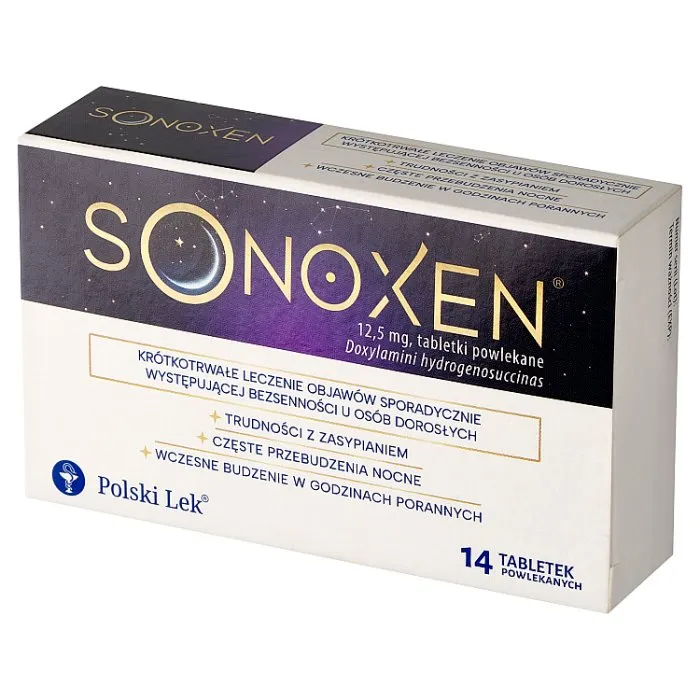
Table of Contents
Before using this medicine, carefully read the leaflet and familiarize yourself with the
"Patient Information Leaflet" included in the medicine package. To use the medicine safely,
you must answer all questions contained in the information leaflet. This medicine is intended only for adult patients.
Package leaflet: information for the user
Sonoxen, 12.5 mg, coated tablets
Doxylamine hydrogen succinate
Please read this leaflet carefully before taking the medicine, as it contains important information for the patient.
This medicine should always be taken exactly as described in this patient leaflet or as directed by a doctor or pharmacist.
- Keep this leaflet for future reference.
- If you need advice or further information, please consult your pharmacist.
- If you experience any adverse reactions, including any not listed in this leaflet, inform your doctor or pharmacist. See section 4.
- If there is no improvement after 7 days, or if you feel worse, you should contact your doctor.
Leaflet contents:
- What Sonoxen is and what it is used for
- Important information before taking Sonoxen
- How to take Sonoxen
- Possible side effects
- How to store Sonoxen
- Contents of the package and other information
1. What Sonoxen is and what it is used for
Sonoxen is a medicine containing the active substance doxylamine hydrogen succinate. Doxylamine belongs to a group of medicines called antihistamines with sedative and calming effects.
The medicine is indicated for short-term, symptomatic treatment of occasional insomnia in adults aged over 18 years, particularly in cases of: difficulty falling asleep, frequent awakenings during the night, or early morning awakening.
Sleep disturbances may negatively affect physiological processes and lead to reduced psycho-physical performance. Insomnia is diagnosed, among other criteria, when: the time to fall asleep exceeds half an hour, total awakenings during the night last longer than half an hour, such disturbances occur at least three nights per week, and poor sleep quality causes fatigue or reduced daytime psycho-physical performance.
Transient sleep disturbances usually last for several days and are associated with certain factors such as illness, anxiety, noise, inappropriate ambient temperature, or time zone changes.
Medication should not be the primary method of treating sleep disorders and should be limited to short-term use only. Persistent poor sleep quality may be a symptom of mental or physical disorders requiring different treatment approaches, which should be evaluated by a doctor. Consultation with a doctor is also necessary if symptoms other than insomnia are present. Failure to properly diagnose and treat the underlying cause of sleep disturbances may pose a health risk. Treating the underlying condition causing sleep disturbances is essential for achieving lasting improvement in sleep quality. This medicine must not be used to treat chronic sleep disorders.
The treatment period should be as short as possible. Treatment usually lasts from several days up to 1 week. This medicine must not be used for longer than 7 days without consulting a doctor.
If there is no improvement after 7 days, or if you feel worse, you should consult your doctor.
2. Important information before taking Sonoxen
When not to take Sonoxen
- If the patient is allergic to the active substance or to any of the other ingredients of this medicine (listed in section 6).
- If the patient is allergic to other antihistamines (antiallergy medicines).
- If the patient is breastfeeding.
- If the patient has respiratory disorders such as asthma, chronic bronchitis (persistent cough associated with sputum and mucus production), or emphysema (difficulty breathing).
- If the patient has glaucoma (increased pressure in the eye).
- If the patient has benign prostatic hyperplasia (enlarged prostate gland), difficulty in passing urine from the bladder (urinary tract disorder), or has problems urinating.
- If the patient has peptic ulcer disease or duodenal erosion, or pyloroduodenal stenosis (difficulty in food passage from the stomach to the intestine).
- If the patient is taking monoamine oxidase inhibitors (medicines used in depression and Parkinson's disease).
- If the patient is taking certain medicines, e.g. antidepressants, certain antibiotics, cardiac medicines such as those used to treat heart rhythm disorders, certain antiviral and antifungal medicines, certain lipid-lowering (fat-reducing) medicines in blood, or quinidine (a medicine used to treat seizures).
- If the patient has severe kidney or liver function impairment.
Warnings and precautions
Before starting treatment with Sonoxen, discuss it with your doctor or pharmacist.
- The patient must inform the doctor before starting treatment if any of the following conditions are present:
- mild or moderate liver or kidney dysfunction, as this may require dose adjustment;
- epilepsy (antihistamines may sometimes cause hyperexcitability and thereby lower the seizure threshold);
- QT interval prolongation (a heart condition leading to sudden changes in heart rate in response to exertion or stress);
- low blood potassium levels or other electrolyte imbalances;
- heart diseases and high blood pressure.
- If daytime drowsiness occurs, the patient is advised to reduce the dose or take the dose earlier, ensuring at least an 8-hour interval between taking the medicine and waking up.
- When taking other medicines that may be harmful to hearing, such as:
carboplatin or cisplatin (medicines used in cancer treatment), chloroquine (a medicine used
in the treatment or prevention of malaria), and certain antibiotics (used to treat infections) such as erythromycin or parenteral aminoglycosides, Sonoxen may
mask the harmful effects of these medicines. Therefore, regular hearing tests should be performed.
- Sonoxen may worsen symptoms of dehydration and heat stroke caused by reduced sweating, especially during hot weather.
- Do not consume alcohol during treatment.
- Patients over 65 years of age may be more susceptible to adverse effects. Therefore, close monitoring of treatment effects is recommended (see section 4).
- Doksylamine should not be taken with grapefruit or grapefruit juice.
- If the patient is taking medicines such as: phenytoin, digoxin, warfarin, lithium, aminoglycosides, or vancomycin, doksylamine should be avoided, as it may lead to acute poisoning.
Do not take Sonoxen for longer than 7 days without consulting a doctor.
Children and adolescents
Sonoxen is not recommended for use in children and adolescents under 18 years of age.
Sonoxen and other medicines
Tell your doctor or pharmacist about all medicines you are currently taking or have recently taken, as well as any medicines you plan to take.
Do not take Sonoxen while using the following medicines:
- monoamine oxidase inhibitors (e.g. medicines used to treat depression, Parkinson's disease or other conditions, such as: moclobemide, phenelzine, tranylcypromine, isocarboxazid, linezolid, methylene blue, procarbazine, rasagiline, and selegiline);
- medicines such as: medicines used to treat heart rhythm disorders (amiodarone, quinidine), certain macrolide antibiotics (clarithromycin, erythromycin, telithromycin), certain lipid-lowering (fat-reducing) medicines in blood (gemfibrozil), certain antidepressants (e.g. fluoxetine, fluvoxamine, paroxetine, nefazodone, bupropion), antiviral protease inhibitors (indinavir, ritonavir, telaprevir), and antifungal azole compounds (fluconazole, ketoconazole, itraconazole, voriconazole, terbinafine).
Patients should avoid using Sonoxen while taking the following medicines,
as this may intensify their effects or lead to adverse reactions:
- adrenaline (used to treat low blood pressure);
- certain antimalarial medicines or certain antihistamines;
- certain diuretics (medicines increasing urine excretion);
- alcohol and other medicines that depress the central nervous system, e.g. barbiturates, sleeping pills, sedatives, other medicines used for insomnia or anxiety disorders (alprazolam, diazepam, zolpidem), opioid analgesics (codeine), psychotropic medicines (chlorpromazine, risperidone, amitriptyline, trazodone), or procarbazine;
- antihypertensive medicines (used to treat high blood pressure) acting on the central nervous system, such as guanabenz, clonidine, or alpha-methyldopa;
- other medicines from the group of anticholinergics, such as: antipsychotics (used to treat mental disorders), medicines used to treat spastic conditions (e.g. atropine, belladonna alkaloids), or disopyramide (used to treat certain heart conditions);
- antihistamines applied to the skin (diphenhydramine in cream, ointment, or aerosol) and scopolamine;
- medicines with a narrow therapeutic index (small difference between therapeutic and toxic dose), such as phenytoin, digoxin, warfarin, lithium, aminoglycosides, vancomycin.
Effect on laboratory test results
Doxylamine may affect the results of skin allergy tests. Patients are advised to discontinue
Sonoxen at least three days before undergoing such tests.
Sonoxen with food, drink, and alcohol
Do not drink alcohol while taking Sonoxen.
It is not known whether grapefruit juice inhibits the metabolism of doxylamine. Patients should avoid consuming
grapefruit or grapefruit juice while taking doxylamine.
See section 3. How to take Sonoxen.
Pregnancy, breastfeeding, and fertility
If the patient is pregnant, breastfeeding, suspects she may be pregnant, or is planning to have a
child, she should consult her doctor or pharmacist before using this medicine.
Sonoxen must not be used during pregnancy.
Due to the risk associated with the use of antihistamines in young children, Sonoxen must not be used
by breastfeeding women.
There is no available data on the effect of Sonoxen on fertility.
Driving and operating machinery
Sonoxen has a marked effect on the ability to drive and operate machinery,
as it causes drowsiness. During the first few days of treatment, until it is established
how Sonoxen affects the patient, driving and operating machinery should be avoided.
Sonoxen contains cochineal red (E 124) and orange yellow (E 110)
This medicine may cause allergic reactions.
3. How to take Sonoxen
This medicine should always be taken exactly as described in this patient leaflet or as directed by
your doctor or pharmacist. If in doubt, consult your doctor or pharmacist.
Adults (aged over 18 years)
The recommended dose is 1 to 2 tablets (12.5 mg to 25 mg) once daily, taken 30 minutes before bedtime.
If drowsiness during the day occurs, it is recommended to reduce the dose to 1 tablet (12.5 mg) or
take the dose earlier to ensure at least an 8-hour interval between taking the medicine and waking up.
Do not take more than 2 tablets (25 mg) per day.
Use in elderly patients
Sonoxen is not recommended for use in patients over 65 years of age. Adults over 65 are more likely
to have other medical conditions associated with sleep disturbances; therefore, appropriate therapy
requires medical evaluation.
Use in patients with hepatic or renal impairment
Sonoxen is contraindicated in patients with severe hepatic or renal dysfunction.
In patients with moderate or mild liver and/or kidney disease, consult your doctor before taking the
medicine, who will decide on appropriate treatment. In patients with mild renal or hepatic impairment,
a reduced daily dose of 12.5 mg is recommended. It is also advisable to take the dose earlier to avoid
daytime drowsiness.
Use in children and adolescents
Sonoxen is not indicated for use in children and adolescents under 18 years of age and should not be
used in this patient group.
Route and method of administration
Oral use.
Take tablets 30 minutes before going to bed, with an adequate amount of fluid (preferably water).
Sonoxen may be taken with or without food.
Duration of treatment
Treatment should be as short as possible. Treatment usually lasts from a few days to one week.
Do not use the medicine for longer than 7 days without consulting a doctor.
Overdose of Sonoxen
If you take more Sonoxen than recommended, contact your doctor immediately.
Symptoms of overdose include: drowsiness, central nervous system depression or stimulation,
anticholinergic effects (dilated pupils, fever, dry mouth, reduced intestinal smooth muscle tone),
hot flushes, increased or altered heart rate, elevated blood pressure, nausea, vomiting, excitation,
ataxia, dizziness, irritability, sedation, disorientation, and hallucinations.
Severe poisoning may lead to delirium, psychotic disturbances, hypotension, seizures, reduced
respiratory rate, loss of consciousness, coma, and may be life-threatening.
Severe complications include rhabdomyolysis (muscle breakdown), leading to kidney failure.
There is no specific antidote for antihistamine overdose. If necessary, symptomatic and supportive
treatment should be administered. The doctor will decide whether to induce vomiting, perform
gastric lavage, or prescribe medications to raise blood pressure.
Missed dose of Sonoxen
Do not take a double dose to make up for a missed dose.
Take the next dose at the usual time the following day.
Stopping Sonoxen
If you have any further questions about the use of this medicine, consult your doctor or pharmacist.
4. Possible adverse reactions
Like any medicine, this medicine can cause adverse reactions, although not everyone experiences them.
Adverse reactions caused by doxylamine are generally mild and transient, and occur more frequently
during the first few days of treatment.
Very common adverse reactions (occurring in more than 1 in 10 people): drowsiness.
Common adverse reactions (occurring in less than 1 in 10 people): symptoms such as: dry mouth,
constipation, blurred vision, urinary retention, increased bronchial mucus secretion, dizziness,
lightheadedness, headache, upper abdominal pain, fatigue, insomnia, nervousness.
Uncommon adverse reactions (occurring in less than 1 in 100 people): asthenia (feeling of tiredness),
peripheral edema (hands and feet), nausea, vomiting, diarrhoea, skin rash, tinnitus (ringing in the ears),
orthostatic hypotension (low blood pressure caused by changes in body position), diplopia (double vision),
dyspepsia (indigestion), feeling of relaxation, nightmares and dyspnoea (shortness of breath).
Rare adverse reactions (occurring in less than 1 in 1000 people): excitation (especially in elderly patients),
tremor, convulsions or hematological disorders such as: haemolytic anaemia, thrombocytopenia, leukopenia or agranulocytosis (reduction in the number of certain types of blood cells).
Adverse reactions with unknown frequency (cannot be estimated from available data): malaise.
Other adverse reactions usually associated with antihistamine medicines, which have not been observed
with doxylamine, include: cardiac arrhythmias (changes in heart rate), palpitations, biliary reflux, liver
function disorders (cholestatic jaundice), QT interval prolongation in ECG (heart disease), loss of appetite,
increased appetite, muscle pain, coordination disorders, extrapyramidal disorders (movement disorders),
paraesthesia (sensory disturbances), psychomotor disturbances (sensory/motor coordination), depression,
decreased bronchial mucus secretion, alopecia, allergic dermatitis, excessive sweating, photosensitivity, or
hypotension (low blood pressure).
The severity and frequency of adverse reactions can be controlled by reducing the daily dose.
Adults over the age of 65 are more susceptible to adverse reactions, as they may have other medical
conditions or be taking other medicines concurrently. These individuals are also at increased risk of falls.
Reporting of adverse reactions
If any adverse reactions occur, including any not listed in this leaflet, inform your doctor or pharmacist.
Adverse reactions can be reported directly to the Department of Monitoring Adverse Drug Reactions
of the Office for Registration of Medicinal Products, Medical Devices and Biocidal Products
Al. Jerozolimskie 181C
02-222 Warsaw
Tel.: + 48 22 49 21 301
Fax: + 48 22 49 21 309
Website: https://smz.ezdrowie.gov.pl
Adverse reactions can also be reported to the marketing authorization holder.
Reporting adverse reactions helps to provide more information on the safety of the medicine.
5. How to store the medicine Sonoxen
Keep this medicine out of sight and reach of children.
Do not use this medicine after the expiry date stated on the carton and blister pack after "EXP".
The expiry date refers to the last day of the stated month.
This medicine does not require any special storage conditions.
Medicines must not be disposed of via wastewater or household waste. Ask your pharmacist how to dispose of medicines no longer required. These measures will help protect the environment.
6. Contents of the pack and other information
What Sonoxen contains
-
The active substance is doxylamine succinate. Each coated tablet contains 12.5 mg of doxylamine succinate.
-
The other ingredients are:
Core excipients:
Calcium hydrogen phosphate dihydrate
Microcrystalline cellulose
Sodium carboxymethyl starch (Type A)
Colloidal anhydrous silica
Magnesium stearateCoating excipients:
Hypromellose
Polidextrose
Talc
Titanium dioxide (E 171)
Maltodextrin
Medium-chain triglycerides
Carmine lake (E 124)
Orange yellow lake (E 110)
Quinoline yellow lake (E 104)
What Sonoxen looks like and contents of the pack
Sonoxen is a red, round coated tablet, 7.5 mm in diameter, with a score mark on one side.
The score mark is not a break line and serves only a decorative function.
Aluminium/PVC/PCTFE blister pack in a cardboard box.
The pack contains 7, 14 or 20 tablets.
Not all pack sizes may be marketed.
Marketing Authorisation Holder and Manufacturer
Marketing Authorisation Holder
"Polski Lek – Dystrybucja" Sp. z o.o.
Chopina Street 10
34-100 Wadowice
Tel.: +48 33 870 83 01
e-mail: [email protected]
Manufacturer
Laboratorios Alcalá Farma, S.L.
Avenida de Madrid, 82, Alcalá de Henares,
28802 Madrid
Spain