Solderol
Poland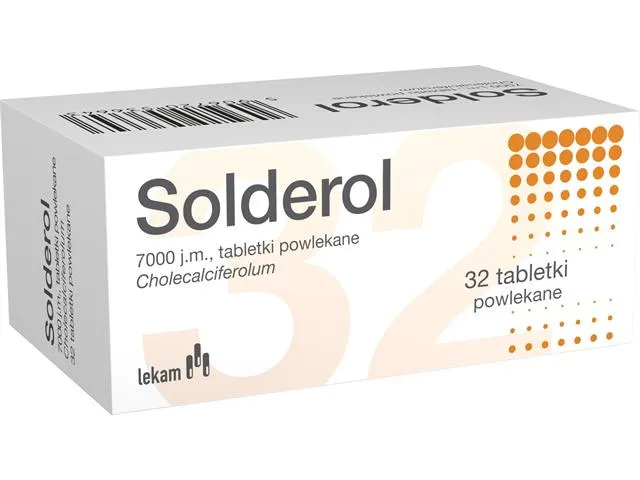
Table of Contents
Package leaflet: Information for the user
Solderol, 7000 IU, coated tablets
Solderol, 30,000 IU, coated tablets
Cholecalciferolum (Vitamin D )
Please read this leaflet carefully before taking this medicine, as it contains important information
for the patient.
- Keep this leaflet, as you may need to read it again.
- If you have any questions, please consult your doctor or pharmacist.
- This medicine has been prescribed for a specific individual. Do not share it with others. This medicine may harm other people, even if their symptoms are the same.
- If the patient experiences any adverse reactions, including any adverse reactions not listed in this leaflet, inform your doctor or pharmacist.
Contents of the leaflet
- What Solderol is and what it is used for
- Important information before taking Solderol
- How to take Solderol
- Possible side effects
- How to store Solderol
- Contents of the pack and other information
1. What Solderol is and what it is used for
The active substance in Solderol is vitamin D .
Vitamin D helps the body absorb calcium, promotes bone formation, and reduces the concentration of parathyroid hormone (PTH).
This medicine is indicated:
- in certain bone conditions such as decreased bone mass (osteoporosis), when administered together with other medicines;
- in the prevention or treatment of vitamin D deficiency. Vitamin D deficiency may occur when diet or lifestyle do not provide sufficient vitamin D, or when the body requires higher amounts of vitamin D (e.g. during pregnancy).
Solderol is intended for use in adults, elderly individuals, and adolescents.
2. Important information before taking Solderol
When not to take Solderol:
- if the patient is allergic to vitamin D or to any of the other ingredients of this medicine (listed in section 6),
- if there is a high concentration of calcium in the blood or urine,
- if kidney stones or calcifications in the kidneys are present,
- if there is severe renal insufficiency,
- if the patient is already taking additional vitamin D (e.g. in multivitamin preparations or dietary supplements containing vitamin D).
Warnings and precautions
Inform your doctor if:
- the patient has a tendency to develop kidney stones,
- the patient suffers from cancer or another disease affecting the bones,
- the patient has a disorder of parathyroid hormone balance (pseudohypoparathyroidism).
If the patient has any of the following conditions, the doctor will monitor the levels of
calcium or phosphates in the blood, or calcium in the urine:
- during long-term treatment with this medicine,
- if the patient has impaired kidney function,
- if the patient has sarcoidosis, an immune system disorder that may affect the liver, lungs, skin, or lymph nodes.
Solderol and other medicines
Tell your doctor about all medicines the patient is currently taking or has recently taken,
as well as any medicines the patient plans to take, including those available without a prescription.
In particular, inform your doctor if the patient is taking the following medicines:
- diuretics (water tablets) – calcium levels in the blood will be monitored regularly,
- corticosteroids ("steroids", e.g. prednisolone, dexamethasone) – a higher dose of vitamin D may be required,
- cholestyramine (a cholesterol-lowering medicine) or laxatives (e.g. liquid paraffin) – these medicines reduce the absorption of vitamin D,
- cardiac glycosides (heart medications) – the patient should be monitored by a doctor who will check the ECG and calcium levels in the blood,
- anticonvulsants (used to treat epilepsy), sedatives (e.g. hydantoin, barbiturates) or primidone – these medicines reduce the effect of vitamin D,
- calcitonin, etidronate, gallium nitrate, pamidronate or plicamycin – these medicines reduce calcium levels in the blood,
- calcium-containing products in high doses: may increase the risk of high calcium levels in the blood,
- magnesium-containing products (e.g. antacids) – should not be used during vitamin D treatment due to the risk of high magnesium levels in the blood,
- products containing high doses of phosphorus – may increase the risk of high phosphate levels in the blood.
Pregnancy and breastfeeding
If the patient is pregnant or breastfeeding, suspects she may be pregnant, or is planning to become pregnant,
she should consult her doctor before using this medicine.
If the patient is breastfeeding, the doctor will monitor calcium or phosphate levels in the blood or calcium levels in the urine.
Driving and operating machinery
It is not known whether this medicine has any effect on the ability to drive or operate machinery.
Solderol contains lactose and sucrose
If the patient has previously been diagnosed with an intolerance to certain sugars, the patient should consult their doctor before taking this medicine.
3. How to take Solderol
This medicine should always be taken as directed by the physician. In case of doubt, consult
your doctor or pharmacist.
Taking Solderol with food and drink
Solderol may be taken with or without food.
Recommended dose
The dose of vitamin D will depend on the patient's vitamin D blood levels and response
to treatment.
Please note that Solderol 7000 IU and Solderol 30,000 IU contain amounts corresponding to
weekly and monthly doses of vitamin D, respectively.
Prevention of vitamin D deficiency (maintenance therapy):
- in adults and elderly patients: 800 to 1600 IU daily, or the equivalent weekly or monthly dose.
- in adults and elderly patients with osteoporosis: up to 2000 IU daily, or the equivalent weekly or monthly dose.
- Treatment of vitamin D deficiency in adults and elderly patients (initial dose): 800 to 4000 IU daily, or the equivalent weekly or monthly dose.
If the recommended dose cannot be achieved using Solderol, other available vitamin D (cholecalciferol) products with lower strengths (e.g. 800 IU and 1000 IU) should be used.
The appropriate dose of Solderol for the patient will be determined by the physician.
Patients with kidney function disorders
The physician may recommend regular blood and urine tests.
Use in children
Solderol is not intended for use in children under 12 years of age.
In adolescents (12–18 years of age):
- 800 IU daily, depending on disease severity and response to treatment. The medicine should be used only under medical supervision.
A dose of 800 IU can be achieved by using another available cholecalciferol-containing product.
If you take more Solderol than recommended
The following symptoms may occur: loss of appetite, excessive thirst, nausea, vomiting, constipation, abdominal pain, muscle weakness, fatigue, confusion, increased urination, bone pain, kidney dysfunction, and in severe cases, irregular heartbeat, coma, or even death.
If you have taken too many tablets, contact your doctor immediately or go to the nearest hospital emergency department. Take the medicine packaging and any unused tablets with you.
If you have any further questions about the use of this medicine, consult your doctor or pharmacist.
4. Possible adverse reactions
Like any medicine, this medicine may cause adverse reactions, although not everybody gets them.
You should stop taking Solderol and immediately contact a doctor if symptoms of a severe allergic reaction occur, such as:
- swelling of the face, lips, tongue or throat,
- difficulty swallowing,
- hives and breathing difficulties.
Uncommon adverse reactions (may occur in up to 1 in 100 people):
- too high a concentration of calcium in the blood (hypercalcaemia) – symptoms include nausea, vomiting, loss of appetite, constipation, stomach pain, bone pain, excessive thirst, frequent urination, muscle weakness, drowsiness and confusion,
- too high a concentration of calcium in the urine (hypercalciuria).
Rare adverse reactions (may occur in up to 1 in 1000 people):
- itching, rash and hives.
Reporting of adverse reactions
If any adverse reactions occur, including any adverse reactions not listed in this leaflet, inform a doctor or pharmacist. Adverse reactions can be reported directly to the Department of Monitoring Adverse Drug Reactions at the Office for Registration of Medicinal Products, Medical Devices and Biocidal Products
Al. Jerozolimskie 181C
02-222 Warsaw
Phone: +48 22 49 21 301
Fax: +48 22 49 21 309
Website: https://smz.ezdrowie.gov.pl
Adverse reactions can also be reported to the marketing authorisation holder.
Reporting adverse reactions helps provide more information on the safety of the medicine.
5. How to store the medicine Solderol
Keep the medicine out of sight and reach of children.
Blister packs: Store below 25°C.
To protect from light, store in the original packaging.
Do not use this medicine after the expiry date stated on the carton. The expiry date refers to the last day of the stated month.
Medicines must not be disposed of via wastewater or household waste. Ask your pharmacist how to dispose of medicines no longer required. This will help protect the environment.
6. Contents of the pack and other information
What Solderol contains
The active substance is cholecalciferol (vitamin D).
Solderol 7000 IU, coated tablets: each coated tablet contains 175 micrograms of cholecalciferol (equivalent to 7000 IU vitamin D).
Solderol 30,000 IU, coated tablets: each coated tablet contains 750 micrograms of cholecalciferol (equivalent to 30,000 IU vitamin D).
The other ingredients are:
- Tablet core: Cellactose 80 (monohydrate lactose and powdered cellulose (E460), modified maize starch, maize starch, sodium croscarmellose (E468), sucrose, colloidal anhydrous silica (E551), colloidal hydrated silica (E551), magnesium stearate (E572), sodium ascorbate (E301), medium-chain saturated triglycerides, all-rac-alpha-tocopherol (E307).
- Coating: Opadry II Yellow 85F 32659: polyvinyl alcohol (E1203), titanium dioxide (E171), macrogol, talc (E553b), quinoline yellow, lac (E104), yellow iron oxide (E172).
What Solderol looks like and contents of the pack
Solderol 7000 IU, coated tablets:
yellow, round, coated tablet with a diameter of 7.2 mm, smooth convex surface on both sides and the letter 'W' embossed on one side.
Pack sizes: 4, 8, 12 or 32 coated tablets in an opaque PVC/PVdC-Alu blister pack contained in a cardboard box.
Solderol 30,000 IU, coated tablets:
yellow, round, coated tablet with a diameter of 13.2 mm, smooth convex surface on both sides.
Pack sizes: 1, 2, 3, 4, 6, 8 or 12 coated tablets in an opaque PVC/PVdC-Alu blister pack contained in a cardboard box.
Not all pack sizes may be marketed.
Marketing Authorisation Holder
Przedsiębiorstwo Farmaceutyczne LEK-AM Sp. z o.o.
ul. Ostrzykowizna 14A
05-170 Zakroczym
Poland
tel.: +48 22 785 27 60
fax: +48 22 785 27 60 ext. 106
Manufacturer
Pharma Patent Kft.
Váci út 36-38. 4. em.,
1132 Budapest
Hungary
This medicinal product is authorised for sale in the Member States of the European Economic Area under the following names:
Netherlands: Cholespark 800 IE filmomhulde tabletten
Cholespark 1000 IE filmomhulde tabletten
Cholespark 7000 IE filmomhulde tabletten
Cholespark 30000 IE filmomhulde tabletten
Ireland: Colecalciferol 800 IU Film-coated Tablets
Colecalciferol 1000 IU Film-coated Tablets
Colecalciferol 7000 IU Film-coated Tablets
Colecalciferol 30000 IU Film-coated Tablets
Lithuania: Solfelix 800 TV plėvele dengtos tabletės
Solfelix 1 000 TV plėvele dengtos tabletės
Solfelix 7 000 TV plėvele dengtos tabletės
Solfelix 30 000 TV plėvele dengtos tabletės
Czech Republic: Vitamin D3 Axonia 1000 IU potahované tablety
Vitamin D3 Axonia 7000 IU potahované tablety
Vitamin D3 Axonia 30000 IU potahované tablety
Slovakia: Vitamin D3 Axonia 1000 IU filmom obalené tablety
Vitamin D3 Axonia 7000 IU filmom obalené tablety
Vitamin D3 Axonia 30000 IU filmom obalené tablety
United Kingdom: Colecalciferol 800 IU Film-coated Tablets
Colecalciferol 1000 IU Film-coated Tablets
Colecalciferol 7000 IU Film-coated Tablets
Colecalciferol 30000 IU Film-coated Tablets
Poland: Solderol, 7000 j.m., tabletki powlekane
Solderol, 30 000 j.m., tabletki powlekane