Sigrada
Poland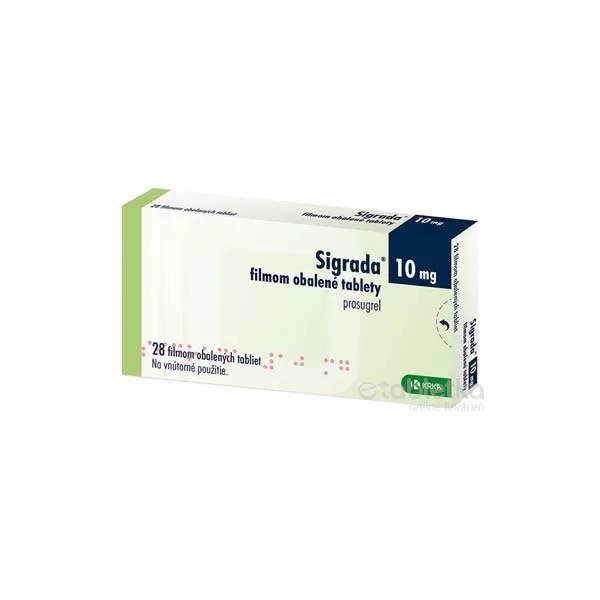
Table of Contents
Package leaflet: Information for the patient
Sigrada, 5 mg, film-coated tablets
Sigrada, 10 mg, film-coated tablets
Prasugrel
Please read all of this leaflet carefully before taking this medicine, because it contains
important information for you.
- Keep this leaflet. You may need to read it again.
- If you have any further questions, ask your doctor or pharmacist.
- This medicine has been prescribed for you only. Do not pass it on to others. It may harm them, even if their symptoms are the same as yours.
- If you experience any side effects, including any not listed in this leaflet, tell your doctor or pharmacist. See section 4.
Contents of the leaflet
- What Sigrada is and what it is used for
- What you need to know before you take Sigrada
- How to take Sigrada
- Possible side effects
- How to store Sigrada
- Contents of the pack and other information
1. What Sigrada is and what it is used for
Sigrada contains the active substance prasugrel and belongs to a group of medicines called antiplatelet medicines. Platelets are very small cells circulating in the blood. When a blood vessel is damaged, for example by a cut, platelets stick together and help form a blood clot. Platelets therefore play a key role in stopping bleeding. However, the formation of a blood clot inside an atherosclerotic (hardened) blood vessel, such as an artery, can be very dangerous, as it may block blood flow and lead to a heart attack (myocardial infarction), stroke, or death. The presence of a clot in the arteries supplying blood to the heart may reduce blood flow and cause unstable angina (worsening chest pain).
Sigrada works by inhibiting platelet aggregation, thereby reducing the risk of clot formation.
Sigrada has been prescribed by your doctor because you have had a heart attack or unstable angina, and you have previously undergone a procedure to open blocked arteries in your heart. You may have had a procedure during which one or more stents were placed to keep open a blocked or narrowed artery supplying blood to the heart. Sigrada reduces the risk of a subsequent heart attack, stroke, or death due to such events. Your doctor will also recommend that you take acetylsalicylic acid (e.g. aspirin), which is another antiplatelet medicine.
2. Important information before using Sigrada
When not to use Sigrada
-
if the patient is allergic to prasugrel or to any of the other ingredients of this medicine (listed in section 6). An allergic reaction may present as rash, itching,
swelling of the face, swelling of the lips or shortness of breath. If such symptoms occur,
immediately inform the doctor. -
if the patient currently has a medical condition causing bleeding, e.g. gastrointestinal bleeding.
-
if the patient has ever had a stroke or transient ischaemic attack (TIA).
-
if the patient has severe liver disease.
Warnings and precautions
Before starting treatment with Sigrada:
Before starting Sigrada, discuss this with your doctor.
If any of the situations listed below apply to the patient, they must inform their doctor before taking
Sigrada:
- If there is an increased risk of bleeding, such as:
- age 75 years or older. The treating doctor will recommend a daily dose of 5 mg, as the risk of bleeding is higher in patients over 75 years of age
- recent severe trauma
- recent surgical procedure (including dental surgery)
- recent or recurrent gastrointestinal bleeding (e.g. gastric ulcer or colon polyps)
- body weight less than 60 kg. If the patient weighs less than 60 kg, the treating doctor will recommend a daily dose of Sigrada of 5 mg
- moderate kidney or moderate liver disease
- use of certain medicines (see below “Sigrada and other medicines”)
- planned surgery (including dental procedures) within the next seven days. Due to increased risk of bleeding, the doctor may recommend temporarily discontinuing Sigrada.
- If the patient has previously experienced allergic reactions (hypersensitivity) to clopidogrel or other antiplatelet medicines, inform the doctor before starting Sigrada. If allergic reactions occur after taking Sigrada, such as: rash, itching, facial swelling, lip swelling or difficulty breathing, immediately inform the treating doctor.
While taking Sigrada:
Inform the treating doctor immediately if a medical condition called thrombotic thrombocytopenic purpura (TTP) occurs, which may present with symptoms such as: fever, skin bruising
which may appear as red pinpoint spots, with or without symptoms of extreme fatigue, confusion, or yellowing of the skin or eyes (jaundice) (see section 4 “Possible unwanted effects”).
Children and adolescents
Sigrada must not be used in children and adolescents under 18 years of age.
Sigrada and other medicines
Inform your doctor about all medicines currently taken or recently taken, as well as any medicines the patient plans to use, including those available without prescription, dietary supplements or herbal medicines. In particular, inform the doctor about use of clopidogrel (an antiplatelet medicine), warfarin (an anticoagulant) or "non-steroidal anti-inflammatory drugs" used to treat pain and fever (such as ibuprofen, naproxen, etoricoxib). Taking these medicines together with prasugrel may increase the risk of bleeding.
Inform the doctor if morphine or other opioids (used to treat severe pain) are being taken.
While taking Sigrada, only take medicines approved by your doctor.
Pregnancy and breastfeeding
If the patient is pregnant or breastfeeding, suspects she may be pregnant, or is planning to become pregnant, she should consult a doctor or pharmacist before using this medicine.
If the patient becomes pregnant or is trying to become pregnant while taking Sigrada, she should inform her treating doctor.
Sigrada may be used only after discussing with the doctor the potential benefits and risks to the unborn child.
Driving and operating machinery
It is unlikely that Sigrada will affect the ability to drive or operate machinery.
Sigrada contains lactose and sodium
If the patient has previously been diagnosed with intolerance to certain sugars, the patient should contact their doctor before taking this medicine.
Sigrada contains less than 1 mmol (23 mg) of sodium per tablet, meaning the medicine is considered "sodium-free".
3. How to use Sigrada
This medicine should always be taken exactly as prescribed by your doctor or pharmacist. If in doubt,
you should consult your doctor or pharmacist.
The recommended dose is 10 mg once daily. Treatment should be initiated with a single 60 mg dose.
If the patient weighs less than 60 kg or is over 75 years of age, the daily dose of Sigrada is 5 mg.
Your doctor will advise on the appropriate dose of acetylsalicylic acid (usually between 75 mg and 325 mg once daily).
Sigrada can be taken with or without food. The dose should be taken at the same time each day. Do not break or crush the tablet.
It is very important to inform your doctor, dentist, and pharmacist that you are taking Sigrada.
Taking more Sigrada than recommended
Contact your doctor or go to hospital immediately due to increased risk of bleeding. Show the doctor the Sigrada packaging.
If you forget to take Sigrada
Do not take a double dose to make up for a missed dose.
If you miss a dose of Sigrada, take it as soon as possible. If you forget to take the dose for the entire day, take the next dose of Sigrada the following day at the usual time. Do not take two doses on the same day.
Stopping Sigrada
Do not stop taking Sigrada without consulting your doctor. Stopping Sigrada too soon may increase the risk of heart attack.
If you have any further questions about the use of this medicine, consult your doctor or pharmacist.
4. Possible adverse reactions
Like all medicines, this medicine can cause adverse reactions, although not everybody gets them.
Contact your doctor immediately if you experience:
- sudden numbness or weakness of the arm, leg, or face, especially if it affects one side of the body,
- sudden confusion, difficulty speaking or understanding others,
- sudden difficulty moving, loss of balance or coordination,
- sudden dizziness or sudden severe headaches of unknown cause.
All of the above symptoms may be signs of stroke. Stroke is an uncommon adverse reaction in patients treated with Sigrada who have never previously had a stroke or transient ischaemic attack.
You should also contact your doctor immediately if you experience:
- fever and bruising under the skin, which may appear as small red pinpoint spots, with or without symptoms of extreme fatigue, confusion, yellowing of the skin or eyes (jaundice) (see section 2 "Important information before taking Sigrada"),
- rash, itching, or swelling of the face, lips or tongue, or difficulty breathing. These may be symptoms of a severe allergic reaction (see section 2 "Important information before taking Sigrada").
Contact your doctor promptly if you experience:
- blood in the urine,
- bleeding from the rectum, blood in the stool, or black stools,
- uncontrolled bleeding, e.g. from a cut.
All of the above symptoms may indicate bleeding, which is the most commonly occurring adverse reaction during treatment with Sigrada. Severe bleeding, although uncommon, may be life-threatening.
Common adverse reactions (may occur in up to 1 in 10 people)
- bleeding from the stomach or intestines,
- bleeding at injection sites,
- nosebleeds,
- rash,
- small red bruises on the skin (petechiae),
- blood in the urine,
- haematoma (subcutaneous or intramuscular bleeding causing swelling),
- low haemoglobin levels or red blood cell count (anaemia),
- cyanosis.
Uncommon adverse reactions (may occur in up to 1 in 100 people)
- allergic reaction (rash, itching, swelling of lips or tongue, or difficulty breathing),
- spontaneous bleeding into the eye, rectum, gums, or within the abdominal cavity around internal organs,
- bleeding after surgical procedures,
- coughing up blood-stained sputum,
- blood in the stool.
Rare adverse reactions (may occur in up to 1 in 1000 people)
- low platelet count,
- subcutaneous haematoma (subcutaneous bleeding causing swelling).
Reporting of adverse reactions
If any adverse reactions occur, including any possible adverse reactions not listed in this leaflet, inform your doctor, pharmacist, or nurse.
Adverse reactions can be reported directly to the Department of Monitoring Adverse Drug Reactions at the Office for Registration of Medicinal Products, Medical Devices and Biocidal Products:
Al. Jerozolimskie 181C, 02-222 Warsaw
Tel.: +48 22 49 21 301
Fax: +48 22 49 21 309
Website: https://smz.ezdrowie.gov.pl
Adverse reactions can also be reported to the marketing authorisation holder.
Reporting adverse reactions helps to provide more information on the safety of the medicine.
5. How to store Sigrada
Keep this medicine out of sight and reach of children.
Do not use this medicine after the expiry date stated on the carton after EXP.
The expiry date refers to the last day of the stated month.
Do not store above 30ºC.
Store in the original packaging to protect from moisture.
Medicines must not be disposed of via wastewater or household waste. Ask your pharmacist how to dispose of medicines no longer required. Such measures help protect the environment.
6. Contents of the packaging and other information
What Sigrada contains
The active substance is prasugrel. Each coated tablet contains 5 mg or 10 mg of prasugrel.
The other ingredients are: microcrystalline cellulose, macrogol 4000, poloxamer 188, fumaric acid – for pH adjustment, sodium croscarmellose, colloidal silicon dioxide, mannitol (E 421), magnesium stearate in the tablet core, as well as hypromellose 15 cP, lactose monohydrate, titanium dioxide (E 171), triacetin, iron oxide yellow (E 172) – only in 5 mg coated tablets, iron oxide red (E 172) – only in 10 mg coated tablets, in the tablet coating. See section 2 "Sigrada contains lactose and sodium".
What Sigrada looks like and contents of the pack
5 mg, coated tablets (tablets)
Light brownish-yellow, oval, biconvex coated tablets, 8.5 mm x 4.5 mm in size.
10 mg, coated tablets (tablets)
Pink, oval, slightly biconvex coated tablets, 10.5 mm x 5.5 mm in size.
Sigrada is available in packs containing 28 coated tablets in a blister.
Blister (OPA/Aluminium/PE+desiccant/Aluminium/PE), in a cardboard box.
Marketing Authorisation Holder and Manufacturer
KRKA, d.d., Novo mesto, Šmarješka cesta 6, 8501 Novo mesto, Slovenia
For further information about this medicinal product, please contact the local representative of the Marketing Authorisation Holder:
KRKA-POLSKA Sp. z o.o.
Równoległa Street 5
02-235 Warsaw, Poland
Telephone: +48 22 573 75 00