Septolete junior
Poland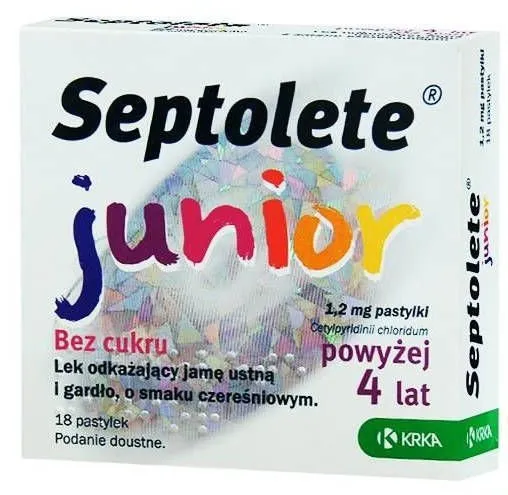
Table of Contents
Package leaflet: Information for the patient
Septolete Junior, 1.2 mg, tablets
Cetylpyridinium chloride
Cherry-flavoured tablets
Please read the entire leaflet carefully before using the medicine, as it contains
important information for the patient.
This medicine should always be used according to the instructions provided in the patient leaflet or as directed by a physician.
- Keep this leaflet for future reference.
- Consult your pharmacist if you need advice or further information.
- If any adverse reactions occur, including any possible adverse reactions not listed in this leaflet, inform your doctor or pharmacist.
- If there is no improvement after 3 days of treatment, or if the patient feels worse, consult a doctor.
Table of contents of the leaflet:
- What is Septolete Junior and what is it used for
- Important information before using Septolete Junior
- How to use Septolete Junior
- Possible side effects
- How to store Septolete Junior
- Contents of the pack and other information
1. What is Septolete Junior and what is it used for
Septolete Junior acts locally as an antiseptic. It contains an antiseptic agent – cetylpyridinium chloride – which has bactericidal properties. It also acts against certain viruses and fungi. The tablets disinfect the oral cavity and throat, thereby relieving inflammatory conditions of the mouth and throat. Due to its good solubility, cetylpyridinium chloride effectively penetrates hard-to-reach areas of the mucous membranes of the oral cavity and throat, inhibiting bacterial growth in these regions.
Septolete Junior tablets have a cherry flavour. They are sugar-free.
Indications
Septolete Junior is recommended for local treatment of mild infections of the mouth and throat (pharyngitis, laryngitis, early stage tonsillitis).
If there is no improvement after 3 days of treatment, or if the patient feels worse, consult a doctor.
2. Important information before using Septolete Junior
When not to use Septolete Junior
- if the patient is hypersensitive (allergic) to cetylpyridinium chloride or any of the other ingredients of this medicine (listed in section 6).
Warnings and precautions
Exercise particular caution when using Septolete Junior in the following cases:
- severe infections associated with high fever, headache, and vomiting – if symptoms worsen or do not improve within 3 days, medical advice should be sought;
- diabetes – patients should be aware that each tablet contains approximately 1 g of maltitol; due to its slow hydrolysis and gradual absorption from the gastrointestinal tract, maltitol affects blood glucose concentration only to a small extent.
Do not use in case of oral wounds or erosions, as cetylpyridinium chloride
slows down the wound healing process.
Doses higher than recommended should not be used.
Use of Septolete Junior is not recommended in children under 4 years of age.
Other medicines and Septolete Junior
Inform your doctor about all medicines you are currently taking, including those
available without a prescription.
Use of Septolete Junior with food and drink
Do not take the medicine immediately before or during meals, and avoid taking it simultaneously with milk.
Pregnancy and breastfeeding
If a woman is pregnant, suspects she may be pregnant, plans to become pregnant, or is breastfeeding,
she should consult a doctor or pharmacist before using this medicine.
Caution is advised when using this medicine during pregnancy.
Caution is advised when using this medicine during breastfeeding.
Driving and operating machinery
There is no data available on the effect of Septolete Junior on the ability to drive or
operate machinery.
Important information about certain ingredients of Septolete Junior
The tablets contain a natural colouring agent and may therefore gradually fade in colour when exposed to light.
The tablets contain sugar alcohols (maltitol, mannitol), which in large amounts may cause diarrhoea.
Glycerol in large amounts may cause headache and gastrointestinal disturbances.
3. How to use Septolete Junior
This medicine should always be used as described in the patient leaflet or according to the doctor's instructions.
If in doubt, consult a doctor or pharmacist.
The usual dose of Septolete Junior for adults and children over 12 years of age is 8 pastilles per day.
One pastille should be sucked every 2 to 3 hours.
For children over 4 years of age, up to 4 pastilles per day are recommended, and for children aged 10 to 12 years, up to 6 pastilles per day. One pastille should be sucked every 3 to 4 hours.
This medicine should not be taken immediately before or during meals.
If you feel that the effect of Septolete Junior is too strong or too weak, consult a doctor or pharmacist.
In case of an overdose of Septolete Junior
Due to the small amount of active substance in one pastille, the possibility of overdosing is very low.
Taking a larger number of pastilles may cause gastrointestinal disturbances such as nausea, vomiting, and diarrhea.
In such a case, discontinue use of the medicine, drink plenty of water or milk, and contact a doctor or pharmacist.
If a dose of Septolete Junior is missed
Do not take a double dose to make up for the missed dose.
4. Possible adverse effects
Like all medicines, Septolete Junior may cause adverse effects, although not everyone will experience them.
Gastrointestinal disturbances such as nausea and diarrhoea may rarely occur, especially when the medicine is used in doses exceeding the recommended ones.
Very rarely, hypersensitivity reactions such as irritation and rash may occur.
Reporting of adverse effects
If any adverse effects occur, including any not listed in this leaflet, inform your doctor or pharmacist. Adverse effects can be reported directly to the Department of Monitoring Adverse Drug Reactions of the Office for Registration of Medicinal Products, Medical Devices and Biocidal Products, Al. Jerozolimskie 181C, 02-222 Warsaw, tel.: + 48 22 49 21 301, fax: + 48 22 49 21 309, e-mail: [email protected]
Adverse effects can also be reported to the marketing authorisation holder.
Reporting adverse effects helps to provide more information on the safety of the medicine.
5. How to store Septolete Junior
Keep the medicine out of sight and reach of children.
Store below 25°C in the original packaging. Protect from light and moisture.
Do not use this medicine after the expiry date stated on the carton after EXP.
The expiry date refers to the last day of the specified month.
Medicines must not be disposed of via wastewater or household waste. Ask your pharmacist what to do with medicines no longer required. This will help protect the environment.
6. Contents of the pack and other information
What Septolete Junior contains
- The active substance is cetylpyridinium chloride. Each pastille contains 1.2 mg of cetylpyridinium chloride.
- The other ingredients are: maltitol liquid (dry mass), maltitol, mannitol, levomenthol, lemon oil, wild cherry flavour, natural red colour (Cochineal, E 120), glycerol, castor oil, colloidal anhydrous silica, magnesium stearate, titanium dioxide (E 171), povidone, Capol 600.
What Septolete Junior looks like and contents of the pack
Violet, round, slightly convex pastilles with a cherry flavour.
Pack: 18 pastilles in blisters, in a cardboard box.
Marketing Authorisation Holder and Manufacturer:
KRKA, d.d., Novo mesto, Šmarješka cesta 6, 8501 Novo mesto, Slovenia
For further information, please contact:
KRKA-POLSKA Sp. z o.o.,
Równoległa 5, 02-235
Warsaw
tel: (22) 57 37 500