Rymphysia
PolandTable of Contents
- Package leaflet: Information for the user
- 1. What Rymphysia is and what it is used for
- 2. Important information before using Rymphysia
- 3. How to use Rymphysia
- 4. Possible side effects
- 5. How to store Rymphysia
- 6. Contents of the pack and other information
- Information intended for healthcare professionals and trained caregivers
Package leaflet: Information for the user
Rymphysia, 500 mg, powder and solvent for solution for infusion
Rymphysia, 1000 mg, powder and solvent for solution for infusion
human alpha1-proteinase inhibitor
This medicinal product will be subject to additional monitoring. This will allow for rapid
identification of new safety information. Users of this medicine can also help by
reporting any adverse reactions that occur after administration. For information on how to report
adverse reactions – see section 4.
Please read all of this leaflet carefully before using this medicine, as it contains
important information for the patient.
- Keep this leaflet, as you may need to read it again.
- If you have any further questions, please consult your doctor or healthcare professional.
- This medicine has been prescribed for a specific individual. Do not pass it on to others. The medicine may harm another person, even if their symptoms are similar.
- If any adverse effects occur in the patient, including any adverse effects not listed in this leaflet, please inform your doctor or another healthcare professional. See section 4.
Contents of the leaflet
- What Rymphysia is and what it is used for
- Important information before using Rymphysia
- How to use Rymphysia
- Possible adverse reactions
- How to store Rymphysia
- Contents of the pack and other information
1. What Rymphysia is and what it is used for
What Rymphysia is
This medicine contains the active substance called "human alpha1-proteinase inhibitor", which is a normal component of blood and is present in the lungs. Its main function in the lungs is to protect lung tissue by inhibiting the activity of an enzyme called neutrophil elastase. Neutrophil elastase may cause damage if its activity is not controlled (for example, if the patient has alpha1-proteinase inhibitor deficiency).
Why Rymphysia is used
This medicine is used in adults diagnosed with severe alpha1-proteinase inhibitor deficiency (also known as alpha1-antitrypsin deficiency) who have developed a lung disease called emphysema. Emphysema occurs when the lack of alpha1-proteinase inhibitor leads to a condition in which neutrophil elastase is not properly controlled, causing damage to the small air sacs in the lungs through which oxygen passes into the body. Due to this damage, the lungs do not function properly.
Regular administration of this medicine increases the concentration of alpha1-proteinase inhibitor in the blood and lungs, thereby protecting the lungs by limiting the activity of neutrophil elastase and consequently slowing the progression of emphysema. Improvement of existing lung damage should not be expected.
2. Important information before using Rymphysia
When not to use Rymphysia
- if the patient is allergic to "human alpha1-proteinase inhibitor" or any of the other components of this medicine (listed in section 6),
- if the patient has been diagnosed with a deficiency of proteins called immunoglobulin A (IgA) in the blood and has antibodies against these immunoglobulins.
If any of the above apply to the patient, Rymphysia must not be used.
Warnings and precautions
Before starting treatment with Rymphysia, discuss this with your doctor or another healthcare professional.
Information about allergic reactions
The patient may be allergic to Rymphysia, even if they have previously received similar medicines and tolerated them well.
- In some cases, a severe allergic reaction may occur.
- The doctor will inform the patient about the symptoms of allergic reactions (for example, chills, hot flushes, rapid heartbeat, drop in blood pressure, feeling dizzy, rash, hives, itching, difficulty breathing or swallowing, as well as swelling of the hands, face, or mouth) – see also "Allergic reactions" in section 4.
- If the reaction is severe, the doctor may decide to slow down or completely stop the infusion. Appropriate treatment for the symptoms of the allergic reaction may then be administered.
Immediately inform the doctor or another healthcare professional if any of the above-mentioned reactions occur during infusion. If treatment is being administered at home and/or self-administered, immediately stop the infusion and contact the doctor or another healthcare professional.
Possibility of infection
Rymphysia is manufactured from human blood plasma (the fluid component of blood from which blood cells have been removed).
When medicines are manufactured from human blood or plasma, specific precautions are taken to prevent transmission of infections to patients. These include:
- careful selection of blood and plasma donors to ensure exclusion of donors who may be carriers of infections,
- testing of each donated sample and pooled plasma batches to detect traces of viruses/infections,
- inclusion of steps in the manufacturing process intended to inactivate or remove viruses.
Nevertheless, despite these precautions, it cannot be completely excluded that, when administering medicines prepared from human blood or plasma, transmission of infection may occur. This also applies to any unknown or new viruses or other types of infections.
The measures taken are considered effective against enveloped viruses such as human immunodeficiency virus (HIV), hepatitis B virus, hepatitis C virus, as well as non-enveloped viruses such as hepatitis A virus and parvovirus B19.
To improve traceability of biological medicinal products, the name and batch number of the administered product should be clearly recorded.
If the patient receives regularly/repeatedly proteinase inhibitors derived from human plasma, the doctor may recommend considering vaccination against hepatitis A and B.
Smoking
Tobacco smoke is an important risk factor for the development and progression of emphysema. Therefore, it is strongly recommended to stop smoking and to avoid passive smoking.
Children and adolescents
This medicine is not intended for use in children and adolescents under 18 years of age.
Rymphysia and other medicines
Inform the doctor or another healthcare professional about all medicines the patient is currently taking or has recently taken, as well as any medicines the patient plans to take. This includes also over-the-counter medicines and herbal remedies.
This is necessary because Rymphysia may affect the action of certain other medicines. In addition, some medicines may affect the action of Rymphysia.
Pregnancy, breastfeeding, and fertility
If the patient is pregnant or breastfeeding, suspects she may be pregnant, or is planning to have a child, she should consult her doctor or another healthcare professional before using this medicine.
Since alpha1-proteinase inhibitor is a normal component of human blood, it is not expected that the recommended dose of this medicine will have harmful effects on the developing fetus. However, due to the lack of available data on the safety of Rymphysia during pregnancy, this medicine should be used during pregnancy only with caution.
It is not known whether Rymphysia passes into human milk. If the patient is breastfeeding, the doctor will discuss with her the risks and benefits associated with using this medicine.
There are no data on the effect on fertility; however, since alpha1-proteinase inhibitor is a normal component of human blood, no adverse effect on fertility is expected when Rymphysia is used at the recommended dose.
Driving and using machines
Rymphysia may have a minor influence on the ability to drive and use tools or machines. If the patient experiences dizziness or symptoms of fatigue, he or she should not drive or operate tools or machinery.
Rymphysia contains sodium
Rymphysia 500 mg, powder and solvent for solution for infusion:
- The medicine contains 108 mg of sodium (a main component of table salt) in each vial containing 25 ml of solution. This corresponds to 5.4% of the maximum recommended daily dietary intake of sodium for adults.
Rymphysia 1000 mg, powder and solvent for solution for infusion:
- The medicine contains 216 mg of sodium (a main component of table salt) in each vial containing 50 ml of solution. This corresponds to 10.8% of the maximum recommended daily dietary intake of sodium for adults.
3. How to use Rymphysia
Rymphysia is administered as an intravenous infusion. The first infusions will be supervised by
medical personnel experienced in the treatment of alpha1-proteinase inhibitor deficiency.
Home treatment and (or) self-administration by the patient
After the initial infusions, Rymphysia may be self-administered by the patient or caregiver,
provided that appropriate training has been completed. If the physician determines that the patient
is eligible for home treatment and (or) self-administration, the patient or caregiver will be trained in the following:
- how to prepare and administer this medicine (see the instructions at the end of this leaflet),
- how to maintain the medicine in a sterile condition (principles of aseptic infusion procedures),
- how to keep a treatment diary,
- how to recognize adverse reactions, including symptoms of allergic reactions, and the measures to be taken if such reactions occur (see also section 2 and section 4).
The treating physician or another qualified healthcare professional will regularly monitor the
patient’s or caregiver’s infusion technique to ensure that the medicine is always correctly prepared and administered.
Dosage
The dose of Rymphysia administered to the patient depends on body weight. The recommended dose is 60 mg per kg of body weight, to be administered once weekly. The infusion will last approximately 15–30 minutes. The appropriate dose and infusion rate will be determined by the physician based on the patient’s body weight and infusion tolerance.
Use of a higher than recommended dose of Rymphysia
If the patient suspects that an overdose of Rymphysia has been administered, they should contact their physician or another qualified healthcare professional, who will decide on the appropriate course of action. The consequences of overdose are unknown.
Missed dose of Rymphysia
If an infusion is missed, the next dose should be administered as soon as possible, and treatment should continue at the regular intervals prescribed by the physician or another qualified healthcare professional.
Do not administer a double dose to make up for a missed dose.
Stopping Rymphysia
Do not discontinue treatment with this medicine without consulting a physician or another qualified healthcare professional. Discontinuation of treatment with Rymphysia may result in worsening of the patient’s condition.
4. Possible side effects
Like all medicines, this medicine can cause side effects, although not everyone will experience them.
Such side effects may occur even if the patient has previously received medicines similar
to Rymphysia and tolerated them well. The following side effects may occur with this medicine:
Allergic reactions
Tell your doctor or another healthcare professional immediately if any of the following
severe side effects occur during administration of Rymphysia, as the patient may require
immediate medical attention:
- chills or hot flushes,
- rapid heartbeat, drop in blood pressure or feeling faint,
- rash, hives or itching,
- difficulty breathing or swallowing, as well as swelling of the hands, face or mouth.
Inform your doctor or another healthcare professional immediately if any of the above severe side effects occur.
If the reaction is severe, the doctor or another healthcare professional may decide to reduce the infusion rate or stop the infusion completely. They may then administer appropriate symptomatic treatment for the allergic reaction.
In case of home treatment and/or self-administration, stop the infusion immediately and contact your doctor or another healthcare professional.
- Allergic reactions are uncommon and may occur in up to 1 in 100 patients.
- Severe allergic reactions are very rare and may occur in up to 1 in 10,000 patients.
- Allergic reactions may occur even if no allergic symptoms were observed during previous infusions.
Other side effects
Tell your doctor or another healthcare professional immediately if any of the following side effects occur:
Very common: may occur in more than 1 in 10 patients
- bronchitis (persistent cough, which may produce mucus, wheezing, difficulty breathing);
- upper respiratory tract infection (common cold, flu-like illness);
- headache;
- cough;
- sore throat (pain in the throat and larynx);
Common: may occur in up to 1 in 10 patients
- altered taste sensation (dysgeusia);
- discomfort in the head, migraine;
- drowsiness;
- eye disorders (conjunctivitis, eye irritation, visual disturbances);
- runny nose (rhinitis);
- throat irritation;
- bloating, diarrhoea, oral ulcers, vomiting;
- pain or discomfort in the chest;
- fever and malaise (flu-like illness);
- pain and bruising at the infusion site;
- feeling of extreme tiredness and drowsiness;
- discomfort, pain or tenderness in muscles (myalgia);
- general feeling of discomfort, illness or being unwell without a clear cause (malaise);
Frequency unknown: frequency cannot be determined from available data
- feeling of weakness;
- feeling unwell;
- reaction at the infusion site, such as bruising, pain and rash;
Reporting of side effects
If any side effects occur, including any side effects not listed in this leaflet, tell your doctor or another healthcare professional. Side effects can be reported directly to the Department of Monitoring Adverse Drug Reactions of the Office for Registration of Medicinal Products, Medical Devices and Biocidal Products
Al. Jerozolimskie 181C
02-222 Warsaw
Tel.: +48 22 49 21 301
Fax: +48 22 49 21 309
Website: https://smz.ezdrowie.gov.pl
Side effects can also be reported to the marketing authorisation holder.
Reporting side effects helps to provide more information on the safety of this medicine.
5. How to store Rymphysia
Keep this medicine out of sight and reach of children.
Do not use this medicine after the expiry date stated on the outer carton and on the vial label after "EXP". The expiry date refers to the last day of the specified month.
Do not store above 25°C. Do not freeze. Store in the original packaging to protect from light.
After reconstitution, the resulting solution should be used immediately. If this is not possible, the solution may be stored at room temperature (up to 25°C) for up to 3 hours. The prepared solution must not be frozen.
6. Contents of the pack and other information
What Rymphysia contains
- Active substance: human alpha1-proteinase inhibitor. One vial contains approximately 500 mg or 1000 mg of human alpha1-proteinase inhibitor.
- Other ingredients: sodium chloride, monosodium dihydrogen phosphate monohydrate, and sodium hydroxide.
- Solvent: sterile water for injection.
What Rymphysia looks like and contents of the pack
Powder and solvent for solution for infusion.
This medicine is a white or off-white to slightly yellow-green or yellow powder.
After reconstitution using water for injection, the solution should be clear, colourless or slightly yellow to yellow-green, and should not contain visible solid particles.
Each pack contains:
Rymphysia 500 mg, powder and solvent for solution for infusion:
- One vial containing 500 mg Rymphysia powder
- One vial containing 25 ml sterile water for injection as solvent
- One sterile double-ended transfer needle
- One sterile filter with a pore size of 20 microns
Rymphysia 1000 mg, powder and solvent for solution for infusion:
- One vial containing 1000 mg Rymphysia powder
- One vial containing 50 ml sterile water for injection as solvent
- One sterile double-ended transfer needle
- One sterile filter with a pore size of 20 microns
Marketing Authorisation Holder
Takeda Pharma Sp. z o.o.
ul. Prosta 68
00-838 Warsaw
Tel.: +48 22 306 24 47
[email protected]
Manufacturer
Takeda Manufacturing Austria AG
Industriestrasse 67
1221 Vienna
Austria
This medicinal product is authorised in the Member States of the European Economic Area under the following names:
Austria, Belgium, Czech Republic, Denmark, Finland, France, Germany, Italy, Latvia, Luxembourg, Norway, Poland, Portugal, Romania, Spain, Sweden: Rymphysia
Information intended for healthcare professionals and trained caregivers
and (or) patients:
General instructions
- Rymphysia is intended for intravenous use only.
- Reconstitution, administration, and any handling of the product must be performed carefully and under aseptic conditions to maintain sterility.
- Prior to reconstitution, allow Rymphysia and the diluent to reach room temperature.
- After reconstitution, Rymphysia must be stored at room temperature and administered within three (3) hours of reconstitution. Partially used vials must be discarded and must not be saved for future use. The solution does not contain any preservative.
- Any unused portions of the medicinal product or waste materials must be disposed of in accordance with local regulations.
Reconstitution
- Remove the caps from the vials containing the diluent and the product.
- Wipe the exposed rubber stopper surfaces with alcohol.
- Remove the cover from one end of the double-ended transfer needle. Insert the exposed end of the needle through the center of the diluent vial stopper.
- Remove the plastic cover from the other end of the transfer needle that is inserted into the diluent vial stopper. To minimize foaming, invert the diluent vial and insert the exposed end of the needle through the center of the product vial stopper at an angle, ensuring that the diluent vial remains above the product vial at all times. Inserting the needle at an angle directs the flow of diluent onto the vial wall. See: figure below. The vacuum in the vial is sufficient to transfer the entire volume of diluent.
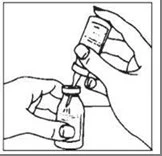
- Disconnect both vials by removing the diluent vial from the transfer needle. This equalizes any low pressure created in the product vial. Then remove the double-ended transfer needle from the product vial and discard the needle into an appropriately secured container.
- Place the vial upright and allow time for most of the content to dissolve, then GENTLY rotate the vial until the powder is completely dissolved. Reconstitution takes no longer than five (5) minutes for the 500 mg vial and no longer than ten (10) minutes for the 1000 mg vial. Caution: Do not shake the vial. Do not invert the vial until ready to withdraw the contents.
- The reconstituted solution is colorless or slightly yellow to yellow-green.
- Occasionally, a few small visible particles may remain in the reconstituted solution. These will be removed by the sterile 20-micron pore filter provided with the product.
Administration
- Prior to administration, inspect the reconstituted solution for particulate matter and discoloration.
- The contents of multiple vials may be transferred into an empty, sterile intravenous solution container. Use aseptic technique and a sterile needle, which is not supplied with the product.
- To minimize the risk of microbial contamination, Rymphysia must be administered within three (3) hours of reconstitution. Any unused solution must be discarded.
- Rymphysia must be administered separately and must not be mixed with any other agents or diluent solutions.
Infusion rate
- The recommended infusion rate is 0.08 ml/kg body weight per minute. The infusion rate may be adjusted according to clinical response and patient tolerance, but must not exceed 0.2 ml/kg body weight per minute.
- If adverse reactions occur, reduce the infusion rate or stop the infusion. After symptoms resolve, restart the infusion at a rate tolerated by the patient.