Pulmicort turbuhaler
Poland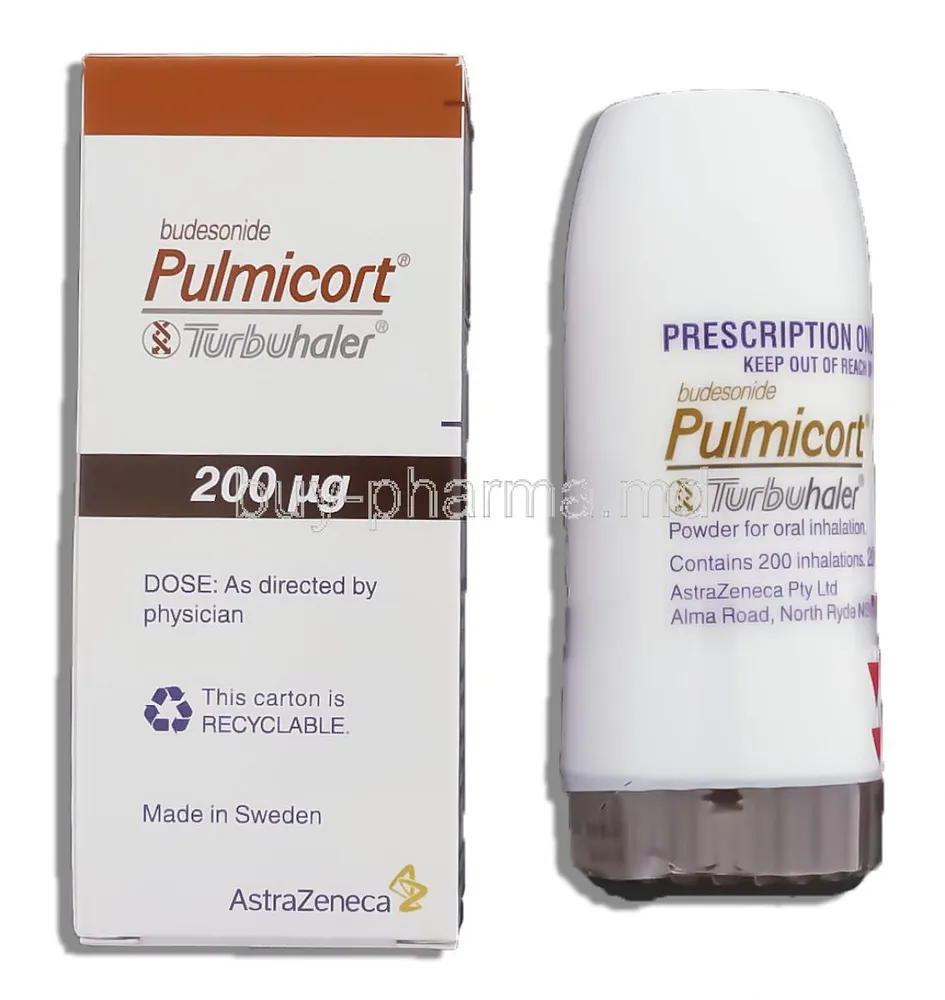
Table of Contents
Patient Information Leaflet
Pulmicort Turbuhaler, 100 μg/inhalation, powder for inhalation
Pulmicort Turbuhaler, 200 μg/inhalation, powder for inhalation
Budesonide
Please read this leaflet carefully before using this medicine, as it contains important information for you.
- Keep this leaflet. You may need to read it again.
- If you have any further questions, ask your doctor or pharmacist.
- This medicine has been prescribed for a specific individual. Do not pass it on to others. It may harm them, even if their symptoms are the same as yours.
- If you experience any adverse reactions, including any not listed in this leaflet, inform your doctor or pharmacist. See section 4.
Table of contents:
- What Pulmicort Turbuhaler is and what it is used for
- What you need to know before using Pulmicort Turbuhaler
- How to use Pulmicort Turbuhaler
- Possible side effects
- How to store Pulmicort Turbuhaler
- Contents of the pack and other information
1. What Pulmicort Turbuhaler is and what it is used for
Budesonide, the active substance in Pulmicort Turbuhaler, belongs to a group of medicines called glucocorticosteroids. These medicines have strong local anti-inflammatory effects. Pulmicort Turbuhaler is used in:
- bronchial asthma,
- chronic obstructive pulmonary disease (COPD).
2. Important information before using Pulmicort Turbuhaler
When not to use Pulmicort Turbuhaler
- if the patient is allergic (hypersensitive) to budesonide.
Warnings and precautions
Before starting to use Pulmicort Turbuhaler, inform your doctor if:
- the patient has pneumonia,
- the patient has a cold or chest infection, or has any breathing problems,
- the patient has ever had tuberculosis of the lungs,
- the patient has liver problems,
- the patient has other diseases or conditions apart from asthma.
Inform your doctor about any anticipated stressful situations (e.g. exams) or planned surgical procedures. Your doctor may then consider increasing the dose of oral glucocorticosteroids.
If the patient experiences blurred vision or other visual disturbances, contact a doctor.
Children and adolescents
The medicine is intended for the treatment of bronchial asthma in children aged 6 years and older.
Regular monitoring of growth in children and adolescents receiving glucocorticosteroids, regardless of the route of administration, is recommended.
Use of Pulmicort Turbuhaler in patients with impaired kidney and/or liver function
Inform your doctor if the patient has had or currently has impaired liver function.
Pulmicort Turbuhaler and other medicines
Inform your doctor about any troubling reactions that occurred after taking other medicines. Tell your doctor about all medicines the patient is currently taking or has recently taken, including those obtained without a prescription, herbal preparations, and any medicines the patient plans to take.
Pulmicort Turbuhaler may affect how some medicines work, and some medicines may affect how Pulmicort Turbuhaler works.
In particular, inform your doctor if the patient is taking:
- steroid medicines, including estrogens or steroid contraceptives,
- medicines used to treat fungal infections (such as ketoconazole and itraconazole),
- HIV protease inhibitors (such as ritonavir and nelfinavir).
Pregnancy and breastfeeding
Pregnancy
If the patient is pregnant, suspects she may be pregnant, or is planning to become pregnant, she should consult a doctor before using this medicine.
If a woman being treated with Pulmicort Turbuhaler becomes pregnant, she should inform her doctor as soon as possible.
Breastfeeding
Consult a doctor before using this medicine.
Driving and operating machinery
Pulmicort Turbuhaler has no influence on the ability to drive vehicles or operate machinery.
3. How to use Pulmicort Turbuhaler
- This medicine should always be used exactly as directed by your doctor. If in doubt, consult your doctor. Bronchial asthma The dosage of Pulmicort Turbuhaler is individual. Below are general recommendations for determining the total initial dose and maximum total dose of Pulmicort Turbuhaler, depending on prior asthma treatment and patient age.
As with other inhaled medicines, paradoxical bronchospasm may occur immediately after using Pulmicort Turbuhaler. If a severe reaction occurs, contact your doctor immediately.
You should also contact your doctor if symptoms do not improve despite regular use of the prescribed doses.
Children aged 6 years and older
- 100 \μ g to 800 \μ g per day, divided into 2 to 4 doses.
- If the total daily dose does not exceed 400 \μ g, it may be administered once daily.
Adults
- The usual total daily dose ranges from 200 \μ g to 800 \μ g and may be given in 2 to 4 divided doses.
- In severe cases, the total daily dose may be increased up to 1600 \μ g.
- If the total daily dose does not exceed 400 \μ g, it may be administered once daily.
The lowest effective maintenance dose should be used.
Due to the very small amount of inhaled powder, you may not taste the medicine after inhalation.
Clinical improvement after a single dose of Pulmicort Turbuhaler may be expected within several hours of inhalation. Full therapeutic effect is achieved after several weeks of treatment.
Pulmicort Turbuhaler is intended for long-term treatment but does not provide rapid relief of acute asthma attacks.
When switching from oral glucocorticosteroids to inhaled therapy, the patient should be as stable as possible. For the first 10 days, high doses of Pulmicort Turbuhaler should be used concomitantly with the previously prescribed oral glucocorticosteroid.
Then, the dose of the oral glucocorticosteroid should be gradually reduced. Often, oral glucocorticosteroid therapy can be completely discontinued.
Chronic obstructive pulmonary disease (COPD)
- The recommended dose of Pulmicort Turbuhaler is 400 \μ g administered twice daily.
For COPD patients who are taking oral glucocorticosteroids and are being switched to Pulmicort Turbuhaler, the same recommendations as described in the "Bronchial asthma" section should be followed during tapering of oral glucocorticosteroids.
If symptoms of COPD worsen, the patient should contact their physician, who will recommend appropriate treatment.
If there is no noticeable improvement after using short-acting bronchodilators, or if they need to be used more frequently than usual, contact your doctor.
Instructions for using Pulmicort Turbuhaler
Preparing the Pulmicort Turbuhaler inhaler for first use
Before the first use of a new Pulmicort Turbuhaler inhaler, prepare it as follows:
- Unscrew and remove the inhaler cap. A characteristic clicking sound may be heard during unscrewing.
- Hold the Pulmicort Turbuhaler inhaler vertically, with the base pointing downwards.
- Turn the base fully in one direction, then fully in the opposite direction (the starting direction does not matter). A characteristic click will be heard.
- Repeat the above step, turning the base fully in both directions.
- The Pulmicort Turbuhaler inhaler is now ready for use.
Using the inhaler
To perform inhalation, always follow the instructions below.
The Turbuhaler is a multidose inhaler designed to deliver
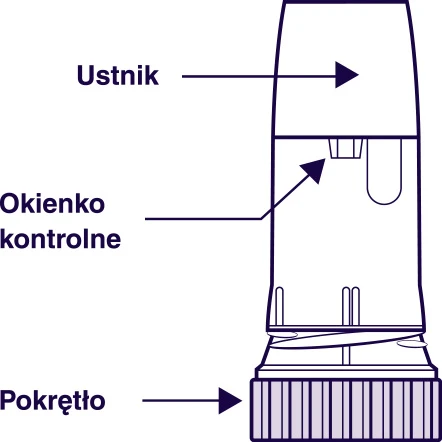
medicine.
When inhaling through the Turbuhaler, the powder is released into the lungs. Therefore, it is very important to inhale deeply and fully through the mouthpiece. Follow the instructions below carefully.
- Unscrew and remove the inhaler cap.
- Hold the inhaler in an upright position, base downwards (Figure 2). During dose loading, do not hold the inhaler by the mouthpiece. To load a dose of medicine,
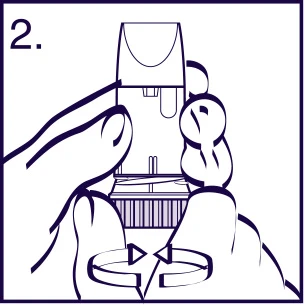
turn the base fully in one direction, then fully in the opposite direction (the starting direction does not matter). A characteristic click will be heard. The inhaler is now loaded and ready for use; do not repeat this step. Proceed to the next steps to inhale the dose.
- Breathe out. Do not exhale through the inhaler.
- Place the mouthpiece between your teeth, close your lips around it, and inhale deeply and forcefully through your mouth.
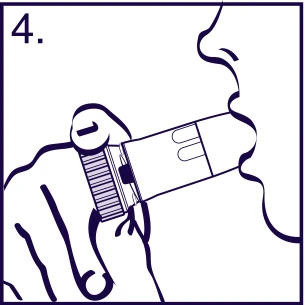
Do not chew or bite the mouthpiece.
Do not use a damaged inhaler or an inhaler without a mouthpiece.
- Remove the inhaler mouthpiece from your mouth before exhaling. If more than one dose has been prescribed, repeat steps 2–5.
- Replace the cap on the inhaler and screw it on tightly.
- Rinse your mouth after inhaling the prescribed dose.
Warning!
Never exhale through the mouthpiece.
After using the medicine, always screw the cap back on tightly.
Due to the very small amount of powdered medicinal substance, you may not taste the medicine after inhalation. However, you can be confident that the prescribed dose has been inhaled if you followed the instructions above.
Cleaning the Pulmicort Turbuhaler inhaler
The outer part of the mouthpiece should be cleaned regularly (once a week) with a dry cloth.
Do not use water to clean the mouthpiece.
When to start using a new inhaler
Dose indicator
When a red mark first appears in the dose counter window, this indicates that approximately 20 doses remain in the device (Fig. 1).
When the red mark reaches the bottom edge of the counter window (Fig. 2), the inhaler should no longer be used. The dose released from the inhaler may then be too low.
A characteristic sound of the moisture-absorbing agent shifting may be heard when shaking the inhaler.


Fig. 1 Fig. 2
If you feel that the effect of Pulmicort Turbuhaler is too strong or too weak, consult your doctor.
Taking more than the recommended dose of Pulmicort Turbuhaler
It is important that the patient uses the medicine exactly as prescribed by the doctor. Do not increase or decrease the dose without consulting your doctor.
If more than the recommended dose is taken, contact your doctor immediately.
Missed dose of Pulmicort Turbuhaler
Pulmicort Turbuhaler powder for inhalation should be used exactly as directed by your doctor, and only the prescribed number of doses should be taken. Do not take a double dose to make up for a missed dose.
If you have any further questions about the use of this medicine, consult your doctor or pharmacist.
4. Possible adverse reactions
Like all medicines, this medicine can cause adverse reactions, although not everyone experiences them.
Treatment with Pulmicort Turbuhaler must be discontinued and immediate contact with a doctor is required
if the patient develops any of the following symptoms: severe allergic reactions, e.g. facial swelling
(particularly around the mouth, tongue and/or throat and/or difficulty swallowing), or urticaria
occurring together with breathing difficulties (angioedema), bronchospasm and/or sudden onset of weakness (fainting).
Other adverse reactions
Frequently occurring adverse reactions (less than 1 in 10 patients)
- Fungal infections (candidiasis) of the mouth and throat. The mouth should be rinsed with water after each dose to reduce the risk of developing oral or pharyngeal candidiasis.
- Throat irritation, cough, hoarseness,
- Loss of voice,
- Pneumonia (lung infection) in patients with COPD.
Patients should inform their doctor if any of the following symptoms occur during budesonide treatment, as they may indicate lung infection:
- Fever or chills,
- Increased mucus production, change in mucus color,
- Worsening cough or increased breathing difficulties.
Uncommon adverse reactions (less than 1 in 100 patients)
- Cataract,
- Blurred vision,
- Muscle cramps,
- Muscle tremors,
- Depression,
- Anxiety.
Rare adverse reactions (less than 1 in 1000 patients)
- Immediate and delayed hypersensitivity reactions, including rash, contact dermatitis, urticaria, angioedema (swelling of soft tissues due to increased vascular permeability: eyelids, face, lips, tongue, larynx), severe allergic reactions,
- Easy bruising (ecchymoses),
- Bronchospasm,
- Nervousness, behavioral changes (mainly in children),
- Systemic effects of glucocorticosteroids, including suppression of adrenal cortex function and growth retardation (in children and adolescents),
- Loss of voice (in children),
- Hoarseness (in children).
Adverse reactions with unknown frequency
- Glaucoma,
- Sleep disorders,
- Anxiety,
- Psychomotor hyperactivity,
- Aggression.
Systemic effects may include: Cushing's syndrome, Cushingoid features, adrenal suppression, growth retardation in children and adolescents, decreased bone mineral density, cataract, glaucoma, and less frequently, psychiatric symptoms or behavioral disturbances such as psychomotor hyperactivity, sleep disturbances, anxiety, depression, or aggression (particularly in children).
If any of the above adverse reactions occur, contact a doctor immediately or go to the nearest hospital.
Reporting of adverse reactions
If any adverse reactions occur, including those not listed in this leaflet, inform a doctor. Adverse reactions can be reported directly to the Department of Monitoring Adverse Drug Reactions, Office for Registration of Medicinal Products, Medical Devices and Biocidal Products, Al. Jerozolimskie 181C, 02-222 Warsaw, Tel: +48 22 49 21 301, Fax: +48 22 49 21 309, Website: https://smz.ezdrowie.gov.pl.
Adverse reactions can also be reported to the marketing authorization holder.
Reporting adverse reactions helps to provide more information on the safety of the medicine.
5. How to store Pulmicort Turbuhaler
Store at a temperature not exceeding 30 °C.
Keep the medicine out of the sight and reach of children.
Do not use this medicine after the expiry date stated on the packaging following the word EXP. The expiry date refers to the last day of the stated month.
Medicines should not be disposed of via wastewater or household waste. Ask your pharmacist how to dispose of medicines no longer required. These measures will help protect the environment.
6. Contents of the pack and other information
What Pulmicort Turbuhaler contains
The active substance is budesonide.
One dose contains 100 micrograms (μg) or 200 micrograms (μg) of budesonide.
What Pulmicort Turbuhaler looks like and contents of the pack
A dosing container with an inhalation mouthpiece and a protective cap, in a cardboard box.
Pulmicort Turbuhaler 100 μg contains 200 doses.
Pulmicort Turbuhaler 200 μg contains 100 doses.
Each inhaler is additionally labelled with:
200 DOSES BUDESONIDE 100 μg/DOSE
LOT/CH.-B/LOTE ZM 1234
EXP/VERW.BIS/CAD MM-YYYY
or
100 DOSES BUDESONIDE 200 μg/DOSE
LOT/CH.-B/LOTE ZM 1234
EXP/VERW.BIS/CAD MM-YYYY
Marketing Authorisation Holder and Manufacturer
Marketing Authorisation Holder:
AstraZeneca AB
S-151 85 Sodertalje
Sweden
Manufacturer:
AstraZeneca AB
Forskargatan 18
151 36 Södertälje
Sweden
For further information, please contact the local representative of the Marketing Authorisation Holder:
AstraZeneca Pharma Poland Sp. z o.o.
ul. Postępu 14
02-676 Warszawa
tel: +48 22 245 73 00
fax: +48 22 485 30 07