Provera
Poland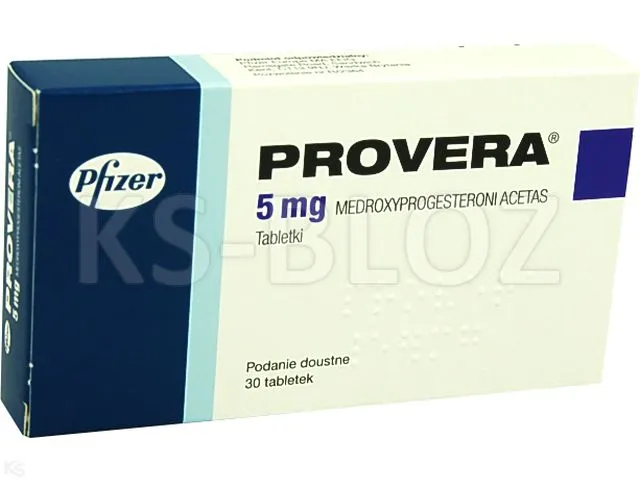
Table of Contents
Package leaflet: Information for the patient
PROVERA, 5 mg, tablets
PROVERA, 10 mg, tablets
Medroxyprogesterone acetate
Please read all of this leaflet carefully before taking this medicine, because it contains
important information for the patient.
- Keep this leaflet, so that you can read it again if necessary.
- If you have any further questions, please consult your doctor or pharmacist.
- This medicine has been prescribed for a specific individual. Do not pass it on to others. This medicine may harm other people, even if their symptoms are the same.
- If you experience any adverse reactions, including any not listed in this leaflet, inform your doctor or pharmacist. See section 4.
Contents of the leaflet
- What PROVERA is and what it is used for
- Important information before taking PROVERA
- How to take PROVERA
- Possible side effects
- How to store PROVERA
- Contents of the pack and other information
1. What PROVERA is and what it is used for
PROVERA has several proven pharmacological effects on the endocrine system:
- inhibits the secretion of pituitary gonadotropins (FSH and LH);
- reduces blood levels of ACTH and hydrocortisone;
- reduces peripheral blood testosterone concentration;
- reduces peripheral blood estrogen concentration.
When administered orally at the recommended doses to women with normal estrogen secretion, PROVERA induces transformation of the endometrium from the proliferative phase to the secretory phase.
PROVERA is used in the treatment of:
- secondary amenorrhea,
- functional (anovulatory) uterine bleeding due to hormonal imbalance,
- mild to moderate endometriosis,
- and for prevention of endometrial hyperplasia (overgrowth of the endometrium) in women receiving estrogens.
2. Important information before using PROVERA
When not to use PROVERA:
- if the patient is allergic to medroxyprogesterone acetate or any of the other ingredients of this medicine (listed in section 6),
- during pregnancy or suspected pregnancy,
- for diagnosis of pregnancy,
- in case of unexplained vaginal or urinary bleeding,
- in case of venous thromboembolic disease,
- in case of history of stroke,
- in case of severe liver failure,
- in case of diagnosed or suspected malignancy of the breast or genital organs,
- in case of missed abortion.
Warnings and precautions
Before starting treatment with PROVERA, discuss this with your doctor or pharmacist.
When to exercise special caution when using PROVERA
- in case of known hypersensitivity to steroids other than the active substance medroxyprogesterone acetate;
- if vaginal bleeding occurs during treatment with PROVERA;
- in patients with concomitant medical conditions such as epilepsy, migraine, asthma, cardiac or renal dysfunction, in which weight gain or fluid retention may worsen the clinical condition;
- in patients with a history of depression;
- some patients may experience symptoms resembling premenstrual dysphoric disorder during treatment with PROVERA;
- in some patients receiving PROVERA, glucose tolerance may decrease. Diabetic patients should be closely monitored during treatment;
- when submitting an endometrial biopsy or cervical canal biopsy for histopathological examination, inform the histopathologist (or laboratory) about the use of PROVERA;
- treatment with PROVERA may reduce serum and/or urinary concentrations of the following biomarkers: a) steroids (e.g. cortisol, estrogens, pregnandiol, progesterone, testosterone) b) gonadotropins (e.g. LH and FSH) c) sex hormone-binding globulin (SHBG)
- if sudden partial or complete loss of vision, sudden proptosis, diplopia, or migraine occurs, discontinue the drug immediately and undergo a thorough ophthalmological examination. If papilledema or retinal vascular lesions are diagnosed, the drug should not be continued;
- in patients with a history of thromboembolic or thrombotic disorders.
Before starting hormonal therapy and periodically thereafter, the doctor should recommend physical examinations including blood pressure measurement, breast, abdominal and pelvic organ examination, including cervical cytology testing.
Hormonal therapy is associated with a risk of venous thromboembolic disease, i.e. deep vein thrombosis or pulmonary embolism.
Estrogens, either alone or in combination with progestogens, should not be used for the prevention of cardiovascular diseases. An increased risk of cardiovascular events such as myocardial infarction, ischemic heart disease, stroke, and venous thromboembolic disease has been observed in postmenopausal women receiving combined regimens of estrogens and/or progestogens.
An increased risk of cardiovascular disease has been demonstrated during the first year of continuous combined use of estrogens and medroxyprogesterone acetate.
An increased risk of stroke has been observed in women receiving estrogens in combination with medroxyprogesterone acetate.
Concomitant use of estrogens and progestogens in postmenopausal women increases the risk of developing breast cancer. The risk increases with longer duration of treatment.
Hormonal therapy is not recommended for the prevention of dementia or mild cognitive impairment in women. There is an increased risk of probable dementia and mild cognitive impairment in postmenopausal women aged 65 years or older.
No studies have been conducted on the effect of orally administered PROVERA on bone mineral density (BMD).
In a study involving women receiving medroxyprogesterone acetate by injection as a contraceptive method, a mean decrease in BMD was observed.
In adult women, partial recovery of BMD to baseline values was observed several years after discontinuation of the drug, whereas complete recovery was observed in adolescent women.
It is not known whether administration of medroxyprogesterone acetate by injection during adolescence and early adulthood—a critical period for bone mass accrual—reduces peak bone mass. The doctor may recommend calcium and vitamin D supplementation and periodic assessment of bone mineral density.
PROVERA with other medicines
Inform your doctor about all medicines currently used or recently used, as well as any medicines you plan to take.
Concomitant administration of aminoglutethimide and high doses of medroxyprogesterone acetate may significantly reduce plasma concentrations of medroxyprogesterone acetate and thus reduce the effectiveness of PROVERA.
Medroxyprogesterone acetate may interfere with the metyrapone test results.
Taking PROVERA with food and drink
Administration of the drug with food increases its bioavailability.
Pregnancy and breastfeeding
If the patient is pregnant or breastfeeding, suspects she may be pregnant, or plans to become pregnant, she should consult her doctor or pharmacist before using this medicine.
Pregnancy
PROVERA is contraindicated in pregnant women.
Data indicate an association between the use of progestogen drugs during the first trimester of pregnancy and developmental abnormalities of the genital tract in fetuses of both sexes.
Patients should be informed of the potential risk to the fetus if PROVERA is used during pregnancy or if pregnancy occurs during treatment.
Breastfeeding
PROVERA and its metabolites pass into human milk. There is no evidence indicating that this may pose any risk to the breastfed infant; however, use of the drug is not recommended during breastfeeding.
Driving and operating machinery
No effects of PROVERA on the ability to drive or operate machinery have been observed.
PROVERA contains lactose monohydrate
PROVERA 5 mg contains lactose monohydrate (84.20 mg) and PROVERA 10 mg contains lactose monohydrate (110 mg). If the patient has previously been diagnosed with intolerance to certain sugars, she should consult her doctor before taking this medicine.
3. How to use PROVERA
This medicine should always be used according to the instructions given by the doctor or pharmacist. In case of doubt, consult your doctor or pharmacist.
Treatment of secondary amenorrhea
From 5 mg to 10 mg daily for 5 to 10 days. Bleeding should occur within 3 to 7 days after stopping the medicine.
Treatment of functional (anovulatory) uterine bleeding due to hormonal imbalance
Dosage from 5 mg to 10 mg daily for 5 to 10 days, starting administration approximately on day 16 to 21 of the cycle. Bleeding should occur within 3 to 7 days after discontinuation of PROVERA. The dose (from 5 to 10 mg) may be repeated, starting on day 16 of the cycle, for 2–3 consecutive cycles. After that, treatment should be interrupted to assess whether the functional disturbances have resolved.
Treatment of mild to moderate endometriosis
The recommended dosage of PROVERA is 10 mg three times daily for 90 consecutive days, starting on the first day of the menstrual cycle. Self-limiting spotting may occur in 30–40% of patients. In such cases, no additional hormone therapy is recommended.
Prevention of endometrial hyperplasia (endometrial proliferation) in women taking estrogens
Dosage and regimen should be individually determined by the physician. The most commonly used regimens are:
- continuous regimen: 2.5 mg to 5 mg daily
- sequential regimen: 5 mg to 10 mg daily for 10–14 consecutive days of a 28-day cycle. Withdrawal bleeding or spotting occurs in 75–80% of women treated in this way.
Combined estrogen and (or) progestagen therapy for the treatment of menopausal symptoms should be limited to the lowest effective dose and used for the shortest possible duration.
Regular examinations of patients are recommended. The type and frequency of these examinations should be based on the individual patient's condition.
Progestagens are not recommended for women who have had a hysterectomy, except in cases where endometriosis has been diagnosed.
Use of a higher than recommended dose of PROVERA
Do not take a higher dose of PROVERA than recommended by your doctor. If you have taken more PROVERA than recommended, consult your doctor immediately.
Oral doses up to 3 g daily have been well tolerated. Treatment of overdose is symptomatic and supportive.
Missed dose of PROVERA
If a patient forgets to take PROVERA, she should do so as soon as possible, unless it is almost time for the next dose. In that case, the next dose should be taken at the scheduled time.
Stopping treatment with PROVERA
The decision to discontinue treatment is made by the doctor. Do not stop treatment without consulting your doctor.
4. Possible adverse effects
Like all medicines, this medicine can cause adverse effects, although not everyone will experience them.
If any of the adverse effects worsen or if you experience any adverse effects not listed in this leaflet,
you should inform your doctor or pharmacist.
Very common (may occur in more than 1 in 10 people)
- headaches,
- nausea,
- abnormal uterine bleeding (irregular, excessive, too light, menstrual spotting).
Common (may occur in no more than 1 in 10 people)
- hypersensitivity to the medicine,
- depression, insomnia, nervousness,
- dizziness,
- hair loss, acne, urticaria, itching,
- cervical discharge, breast pain, breast tenderness,
- fever, feeling of fatigue, injection site reactions, persistent depression at injection site,
- weight gain.
Uncommon (may occur in no more than 1 in 100 people)
- excessive hair growth,
- galactorrhea,
- oedema, fluid retention, nodule at injection site, pain and (or) tenderness at injection site.
Frequency not known (cannot be estimated from available data)
- sudden, severe allergic or non-allergic reaction, which may be fatal, skin and mucous membrane disease characterised by localized swellings (angioedema),
- prolonged anovulatory period,
- somnolence,
- thrombosis and thromboembolic disorders,
- jaundice, cholestatic jaundice,
- atrophy or impaired structure of fatty tissue (acquired lipodystrophy), rash,
- absence of menstruation, cervical erosion,
- decreased glucose tolerance, weight loss.
Adverse effects occurring after administration of the medicine by injection
Reporting of adverse effects
If any adverse effects occur, including those not listed in this leaflet, you should inform your doctor. Adverse effects can be reported directly to the Department of Monitoring of Adverse Drug Reactions of the Office for Registration of Medicinal Products, Medical Devices and Biocidal Products
Al. Jerozolimskie 181C
02-222 Warsaw
Tel.: + 48 22 49 21 301
Fax: + 48 22 49 21 309
Website: https://smz.ezdrowie.gov.pl
Adverse effects can also be reported to the marketing authorisation holder or the representative of the marketing authorisation holder.
By reporting adverse effects, more information on the safety of this medicine can be collected.
5. How to store PROVERA
Keep the medicine out of the sight and reach of children.
Store below 25ºC.
Do not use this medicine after the expiry date stated on the packaging following (EXP).
The expiry date refers to the last day of the stated month.
Medicines should not be disposed of via wastewater or household waste. Ask your pharmacist how to dispose of medicines no longer required. This will help protect the environment.
6. Contents of the pack and other information
What PROVERA contains
Each tablet contains 5 mg of medroxyprogesterone acetate (Medroxyprogesteroni acetas).
The active substance is medroxyprogesterone acetate.
Other ingredients: monohydrate lactose, corn starch, sucrose, liquid paraffin, talc,
calcium stearate, indigotine (E132).
Each tablet contains 10 mg of medroxyprogesterone acetate (Medroxyprogesteroni acetas).
The active substance is medroxyprogesterone acetate.
Other ingredients: monohydrate lactose, corn starch, sucrose, liquid paraffin, talc,
calcium stearate.
What PROVERA looks like and contents of the pack
5 mg tablets: round, blue, with a division line on one side and engraved mark "286" above and below the division line, and engraved mark "U" on the other side.
Pack contains:
10 tablets in a PVC/Al foil blister, 3 blisters in a cardboard box.
10 mg tablets: round, white, with engraved mark "Upjohn 50" on one side and a division line on the other side.
Pack contains: 10 tablets in a PVC/Al foil blister, 3 blisters in a cardboard box.
Marketing Authorisation Holder
Pfizer Europe MA EEIG
Boulevard de la Plaine 17
1050 Bruxelles
Belgium
Manufacturer
Pfizer Italia S.r.l.
Localitá Marino del Tronto
63100 Ascoli Piceno
Italy
For further information on this medicinal product, please contact the local representative of the Marketing Authorisation Holder:
Pfizer Polska Sp. z o.o.
tel. 22 335 61 00
Detailed and up-to-date information on this product can be obtained by scanning the QR code located on the outer packaging using a mobile device. The same information is also available at the URL: https://pfi.sr/ulotka-provera and on the website of the Office for Registration of Medicinal Products, Medical Devices and Biocidal Products: http://www.urpl.gov.pl