Ospamox
Poland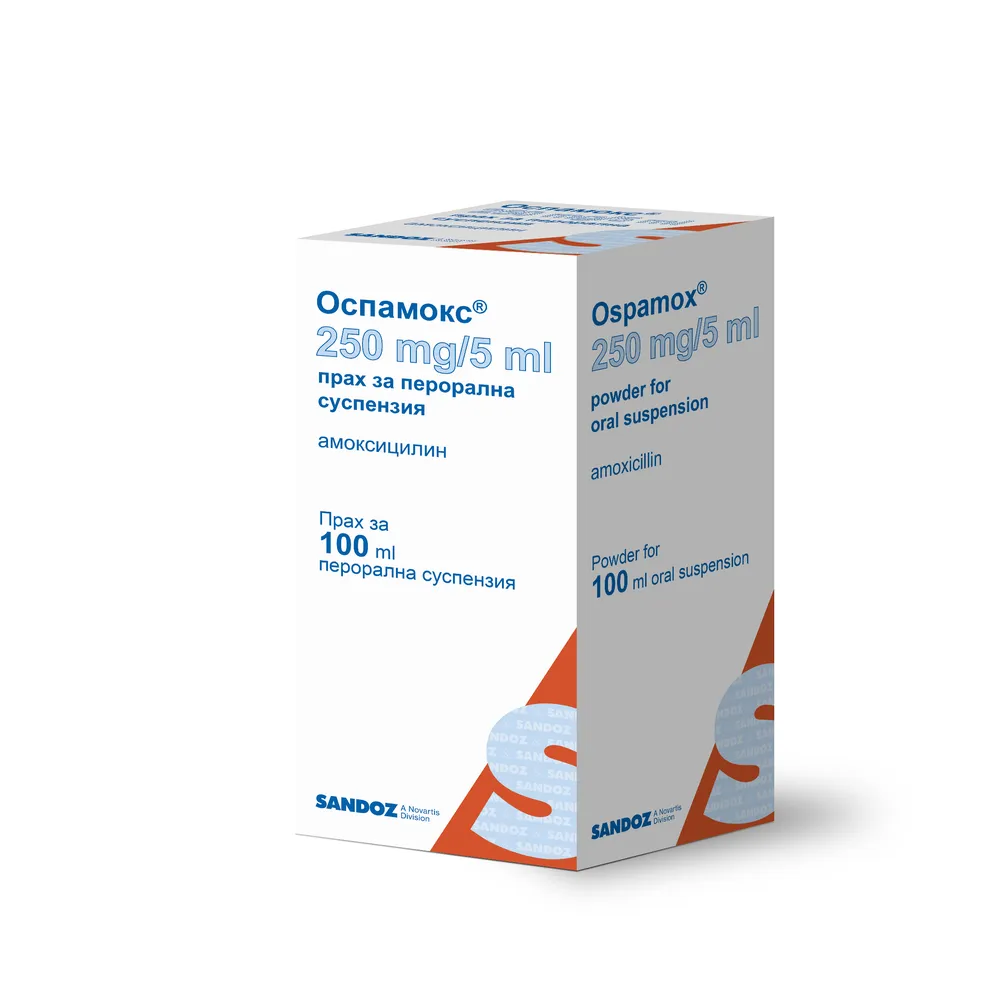
Table of Contents
- Package leaflet: information for the patient
- 1. What Ospamox is and what it is used for
- 2. Important information before using Ospamox
- 3. How to use Ospamox
- 4. Possible side effects
- 5. How to store Ospamox
- 6. Contents of the pack and other information
- Information intended exclusively for healthcare professionals:
Package leaflet: information for the patient
Ospamox, 250 mg/5 ml, powder for oral suspension
Ospamox, 500 mg/5 ml, powder for oral suspension
Amoxicillinum
Read the entire leaflet carefully before using this medicine, as it contains important information for the patient.
- Keep this leaflet for future reference.
- If you have any doubts, consult your doctor or pharmacist.
- This medicine has been prescribed for a specific individual. Do not share it with others. This medicine may harm another person, even if their symptoms are similar.
- If you experience any adverse reactions, including any not listed in this leaflet, inform your doctor or pharmacist. See section 4.
Table of contents:
- What Ospamox is and what it is used for
- Important information before taking Ospamox
- How to take Ospamox
- Possible side effects
- How to store Ospamox
- Contents of the pack and other information
1. What Ospamox is and what it is used for
What Ospamox is
Ospamox is an antibiotic. It contains the active substance amoxicillin, which belongs to a group of medicines called penicillins.
What Ospamox is used for
Ospamox is used to treat bacterial infections in different parts of the body caused by bacteria sensitive to amoxicillin. Ospamox is used in adults and children for the treatment of the following infections:
- Acute bacterial tonsillitis and pharyngitis
- Acute bacterial otitis media and acute bacterial sinusitis
- Lower respiratory tract infections: acute exacerbation of chronic bronchitis, pneumonia
- Infections of the upper and lower urinary tract: bladder infection (acute cystitis), kidney infection (acute pyelonephritis), asymptomatic bacteriuria during pregnancy
- Periapical abscess with spreading cellulitis
- Infections associated with joint prostheses
- Lyme disease (Lyme borreliosis; infection transmitted by parasites called ticks)
- Systemic bacterial infections: typhoid fever and paratyphoid fever
- Prevention of bacterial endocarditis
Ospamox may also be used in combination with other medicines for the treatment of peptic ulcer disease caused by Helicobacter pylori bacteria.
2. Important information before using Ospamox
When not to use Ospamox
if the patient is allergic to amoxicillin, penicillin, or any of the other ingredients
of the medicine (listed in section 6);
if the patient has ever had an allergic reaction to any other antibiotic. This may
include skin rash or swelling of the face or throat.
If any of the above situations apply to the patient, Ospamox must not be taken. If in
doubt, consult the doctor or pharmacist before starting treatment with Ospamox.
Warnings and precautions
Before starting treatment with Ospamox, discuss with the doctor or pharmacist if the patient:
has infectious mononucleosis (fever, sore throat, swollen lymph nodes, and extreme fatigue)
has kidney disease
urinates irregularly.
If in doubt whether any of the above conditions apply, consult the doctor or pharmacist before starting Ospamox.
Blood and urine tests
If the patient is due to have:
urine test (to detect glucose) or blood test (to assess liver function)
estriol level test (performed during pregnancy to check whether the baby is developing
normally),
inform the doctor or pharmacist about taking Ospamox, as it may affect the results of these tests.
Ospamox and other medicines
Tell the doctor or pharmacist about all medicines currently or recently taken, as well as any medicines the patient plans to take.
If the patient is taking allopurinol (used to treat gout) at the same time as Ospamox, skin allergic reactions may be more likely.
If the patient is taking probenecid (used to treat gout), concomitant use of probenecid may reduce the elimination of amoxicillin and is not recommended. The treating doctor may decide to adjust the dose of Ospamox.
If Ospamox is taken together with anticoagulant medicines (such as warfarin), additional blood tests may be required.
If the patient is also taking other antibiotics (such as tetracyclines), Ospamox may be less effective.
If the patient is taking methotrexate (a medicine used to treat cancer and severe psoriasis), penicillins may reduce methotrexate elimination, increasing the risk of adverse effects.
Pregnancy, breastfeeding and fertility
If the patient is pregnant or breastfeeding, suspects she is pregnant, or is planning to have a child, she should consult her doctor or pharmacist before using this medicine.
Driving and operating machinery
Ospamox may cause adverse effects and symptoms (such as allergic reactions, dizziness and convulsions) that may impair the ability to drive vehicles.
The patient should not drive or operate machinery unless feeling well.
Ospamox contains aspartame, sodium benzoate, benzyl alcohol, benzyl benzoate, ethanol,
sorbitol, sulfur dioxide, glucose and sodium
This medicine contains 8.5 mg of aspartame in 5 ml of reconstituted oral suspension. Aspartame is a source of phenylalanine. It may be harmful to patients with phenylketonuria. This is a rare genetic disorder in which phenylalanine accumulates in the body due to impaired excretion.
This medicine contains 7.1 mg of sodium benzoate (E 211) in 5 ml of reconstituted oral suspension, which may cause mild irritation of the skin, eyes, and mucous membranes. This medicine contains up to 0.44 mg of benzyl benzoate in 5 ml of reconstituted oral suspension. Sodium benzoate and benzyl benzoate may increase the risk of jaundice (yellowing of the skin and whites of the eyes) in newborns (up to 4 weeks of age).
This medicine contains up to 3.0 mg of benzyl alcohol in 5 ml of reconstituted oral suspension. Benzyl alcohol may cause allergic reactions. Pregnant women, breastfeeding women, and patients with liver or kidney disease should consult a doctor or pharmacist, as large amounts of benzyl alcohol may accumulate in their bodies and cause adverse effects (so-called metabolic acidosis). Do not administer to young children (under 3 years of age) for longer than one week without medical advice. Do not administer to newborns (up to 4 weeks of age) without medical advice. Administration of benzyl alcohol to young children is associated with the risk of severe adverse effects, including respiratory disorders.
This medicine contains small amounts of ethanol (less than 100 mg in 5 ml of reconstituted oral suspension).
This medicine contains less than 1 mmol (23 mg) of sodium in 5 ml of reconstituted oral suspension, meaning the medicine is considered "sodium-free".
This medicine contains 0.14 mg of sorbitol in 5 ml of reconstituted oral suspension.
This medicine contains 100 ng of sulfur dioxide, which rarely may cause severe hypersensitivity reactions and bronchospasm.
This medicine contains 0.68 mg of glucose. If the patient has previously been diagnosed with intolerance to certain sugars, the patient should consult the doctor before taking the medicine.
3. How to use Ospamox
This medicine should always be taken exactly as directed by your doctor or pharmacist. If you are unsure,
you should consult your doctor or pharmacist.
Before each dose, always shake the bottle well.
Doses of this medicine should be taken at regular intervals throughout the day, with at least
4-hour intervals between doses.
Usual dosage:
Children weighing less than 40 kg
All doses are determined according to the child's body weight (expressed in kilograms).
Your doctor will advise the appropriate dose of Ospamox for your child.
The usual dose is 40 mg to 90 mg per kilogram of body weight per day,
administered in two or three divided doses.
The maximum recommended dose is 100 mg per kilogram of body weight per day.
Adults, elderly patients, and children weighing 40 kg or more
The usual dose is 250 mg to 500 mg three times a day or 750 mg to 1 g every 12 hours,
depending on the severity and type of infection.
Severe infections: 750 mg to 1 g three times a day.
Urinary tract infections: 3 g twice a day for one day.
Lyme disease (tick-borne infection):
- Erythema migrans (early stage – red or pink rash around the bite site): 4 g per day;
- Systemic symptoms (late stage – presence of more serious symptoms or spread of infection in the body): up to 6 g per day.
Peptic ulcer disease: 750 mg or 1 g twice a day for 7 days, together with other antibiotics
and medications used in the treatment of peptic ulcer disease.
Prophylaxis of endocarditis during surgery: the dose depends on the type of procedure.
Other medicines may also be administered at the same time. Your doctor, pharmacist, or nurse
will provide further information on this.
The maximum dose is 6 g per day.
Kidney disease
If the patient has kidney disease, the dose of this medicine may be lower than the usual dose.
Taking more Ospamox than recommended
If you take more Ospamox than recommended, gastrointestinal disturbances (nausea, vomiting, or diarrhoea)
or crystals of amoxicillin in the urine (observed as cloudy urine or felt as difficulty in passing urine) may occur.
You should contact your doctor as quickly as possible. Take the medicine with you to show to the doctor.
If you forget to take a dose of Ospamox
If you forget to take a dose, take it as soon as you remember.
Do not take the next dose too early; wait approximately 4 hours before taking the next dose.
Do not take a double dose to make up for a missed dose.
How long to take Ospamox
You should always take this medicine for as long as your doctor has instructed, even if you feel better.
All doses are necessary to eliminate the infection. If some bacteria survive, they may cause the infection to return.
If you still do not feel better after completing treatment, consult your doctor again.
If you take Ospamox for a prolonged period, fungal infections (candidiasis – yeast infection of mucous membranes causing local pain, itching, and white discharge) may occur.
In such a case, consult your doctor.
If you take Ospamox for a prolonged period, your doctor may recommend additional tests to monitor kidney, liver, and blood function.
If you have any further questions about the use of this medicine, consult your doctor or pharmacist.
4. Possible side effects
Like all medicines, this medicine can cause side effects, although not everybody gets them.
If the patient experiences any of the serious side effects listed below,
treatment with Ospamox must be stopped immediately and medical advice sought, as
immediate medical intervention may be necessary.
Very rare side effects (may occur in less than 1 in 10,000 patients):
allergic reactions, including skin itching or rash, swelling of the face, lips, tongue, body, or
difficulty breathing; these may be severe symptoms and rarely may lead to death;
rash or small, flat, red, round spots beneath the skin surface or skin bruising, which may
indicate vasculitis (inflammation of blood vessels) due to an allergic reaction; these may occur
with joint pain (arthritis) and kidney function disorders.
delayed-type allergic reaction, usually occurring 7 to 12 days after taking Ospamox; symptoms
include, among others, rash, fever, joint pain, and enlarged lymph nodes, especially under the
arms;
a skin reaction known as erythema multiforme, characterized by itchy red-purple skin lesions,
especially on the palms or soles of the feet, skin swelling (resembling hives), tender areas inside
the mouth, eyes, and genital organs; fever and severe fatigue may also occur;
other severe skin reactions, such as skin discoloration, subcutaneous nodules, blister or pustule
formation, skin peeling, redness, pain, itching, or skin desquamation; these changes may be
accompanied by fever, headache, and body aches;
flu-like symptoms with rash, fever, enlarged lymph nodes, and abnormal blood test results [including
increased white blood cell count (eosinophilia) and increased liver enzyme activity]; drug reaction
with eosinophilia and systemic symptoms (DRESS);
fever, chills, sore throat or other signs of infection, or easy bruising; these may be symptoms of
blood cell disorders;
the Jarisch-Herxheimer reaction, which occurs during amoxicillin treatment of Lyme disease and
is characterized by fever, chills, headache, muscle pain, and skin rash;
inflammation of the large intestine causing diarrhoea (sometimes with blood), abdominal pain, and
fever;
severe adverse effects affecting the liver; these usually occur in patients treated for a prolonged
period, in men, and in elderly patients.
Immediately inform a doctor if the patient experiences:
severe diarrhoea with bleeding
blisters on the skin, redness, or bruising
dark-coloured urine or pale stools
yellowing of the skin or whites of the eyes (jaundice). Also read the information below regarding
anaemia, which may cause jaundice.
These symptoms may occur during treatment or up to several weeks after treatment has ended.
chest pain associated with an allergic reaction, which may be a sign of allergy leading to heart attack
(Kounis syndrome). The frequency of this adverse reaction is unknown.
drug-induced enterocolitis syndrome (DIES): drug-induced enterocolitis has occurred mainly in
children receiving amoxicillin. This is a type of allergic reaction, the main symptom of which is
repeated vomiting (1–4 hours after taking the medicine). Further symptoms may include abdominal
pain, lethargy, diarrhoea, and low blood pressure. The frequency of this adverse reaction is unknown.
rash with blisters arranged in a ring-like pattern with scabs in the center or resembling a string of
pearls (linear IgA dermatosis). The frequency of this adverse reaction is unknown.
inflammation of the membranes surrounding the brain and spinal cord (aseptic meningitis). The
frequency of this adverse reaction is unknown.
If the patient experiences any of these symptoms, treatment must be stopped immediately and
medical advice sought.
Less severe skin reactions may sometimes occur, such as:
mildly itchy rash (round, pink-red lesions), hives-like swelling on the forearms, legs, hands, or feet.
These occur not frequently (may occur in less than 1 in 100 patients).
If the patient experiences any of these symptoms, medical advice should be sought, as
treatment discontinuation may be necessary.
Other possible side effects:
Common side effects (may occur in less than 1 in 10 patients):
rash
nausea
diarrhoea
Uncommon side effects (may occur in less than 1 in 100 patients):
vomiting
Very rare side effects (may occur in less than 1 in 10,000 patients):
thrush (yeast infection of the vagina, mouth, or skin folds) – a doctor or pharmacist can advise on
treatment
kidney function disorders
seizures (observed in patients receiving high doses or patients with kidney function disorders)
dizziness
excessive activity
tooth discoloration (in children), which can usually be removed by brushing
tongue discoloration turning yellow, brown, or black (the tongue may appear hairy)
excessive breakdown of red blood cells leading to anaemia; symptoms include: fatigue, headache,
shortness of breath, dizziness, pallor, and yellowing of the skin and whites of the eyes
reduction in white blood cell count
reduction in platelet count (blood cells involved in blood clotting)
prolonged blood clotting time (may be evident during nosebleeds or minor cuts).
Frequency not known (frequency cannot be estimated from available data):
crystals in urine leading to acute kidney injury
Reporting of side effects
If any adverse effects occur, including any not listed in this leaflet, inform a doctor, pharmacist, or nurse.
Adverse effects can be reported directly to the Department of Monitoring Adverse Drug Reactions of the
Office for Registration of Medicinal Products, Medical Devices and Biocidal Products:
Al. Jerozolimskie 181C, 02-222 Warsaw
tel: +48 22 49 21 301 / fax: +48 22 49 21 309 / website: https://smz.ezdrowie.gov.pl
Adverse effects can also be reported to the marketing authorization holder.
Reporting adverse effects helps to provide more information on the safety of the medicine.
5. How to store Ospamox
Keep the medicine out of the sight and reach of children.
Do not use Ospamox after the expiry date stated on the carton and bottle after EXP. The expiry date refers to the last day of the month indicated.
Do not store above 25°C. Store the bottle tightly closed to protect from moisture.
Reconstituted suspension: store in a refrigerator (2°C–8°C).
Do not use the prepared suspension for longer than 14 days.
Do not use the medicine if, before reconstitution, there are visible lumps of powder in the bottle.
Medicines must not be disposed of via wastewater or household waste. Ask your pharmacist how to dispose of medicines no longer required. This will help protect the environment.
6. Contents of the pack and other information
What Ospamox contains
The active substance is amoxicillin (in the form of amoxicillin trihydrate).
Each 5 ml of reconstituted oral suspension contains 250 mg or 500 mg of amoxicillin (in the form
of amoxicillin trihydrate).
The other ingredients are: anhydrous citric acid, sodium benzoate, aspartame, talc, anhydrous sodium citrate,
guar gum, precipitated silica, lemon flavour [contains glucose, sorbitol (E 420),
sulfur dioxide (E 220)], apricot-plum flavour [contains benzyl benzoate, ethanol,
sorbitol (E 420), sulfur dioxide (E 220)], orange flavour [contains benzyl alcohol].
See section "Ospamox contains aspartame, sodium benzoate, benzyl alcohol, benzyl benzoate, ethanol, sorbitol, sulfur dioxide, glucose and sodium".
What Ospamox looks like and contents of the pack
White or slightly yellowish powder with a fruity odour.
The powder for oral suspension is packed in 60 ml or 100 ml amber glass bottles with a "press and turn" cap and a protective seal.
Ospamox, 250 mg/5 ml
Pack sizes:
6.60 g of powder for reconstitution to 60 ml of oral suspension
11.0 g of powder for reconstitution to 100 ml of oral suspension.
Ospamox, 500 mg/5 ml
Pack sizes:
12.00 g of powder for reconstitution to 60 ml of oral suspension
20.0 g of powder for reconstitution to 100 ml of oral suspension.
Ospamox, 250 mg/5 ml and Ospamox, 500 mg/5 ml
A measuring spoon or oral syringe (with adapter) graduated at 1.25 ml, 2.5 ml, and 5.0 ml is included in the pack.
To measure the correct amount of suspension:
- Shake the bottle.
- Insert the dosing adapter into the bottle.
- Insert the tip of the oral syringe into the adapter.
- Turn the bottle upside down.
- Pull the plunger of the syringe to draw up the required dose of medicine.
- Turn the bottle right side up, remove the syringe, leaving the adapter in the bottle, and close the bottle.
Marketing Authorisation Holder and Manufacturer
Marketing Authorisation Holder
Sandoz GmbH
Biochemiestrasse 10
6250 Kundl, Austria
Manufacturer
Sandoz GmbH
Biochemiestrasse 10
6250 Kundl, Austria
Salutas Pharma GmbH
Otto-von-Guericke-Allee 1
39179 Barleben, Germany
For further information about this medicinal product, please contact the local representative of the Marketing Authorisation Holder:
Sandoz Polska Sp. z o.o.
ul. Domaniewska 50 C
02-672 Warszawa
tel. +48 22 209 70 00
This medicinal product is authorised for marketing in the Member States of the European Economic Area and in the United Kingdom (Northern Ireland) under the following names:
Austria
Amoxicillin Hexal 125 mg/5 ml – Powder for the preparation of an oral suspension
Amoxicillin Hexal 250 mg/5 ml – Powder for the preparation of an oral suspension
Amoxicillin Hexal 500 mg/5 ml – Powder for the preparation of an oral suspension
Poland
Ospamox, 250 mg/5 ml, powder for the preparation of oral suspension
Ospamox 500 mg/5 ml, powder for the preparation of oral suspension
(logo of the Marketing Authorisation Holder)
General advice on the use of antibiotics
Antibiotics are used to treat bacterial infections. They are ineffective in treating viral infections.
Sometimes bacterial infections do not respond to antibiotic treatment. One of the most common reasons for this is bacterial resistance to the antibiotic administered. This means that bacteria can survive and even multiply despite the use of the antibiotic.
Bacteria may become resistant to antibiotics for various reasons. Careful use of antibiotics may help reduce the risk of development of resistant bacteria.
The antibiotic prescribed by your doctor is intended solely for the treatment of the current illness. Observing the following advice will help prevent the development of resistant bacteria that could hinder the effectiveness of antibiotics.
- It is very important to take the antibiotic at the correct dose, at the right time, and for the correct number of days. Read the instructions in the leaflet carefully and, if any are unclear, ask your doctor or pharmacist for clarification.
- Do not take an antibiotic unless it has been prescribed specifically for you, and use it only to treat the infection for which it was prescribed.
- Do not take an antibiotic prescribed for another person, even if they had a similar infection.
- Do not give antibiotics prescribed for you to other people.
- If any antibiotic remains after completing the prescribed course of treatment, return it to a pharmacy for proper disposal.
Instructions for preparing the medicine for use
Before use, check that the bottle cap seal is intact.
Turn the medicine bottle upside down and shake to loosen the powder.
Fill the bottle with cooled boiled water up to a level slightly below the mark indicated on the bottle. Turn the bottle upright and shake thoroughly, then add water exactly up to the marked level. Turn the bottle upside down again and shake thoroughly.
Shake the bottle containing the reconstituted suspension well before each use.
The white or slightly yellowish suspension is ready for use.
Information intended exclusively for healthcare professionals:
After removing the cap, check that the protective foil is intact and tightly sealed to the bottle's neck. Do not use the medicine if the protective foil is damaged. Shake the bottle vigorously to loosen the powder.
To prepare the suspension, fill the bottle with the following amount of water:
250 mg/5 ml
60 ml bottle: add 55 ml of water
100 ml bottle: add 92 ml of water
500 mg/5 ml
60 ml bottle: add 51 ml of water
100 ml bottle: add 85 ml of water
Shake the bottle vigorously again.
The resulting white or slightly yellowish suspension is ready for use.
Do not use the medicine if, after preparation, the suspension is not white or slightly yellowish.
Shake the bottle well before each use.