Niko-lek lemon
Poland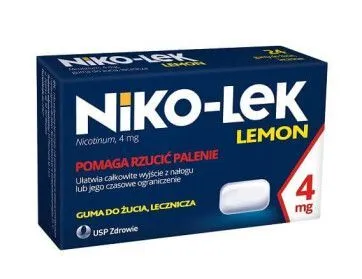
Table of Contents
Patient Information Leaflet
NIKO-LEK LEMON, 2 mg, chewing gum, medicinal
NIKO-LEK LEMON, 4 mg, chewing gum, medicinal
nicotinum
For use in adults.
Please read this leaflet carefully before using this medicine, as it contains
important information for you.
This medicine should always be used exactly as described in this patient leaflet or as directed by
your doctor or pharmacist.
- Keep this leaflet so that you can read it again if necessary.
- If you need advice or further information, please consult your pharmacist.
- If you experience any adverse reactions, including any possible adverse reactions not listed in this leaflet, inform your doctor or pharmacist. See section 4.
Table of Contents
- What Niko-lek Lemon is and what it is used for
- Important information before using Niko-lek Lemon
- How to use Niko-lek Lemon
- Possible side effects
- How to store Niko-lek Lemon
- Contents of the pack and other information
1. What Niko-lek Lemon is and what it is used for
Niko-lek Lemon is a chewing gum containing an active substance that helps in quitting smoking.
Niko-lek Lemon is used for the treatment of nicotine dependence and works by reducing
withdrawal symptoms, thereby supporting smoking cessation.
Even smokers who are currently unable to completely stop smoking may first use Niko-lek Lemon to reduce cigarette consumption (smoking reduction) as a step towards quitting smoking.
Niko-lek Lemon 2 mg is intended for smokers who smoked up to 20 cigarettes per day before starting treatment.
Niko-lek Lemon 4 mg is intended for heavily dependent smokers who smoked more than 20 cigarettes per day before starting treatment.
Treatment effectiveness can be increased by combining it with appropriate counseling and other support measures.
2. Important information before using Niko-Lek Lemon
When not to use Niko-Lek Lemon
- if the patient is allergic to nicotine, levomenthol, maltitol (E965), or butylhydroxytoluene (E321), or any of the other ingredients of this medicine (listed in section 6);
- if the patient does not smoke tobacco;
- if the patient smokes occasionally and smokes one cigarette per day or less.
Warnings and precautions
Before starting to use Niko-Lek Lemon, discuss this with your doctor or pharmacist.
You may use Niko-Lek Lemon gum on your own, but you should consult your doctor if:
- you have recently (within the last 3 months) had a myocardial infarction or stroke;
- you suffer from chest pain due to unstable angina;
- you have a condition affecting heart rate and rhythm;
- you have high blood pressure that is uncontrolled by pharmacological treatment;
- you have ever experienced allergic reactions such as swelling of the lips, face, and throat (angioedema), or itchy skin reactions (urticaria); nicotine replacement therapy may sometimes cause such reactions;
- you have moderate or severe liver impairment;
- you have severe renal impairment;
- you have diabetes;
- you have hyperthyroidism;
- you have a pheochromocytoma;
- you have been diagnosed with esophagitis;
- you have a peptic ulcer of the stomach or duodenum.
Your doctor will carefully weigh the risks of using nicotine replacement therapy against the benefits of quitting smoking.
Adverse effects related to high blood nicotine levels may occur if you smoke shortly after chewing Niko-Lek Lemon. Please consider situations in which you are particularly prone to reaching for a cigarette without thinking.
Pre-existing nicotine dependence caused by tobacco may persist during nicotine replacement therapy, but using nicotine alone is less harmful than smoking tobacco.
People wearing dentures may have difficulty chewing the product due to the stickiness of Niko-Lek Lemon; in some cases, use of Niko-Lek Lemon may not be possible. Dental fillings or inlays that are not properly secured may become further loosened during chewing of Niko-Lek Lemon.
Risk to children:
Nicotine administered at doses appropriate for adults may cause severe, even fatal, poisoning in children. Therefore, Niko-Lek Lemon must always be stored out of sight and out of reach of children (see section 3 "If you use more Niko-Lek Lemon than you should").
Children and adolescents
Nicotine chewing gum should not be used in children under 12 years of age.
Individuals under 18 years of age should not use Niko-Lek Lemon unless otherwise decided by a doctor.
Niko-Lek Lemon and other medicines
Tell your doctor or pharmacist about any medicines you are currently taking, have recently taken, or plan to take.
After quitting smoking, changes in your body may enhance the effects of insulin. Your doctor may need to reduce your insulin dose.
The effectiveness of the following medicines may also increase:
- theophylline (used in the treatment of asthma);
- tacrine (a medicine used in Alzheimer's disease);
- clozapine (a medicine for schizophrenia);
- ropinirole (a medicine used in Parkinson's disease).
Niko-Lek Lemon with food and drink
While chewing Niko-Lek Lemon gum, you should not eat or drink, as this may reduce its effectiveness.
Beverages that lower the pH in the mouth, such as coffee, fruit juices, or carbonated drinks, may reduce the absorption of nicotine from the oral cavity. To achieve maximum nicotine absorption, a 15-minute interval should be maintained between consuming such a drink and using the medicinal chewing gum.
Pregnancy, breastfeeding, and fertility
If you are pregnant or breastfeeding, think you may be pregnant, or are planning to have a baby, you should consult your doctor or pharmacist before using this medicine.
Pregnancy
Stopping smoking during pregnancy is extremely important, as smoking may negatively affect the child's development. It may also lead to premature birth or stillbirth. Ideally, a pregnant woman should stop smoking without using nicotine-containing medicines. However, if this is not possible, Niko-Lek Lemon may be used only after consulting a doctor.
Breastfeeding
Niko-Lek Lemon should be avoided during breastfeeding, as nicotine passes into breast milk and may affect the infant. If your doctor advises using Niko-Lek Lemon during breastfeeding, the chewing gum should be taken immediately after breastfeeding, not during or before.
Fertility
Smoking may adversely affect fertility in both women and men. The specific effect of nicotine on these processes is unknown. If possible, women planning pregnancy should not smoke or use nicotine replacement therapy.
Driving and operating machinery
Niko-Lek Lemon has no effect or has a negligible effect on the ability to drive vehicles or operate machinery.
Niko-Lek Lemon contains maltitol (E965), butylhydroxytoluene (E321), and sodium
If your doctor has informed you that you have an intolerance to certain sugars, consult your doctor before starting to use Niko-Lek Lemon.
Butylhydroxytoluene may cause local skin reactions (e.g. contact dermatitis) or irritation of the mucous membranes in the mouth.
The medicine contains less than 1 mmol (23 mg) of sodium per dose, meaning the medicine is considered "sodium-free".
3. How to take Niko-Lek Lemon
This medicine should always be taken exactly as described in this patient leaflet or as advised
by your doctor or pharmacist. If in doubt, consult your doctor or pharmacist.
If your doctor has not prescribed a different dosage, the recommended doses are as follows:
Stopping smoking
Adults and elderly people
[For 2 mg gum only]
1 piece of Niko-Lek Lemon 2 mg per hour, up to a maximum of 24 pieces per day, although
usually 8 to 12 pieces are used
- for smokers who are not heavily dependent on tobacco (less than 20 cigarettes per day)
Niko-Lek Lemon 2 mg should be used every time the patient would normally reach for a cigarette or when nicotine craving occurs. To increase the chances of successfully quitting smoking and to prevent relapses, it is important to chew an appropriate number of Niko-Lek Lemon 2 mg pieces daily.
Experience shows that smokers trying to quit require fewer Niko-Lek Lemon pieces than the number of cigarettes they previously smoked each day. For heavy smokers (more than 20 cigarettes per day), there is a 4 mg nicotine chewing gum available. Ask your pharmacist for advice.
[ For 4 mg gum only ]
1 piece of Niko-Lek Lemon 4 mg per hour, up to a maximum of 16 pieces per day, although
usually 8 to 12 pieces are used
- for heavily dependent smokers (a smoker is considered more dependent if they smoke their first cigarette within 20 minutes of waking and smoke more than 20 cigarettes per day),
- for smokers who were unable to quit using the lower dose of Niko-Lek Lemon 2 mg.
Niko-Lek Lemon 4 mg should be used every time the patient would normally reach for a cigarette or when nicotine craving occurs. To increase the chances of successfully quitting smoking and to prevent relapses, it is important to chew an appropriate number of Niko-Lek Lemon 4 mg pieces daily.
Experience shows that smokers trying to quit require fewer Niko-Lek Lemon pieces than the number of cigarettes they previously smoked each day.
Smoking reduction with subsequent smoking cessation:
Niko-Lek Lemon 2 mg should be used between smoked cigarettes to reduce tobacco craving and thereby extend the time without smoking. The aim of use is to reduce smoking as much as possible.
Niko-Lek Lemon 4 mg should be used between smoked cigarettes to reduce tobacco craving and thereby extend the time without smoking. The aim of use is to reduce smoking as much as possible.
Children and adolescents
Nicotine chewing gums must not be used in children under 12 years of age.
Adolescents (aged 12 years and older up to 18 years) should only use nicotine chewing gums if advised by a doctor. Experience with the use of nicotine chewing gums in children and adolescents under 18 years of age is limited.
Method of administration
One piece of Niko-Lek Lemon chewing gum should be chewed intermittently for about 30 minutes to release all available nicotine from the gum base. It is important to chew the Niko-Lek Lemon gum slowly. Rapid and/or intense chewing should be avoided, as this may cause nicotine to be released too quickly from the gum base.
To achieve this, chew the gum until a strong taste is noticed. Then it is important to place and hold the gum between the gum and the cheek until the taste fades. Chewing can then be resumed. To increase the chances of success, it is important to avoid underdosing. Therefore, an appropriate number of Niko-Lek Lemon pieces should be chewed daily.
Duration of treatment
Smoking cessation
[For 2 mg gum only]
Niko-Lek Lemon 2 mg should be used for at least 3 months.
- 1 piece of Niko-Lek Lemon 2 mg per hour, up to a maximum of 24 pieces per day, although usually 8 to 12 pieces are used
- 4 to 6 weeks after starting treatment, the dose should be gradually reduced by chewing Niko-Lek Lemon 2 mg at intervals longer than 1 hour.
- The first attempt to stop using Niko-Lek Lemon 2 mg should be made when the average daily consumption over the past week has been 1 to 2 pieces of chewing gum.
[For 4 mg gum only]
Niko-Lek Lemon 4 mg should be used for at least 3 months.
- 1 piece of Niko-Lek Lemon 4 mg per hour, up to a maximum of 16 pieces per day, although usually 8 to 12 pieces are used
- 4 to 6 weeks after starting treatment, the dose should be gradually reduced by chewing Niko-Lek Lemon 4 mg at intervals longer than 1 hour.
- The first attempt to stop using Niko-Lek Lemon 4 mg should be made when the average daily consumption over the past week has been 1 to 2 pieces of chewing gum.
However, the medicinal product should remain readily available for some time after stopping treatment to counteract any renewed desire to smoke.
Treatment with Niko-Lek Lemon is not recommended for longer than 6 months. However, in some former smokers, longer treatment may be necessary to prevent relapse.
Smoking reduction with subsequent smoking cessation:
Smoking should be completely stopped as soon as you feel ready, but no later than 6 months after starting Niko-Lek Lemon. However, if this is not achieved within 9 months of starting Niko-Lek Lemon, consult your doctor.
Please follow the appropriate instructions for quitting smoking. For example, carry out the following steps:
1. Step 1 – 0-6 weeks: reduce cigarette consumption by 50%
Chew Niko-Lek Lemon gum whenever you feel the urge to smoke. Try to reduce your cigarette consumption by half by the end of the sixth week – or even earlier if possible.
2. Step 2 – within 6 months
Continue reducing cigarette smoking until complete cessation. To prevent relapse, chew Niko-Lek Lemon every time you feel the need to smoke. Try to quit smoking within 4 months or earlier if possible.
3. Step 3 – within 9 months: Quit smoking!
Use of a higher than recommended dose of Niko-Lek Lemon
Symptoms of overdose may occur due to excessive use of Niko-Lek Lemon and/or continued smoking. The risk of poisoning from swallowing gum is very low because, without chewing, nicotine absorption is slow and incomplete. Symptoms of Niko-Lek Lemon overdose are similar to those of acute nicotine poisoning: nausea, vomiting, excessive salivation, abdominal pain, diarrhoea, excessive sweating, headache, dizziness, hearing disturbances, and significant weakness. After large doses, these symptoms may be accompanied by low blood pressure, weak and irregular pulse, breathing difficulties, severe exhaustion, circulatory collapse (caused by very low blood pressure), and seizures.
Nicotine doses tolerated by adult smokers during treatment may cause severe poisoning symptoms in young children and may be fatal. Suspected nicotine poisoning in a child should be treated as a medical emergency – contact your doctor or the hospital emergency department immediately.
Management in case of overdose
If symptoms of nicotine overdose occur, temporarily discontinue nicotine use. Then reduce nicotine intake by decreasing the frequency of use or by switching to a lower strength.
If symptoms of nicotine poisoning occur, discontinue nicotine use immediately. Contact your doctor or the hospital emergency department. Symptomatic treatment may be required. In cases of oral ingestion of excessive amounts of nicotine, activated charcoal may reduce nicotine absorption from the gastrointestinal tract.
If a dose of Niko-Lek Lemon is missed
Do not take a double dose to make up for a missed dose.
If you have any further doubts about the use of this medicine, consult your doctor or pharmacist.
4. Possible adverse effects
Like all medicines, this medicine can cause adverse effects, although not everyone experiences them.
Niko-Lek Lemon may cause adverse effects similar to those occurring during use of nicotine in other forms. Most adverse effects appear at an early stage of treatment and are usually dose-dependent.
Withdrawal symptoms (nicotine withdrawal)
Some adverse effects that may occur after quitting smoking may be withdrawal symptoms resulting from reduced nicotine intake.
These include:
- Irritability, frustration, impatience or anger
- Anxiety, nervousness or difficulty concentrating
- Night-time awakenings or sleep disturbances
- Increased appetite or weight gain, constipation
- Depressed mood
- Cravings to smoke (urges to smoke)
- Decreased heart rate
- Bleeding in the oral cavity
- Dizziness or fainting
- Cough, sore throat, nasal congestion or runny nose
Discontinue use of Niko-Lek Lemon and contact a doctor immediately if the patient experiences any symptoms of an allergic reaction, which may be severe (such as angioedema).
These are rare adverse effects (may occur in 1 out of 1000 patients using the medicine):
- Swelling of the face, tongue or throat
- Difficulty swallowing
- Urticaria and breathing difficulties
Oral ulcers may appear after quitting smoking. The cause is unclear. However, adverse effects during treatment with Niko-Lek Lemon are likely to be less severe than those associated with smoking, due to lower peak blood nicotine concentrations. In addition to the effects of nicotine, smoking poses additional risks for smokers and passive smokers due to the known harmful effects of carbon monoxide, tar and other toxic substances.
Throat irritation, increased salivation and occasional damage to the oral mucosa may occur. Hiccups may also occur at the beginning of treatment due to frequent swallowing of saliva containing nicotine. If the patient is prone to gastric sensitivity, Niko-Lek Lemon may cause mild stomach upset or heartburn. Slow chewing with longer breaks may help alleviate this.
In patients allergic to levomenthol, hypersensitivity reactions (including shortness of breath) may occur.
Very common adverse effects (may affect more than 1 in 10 patients using the medicine):
- Headache
- Cough
- Hiccups
- Nausea
- Irritation of the mouth or throat
Common adverse effects (may affect 1 in 10 patients using the medicine):
- Hypersensitivity, dizziness
- Taste disturbances
- Tingling
- Diarrhoea
- Dyspepsia
- Dry mouth
- Increased salivation
- Inflammation in the oral cavity
- Vomiting (nausea)
- Burning sensation
- Flatulence
- Fatigue, tiredness
- Abdominal pain
Uncommon adverse effects (may affect 1 in 100 patients using the medicine):
- Unusual dreams
- Urticaria
- Palpitations (rapid heartbeat)
- Hot flushes
- High blood pressure
- Sudden constriction of the small airways in the lungs
- Voice loss or damage
- Shortness of breath
- Nasal mucosal congestion
- Pain in the mouth and throat
- Sneezing
- Sensation of throat tightness
- Belching
- Glossitis (inflammation of the tongue)
- Ulceration and inflammation of the oral mucosa
- Numbness of the lips
- Weakness
- Discomfort and chest pain
- Malaise
- Excessive sweating
- Itching
- Jaw muscle pain
Rare adverse effects (may affect 1 in 1000 patients using the medicine):
- Difficulty swallowing
- Decreased sensitivity in the oral cavity
- Vomiting reflex
Adverse effects of unknown frequency:
- Allergic reactions (anaphylaxis)
- Blurred vision
- Increased tear production
- Dry throat
- Gastrointestinal discomfort
- Lip pain
- Swelling of the face, tongue or throat (angioedema)
- Skin redness
- Muscle tension
- Fast and irregular heartbeat (atrial fibrillation)
Reporting of adverse effects
If any adverse effects occur, including those not listed in this leaflet, inform your doctor or pharmacist. Adverse effects can be reported directly to the Department of Monitoring Adverse Drug Reactions of the Office for Registration of Medicinal Products, Medical Devices and Biocidal Products
Al. Jerozolimskie 181C
02-222 Warsaw
Tel: +48 22 49 21 301, Fax: +48 22 49 21 309
Website: https://smz.ezdrowie.gov.pl
Adverse effects can also be reported to the marketing authorization holder.
Reporting adverse effects helps to provide more information on the safety of the medicine.
5. How to store Niko-Lek Lemon
Keep this medicine out of the sight and reach of children.
Store below 25 °C.
Do not use this medicine after the expiry date stated on the packaging.
The expiry date refers to the last day of the stated month.
Medicines must not be disposed of via wastewater or household waste. Ask your pharmacist how to dispose of medicines no longer required. Such measures help protect the environment.
6. Contents of the pack and other information
What Niko-Lek Lemon contains
[for 2 mg only]
- The active substance is nicotine. One chewing gum contains 2 mg of nicotine (as 13.2 mg of nicotine polacrilex).
- Other ingredients are: gum core: gum base (containing butylated hydroxytoluene [E321]), xylitol, calcium carbonate, anhydrous sodium carbonate, peppermint flavour, sodium bicarbonate, Coolmix flavour, levomenthol, potassium acesulfame, sucralose; coating of the gum: maltitol (E965), liquid maltitol, lemon flavour, titanium dioxide (E171), levomenthol, sucralose.
[for 4 mg only]
- The active substance is nicotine. One chewing gum contains 4 mg of nicotine (as 26.5 mg of nicotine polacrilex).
- Other ingredients are: gum core: gum base (containing butylated hydroxytoluene [E321]), xylitol, calcium carbonate, anhydrous sodium carbonate, peppermint flavour, Coolmix flavour, levomenthol, potassium acesulfame, sucralose; coating of the gum: maltitol (E965), liquid maltitol, lemon flavour, titanium dioxide (E171), levomenthol, sucralose.
What Niko-Lek Lemon looks like and contents of the pack
Niko-Lek Lemon is a white or almost white, slightly convex, rectangular chewing gum with approximate dimensions of 19 x 12 mm.
The Niko-Lek Lemon pack contains 12, 20, 24, 30, 36, 48, 50, 80, 96 or 108 medicinal chewing gums in blisters placed in a cardboard box.
Not all pack sizes may be marketed.
Marketing Authorisation Holder
Fertin Pharma A/S
Dandyvej 19, DK-7100 Vejle
Denmark
Manufacturer
Fertin Pharma A/S
Dandyvej 19, DK-7100 Vejle
Denmark
This medicinal product is authorised in the Member States of the European Economic Area under the following names:
[for 2 mg only]
Germany: Nicotin AL 2 mg wirkstoffhaltiges Kaugummi mit Zitronengeschmack
France: NICOTINE EUROGENERICS CITRON 2 mg SANS SUCRE, gomme à mâcher médicamenteuse édulcorée au xylitol, à l'acésulfame potassique, au sucralose et au maltitol
Spain: Quitt 2 mg chicle medicamentoso sabor limón EFG
Poland: NIKO-LEK LEMON
[for 4 mg only]
Germany: Nicotin AL 4 mg wirkstoffhaltiges Kaugummi mit Zitronengeschmack
France: NICOTINE EUROGENERICS CITRON 4 mg SANS SUCRE, gomme à mâcher médicamenteuse édulcorée au xylitol, à l'acésulfame potassique, au sucralose et au
Spain: Quitt 4 mg chicle medicamentoso sabor limón EFG
Poland: NIKO-LEK LEMON