Nicorette invisipatch
Poland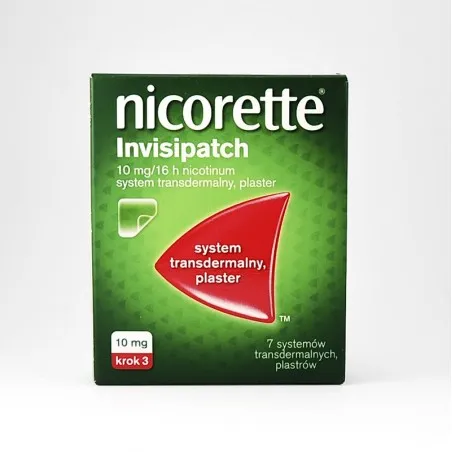
Table of Contents
- PACKAGE LEAFLET: INFORMATION FOR THE USER
- 1. What Nicorette Invisipatch is and what it is used for
- 2. Important information before using Nicorette Invisipatch
- 3. How to use the medicine Nicorette Invisipatch
- 4. Possible adverse reactions
- 5. How to store Nicorette Invisipatch
- 6. Contents of the pack and other information
PACKAGE LEAFLET: INFORMATION FOR THE USER
NICORETTE INVISIPATCH
10 mg/16 h transdermal system, patch
Nicotinum
NICORETTE INVISIPATCH
15 mg/16 h transdermal system, patch
Nicotinum
NICORETTE INVISIPATCH
25 mg/16 h transdermal system, patch
Nicotinum
Please read this leaflet carefully before using the medicine, as it contains
important information for the patient.
This medicine should always be used exactly as described in this patient leaflet or as directed by a
doctor or pharmacist.
- Keep this leaflet, as you may need to read it again.
- Consult your pharmacist if you need advice or further information.
- If there is no improvement or if the patient feels worse, contact a doctor.
- If any adverse reactions occur, including any possible adverse reactions not listed in this leaflet, inform your doctor or pharmacist. See section 4.
Leaflet contents:
- What Nicorette Invisipatch is and what it is used for
- Important information before using Nicorette Invisipatch
- How to use Nicorette Invisipatch
- Possible side effects
- How to store Nicorette Invisipatch
- Contents of the pack and other information
1. What Nicorette Invisipatch is and what it is used for
Mechanism of action
When a patient stops smoking cigarettes and nicotine is no longer regularly supplied to the body, various symptoms of nicotine withdrawal begin to appear, such as irritability, restlessness, mood disturbances, dizziness, headaches, and sleep disturbances. Nicorette Invisipatch patches can help prevent or reduce these symptoms by delivering appropriate doses of nicotine to the body.
The nicotine contained in Nicorette Invisipatch patches is administered in pure form. Unlike cigarettes, Nicorette Invisipatch patches do not release harmful tar substances or carbon dioxide produced during combustion.
Nicotine is slowly and steadily released from the Nicorette Invisipatch patch and absorbed through the skin at a constant rate. Continuous release of nicotine is possible due to its uniform distribution within the patch.
Nicorette patches are intended for use during waking hours, i.e. for approximately 16 hours per day, as they are designed to mimic the nicotine delivery pattern during smoking. Maximum concentration is reached in the afternoon/evening, when the risk of relapse is highest.
Indications
The medicine is indicated for the treatment of tobacco dependence in individuals determined to quit smoking, by reducing nicotine craving and withdrawal symptoms occurring after smoking cessation.
2. Important information before using Nicorette Invisipatch
When not to use Nicorette Invisipatch
- If the patient is allergic to nicotine or to any of the other ingredients of this medicine (listed in section 6).
Warnings and precautions
Consult a doctor before using Nicorette Invisipatch patches if the patient has:
- Recently suffered a stroke or myocardial infarction;
- Chest pain or symptoms of angina pectoris;
- Uncontrolled arterial hypertension;
- Peptic ulcer of the stomach or duodenum;
- Hyperthyroidism;
- Insulin-dependent diabetes (lower insulin doses may be required as a result of stopping smoking);
- Diagnosed pheochromocytoma;
- Severe or moderate liver disease;
- Severe kidney disease;
- Oesophagitis;
- A history of epilepsy or seizures.
The Nicorette Invisipatch patch must be removed before undergoing magnetic resonance imaging (MRI) to prevent burns.
Some patients may continue using Nicorette Invisipatch beyond the recommended treatment period; however, the potential risk of long-term use of Nicorette Invisipatch is significantly lower than the risk associated with returning to smoking tobacco.
Combination therapy
Warnings and precautions for combination therapy are the same as those applying to the use of Nicorette Invisipatch and the chosen Nicorette oral product used as monotherapy. Please refer to the package leaflet of the chosen Nicorette product for information on warnings and precautions regarding its use.
Nicorette Invisipatch and other medicines
Inform the doctor about all medicines currently or recently taken, as well as any medicines the patient plans to take. Stopping cigarette smoking may require dosage adjustments of these medicines.
If taking medicines such as imipramine, clomipramine, fluvoxamine (medicines used in the treatment of depression), clozapine, olanzapine (medicines used in the treatment of schizophrenia), theophylline (a medicine used in the treatment of bronchial asthma, chronic obstructive pulmonary disease, and bronchial inflammatory conditions), tacrine (a medicine used in Alzheimer's disease), ropinirole (a medicine used in Parkinson's disease), flecainide (a medicine used, among others, in tachycardia, paroxysmal atrial fibrillation, arrhythmia), pentazocine (an analgesic), or insulin, consult a doctor before using Nicorette Invisipatch patches.
Pregnancy and breastfeeding
If the patient is pregnant or breastfeeding, suspects she may be pregnant, or is planning to have a child, she should consult a doctor before using this medicine.
Nicotine passes into breast milk in amounts that may affect the child, even when used at therapeutic doses.
Driving and operating machinery
This medicine has no effect or negligible effect on the ability to drive and operate machinery.
3. How to use the medicine Nicorette Invisipatch
Children and adolescents
Nicorette Invisipatch should not be used in individuals under 18 years of age without medical advice. Data on the treatment of this age group with Nicorette Invisipatch are limited.
Adults and elderly
The patch should be applied in the morning upon waking, onto intact skin, and removed before going to sleep. Treatment with patches (transdermal system) mimics the fluctuations in nicotine levels seen in smokers during the day, while avoiding nicotine intake during sleep. Using the patch during the day does not cause sleep disturbances observed when nicotine is administered during sleep.
Monotherapy
For individuals with high dependence, treatment should begin with Step 1, i.e. the 25 mg/16 h patch applied once daily for eight weeks. Then, gradual discontinuation of patches (transdermal system) should begin. Apply the 15 mg/16 h patch once daily for two weeks, followed by the 10 mg/16 h patch once daily for another two weeks.
For individuals with low dependence, treatment should begin with Step 2, i.e. the 15 mg/16 h patch applied once daily for eight weeks, followed by continued treatment with the 10 mg/16 h patch (Step 3) for another four weeks.
Dosing schedule
| High dependence | | Low dependence | | |----------------------|----------------------|----------------------|----------------------| | Dose | Duration of therapy | Dose | Duration of therapy | | Step 1 Nicorette Invisipatch, 25 mg/16 h | First 8 weeks | Step 2 Nicorette Invisipatch, 15 mg/16 h | First 8 weeks | | Step 2 Nicorette Invisipatch, 15 mg/16 h | Next 2 weeks | Step 3 Nicorette Invisipatch, 10 mg/16 h | Last 4 weeks | | Step 3 Nicorette Invisipatch, 10 mg/16 h | Last 2 weeks | | |
The use of patches is not recommended for longer than 6 months. However, some former smokers may require a longer treatment period to prevent relapse.
Combination therapy
Patches can be used alone or in combination with other Nicorette nicotine-containing products. Using more than one form of nicotine replacement therapy (NRT) is beneficial for highly dependent smokers, those who have relapsed despite monotherapy with NRT, or those who have difficulty controlling cigarette cravings while on monotherapy. If needed to quickly manage an urge to smoke, the Nicorette Invisipatch patch may be used together with the following Nicorette products: 2 mg chewing gum, 2 mg lozenges, or 1 mg/dose oral spray.
Smokers using combination therapy should follow the dosing recommendations for patches and the selected oral Nicorette product as advised for monotherapy.
Patients using combination therapy are advised to use only one selected Nicorette product in addition to the patch during the day.
The patch should be applied in the morning upon waking and removed after 16 hours, before going to sleep, according to the dosing schedule recommended for monotherapy (see above).
The Nicorette 2 mg chewing gum or Nicorette 2 mg lozenge should be used as needed when a smoker feels a strong urge to smoke, without exceeding the maximum daily dose of 15 gums or lozenges.
The gum may be used as needed for up to 12 weeks, after which its use should be gradually reduced. The maximum duration of gum use is 12 months.
The lozenge may be used as needed for up to 6 weeks, after which its use should be gradually reduced. The maximum duration of lozenge use is 9 months.
The Nicorette 1 mg/dose oral spray should be used as needed, without exceeding 2 doses at a time or 64 doses (4 doses per hour for 16 hours) per day. Regular use of the oral spray is generally not recommended for longer than 6 months.
Some former smokers may require longer use of gum, lozenges, or spray to prevent relapse. The remaining product should be kept for use in case of sudden nicotine cravings.
Weaning schedule: Weaning should begin with gradual discontinuation of patches according to the dosing schedule recommended for monotherapy (see above). If further treatment is needed, the selected Nicorette product should be used according to the dosing recommendations for monotherapy.
Recommended dosing of patches in combination with 2 mg chewing gum / 2 mg lozenges / 1 mg/dose oral spray:
High degree of dependence
| Dosage | Duration of therapy | Gum 2 mg | Tablets 2 mg | Aerosol 1 mg/dose | |
| Step 1 | Nicorette Invisipatch, 25 mg/16 h | First 8 weeks | Use as needed, but no more than 15 gums/day. Recommended dosage is 5–6 gums/day. | Use as needed, but no more than 15 tablets/day. Recommended dosage is 5–6 tablets/day. | Use as needed, but no more than 64 doses/day (4 doses/hour for 16 hours). Recommended dosage is 1–2 doses every 30 min for 1 hour. From week 7, begin reducing the number of doses. |
| Step 2 | Nicorette Invisipatch, 15 mg/16 h | Next 2 weeks | Use as needed, but no more than 15 gums/day. | Use as needed, but no more than 15 tablets/day. | Use as needed, but no more than 64 doses/day (4 doses/hour for 16 hours). Continue reducing the number of daily doses. By the end of week 9, the patient should be using half the average number of doses used up to week 6. |
| Step 3 | Nicorette Invisipatch, 10 mg/16 h | Last 2 weeks | Use as needed, but no more than 15 gums/day. Begin gradual reduction in the number of gums. | Use as needed, but no more than 15 tablets/day. Begin gradual reduction in the number of tablets. | Continue to reduce the number of daily doses so that by week 12, no more than 4 doses/day are used. When the number of daily doses |
| has been reduced to 2–4, aerosol use should be discontinued. Do not use more than 64 doses/day (4 doses/hour for 16 hours). | |||||
| After step 3 | None | After 12 weeks | Use as needed, up to 12 months. | Use as needed, up to 9 months. | Use as needed, up to 6 months. |
Low dependence potential
| Dosage | Duration of therapy | Gum 2 mg | Tablets 2 mg | Aerosol 1 mg/dose | |
| Step 2 | Nicorette Invisipatch, 15 mg/16 h | First 8 weeks | Use as needed, but no more than 15 gums/day. | Use as needed, but no more than 15 tablets/day. | Use as needed, but no more than 64 doses/day (4 doses/hour for 16 hours). Recommended dosage is 1-2 doses every 30 minutes for up to 1 hour. From week 7, begin reducing the number of doses. |
| Step 3 | Nicorette Invisipatch, 10 mg/16 h | Last 4 weeks | Use as needed, but no more than 15 gums/day. Begin gradual reduction of the number of gums. | Use as needed, but no more than 15 tablets/day. Begin gradual reduction of the number of tablets. | Continue reducing the number of doses per day. By the end of week 9, the patient should be using half the average number of doses used up to week 6. By week 12, no more than 4 doses/day. When the number of doses per day has been reduced to 2–4, discontinue use of the aerosol. Do not exceed 64 doses/day (4 doses/hour for 16 hours). |
| After step 3 | None | After 12 weeks | Use as needed, up to 12 months. | Use as needed, up to 9 months. | Use as needed, up to 6 months. |
It is advisable to seek support group advice, as it may help support the smoking cessation process
and lead to a successful outcome of therapy.
Instructions for use
Apply the Nicorette Invisipatch patch to clean, dry, intact, non-hairy skin, for example on the buttocks,
upper arm, or chest area. Change the application site daily; do not use the same site on consecutive days.
You may bathe and shower as usual.
- Wash your hands before applying the patch.
- Cut the packaging along the marked line with scissors. Select a clean, dry, intact, non-hairy area of skin, such as the buttocks, upper arm, or chest.
- Remove the silver aluminum protective liner from the patch. Avoid touching the adhesive side of the patch with fingers as much as possible.
- Carefully apply the patch to the skin and peel off the remaining part of the silver aluminum protective liner.
- Press the patch firmly onto the skin with your hand or fingers.
- Rub the edges of the patch with your fingers to ensure it is properly adhered. After removal, dispose of used patches properly.
Use of a higher than recommended dose of Nicorette Invisipatch
Abuse of nicotine, either during replacement therapy and (or) smoking, may lead to
symptoms of overdose.
Overdose symptoms are the same as those of acute nicotine poisoning and include nausea,
vomiting, excessive salivation, abdominal pain, diarrhea, profuse sweating, headache, dizziness,
hearing disturbances, and significant weakness. At high doses, these symptoms may be
accompanied by hypotension, weak and irregular pulse, breathing difficulties, exhaustion, circulatory collapse, and generalized seizures.
Doses of nicotine tolerated by adults during treatment may cause severe poisoning in young children and may be fatal.
Management in case of overdose
Nicotine administration should be stopped immediately; the patient should be treated symptomatically.
In case of ingestion of excessive nicotine, activated charcoal reduces gastrointestinal absorption of nicotine.
Remove the patch and wash the application site with water.
Missed dose of Nicorette Invisipatch
Do not use a double dose to make up for a missed dose.
4. Possible adverse reactions
Like all medicines, this product may cause adverse reactions, although not everybody will experience them.
Some symptoms may occur as a result of stopping smoking. These include mood deterioration,
insomnia, irritability, frustration, anger, anxiety, difficulty concentrating, restlessness,
or impatience. Physical symptoms may also occur, such as decreased heart rate, increased appetite or weight gain,
dizziness or pre-syncopal symptoms, cough, constipation, gum bleeding, aphthous ulcers or nasopharyngitis, and
nicotine craving associated with the urge to smoke.
The medicine Nicorette Invisipatch may cause adverse reactions similar to those occurring with nicotine absorbed
from cigarette smoking or use of other tobacco products.
These effects are mostly dose-dependent with regard to nicotine.
Mild, local skin reactions occur in approximately 20% of patients using Nicorette Invisipatch patches
during the first weeks of treatment.
Allergic reactions (including severe allergic reactions) may rarely occur during use of Nicorette Invisipatch.
Adverse reactions related to nicotine reported in the post-marketing period are listed in the table below.
The frequency of occurrence is defined according to the following classification:
Common (may occur in 1 to 10 out of 100 people)
Uncommon (may occur in 1 to 10 out of 1,000 people)
Not known (frequency cannot be estimated based on available data)
| System Organ Class Frequency | Adverse Reaction |
| Cardiac disorders Not very common Not very common | Palpitations Tachycardia |
| Gastrointestinal disorders Unknown | Gastrointestinal discomfort* |
| General disorders and administration site conditions Not very common Not very common Not very common Not very common | Reactions at the injection site Asthenia Chest discomfort and pain Malaise |
| Immune system disorders Unknown | Anaphylactic reaction (sudden, severe allergic reaction) |
| Musculoskeletal and connective tissue disorders Not very common Unknown | Muscle pain* Limb pain |
| Psychiatric disorders Not very common | Unusual dreams |
| Nervous system disorders Unknown | Seizures |
| Respiratory, thoracic and mediastinal disorders Not very common | Dyspnoea |
| Skin and subcutaneous tissue disorders Unknown Unknown Not very common Frequent Frequent | Angioedema (a skin and mucous membrane disorder characterized by localized swelling) Erythema Excessive sweating Rash Urticaria |
| Vascular disorders Not very common Not very common | Facial flushing Hypertension |
in the area of the patch
Combined therapy
When using combined therapy, in addition to adverse reactions related to the use of Nicorette Invisipatch patches, adverse reactions resulting from the use of the selected Nicorette oral product may also occur, including local adverse reactions associated with the specific pharmaceutical form. Please refer to the leaflet included in the packaging of the selected Nicorette product to learn about adverse reactions related to its use.
Reporting adverse reactions
If any adverse symptoms occur, including any adverse symptoms not listed in this leaflet, inform your doctor or pharmacist. Adverse reactions can be reported directly to the Department of Monitoring Adverse Drug Reactions of the Office for Registration of Medicinal Products, Medical Devices and Biocidal Products, Al. Jerozolimskie 181C, 02-222 Warsaw, telephone: +48 22 49 21 301, fax: +48 22 49 21 309, website: https://smz.ezdrowie.gov.pl.
Adverse reactions can also be reported to the responsible entity.
Reporting adverse reactions helps to gather further information on the safety of the medicinal product.
5. How to store Nicorette Invisipatch
Keep the medicine out of the reach and sight of children.
Store below 25°C.
Do not use Nicorette Invisipatch after the expiry date stated on the packaging. The expiry date refers to the last day of the specified month.
Medicines must not be disposed of via wastewater or household waste. Ask your pharmacist how to dispose of medicines no longer required. This will help protect the environment.
6. Contents of the pack and other information
What Nicorette Invisipatch contains
- The active substance is nicotine. One patch (transdermal system) 10 mg/16 h contains 15.75 mg of nicotine. One patch (transdermal system) 15 mg/16 h contains 23.62 mg of nicotine. One patch (transdermal system) 25 mg/16 h contains 39.37 mg of nicotine.
- Other components are: Backing layer: medium-chain triglycerides, basic butyl methacrylate copolymer; Outer protective layer: polyethylene terephthalate (PET) 19 µm; Adhesive acrylic layer: Durotak 387-2051 acrylic adhesive solution, potassium hydroxide, sodium croscarmellose, aluminium acetylacetonate; Protective liner, removed before application of the patch to the skin: polyethylene terephthalate (PET) 100 µm.
What Nicorette Invisipatch looks like and contents of the pack
The medicine is in the form of patches packed in individual sachets made of laminated foil (paper, PET film, aluminium, acrylonitrile copolymer or extruded cyclic polyolefin copolymer), placed in a cardboard box.
The pack contains 7, 14 or 28 patches.
Marketing Authorisation Holder and Manufacturer
Marketing Authorisation Holder: McNeil AB, SE-251 09 Helsingborg, Sweden.
Manufacturer: LTS Lohmann Therapie-Systeme AG, Lohmannstrasse 2, D-56626 Andernach, Germany.
For further information, please contact:
email: [email protected]