Nicorette icy white chewing gum
Poland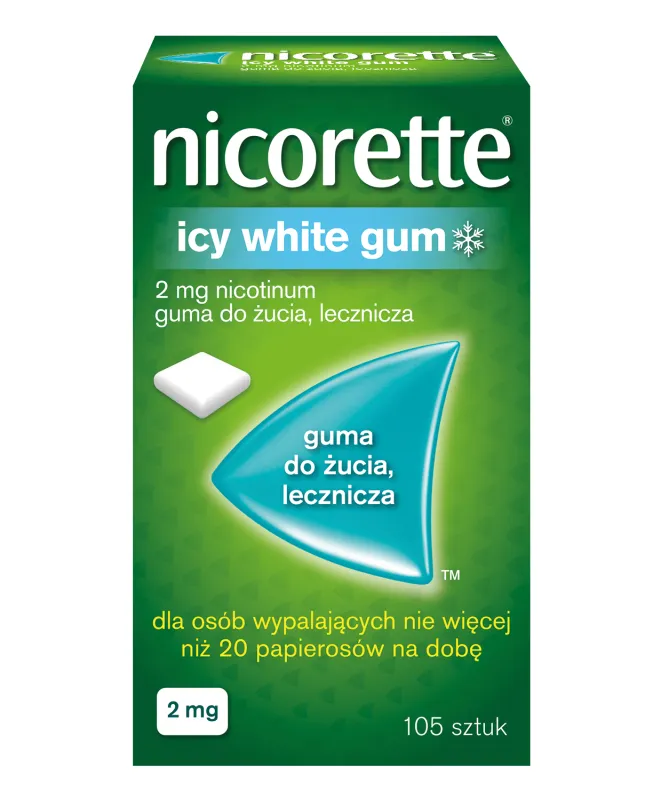
Table of Contents
- Package leaflet: Information for the patient
- 1. What Nicorette Icy White Gum is and what it is used for
- 2. Important information before using Nicorette Icy White Gum
- 3. How to use Nicorette Icy White Gum
- 4. Possible adverse reactions
- 5. How to store Nicorette Icy White Gum
- 6. Contents of the pack and other information
Package leaflet: Information for the patient
Nicorette Icy White Gum, 2 mg, chewing gum, medicinal
Nicorette Icy White Gum, 4 mg, chewing gum, medicinal
Nicotinum
Please read this leaflet carefully before using this medicine, because it contains
important information for the patient.
This medicine should always be used exactly as described in this patient leaflet or as directed by
the doctor or pharmacist.
- Keep this leaflet so that it can be read again if necessary.
- If advice or further information is needed, consult a pharmacist.
- If the patient experiences any adverse reactions, including any adverse reactions not listed in this leaflet, inform the doctor or pharmacist. See section 4.
- If after 9 months the patient still has difficulty refraining from smoking without the help of Nicorette Icy White Gum, he or she should contact a doctor.
Contents of the leaflet:
- What Nicorette Icy White Gum is and what it is used for
- Important information before using Nicorette Icy White Gum
- How to use Nicorette Icy White Gum
- Possible side effects
- How to store Nicorette Icy White Gum
- Contents of the pack and other information
1. What Nicorette Icy White Gum is and what it is used for
Mechanism of action
When the patient stops smoking cigarettes and nicotine is no longer regularly supplied to the body, various withdrawal symptoms begin to appear, including irritability, restlessness, mood disturbances, dizziness and headaches, and sleep disturbances. Nicorette Icy White Gum chewing gum can help prevent or reduce these symptoms by delivering small doses of nicotine to the body over a short period of time.
The nicotine contained in Nicorette Icy White Gum chewing gum is administered in pure form.
Unlike cigarettes, Nicorette Icy White Gum chewing gum does not release harmful tar substances or carbon dioxide, which are produced during tobacco combustion.
Indications
Nicorette Icy White Gum is indicated in the treatment of tobacco dependence by reducing nicotine craving and withdrawal symptoms occurring after stopping smoking.
2. Important information before using Nicorette Icy White Gum
When not to use Nicorette Icy White Gum
- If the patient is allergic to nicotine or to any of the other ingredients of this medicine (listed in section 6).
Warnings and precautions
Before starting to use Nicorette Icy White Gum, consult a doctor in the following cases:
- Recent stroke or myocardial infarction,
- Chest pain or symptoms of angina pectoris,
- Uncontrolled hypertension,
- Peptic ulcer of the stomach or duodenum,
- Hyperthyroidism,
- Insulin-dependent diabetes (lower insulin doses may be required as a result of stopping smoking),
- Diagnosed pheochromocytoma,
- Severe or moderate liver disease,
- Severe kidney disease,
- Oesophagitis,
- History of epilepsy or seizures.
The chewing gum may adhere to, and in rare cases cause damage to, dental prostheses.
Some patients may continue using Nicorette Icy White Gum for longer than the recommended treatment period; however, the potential risk of long-term use is considerably lower than the risk associated with returning to smoking tobacco.
Nicorette Icy White Gum and other medicines
Inform the doctor about all medicines currently used or recently used, as well as any medicines the patient plans to take. Stopping smoking may require adjustment of dosages of other medicines.
If the patient is taking imipramine, clomipramine, fluvoxamine (medicines used in the treatment of depression), clozapine, olanzapine (medicines used in the treatment of schizophrenia), theophylline (a medicine used in the treatment of bronchial asthma, chronic obstructive pulmonary disease and inflammatory airway conditions), tacrine (a medicine used in Alzheimer's disease), ropinirole (a medicine used in Parkinson's disease), flecainide (a medicine used, among others, in tachycardia, paroxysmal atrial fibrillation and cardiac arrhythmias), pentazocine (a pain-relieving medicine), or insulin, medical advice should be sought before using Nicorette Icy White Gum therapeutic chewing gum.
Pregnancy and breastfeeding
If the patient is pregnant or breastfeeding, suspects she may be pregnant, or is planning to have a baby, she should consult a doctor before using this medicine.
To reduce exposure to the infant, the medicine should be used immediately after breastfeeding.
Driving and operating machinery
This medicine has no effect or has a negligible effect on the ability to drive and operate machinery.
Nicorette Icy White Gum contains butylated hydroxytoluene (E 321). The medicine may cause irritation of mucous membranes.
The medicine contains less than 1 mmol (23 mg) of sodium per dose, i.e. the medicine is considered "sodium-free".
3. How to use Nicorette Icy White Gum
Children and adolescents
Nicorette Icy White Gum chewing gum should not be used in individuals under 18 years of age without medical advice. Data on treatment with Nicorette Icy White Gum in this age group are limited.
Adults and elderly
The initial dose should be individually determined according to the degree of nicotine dependence. Typically, 8–12 chewing gums per day containing the appropriate amount of nicotine are used. Individuals with low dependence (smoking ≤ 20 cigarettes/day) should start treatment with the 2 mg dose. Individuals with high dependence should start treatment with the 4 mg dose. Do not use more than 15 gums per day.
Smoking cessation
Nicorette Icy White Gum helps individuals determined to quit smoking to stop the habit. The gum should be used for at least 3 months. Then, gradual discontinuation should be initiated. Treatment should be stopped when the dose has been reduced to 1–2 gums per day.
Smoking reduction
Nicorette Icy White Gum helps reduce smoking in individuals unwilling or unable to quit completely. To extend the intervals between cigarettes and maximally reduce the number of cigarettes smoked, use the gum between cigarettes, whenever the urge to smoke arises. If no reduction in daily cigarette consumption is achieved after 6 weeks, consult a doctor.
Consider making a serious attempt to quit smoking as soon as possible, but no later than 6 months after starting treatment. If a serious attempt to quit smoking is not possible within 9 months of starting treatment, consult a doctor.
Regular use of the gum for longer than 12 months is generally not recommended. However, some former smokers may require longer treatment to prevent relapse. Unused gums should be kept for sudden nicotine cravings.
Seek advice from support groups, as they may improve the quitting process and help achieve successful treatment outcomes.
Temporary abstinence
Nicorette Icy White Gum helps smokers temporarily refrain from smoking. Use the gum during breaks between cigarettes when the urge to smoke arises, for example in places where smoking is prohibited or in other situations where smoking should be avoided.
Use of gum in combination with patches
The gum can be used alone or in combination with nicotine-containing patches. Using more than one form of nicotine replacement therapy (NRT) is beneficial for smokers who have relapsed despite previous monotherapy with NRT or who have difficulty controlling cigarette cravings during monotherapy. Therefore, if necessary, Nicorette Invisipatch 15 mg/16 h and Nicorette Icy White Gum 2 mg may be used together.
Apply the Nicorette Invisipatch 15 mg/16 h patch in the morning upon waking and remove it after 16 hours, before going to sleep. Use it according to the dosing regimen approved for monotherapy. Chew Nicorette Icy White Gum 2 mg when experiencing a strong urge to smoke, without exceeding the maximum daily dose of 15 gums. The gum may be used in this way for up to 12 weeks, after which gum use should be gradually reduced. The maximum duration of gum use is 12 months.
How to chew Nicorette Icy White Gum
Chew the gum whenever you feel the need to smoke. Chew the gum slowly to release nicotine, then stop chewing and place it between your gum and cheek to allow nicotine to be absorbed through the oral mucosa. Swallowed nicotine mixed with saliva has no beneficial effect and may irritate the throat or stomach, potentially causing hiccups. Do not chew Nicorette Icy White Gum continuously and vigorously like regular gum, as this causes too rapid release of nicotine. Nicorette Icy White Gum should be chewed slowly, with regular pauses.
Chewing technique
- Chew the gum slowly until you taste the flavour.
- Then stop chewing and place the gum between your gum and cheek.
- Start chewing again when the taste fades.
- Repeat this process for approximately 30 minutes.
Use of more than the recommended dose of Nicorette Icy White Gum
Abuse of nicotine, either from nicotine replacement products and/or continued cigarette smoking, may lead to symptoms of overdose. The risk of poisoning following ingestion of the chewing gum is very low because nicotine absorption without chewing is slow and incomplete.
Symptoms of nicotine overdose include: nausea, vomiting, excessive salivation, abdominal pain, diarrhoea, excessive sweating, headache, dizziness, hearing disturbances, and marked weakness. After large doses, these symptoms may be accompanied by hypotension, weak and irregular pulse, breathing difficulties, exhaustion, circulatory collapse, and generalized seizures.
Doses of nicotine tolerated by adults during treatment may cause severe poisoning in young children and may be fatal.
Keep the medicine out of the reach of children. In case of overdose, stop administering nicotine immediately and seek medical help. The doctor will provide appropriate symptomatic treatment.
In cases of excessive nicotine ingestion, activated charcoal reduces gastrointestinal absorption of nicotine.
If too many gums have been used, or if a child has chewed or swallowed a gum, contact a doctor immediately or go to the nearest hospital, taking the gum packaging and this leaflet with you.
4. Possible adverse reactions
Like any medicine, this product may cause adverse reactions, although not everyone experiences them.
Some symptoms may occur as a result of stopping smoking. These include mood deterioration,
insomnia, irritability, frustration, anger, anxiety, difficulty concentrating, restlessness,
or impatience. Physical symptoms may also occur, such as decreased heart rate, increased
appetite or weight gain, dizziness or pre-syncope symptoms, cough, constipation, gum bleeding,
aphthous ulcers or nasopharyngitis, and nicotine craving associated with the urge to smoke.
Most of the reported adverse reactions occur during the first weeks of treatment. Irritation of the
oral cavity and throat may occur, but most patients become accustomed to this during treatment.
The chewing gum may stick to, and in rare cases cause damage to, dental prostheses.
Allergic reactions (including severe allergic reactions) may rarely occur during use of Nicorette Icy White Gum.
Adverse reactions reported in at least 1% of patients treated with nicotine in clinical trials and during the post-marketing period are listed in the table below. The frequency of occurrence is defined according to the following classification:
Very common (may affect up to 1 in 10 people)
Common (may affect up to 1 in 100 people)
Uncommon (may affect up to 1 in 1,000 people)
Rare (may affect up to 1 in 10,000 people)
Not known (frequency cannot be estimated from the available data)
| System Organ Class Frequency | Adverse Reaction |
| Cardiac disorders Not frequently Not frequently Unknown | Palpitations (pounding heartbeat) Tachycardia (increased heart rate) Rapid and irregular heartbeat (atrial fibrillation) |
| Eye disorders Unknown Unknown | Blurred vision Increased lacrimation |
| Gastrointestinal disorders Frequent Frequent Frequent Frequent Very frequent Frequent Frequent Frequent Frequent Unknown Rare Not frequently Unknown Not frequently Rare Not frequently Unknown Not frequently Rare | Abdominal pain Dry mouth Dyspepsia Flatulence Nausea Excessive salivation Stomatitis Vomiting Diarrhea Dryness of mucous membranes in the throat Dysphagia (difficulty swallowing) Belching Gastrointestinal discomfort Glossitis (inflammation of the tongue) Oral hypogeusia Blisters and peeling of the oral mucosa Lip pain Tingling/numbness sensation in the mouth Vomiting reflex |
| General disorders and administration site conditions Frequent Frequent Not frequently Not frequently Not frequently | Burning sensation Fatigue Weakness Chest discomfort and pain Malaise |
| Immune system disorders Frequent Unknown | Hypersensitivity Anaphylactic reaction (sudden, severe allergic reaction which may manifest as urticaria, itching, flushing, shortness of breath, hypotension, abdominal pain, diarrhea or vomiting) |
| Nervous system disorders Very frequent Frequent Frequent Unknown | Headache Altered taste sensation Sensation of cold, heat and tingling on the skin Seizures |
| Musculoskeletal disorders Unknown Not frequently | Jaw muscle stiffness Jaw pain |
| Psychiatric disorders Not frequently | Unusual dreams |
| Respiratory, thoracic and mediastinal disorders Frequent | Cough |
| Very frequent Very frequent Not frequently Not frequently Not frequently Not frequently Not frequently Not frequently Not frequently | Hiccups Throat irritation Bronchospasm Voice disorders Dyspnea Nasal mucosa hyperemia Pain in mouth and throat Sneezing Throat tightness |
| Skin and subcutaneous tissue disorders Unknown Unknown Not frequently Not frequently Not frequently Not frequently | Angioedema (a skin and mucous membrane disorder characterized by localized swelling) Erythema Excessive sweating Itching Rash Urticaria |
| Vascular disorders Not frequently Not frequently | Facial flushing Hypertension |
Reporting of adverse reactions
If any adverse reactions occur, including any adverse reactions not listed
in this leaflet, inform a doctor or pharmacist. Adverse reactions can
be reported directly to the Department of Monitoring Adverse Drug Reactions of the Office for Registration of Medicinal Products, Medical Devices and Biocidal Products, Al. Jerozolimskie 181C, 02-222 Warsaw, phone: +48 22 49 21 301,
fax: +48 22 49 21 309, website: https://smz.ezdrowie.gov.pl.
Adverse reactions can also be reported to the marketing authorization holder.
Reporting adverse reactions helps to gather further information on the safety of the medicine.
5. How to store Nicorette Icy White Gum
Keep the medicine out of the sight and reach of children.
Store below 25°C.
Do not use this medicine after the expiry date stated on the packaging. The expiry date refers to the last day of the stated month.
Medicines must not be disposed of via wastewater or household waste. Ask your pharmacist how to dispose of medicines no longer required. This will help protect the environment.
6. Contents of the pack and other information
What Nicorette Icy White Gum contains
- The active substance is nicotine. Each chewing gum contains 2 mg or 4 mg of nicotine, in the form of nicotine with cationite.
- Other ingredients are: core – chewing gum base (Cafosa 258 Soft) (E321), xylitol (E967), peppermint oil, anhydrous sodium carbonate, sodium bicarbonate (only in the 2 mg dose), acesulfame potassium (E950), levomenthol, magnesium oxide, aluminium lake of quinoline yellow (E104) (only in the 4 mg dose); sub-coating – Winterfresh RDE4-149, hypromellose, sucralose (E955), polysorbate 80; hard coating – xylitol (E967), starch, titanium dioxide (E171), Winterfresh RDE4-149, carnauba wax, aluminium lake of quinoline yellow (E104) (only in the 4 mg dose).
Nicorette Icy White Gum chewing gum does not contain sugar (sucrose) or ingredients of animal origin.
What Nicorette Icy White Gum looks like and contents of the pack
The pack contains 6, 10, 12, 15, 30, 105 or 210 chewing gums in blisters, packed in a cardboard box.
Marketing Authorisation Holder and Manufacturer
Marketing Authorisation Holder: McNeil AB, SE-251 09 Helsingborg, Sweden.
Manufacturer: McNeil AB, SE-251 09 Helsingborg, Sweden.
For further information, please contact:
email: [email protected]