Lerivon
Poland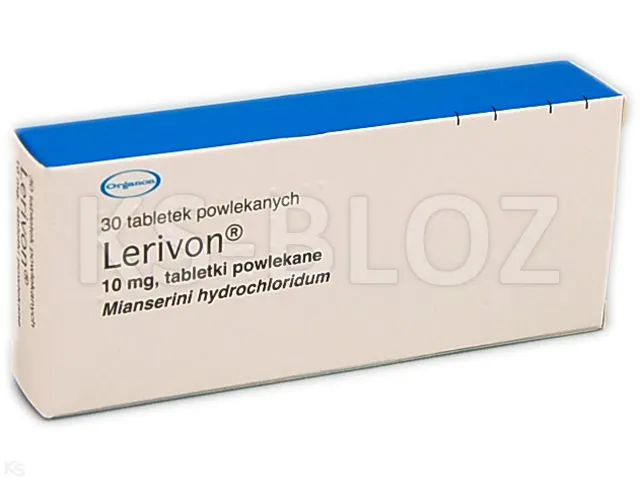
Table of Contents
Package leaflet: Information for the user
Lerivon, 10 mg, film-coated tablets
Lerivon, 30 mg, film-coated tablets
Mianserin hydrochloride
Please read all of this leaflet carefully before taking this medicine, because it contains
important information for you.
- Keep this leaflet. You may need to read it again.
- If you have any further questions, ask your doctor or pharmacist.
- This medicine has been prescribed for you only. Do not pass it on to others. It may harm them even if their symptoms are the same as yours.
- If you experience any side effects, including any not listed in this leaflet, tell your doctor or pharmacist. See section 4.
Contents of the leaflet
- What Lerivon is and what it is used for
- What you need to know before taking Lerivon
- How to take Lerivon
- Possible side effects
- How to store Lerivon
- Contents of the pack and other information
1. What Lerivon is and what it is used for
Lerivon is an antidepressant medicine containing mianserin hydrochloride as the active substance.
Lerivon is an antidepressant medicine that helps relieve depressive mood, which is the most common symptom of depression. Depression is a mental illness. During depression, changes occur in the brain. Brain nerve cells communicate with each other using chemical substances. In depression, the amount of these substances decreases. Antidepressant medicines increase the levels of these substances and restore normal brain function.
Improvement usually occurs after 2 to 4 weeks of treatment.
2. Important information before using Lerivon
When not to use Lerivon
Do not use Lerivon if the patient:
- is allergic to mianserin or any of the other ingredients of this medicine (listed in section 6);
- is experiencing mania (a state of excitement and excessive activity);
- has severe liver failure;
- is currently taking or has recently taken (within the last two weeks) medicines that are monoamine oxidase inhibitors (MAO inhibitors).
Use in children and adolescents under 18 years of age
Lerivon is normally not intended for use in children and adolescents under 18 years of age.
It should also be emphasized that when medicines of this class are used, patients under 18 years of age are at increased risk of experiencing adverse effects such as suicidal behaviour, suicidal thoughts, and hostility (particularly aggression, defiant behaviours, and manifestations of anger). Nevertheless, a doctor may prescribe Lerivon to patients under 18 years of age if they consider it necessary. If your doctor has prescribed Lerivon for a patient under 18 years of age and you have any doubts, please consult the prescribing doctor. If any of the above-mentioned symptoms develop or worsen in patients under 18 years of age taking Lerivon, you should inform your doctor immediately. Furthermore, to date, there are no data on the long-term safety of Lerivon use in this age group regarding growth, maturation, cognitive development, and behavioural development.
Suicidal thoughts and worsening of depression
Patients with depression and/or anxiety disorders may sometimes have thoughts about self-harm or suicidal ideation. Patients with depression are at increased risk of self-harm or suicide, especially at the beginning of treatment, before the medicine starts to take effect, which usually takes about two weeks or sometimes longer.
This may occur:
- if the patient has previously experienced thoughts of suicide or self-harm;
- if the patient is a young adult. Clinical trial data show an increased risk of suicidal behaviour in psychiatric patients under 25 years of age taking antidepressant medicines.
Seek immediate medical advice or go to hospital immediately if you experience suicidal thoughts or thoughts of self-harm.
It may be helpful if the patient informs a family member or someone close that they have depression or anxiety disorders and asks them to read this leaflet. The patient may also ask them to inform if they notice worsening of depression or anxiety, or if they are concerned about changes in the patient's behaviour.
Special caution is required when using Lerivon if the following conditions are present or have ever been present:
- epilepsy (seizures);
- diabetes;
- liver disorders, such as jaundice;
- kidney disorders;
- problems with urination due to benign prostatic hyperplasia;
- heart disorders, including arrhythmias, recent myocardial infarction, heart failure, or if the patient is taking medicines that affect heart rhythm;
- hypertension;
- glaucoma (increased pressure in the eye);
- psychiatric disorders, such as occurrence of hypomania in patients with bipolar affective disorder (alternating elevated mood/depressed mood);
- reduced white blood cell count or absence of white blood cells (see section 4, "Possible side effects").
Consult your doctor if any of the above conditions apply.
Warnings and precautions
Before starting Lerivon, discuss this with your doctor or pharmacist.
Lerivon and other medicines
Inform your doctor about all medicines currently used or recently used, as well as any medicines the patient plans to take, including those available without a prescription.
Other medicines may affect the action of Lerivon, and Lerivon may also affect other medicines.
Do not use Lerivon in combination with:
- monoamine oxidase inhibitors (MAOIs), or within two weeks of stopping such treatment. After discontinuing Lerivon, MAO inhibitors should not be taken for two weeks. MAO inhibitors include: moclobemide, tranylcypromine (antidepressants), selegiline (used in the treatment of Parkinson's disease), and linezolid (an antibiotic).
Exercise caution when using Lerivon in combination with:
- anticonvulsant medicines such as carbamazepine and phenytoin;
- anticoagulant medicines such as warfarin. Lerivon may enhance the effect of warfarin. Inform your doctor if you are taking these medicines. Blood monitoring is recommended when Lerivon is used concomitantly;
- medicines that may affect heart rhythm, such as certain antibiotics and antipsychotic medicines.
Lerivon with food and drink
Do not drink alcohol while taking Lerivon, as it intensifies the effects of alcohol.
Pregnancy and breastfeeding
If the patient is pregnant or breastfeeding, suspects she may be pregnant, or is planning to have a baby, she should consult her doctor or pharmacist before using this medicine.
Animal studies and limited human safety data indicate that mianserin has no harmful effects on the fetus or newborn. Mianserin passes into breast milk only in very small amounts. The benefits of mianserin for the mother during pregnancy and breastfeeding should be weighed against the potential risks to the fetus or newborn.
Driving and operating machinery
Lerivon may cause drowsiness.
Do not drive, as Lerivon impairs psychomotor performance.
Do not operate machinery or use tools.
3. How to use Lerivon
This medicine should always be used exactly as directed by the physician. If in doubt, consult
your doctor or pharmacist.
Recommended dose
Treatment should usually be started at a lower dose (30 mg daily), which may then be increased
until an appropriate patient response is achieved.
The dosage ranges from 60 to 90 mg, depending on the severity of depression. To ensure treatment
effectiveness, the medicine must be taken daily. It is essential to strictly follow the recommended
dosage and instructions for use. Tablets should be taken every day at the same time, preferably
as a single dose before going to bed.
If your doctor advises, Lerivon may also be taken in divided doses (one in the morning and one
in the evening before going to bed).
The tablets should be swallowed whole, without chewing, with a small amount of water or other
fluids.
Do not stop treatment immediately after improvement is observed. Stopping the medicine too early
or abruptly may lead to a worsening of health condition.
Consult your doctor, who will decide how to reduce the dosage and when treatment should be
discontinued.
Elderly patients:
Dosage should be individually adjusted for each patient. Initially, the dose should be 30 mg
daily. The dose may be increased every few days.
Usually, a dose lower than that for adults is sufficient to achieve a satisfactory clinical
response.
Use in children and adolescents:
Lerivon should not be used in the treatment of children and adolescents under 18 years of age.
Taking more Lerivon than recommended
If you take more than the recommended dose of Lerivon, contact your doctor or pharmacist
immediately.
Vomiting should be induced as quickly as possible. Symptoms of overdose include prolonged
drowsiness or sleepiness. Symptoms may also include changes in heart rhythm (rapid, irregular
heartbeat) and/or fainting. These may be signs of life-threatening ventricular arrhythmias
known as "torsade de pointes".
Missed dose of Lerivon
Do not take a double dose to make up for a missed dose.
If you miss a dose and take the medicine once daily before going to bed, do not take the
missed dose in the morning, as this may cause drowsiness and sleepiness during the day.
Continue treatment by taking the medicine in the evening according to the previously established
schedule.
If you miss one or both doses and take the medicine twice daily (one dose in the morning
after breakfast and one before going to bed), then:
- if you miss the morning dose, take it together with the evening dose;
- if you miss the evening dose, do not take it together with the morning dose; instead, continue treatment by taking the medicine the next day according to the previously established schedule;
- if you miss both doses, do not try to compensate for them; the next day, continue treatment by taking the usual doses: morning and evening.
Stopping Lerivon
Although Lerivon is not addictive, abrupt discontinuation after prolonged use may cause
dizziness, agitation, anxiety, headache, and nausea. Therefore, the dose should be gradually
reduced.
If you have any further questions about the use of this medicine, consult your doctor or
pharmacist.
4. Possible adverse reactions
Like all medicines, this medicine can cause adverse reactions, although not everyone experiences them.
The following may occur transiently:
- drowsiness or somnolence,
- weight gain,
- thoughts of self-harm or suicidal thoughts. In such a case, contact your doctor immediately or go to hospital.
In rare cases, Lerivon may cause a deficiency of white blood cells, which leads to
reduced resistance of the body to infections. If fever, sore throat, oral ulcers or other
signs of infection occur, immediate medical consultation and blood tests are required.
These symptoms usually appear after 4-6 weeks of treatment and resolve after
discontinuation of the medicine.
Other adverse reactions include:
- low blood pressure manifested by dizziness, blurred vision or fainting upon sudden change in body position;
- seizures;
- hypomania;
- increased levels of liver enzymes;
- swelling of the ankles or feet due to fluid accumulation;
- yellowing of the eyes or skin, which may indicate liver function disorders;
- hepatitis;
- reduced heart function after initial dose administration;
- neuroleptic malignant syndrome (key symptoms include whole-body rigidity, involuntary movements, increased body temperature);
- joint pain;
- restless legs syndrome (burning or tingling sensation in the legs causing insomnia);
- rash;
- changes in heart rhythm (rapid, irregular heartbeat) and/or fainting. These may be symptoms of life-threatening ventricular arrhythmias known as "torsade de pointes".
Suicidal thoughts, worsening of depression or anxiety disorders
Patients with depression or anxiety disorders may sometimes experience thoughts of self-harm or suicide. Such thoughts may worsen at the beginning of treatment with antidepressants, as these medicines usually start to work after about 2 weeks, sometimes later.
The occurrence of suicidal thoughts, thoughts of self-harm or suicide is more likely if:
- the patient has previously experienced suicidal thoughts or self-harm;
- the patient is a young adult; clinical data indicate an increased risk of suicidal behaviour in individuals under 25 years of age with psychiatric disorders who are treated with antidepressants. If the patient experiences suicidal thoughts or thoughts of self-harm, medical advice should be sought immediately or the patient should go to hospital.
It may be helpful to inform family members or friends about the depression or anxiety disorder and ask them to read this leaflet. The patient may ask family members or friends for help and request them to report any information if they notice that depression or anxiety has worsened or if worrying changes in behaviour occur.
Reporting of adverse reactions
If any adverse reactions occur, including any adverse reactions not listed in this leaflet, inform your doctor or pharmacist. Adverse reactions can be reported directly to the Department of Monitoring Adverse Drug Reactions of the Office for Registration of Medicinal Products, Medical Devices and Biocidal Products: Al. Jerozolimskie 181C, 02-222 Warsaw, Tel.: +48 22 49 21 301, Fax: +48 22 49 21 309, Website: https://smz.ezdrowie.gov.pl.
Adverse reactions can also be reported to the marketing authorization holder.
Reporting of adverse reactions helps to provide more information on the safety of the medicine.
5. How to store Lerivon
Keep this medicine out of the sight and reach of children.
Do not use this medicine after the expiry date stated on the packaging following the text: "Expiry date (EXP)". The expiry date refers to the last day of the stated month.
Store below 30 °C, protect from light and moisture.
Medicines must not be disposed of via wastewater or household waste. Ask your pharmacist how to dispose of medicines no longer required. Such measures help protect the environment.
6. Contents of the pack and other information
What Lerivon contains
- The active substance is mianserin hydrochloride. One tablet contains 10 mg or 30 mg of mianserin hydrochloride.
- The other ingredients are: potato starch, colloidal anhydrous silica, magnesium stearate, methylcellulose, calcium hydrogen phosphate dihydrate. Coating: Opadry OY-S-28914 White: hypromellose, polyethylene glycol 8000, titanium dioxide (E 171).
What Lerivon looks like and contents of the pack
The coated tablets are round, convex (10 mg) or oval, scored and convex (30 mg). All tablets are marked with the word “Organon” on one side and a code on the other side.
Pack containing 10 mg coated tablets (code CT/4):
Aluminium/PVC foil blisters in a cardboard box – 30 tablets (1 blister with 30 tablets).
Packs containing 30 mg coated tablets (code CT/7):
Aluminium/PVC foil blisters in a cardboard box – 30 tablets (3 blisters with 10 tablets each).
Marketing Authorisation Holder
Organon Polska Sp. z o.o.
ul. Marszałkowska 126/134
00-008 Warszawa
Tel.: + 48 22 306 57 64
[email protected]
Lerivon 10 mg, 30 mg:
Manufacturer/Importer
Organon Heist bv, Industriepark 30, 2220 Heist-op-den-Berg, Belgium