Lapixen
Poland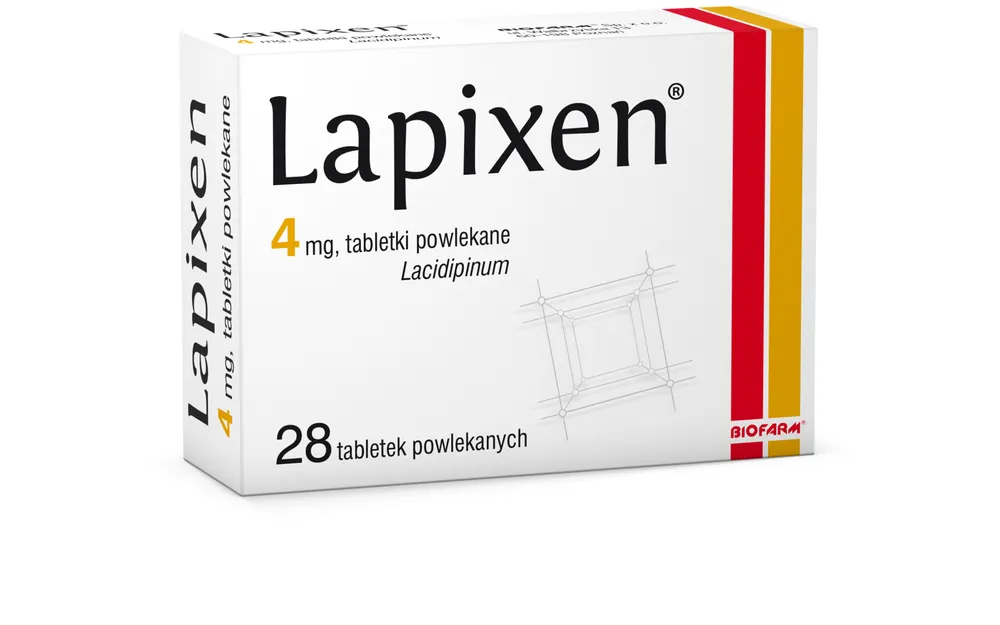
Table of Contents
Package leaflet: Information for the patient
Lapixen, 2 mg, film-coated tablets
Lapixen, 4 mg, film-coated tablets
Lapixen, 6 mg, film-coated tablets
Lacidipinum
Please read all of this leaflet carefully before taking this medicine, because it contains
important information for you.
- Keep this leaflet, as you may need to read it again.
- If you have any questions, please consult your doctor or pharmacist.
- This medicine has been prescribed for a specific individual. Do not pass it on to others. It may harm someone else, even if their symptoms are the same.
- If you experience any side effects, including any not listed in this leaflet, tell your doctor or pharmacist. See section 4.
Contents of the leaflet
- What Lapixen is and what it is used for
- What you need to know before taking Lapixen
- How to take Lapixen
- Possible side effects
- How to store Lapixen
- Contents of the pack and other information
1. What Lapixen is and what it is used for
Lapixen contains lacidipine, which belongs to a group of medicines called calcium channel blockers.
Lapixen helps relax blood vessels, causing them to widen. This improves blood flow and consequently lowers blood pressure.
Lapixen tablets, taken regularly as directed by your doctor, help reduce high blood pressure (treatment of hypertension).
2. Important information before using Lapixen
When not to use Lapixen
- If the patient is allergic to lacydipine, other calcium antagonists, or any of the other ingredients of this medicine (listed in section 6).
- If the patient has a heart condition called aortic valve stenosis. This is a narrowing of the heart valve, causing impaired blood outflow.
- If the patient has suffered a myocardial infarction (heart attack) within the past month.
- The use of lacydipine should be discontinued if chest pain (angina pectoris) occurs, or rapid and weak pulse, fast and shallow breathing, low blood pressure, cold and clammy skin, cyanosis of the lips, dizziness, fainting, weakness, or nausea.
Lapixen must not be taken if any of the above conditions apply to the patient.
If in doubt, consult a doctor or pharmacist before starting to take Lapixen.
Warnings and precautions
Before starting to take Lapixen, discuss the following with your doctor or pharmacist:
- if the patient has heart rhythm disorders or any other heart diseases,
- if the patient currently has or has ever had any liver disorders.
Children and adolescents
Lapixen is not recommended for use in children and adolescents under 18 years of age due to lack of experience regarding safety and efficacy in this patient group.
Lapixen and other medicines
Inform your doctor or pharmacist about all medicines currently taken or recently taken, as well as any medicines the patient plans to take.
This also includes herbal preparations, as Lapixen may affect the action of certain medicines, and certain medicines may affect the action of Lapixen.
In particular, inform your doctor or pharmacist if the patient is taking any of the following medicines:
- medicines used to treat high blood pressure,
- medicines controlling heart rhythm (called antiarrhythmics),
- medicines used to treat depression, known as tricyclic antidepressants,
- medicines used to treat fungal infections (e.g. ketoconazole, itraconazole),
- antibiotics (e.g. erythromycin, rifampicin),
- sedatives and sleeping medicines,
- medicines used to treat psychiatric disorders,
- medicines used to treat epilepsy (seizures),
- antihistamines – used to treat allergies,
- cimetidine (a medicine used to treat gastrointestinal disorders),
- cyclosporine (an immunosuppressive medicine used, for example, in transplant recipients),
- tetracosactide (a medicine used in the diagnosis and treatment of adrenal cortex disorders),
- corticosteroids (medicines used to treat inflammatory conditions, asthma, and certain skin diseases).
Before undergoing blood tests, inform the person performing the test that Lapixen is being taken, as this medicine may affect liver function test results.
Lapixen with food, drink, and alcohol
The medicine may be taken on an empty stomach or with food.
While taking Lapixen, grapefruit juice must not be consumed.
Alcohol may enhance the effect of the medicine. Caution should be exercised when taking Lapixen and consuming alcohol simultaneously.
Pregnancy, breastfeeding, and fertility
If the patient is pregnant, breastfeeding, suspects she may be pregnant, or is planning to have a child, she should consult a doctor or pharmacist before using this medicine.
Lapixen must not be used during pregnancy, when planning pregnancy, or during breastfeeding.
This medicine may impair fertility in men.
Driving and operating machinery
Dizziness may occur while taking Lapixen. In such cases, the patient should not drive, use tools, or operate machinery.
Lapixen contains lactose (a sugar found in milk).
If the patient has previously been diagnosed with intolerance to certain sugars, the patient should consult a doctor before taking this medicine.
3. How to use Lapixen
This medicine should always be taken as directed by your doctor. If in doubt, consult your doctor or pharmacist.
It is important to take the correct number of tablets every day at the same time.
- The usual starting dose is 2 mg once daily, taken every morning.
- After 3–4 weeks, your doctor may increase the dose to 4 mg once daily, taken every morning.
- If necessary, your doctor may further increase the dose to 6 mg once daily, taken every morning, which is the maximum daily dose.
- Tablets should be removed from the blister pack immediately before taking.
- Swallow the tablet with water.
- Do not take the tablet with grapefruit juice.
Lapixen 4 mg coated tablets
The tablet may be divided into two equal doses.
If the prescribed dose is 2 mg of Lapixen, i.e. half a 4 mg tablet, the unused half must be left in the blister and taken within 48 hours.
Taking more Lapixen than prescribed
If you take more Lapixen than prescribed, contact your doctor immediately or go to the emergency department of your nearest hospital. Take this leaflet, any remaining tablets, and the packaging with you so that it is clear which tablets have been taken. Treatment may be necessary.
Overdose may cause irregular heartbeat, rapid and shallow breathing, low blood pressure, cold and clammy skin, dizziness, fainting, weakness, or nausea.
Missing a dose of Lapixen
If you miss a dose, take it as soon as you remember, on the same day. However, if it is almost time for your next dose, skip the missed dose and take the next dose at the regular time.
Do not take a double dose to make up for a missed dose.
Stopping Lapixen
If you have any further questions about using this medicine, consult your doctor or pharmacist.
4. Possible adverse reactions
Like all medicines, this medicine can cause adverse reactions, although not everyone experiences them.
You should stop taking Lapixen and contact your doctor immediately
if any of the following symptoms occur:
- Chest pain (angina), including worsening chest pain,
- Sudden swelling of the face, lips, and tongue, which may lead to breathing difficulties (angioedema),
- Rapid and weak pulse, rapid shallow breathing, low blood pressure, cold and clammy skin, bluish discoloration of the lips.
Adverse reactions have been categorized according to the following frequency of occurrence:
Very common: occurs in more than 1 in 10 patients,
Common: occurs in 1 to 10 in 100 patients,
Uncommon: occurs in 1 to 10 in 1,000 patients,
Rare: occurs in 1 to 10 in 10,000 patients,
Very rare: occurs in fewer than 1 in 10,000 patients,
Frequency not known: cannot be estimated from available data.
Common:
- Headache,
- Dizziness,
- Sudden flushing (especially of the face),
- Fast or irregular heartbeat (palpitations),
- Swelling (edema), particularly around the ankles. The above adverse reactions usually resolve during continued treatment.
- Increased heart rate,
- Indigestion or nausea,
- Skin rash, redness (erythema), and itching of the skin,
- Increased urine production (polyuria),
- Feeling of weakness,
- Changes in blood test results related to the liver.
Uncommon:
- Chest pain (angina), including worsening chest pain,
- Fainting, hypotension,
- Swelling of the gums (gingival hyperplasia).
Rare:
- Angioedema (an allergic reaction causing swelling, e.g., of the face, tongue, and throat, which may cause breathing and swallowing difficulties),
- Urticaria,
- Depression,
- Muscle cramps.
Very rare:
- Tremor.
Frequency not known:
- Involuntary muscle contractions or tics, changes in muscle tone, and slowed movements.
Reporting of adverse reactions
If any adverse reactions occur, including any not listed in this leaflet, inform your doctor or pharmacist. Adverse reactions can be reported directly to the Department of Monitoring Adverse Drug Reactions of the Office for Registration of Medicinal Products, Medical Devices and Biocidal Products:
{current address, telephone and fax number of the above Department}
e-mail: [email protected]
Adverse reactions can also be reported to the marketing authorization holder.
Reporting adverse reactions helps provide more information on the safety of this medicine.
5. How to store Lapixen
Keep this medicine out of the sight and reach of children.
Store in the original packaging to protect from light.
Do not use this medicine after the expiry date stated on the carton and blister.
The expiry date refers to the last day of the stated month.
Medicines must not be disposed of via wastewater or household waste. Ask your pharmacist how to dispose of medicines no longer required. Proper disposal helps protect the environment.
6. Contents of the pack and other information
What Lapixen contains
The active substance in Lapixen is lacidipine.
Lapixen 2 mg, coated tablets: each tablet contains 2 mg of lacidipine.
Lapixen 4 mg, coated tablets: each tablet contains 4 mg of lacidipine.
Lapixen 6 mg, coated tablets: each tablet contains 6 mg of lacidipine.
Other ingredients are:
tablet core:
lactose, povidone K30, magnesium stearate;
tablet coating: AquaPolish P white 010.47 C, composition – hypromellose, talc, propylene glycol,
titanium dioxide (E171).
What Lapixen looks like and contents of the pack
Lapixen 2 mg, coated tablets:
white, round, film-coated tablets, biconvex on both sides.
Lapixen 4 mg, coated tablets:
white, oval, film-coated tablets, biconvex on both sides, with a score line on one side.
The tablet can be divided into two equal doses.
Lapixen 6 mg, coated tablets:
white, oval, film-coated tablets, biconvex on both sides, with the inscription "6 mg" embossed on one side.
Lapixen coated tablets are packed in blisters made of OPA/Aluminium/PVC/Aluminium, placed together with the patient leaflet in a cardboard box.
Pack contents:
7, 14, 28 or 56 coated tablets.
Not all pack sizes may be marketed.
Marketing Authorisation Holder and Manufacturer
Biofarm Sp. z o.o.
ul. Wałbrzyska 13
60-198 Poznań
tel.: +48 61 66 51 500
fax: +48 61 66 51 505
[email protected]
September 2025