Ipinzan
Poland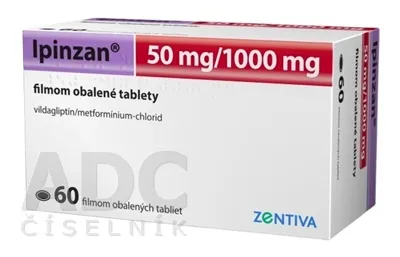
Table of Contents
Package leaflet: Information for the patient
Ipinzan, 50 mg + 850 mg, film-coated tablets
Ipinzan, 50 mg + 1000 mg, film-coated tablets
vildagliptin + metformin hydrochloride
Please read this leaflet carefully before using this medicine because it contains important information for you.
- Keep this leaflet. You may need to read it again.
- If you have any further questions, ask your doctor, pharmacist, or nurse.
- This medicine has been prescribed for you personally. Do not give it to others. It may harm them, even if their symptoms are the same as yours.
- If you experience any side effects, including any not listed in this leaflet, tell your doctor, pharmacist, or nurse. See section 4.
Leaflet contents
- What Ipinzan is and what it is used for
- What you need to know before taking Ipinzan
- How to take Ipinzan
- Possible side effects
- How to store Ipinzan
- Contents of the pack and other information
1. What Ipinzan is and what it is used for
The active substances in Ipinzan are vildagliptin and metformin, which belong to a group of medicines called oral antidiabetic agents.
Ipinzan is used in the treatment of adult patients with type 2 diabetes mellitus. This type of diabetes is also known as non-insulin-dependent diabetes. Ipinzan is used when diabetes cannot be controlled by diet and exercise alone, and (or) when it is used in combination with other antidiabetic medicines (such as insulin or sulfonylureas).
Type 2 diabetes is a condition in which the body either does not produce enough insulin or the insulin produced does not work properly. Type 2 diabetes may also occur when the body produces too much glucagon.
Both insulin and glucagon are produced in the pancreas. Insulin helps lower blood sugar levels, especially after a meal. Glucagon is a substance that stimulates the liver to produce glucose, thereby increasing blood sugar levels.
How Ipinzan works
Both active substances, vildagliptin and metformin, help control blood sugar levels.
Vildagliptin works by stimulating the pancreas to produce more insulin and by reducing the production of glucagon. Metformin helps the body use insulin more effectively.
The medicine has been shown to reduce blood glucose levels, which may help prevent complications associated with diabetes.
2. Important information before using Ipinzan
When not to use Ipinzan
-
If the patient is allergic to vildagliptin, metformin, or any of the other
ingredients of this medicine (listed in section 6). If the patient thinks they may be
allergic to any of these ingredients, they should inform their doctor before
using Ipinzan. -
If the patient has uncontrolled diabetes, for example severe hyperglycaemia (high blood glucose levels), nausea, vomiting, diarrhoea, sudden weight loss, lactic acidosis (see also "Risk of lactic acidosis" below), or ketoacidosis. Ketoacidosis is a condition in which substances called ketone bodies accumulate in the blood and may lead to diabetic pre-coma. Symptoms include: abdominal pain, rapid and deep breathing, drowsiness, or an unusual fruity odour of the breath.
-
If the patient has recently had a heart attack or if they have heart failure, severe circulatory disorders, or breathing difficulties which may be symptoms of heart failure.
-
If the patient has significantly reduced kidney function.
-
If the patient has a severe infection or is severely dehydrated (has lost a large amount of body fluid).
-
If the patient is due to undergo a contrast radiological procedure (a special type of imaging requiring injection of a contrast agent). For further information, see section "Warnings and precautions" below.
-
If the patient has liver disease.
-
If the patient consumes excessive amounts of alcohol (either regularly or occasionally).
-
If the patient is breastfeeding (see also section "Pregnancy and breastfeeding" below).
Warnings and precautions
Before starting treatment with Ipinzan, discuss this with your doctor, pharmacist, or
nurse.
Risk of lactic acidosis
Ipinzan may cause a very rare but serious adverse effect called lactic acidosis, particularly if the patient has impaired kidney function. The risk of lactic acidosis is also increased in cases of uncontrolled diabetes, severe infection, prolonged fasting or alcohol consumption, dehydration (see further details below), liver dysfunction, and any medical conditions in which part of the body is inadequately supplied with oxygen (e.g. acute severe heart disease).
If any of the above conditions apply to the patient, they should consult their doctor for further instructions.
Treatment with Ipinzan should be temporarily discontinued if the patient develops a medical condition that may lead to dehydration (significant loss of body fluids), such as severe vomiting, diarrhoea, fever, exposure to high temperatures, or if the patient drinks less fluid than usual. The patient should consult their doctor for further instructions.
Ipinzan must be discontinued and the patient should contact their doctor or the nearest hospital immediately if any symptoms of lactic acidosis occur, as this condition may progress to coma.
Symptoms of lactic acidosis include:
- vomiting,
- abdominal pain,
- muscle cramps,
- general malaise accompanied by profound fatigue,
- difficulty breathing,
- decreased body temperature and slowed heart rate.
Lactic acidosis is an acute, life-threatening condition requiring immediate hospital treatment.
Contact your doctor immediately for further instructions if:
- the patient has a genetically inherited mitochondrial disorder (energy-producing structures in cells), such as MELAS (mitochondrial encephalopathy, myopathy, lactic acidosis and stroke-like episodes) or maternally inherited diabetes and deafness (MIDD).
- after starting metformin, the patient experiences any of the following symptoms: seizures, worsening cognitive function, difficulty moving, signs indicating nerve damage (e.g. pain or numbness), migraine, or deafness. Ipinzan does not replace insulin. Therefore, Ipinzan must not be used in the treatment of type 1 diabetes. Before starting Ipinzan, discuss with your doctor, pharmacist, or nurse if the patient has or has had pancreatic disorders.
Before starting treatment with Ipinzan, the patient should consult their doctor, pharmacist, or nurse if they are taking an antidiabetic medicine called a sulfonylurea. The doctor may wish to reduce the dose of the sulfonylurea taken together with Ipinzan to avoid low blood glucose levels (hypoglycaemia).
If the patient previously used vildagliptin but had to stop due to liver disease, they should not take this medicine.
Diabetic skin complications are a common complication of diabetes. Follow your doctor's or nurse's advice regarding skin and foot care. It is also recommended that the patient pay particular attention to the development of new blisters or ulcers while taking Ipinzan.
If these occur, the patient should promptly discuss them with their treating doctor.
If the patient is scheduled for major surgery, they must not take Ipinzan during the procedure and for some time afterwards. The doctor will decide when the patient should stop and restart treatment with Ipinzan.
Before starting treatment with Ipinzan and every three months during the first year of treatment, and thereafter periodically, liver function tests should be performed. This allows early detection of signs of increased liver enzyme activity.
During treatment with Ipinzan, the doctor will monitor the patient's kidney function at least once a year, or more frequently if the patient is elderly and/or has worsening kidney function.
The doctor will regularly monitor blood and urine glucose levels.
Children and adolescents
Ipinzan is not recommended for use in children and adolescents under 18 years of age.
Ipinzan with other medicines
If the patient is to receive an intravenous iodine-containing contrast agent, for example for an X-ray or CT scan, they must stop taking Ipinzan before or at the latest at the time of administration. The doctor will decide when the patient should stop and restart treatment with Ipinzan.
Tell your doctor about all medicines currently or recently taken, as well as any medicines the patient plans to take. The patient may require more frequent monitoring of blood glucose levels and kidney function assessments, or dose adjustments of Ipinzan by the doctor. It is particularly important to inform the doctor about the following medicines:
- glucocorticoids, usually used to treat inflammatory conditions
- beta-2 adrenergic receptor agonists, usually used to treat respiratory disorders
- other medicines used to treat diabetes
- diuretics (medicines that increase urine production)
- medicines used to treat pain and inflammation (NSAIDs and COX-2 inhibitors, such as ibuprofen and celecoxib)
- certain medicines used to treat high blood pressure (ACE inhibitors and angiotensin II receptor antagonists)
- certain medicines affecting the thyroid gland
- certain medicines affecting the nervous system
- certain medicines used to treat angina pectoris, e.g. ranolazine
- certain medicines used to treat HIV infection, e.g. dolutegravir
- certain medicines used to treat a specific type of thyroid cancer (medullary thyroid cancer), e.g. vandetanib
- certain medicines used to treat heartburn and peptic ulcers, e.g. cimetidine. Ipinzan and alcohol Avoid consuming excessive amounts of alcohol while taking Ipinzan, as this may increase the risk of lactic acidosis (see also section "Warnings and precautions" above). Pregnancy and breastfeeding
- If the patient is pregnant, suspects she may be pregnant, or is planning to become pregnant, she should consult her doctor before using this medicine. The doctor will discuss with the patient the potential risks associated with taking Ipinzan during pregnancy.
- Do not use Ipinzan during pregnancy or while breastfeeding (see also "When not to use Ipinzan" above). Consult your doctor or pharmacist before taking any medicine. Driving and using machines If the patient experiences dizziness while taking Ipinzan, they should not drive or operate machinery.
Ipinzan contains maltodextrin (a source of glucose)
If the patient has previously been diagnosed with intolerance to certain sugars, they should
consult their doctor before taking this medicine.
3. How to take Ipinzan
This medicine should always be taken as directed by the physician. If in doubt, consult
your doctor or pharmacist.
The dose of Ipinzan varies depending on the patient's condition. Your doctor will determine the appropriate
dose of Ipinzan for you.
The recommended dose is one tablet of 50 mg + 850 mg or 50 mg + 1000 mg taken twice
daily.
If the patient has impaired kidney function, the doctor may prescribe a lower dose. If the patient
is taking an antidiabetic medicine called a sulfonylurea, the doctor may also prescribe
a lower dose.
The doctor may prescribe this medicine to be taken alone (as monotherapy) or in combination with certain other
medicines that lower blood glucose levels.
When and how to take Ipinzan
- Ipinzan is taken orally.
- Tablets should be swallowed whole with a glass of water.
- Take one tablet in the morning and one in the evening with a meal or immediately after a meal. Taking the tablet right after a meal may help reduce the risk of gastrointestinal disturbances.
- Continue to follow all dietary advice given by your doctor. Following a proper diet while taking Ipinzan is particularly important, especially if the patient is on a weight-control diet.
Taking more Ipinzan than prescribed
If too many Ipinzan tablets are taken by accident, or if someone else takes these
tablets, seek immediate medical advice from a doctor or pharmacist. Medical attention may
be required. If it is necessary to visit a doctor or hospital, bring the medicine packaging and leaflet with you.
If you forget to take Ipinzan
If a dose is missed, take it with the next meal, unless it is almost time for the next dose. Do not take a double dose (two tablets at once) to make up for a missed tablet.
Stopping Ipinzan
To maintain control of blood glucose levels, continue taking this medicine for as long as your doctor has instructed. Do not stop taking Ipinzan without consulting your doctor. If you have any questions about how long to take Ipinzan, consult your doctor.
If you have any further questions about the use of this medicine, consult your doctor, pharmacist, or nurse.
4. Possible adverse reactions
Like all medicines, this medicine can cause adverse reactions, although not everyone will experience them.
You should stop taking Ipinzan and contact your doctor immediately if any of the following adverse reactions occur:
- Lactic acidosis (very rare: may occur in no more than 1 in 10,000 patients): Ipinzan may very rarely cause a serious adverse reaction known as lactic acidosis (see also section 2 “Warnings and precautions”). If this occurs in a patient, treatment with Ipinzan must be stopped and medical advice must be sought immediately from a doctor or the nearest hospital, as lactic acidosis may lead to coma.
- Angioedema (rare: may occur in no more than 1 in 1,000 patients): Symptoms include swelling of the face, tongue or throat, difficulty swallowing, breathing difficulties, sudden onset of rash or hives. These may indicate a reaction known as “angioedema”.
- Liver disease (hepatitis) (not common: may occur in up to 1 in 100 patients): Symptoms include yellowing of the skin and whites of the eyes, nausea, loss of appetite, or dark-coloured urine. These may indicate liver disease (hepatitis).
- Pancreatitis (not common: may occur in up to 1 in 100 patients): Symptoms include severe and persistent abdominal pain (around the stomach area), which may radiate to the back, as well as nausea and vomiting.
Other adverse reactions
The following adverse reactions have been reported in some patients taking Ipinzan:
- Common (may affect up to 1 in 10 patients): sore throat, nasal congestion, fever, itchy rash, excessive sweating, joint pain, dizziness, headache, uncontrolled tremor, constipation, nausea, vomiting, diarrhoea, bloating, heartburn, stomach and abdominal pain.
- Not common (may affect up to 1 in 100 patients): fatigue, weakness, metallic taste in the mouth, low blood glucose levels, loss of appetite, swelling of hands, ankles or feet (oedema), chills, pancreatitis, muscle pain.
- Very rare (may affect up to 1 in 10,000 patients): symptoms of high levels of lactic acid in the blood (known as lactic acidosis), such as drowsiness or dizziness, severe nausea or vomiting, abdominal pain, irregular heartbeat or deep, rapid breathing; skin redness, itching; decreased vitamin B12 levels (pallor, fatigue, psychiatric symptoms such as confusion or memory disturbances).
Following the marketing of this medicine, the following adverse reactions have also been reported:
- Frequency unknown (cannot be estimated from available data): localised skin peeling or blistering, vasculitis, which may cause skin rash or small, flat, red, circular spots under the skin or bruising.
Reporting of adverse reactions
If any adverse reactions occur, including any not listed in this leaflet, inform your doctor, pharmacist or nurse. Adverse reactions can be reported directly to the Department of Monitoring Adverse Drug Reactions, Office for Registration of Medicinal Products, Medical Devices and Biocidal Products, Al. Jerozolimskie 181C, 02-222 Warsaw, tel.: +48 22 49-21-301, fax: +48 22 49-21-309, website: https://smz.ezdrowie.gov.pl
Adverse reactions can also be reported to the responsible entity.
Reporting adverse reactions helps provide more information on the safety of the medicine.
5. How to store Ipinzan
- Keep this medicine out of the sight and reach of children.
- Do not use this medicine after the expiry date stated on the blister or carton following "EXP". The expiry date refers to the last day of the specified month.
- Do not store above 30°C.
- Store in the original packaging to protect from moisture.
- Medicines must not be disposed of via wastewater or household waste. Ask your pharmacist how to dispose of medicines no longer required. Such measures help protect the environment.
6. Contents of the pack and other information
What Ipinzan contains
- The active substances in this medicine are vildagliptin and metformin hydrochloride.
- Each coated tablet of Ipinzan 50 mg + 850 mg contains 50 mg of vildagliptin and 850 mg of metformin hydrochloride (equivalent to 660 mg of metformin).
- Each coated tablet of Ipinzan 50 mg + 1000 mg contains 50 mg of vildagliptin and 1000 mg of metformin hydrochloride (equivalent to 780 mg of metformin).
- Other ingredients are: copovidone (K 28), anhydrous colloidal silicon dioxide, magnesium stearate, hypromellose 2910, polydextrose, titanium dioxide (E 171), talc, yellow iron oxide (E 172), maltodextrin/dextrin, medium-chain triglycerides.
What Ipinzan looks like and contents of the pack
Ipinzan 50 mg + 850 mg tablets are yellow, oval-shaped, film-coated tablets with bevelled edges, engraved with "50" on one side and "850" on the other, measuring: length: 21.6 ± 0.2 mm, width: 8.6 ± 0.2 mm.
Ipinzan 50 mg + 1000 mg tablets are dark yellow, oval-shaped, film-coated tablets with bevelled edges, engraved with "50" on one side and "1000" on the other, measuring: length: 22.0 ± 0.2 mm, width: 9.0 ± 0.2 mm.
Ipinzan is packaged in a cardboard box containing a specific number of blisters made of OPA/Aluminium/PVC/Aluminium or transparent blisters made of PVC/PCTFE/Aluminium.
Ipinzan is available in packs containing 10, 30, 60 or 180 film-coated tablets.
Not all pack sizes may be marketed.
Marketing Authorisation Holder
Zentiva k.s.
U kabelovny 130
Dolní Měcholupy
102 37 Prague 10
Czech Republic
(logo of the marketing authorisation holder)
Manufacturer
PHARMATHEN INTERNATIONAL S.A.
Industrial Park Sapes, Rodopi Prefecture, Block No 5,
69300 Rodopi
Greece
PHARMATHEN S.A.
Dervenakion 6
15351 Pallini Attiki
Greece
For further information about this medicine, please contact the local representative of the marketing authorisation holder:
Zentiva Polska Sp. z o.o.
ul. Bonifraterska 17
00-203 Warsaw
tel.: +48 22 375 92 00