Hydroxyzine adamed
Poland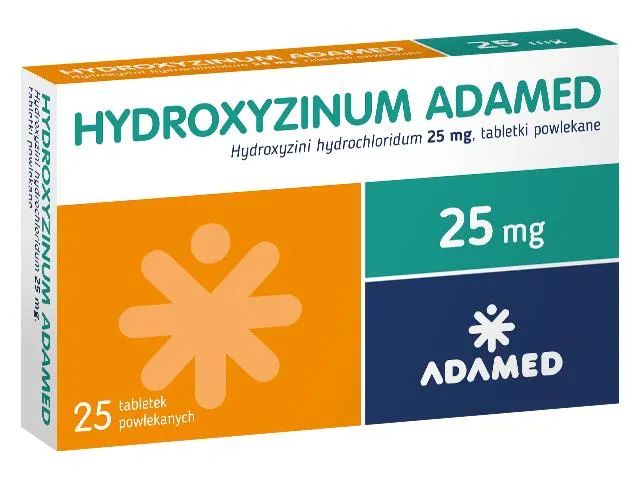
Table of Contents
- Package leaflet: Information for the user
- 1. What Hydroxyzinum Adamed is and what it is used for
- 2. Important information before taking Hydroxyzinum Adamed
- 3. How to use Hydroxyzinum Adamed
- 4. Possible adverse reactions
- 5. How to store Hydroxyzinum Adamed
- 6. Contents of the pack and other information
Package leaflet: Information for the user
Hydroxyzinum Adamed, 10 mg, film-coated tablets
Hydroxyzinum Adamed, 25 mg, film-coated tablets
Hydroxyzini hydrochloridum
Please read carefully all of this leaflet before taking this medicine because it contains
important information for the patient.
- Keep this leaflet as you may need to read it again.
- If you have any further questions, please consult your doctor or pharmacist.
- This medicine has been prescribed for a specific individual. Do not give it to others. This medicine may harm others, even if their symptoms are the same.
- If you experience any adverse reactions, including those not listed in this leaflet, inform your doctor or pharmacist immediately. See section 4.
Table of contents
- What Hydroxyzinum Adamed is and what it is used for
- Important information before taking Hydroxyzinum Adamed
- How to take Hydroxyzinum Adamed
- Possible side effects
- How to store Hydroxyzinum Adamed
- Contents of the pack and other information
1. What Hydroxyzinum Adamed is and what it is used for
Hydroxyzinum Adamed reduces certain brain activities without causing dependence and blocks histamine, a substance present in body tissues. It is effective in the treatment of anxiety and itching.
Hydroxyzinum Adamed is used to treat:
- anxiety in adults
- itching in adults, adolescents, and children aged 6 years and older.
The effect on anxiety becomes noticeable after approximately 30–45 minutes.
The effect on itching is achieved after approximately 1 hour.
2. Important information before taking Hydroxyzinum Adamed
Do not take Hydroxyzinum Adamed:
- if you are allergic to hydroxyzine hydrochloride or any of the other ingredients of this medicine (listed in section 6);
- if you are allergic (hypersensitive) to cetirizine, aminophylline, ethylenediamine, or piperazine derivatives (similar active substances in other medicines);
- if you have porphyria (a metabolic disorder);
- if you are pregnant or breastfeeding (see "Pregnancy, breastfeeding and fertility" below);
- if your ECG (electrocardiogram) shows heart rhythm disturbances known as QT interval prolongation;
- if you have or have had cardiovascular disease, or if your heart rate is very slow;
- if you have low blood electrolyte levels (e.g. low potassium or magnesium levels);
- if you are taking certain medicines used to treat heart rhythm disorders or medicines that may affect heart rhythm (see "Hydroxyzinum Adamed with other medicines");
- if someone in your family has died suddenly due to heart disease.
Warnings and precautions
Before starting treatment with Hydroxyzinum Adamed, discuss with your doctor or pharmacist if:
- you have kidney or liver disease, or if you are elderly. A lower dose may be required;
- you have an increased tendency to seizures (convulsions);
- you have risk factors for stroke;
- you have increased intraocular pressure (glaucoma);
- you have difficulty urinating;
- you have constipation (reduced intestinal peristalsis);
- you have severe muscle weakness (myasthenia gravis);
- you have psychiatric disorders (dementia).
Treatment with Hydroxyzinum Adamed may be associated with an increased risk of life-threatening heart rhythm disturbances. Therefore, inform your doctor about any heart problems and about all other medicines you are taking, including those available without a prescription.
If you experience heart-related symptoms while taking Hydroxyzinum Adamed, such as rapid heartbeat (palpitations), difficulty breathing, or loss of consciousness, seek immediate medical attention. You should also discontinue treatment with hydroxyzine.
Dry mouth may occur as a side effect of Hydroxyzinum Adamed. Therefore, maintaining good oral hygiene during treatment with Hydroxyzinum Adamed is important.
If you are undergoing allergy testing, treatment with Hydroxyzinum Adamed should be discontinued at least 5 days before the tests. Consult your doctor for advice.
Use with caution in elderly patients. The duration of treatment should be as short as possible.
Children
Use of Hydroxyzinum Adamed is not recommended in children under 6 years of age due to possible difficulties in swallowing tablets.
The medicine should not be used in children under 12 months of age, as it has not been studied in this age group.
Younger children are more susceptible to central nervous system side effects, such as seizures.
Hydroxyzinum Adamed with other medicines
Inform your doctor or pharmacist about all medicines you are currently taking or have recently taken, as well as any medicines you plan to take. This includes medicines available without a prescription. Hydroxyzinum Adamed may affect the action of other medicines, and other medicines may affect the action of Hydroxyzinum Adamed.
Do not take Hydroxyzinum Adamed if you are taking medicines used to treat:
- bacterial infections (e.g. antibiotics such as erythromycin, moxifloxacin, levofloxacin);
- fungal infections (e.g. pentamidine);
- heart disease or high blood pressure (e.g. amiodarone, quinidine, disopyramide, sotalol);
- psychosis (e.g. haloperidol);
- depression (e.g. citalopram, escitalopram);
- gastrointestinal disorders (e.g. prucalopride);
- allergies;
- malaria (e.g. mefloquine);
- cancer (e.g. toremifene, vandetanib);
- drug dependence or severe pain (methadone).
Also inform your doctor if you are taking:
- betahistine used to treat Meniere’s disease (a disorder affecting balance and hearing);
- phenytoin used to treat seizures (convulsions);
- adrenaline used to treat severe allergic reactions;
- medicines used to treat anxiety or sleeping medicines;
- anticholinergic medicines used, for example, in the treatment of irritable bowel syndrome (a gastrointestinal disorder) or asthma;
- cimetidine used to treat stomach disorders. It may increase the blood concentration of Hydroxyzinum Adamed;
- monoamine oxidase inhibitors (MAOIs) used to treat depression and Parkinson’s disease;
- thiazide diuretics (used, for example, in the treatment of high blood pressure). These may increase the risk of heart rhythm disturbances.
Hydroxyzinum Adamed with food, drink and alcohol
Avoid taking Hydroxyzinum Adamed with alcohol, as this combination may enhance the effect of the medicine and increase the risk of adverse reactions.
Pregnancy, breastfeeding and fertility
If you are pregnant, breastfeeding, think you may be pregnant, or are planning to have a baby, consult your doctor or pharmacist before taking this medicine.
Do not take Hydroxyzinum Adamed during pregnancy.
Hydroxyzine, the active substance in Hydroxyzinum Adamed, crosses the placenta. There is a risk of effects on the unborn child.
Newborns of mothers who took Hydroxyzinum Adamed in late pregnancy and/or during delivery may experience the following symptoms immediately or within a few hours after birth: tremors, stiffness and/or weakness, breathing difficulties, and urinary retention (inability to pass urine).
Do not take Hydroxyzinum Adamed while breastfeeding.
If treatment with Hydroxyzinum Adamed is necessary, breastfeeding must be discontinued, as hydroxyzine passes into breast milk.
Driving and using machines
Hydroxyzinum Adamed may impair the ability to drive and operate machinery.
The medicine may cause drowsiness, reduced attention, and decreased reaction ability. These side effects are more likely at the beginning of treatment or after a dose increase. Do not drive or operate machinery if any of these symptoms occur.
Hydroxyzinum Adamed contains lactose
Hydroxyzinum Adamed tablets contain lactose. If you have been diagnosed with an intolerance to certain sugars, consult your doctor before taking this medicine.
Hydroxyzinum Adamed contains sodium
The medicine contains less than 1 mmol (23 mg) of sodium per tablet, meaning it is considered "sodium-free".
3. How to use Hydroxyzinum Adamed
This medicine should always be used according to the instructions given by the doctor or pharmacist. If in doubt,
consult your doctor or pharmacist.
The doctor determines the dose and adjusts it individually for each patient.
Hydroxyzinum Adamed should be used at the lowest effective dose. The duration of treatment
should be as short as possible.
The 25 mg tablet may be divided into two equal doses.
Recommended dose:
Itching:
Adults:
Initial dose is 25 mg in the evening, approximately one hour before bedtime. If necessary,
a total of up to 25 mg may be taken 3 to 4 times daily. In adults, the maximum daily dose
is 100 mg.
Children aged 6 years and above:
1–2 mg/kg body weight per day in several divided doses.
In children with body weight above 40 kg, the maximum daily dose is 100 mg.
In children with body weight up to 40 kg, the maximum daily dose is 2 mg/kg body weight per day.
Anxiety:
Adults:
50 mg per day, divided into 3 doses: half a tablet (12.5 mg), half a tablet (12.5 mg), and one tablet (25 mg).
In more severe cases, up to 100 mg per day may be used. In adults, the maximum daily dose is 100 mg.
In the treatment of anxiety, this medicine should be used only as an adjunctive therapy.
Do not change the dose without prior consultation with your doctor.
Elderly patients
Due to prolonged effects, treatment should be initiated at half the recommended dose in elderly patients.
The maximum daily dose is 50 mg.
Patients with renal impairment
In patients with moderate or severe renal impairment, the dose should be reduced.
Patients with hepatic impairment
In patients with reduced liver function, the daily dose should be reduced.
Use in children and adolescents
In adolescents and children aged 6 years and above, Hydroxyzinum Adamed is indicated
exclusively for the treatment of itching.
If a child has difficulty swallowing tablets, other hydroxyzine-containing medicines may be more suitable.
Consult your doctor.
Method of administration
The tablets should be swallowed with an adequate amount of water. Tablets may be taken with food or
independently of meals.
Use of a higher than recommended dose of Hydroxyzinum Adamed
If a patient has taken too high a dose of Hydroxyzinum Adamed, contact a doctor immediately,
especially if this concerns a child. In case of overdose, symptomatic treatment may be applied.
ECG monitoring is recommended due to the possibility of cardiac rhythm disturbances such as QT
interval prolongation or torsade de pointes.
Missed dose of Hydroxyzinum Adamed
Do not take a double dose to make up for a missed tablet.
4. Possible adverse reactions
Like all medicines, this medicine can cause adverse reactions, although not everyone will experience them.
Treatment with this medicine must be discontinued and immediate medical help sought if the patient experiences:
- any heart rhythm disturbances, such as rapid heartbeat (palpitations), breathing difficulties, loss of consciousness (frequency unknown, cannot be estimated from available data),
- swelling of the face, lips, tongue and (or) throat, sometimes causing breathing or swallowing difficulties (angioedema) (very rare adverse reactions, which may occur in no more than 1 in 10,000 people),
- generalized blistering rash (acute generalized exanthematous pustulosis), red ring-shaped rash, often with blisters, mainly on the palms and soles (erythema multiforme), mucosal and skin inflammation combined with high fever (Stevens-Johnson syndrome) (very rare adverse reactions, which may occur in no more than 1 in 10,000 people),
- severe peeling and shedding of the skin (toxic epidermal necrolysis) (frequency unknown, cannot be estimated from available data).
Other possible adverse reactions:
Very common adverse reactions (may occur in more than 1 in 10 people):
- drowsiness.
Common adverse reactions (may occur in no more than 1 in 10 people):
- headache,
- sedation,
- dry mouth,
- fatigue.
Uncommon adverse reactions (may occur in no more than 1 in 100 people):
- restlessness,
- confusion,
- dizziness,
- insomnia,
- tremor,
- nausea,
- fever.
Rare adverse reactions (may occur in no more than 1 in 1,000 people):
- allergic reactions (hypersensitivity),
- disorientation, hallucinations (seeing things that are not real),
- convulsions (seizures), movement disorders (dyskinesias),
- eye accommodation disorders (difficulty focusing), blurred vision,
- low blood pressure,
- constipation,
- vomiting,
- changes in liver enzyme activity (aminotransferases, alkaline phosphatase, bilirubin, and glutamyl),
- itching, skin rash with redness, skin spots or discolorations, skin inflammation,
- urinary retention,
- cardiac arrest, effects on heart rhythm, irregular heartbeat.
Very rare adverse reactions (may occur in no more than 1 in 10,000 people):
- anaphylactic shock (severe allergic reaction),
- narrowing of the airways (bronchospasm),
- excessive sweating.
Frequency not known (frequency cannot be estimated from available data):
- decreased number of blood platelets (thrombocytopenia),
- aggression,
- depression,
- repetitive, involuntary muscle contractions (tics),
- abnormal, prolonged muscle contractions (dystonia),
- sensations of tingling, prickling, or numbness (paresthesia),
- fainting,
- uncontrolled, circular eye movements (oculogyric crisis),
- irregular heart rhythm and associated changes in electrocardiogram (prolonged QT interval, torsade de pointes),
- diarrhea,
- hepatitis,
- pemphigoid (blisters appearing on hands, feet, abdomen, and mucous membranes),
- nocturnal enuresis or difficulties in urination (urinary elimination disorders),
- extreme weakness (asthenia),
- tissue swelling due to fluid retention (edema),
- weight gain.
Reporting of adverse reactions
If any adverse symptoms occur, including any adverse symptoms not listed in this leaflet, inform a doctor or pharmacist. Adverse reactions can be reported directly to the Department of Monitoring Adverse Reactions of Medicinal Products, Office for Registration of Medicinal Products, Medical Devices and Biocidal Products, Al. Jerozolimskie 181 C, 02-222 Warsaw, Tel.: +48 22 49 21 301, Fax: +48 22 49 21 309, website: https://smz.ezdrowie.gov.pl
Adverse reactions can also be reported to the marketing authorization holder.
Reporting adverse reactions helps to provide more information on the safety of the medicine.
5. How to store Hydroxyzinum Adamed
Keep this medicine out of the sight and reach of children.
Blister:
No special temperature storage requirements for this medicine.
HDPE bottle:
No special temperature storage requirements for this medicine.
Store in the original packaging to protect from moisture.
Do not use this medicine after the expiry date stated on the carton and blister after:
"Expiry" (EXP). The expiry date refers to the last day of the stated month.
Medicines must not be disposed of via wastewater or household waste. Ask your pharmacist how to dispose of medicines no longer required. Such measures will help protect the environment.
6. Contents of the pack and other information
What Hydroxyzinum Adamed contains
- The active substance is hydroxyzine hydrochloride, 10 mg and 25 mg respectively.
- The other ingredients are: microcrystalline cellulose, lactose monohydrate, sodium croscarmellose, colloidal anhydrous silica, talc, magnesium stearate, hypromellose 5 cPs, polyethylene glycol 400, titanium dioxide (E 171).
What Hydroxyzinum Adamed looks like and contents of the pack
10 mg: White or almost white, round, biconvex film-coated tablets.
25 mg: White or almost white, capsule-shaped, biconvex film-coated tablets with a division line on both sides. The tablet can be divided into two equal doses.
Blister packs:
10 mg: 25, 30, 84, 100 and 250 tablets.
25 mg: 20, 25, 28, 30, 50, 60, 100 and 250 tablets.
Bottles with child-resistant closures:
10 mg: 25, 30, 84 and 100 tablets.
25 mg: 20, 25, 28, 30, 50, 60 and 100 tablets.
Polypropylene bottles:
250 tablets. Packaging intended for dispensing the medicine by healthcare professionals.
Not all pack sizes may be marketed.
Marketing Authorisation Holder and Manufacturer
Marketing Authorisation Holder
Adamed Pharma S.A.
Pieńków, ul. M. Adamkiewicza 6A
05-152 Czosnów
tel.: +48 22 732 77 00
Manufacturer
Bluefish Pharmaceuticals AB
Gävlegatan 22
113 30 Stockholm
Sweden
Adamed Pharma S.A.
Pieńków, ul. M. Adamkiewicza 6A
05-152 Czosnów
This medicinal product is authorised in the European Economic Area and the United Kingdom (Northern Ireland)
under the following names:
| Member country | Trade name |
| Denmark | Hydroxizine Bluefish |
| Germany | Hydroxyzin Bluefish 25 mg Filmtabletten |
| Iceland | Hydroxyzine Bluefish |
| Sweden | Hydroxyzine Bluefish |
| Norway | Hydroxyzine Bluefish |
| Portugal | Hidroxizina Bluefish 25 mg comprimidos revestidos por película |
| Poland | Hydroxyzinum Adamed, 10 mg, film-coated tablets Hydroxyzinum Adamed, 25 mg, film-coated tablets |
| United Kingdom (Northern Ireland) | Hydroxyzine hydrochloride 10 mg film-coated tablets Hydroxyzine hydrochloride 25 mg film-coated tablets |
| France | HYDROXYZINE BLUEFISH 10 mg, comprimé pelliculé HYDROXYZINE BLUEFISH 25 mg, comprimé pelliculé |