Glucose teva
Poland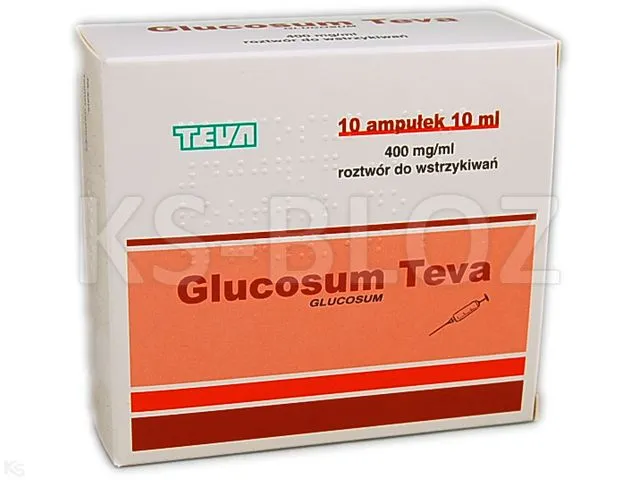
Table of Contents
Package leaflet: Information for the user
GLUCOSUM TEVA
200 mg/ml injection solution
400 mg/ml injection solution
Glucosum
Please read this leaflet carefully before using this medicine because it contains important
information for the patient.
- Keep this leaflet as you may need to read it again.
- If you have any further questions, please ask your doctor or pharmacist.
- This medicine has been prescribed for a specific individual. Do not pass it on to others. It may harm other people, even if their symptoms are the same.
- If you experience any adverse effects, including any not listed in this leaflet, tell your doctor or pharmacist. See section 4.
Contents of the leaflet
- What Glucosum Teva is and what it is used for
- Important information before using Glucosum Teva
- How to use Glucosum Teva
- Possible side effects
- How to store Glucosum Teva
- Contents of the pack and other information
1. What Glucosum Teva is and what it is used for
Glucose is a simple sugar and a natural source of energy for the body, primarily used by nerve cells, the heart muscle, striated muscles, and the liver. One gram of glucose provides 4 kcal of energy.
Glucose solutions from 10% to 40% are hypertonic relative to blood.
100 ml of 20% glucose solution provides 80 kcal.
100 ml of 40% glucose solution provides 160 kcal.
40% solutions, due to their osmotic action, reduce intracranial pressure. They also exhibit alkalizing and diuretic effects.
Indications for use of Glucosum Teva:
- hypoglycemia (abnormally low blood glucose levels)
- carbohydrate deficiency and energy deficits
- parenteral nutrition
- hyperosmotic and isoosmotic dehydration
- symptomatic treatment of disease states associated with increased intracranial pressure.
2. Important information before using Glucosum Teva
When not to use Glucosum Teva:
- diabetes mellitus
- hyperglycemic coma
- anuria
- hemorrhage into the central nervous system
- glucose-galactose malabsorption
- hypotonic dehydration
- fluid overload
- delirium tremens in dehydrated patients
- conditions following acute cerebral ischemia
- hypokalemia
- allergy to cereals or cereal products.
Warnings and precautions
Before starting treatment with Glucosum Teva, discuss it with your doctor or pharmacist.
During prolonged administration of glucose infusions, blood electrolyte levels, hydration status, and blood glucose concentration should be monitored periodically. Glucose solutions with concentrations above 15% should be administered into central vessels, except in life-threatening conditions (severe hypoglycemia - significant drop in blood glucose levels). In cases of hypoglycemia requiring administration of a highly concentrated solution into a peripheral vein, slow infusion is recommended. After sudden interruption of hypertonic glucose infusion, secondary drop in blood glucose concentration may occur.
Caution is also required when administering concentrated glucose solutions to patients with sepsis, severe trauma, severe malnutrition, vitamin B deficiency, hypophosphatemia, and hemodilution (blood dilution).
Use of Glucosum Teva in patients with impaired kidney and/or liver function
There are no data indicating the need for dose adjustment in patients with impaired kidney and/or liver function.
Glucosum Teva with other medicines
Glucose solutions should not be mixed with aminophylline, barbiturates, erythromycin, hydrocortisone, warfarin, kanamycin, sulfonamides, vitamin B, or phenytoin.
Glucose solution should not be administered using the same infusion set before, during, or after blood transfusion.
Caution is advised in patients receiving digitalis preparations, as concentrated glucose solutions may enhance their effects.
Pregnancy and breastfeeding
If the patient is pregnant or breastfeeding, suspects she may be pregnant, or is planning to have a child, she should consult her doctor or pharmacist before using this medicine.
Appropriate studies have not been conducted in pregnant or breastfeeding women.
The decision to use this medicine during pregnancy and breastfeeding is made by the physician.
Driving and operating machinery
Glucose does not impair psycho-motor performance and does not affect the ability to drive or operate machinery.
3. How to use Glucosum Teva
This medicine should always be used exactly as directed by the physician. In case of doubt, consult
your doctor or pharmacist.
Glucose 20% and 40% solutions are administered intravenously, either as injections or infusions,
in individually adjusted doses depending on the patient's health status, age, and body weight.
Close monitoring of blood glucose and electrolyte levels is recommended, especially during
prolonged parenteral nutrition.
Adults:
- In emaciated and malnourished patients, up to 300 g of glucose may be administered as a slow infusion. When concentrated glucose solutions are used, it is necessary to administer insulin at a dose of 1 IU of insulin per approximately 4 g of glucose.
- In parenteral nutrition: the required dose is usually 1.5 g – 3.0 g glucose/kg body weight per day; the recommended dose is 3 g glucose/kg body weight per day, administered as a slow infusion into a central vein.
- In hypoglycemia: administer 20% or 40% glucose solution intravenously (0.2 g/kg body weight) until normal blood glucose concentration is achieved.
Use in children:
- In children with hypoglycemia: administer 0.5 g glucose/kg body weight.
- During resuscitation procedures: 0.5 g to 1 g glucose/kg body weight, administered intravenously. If you feel the medicine's effect is too strong or too weak, consult your doctor.
Use of a higher than recommended dose of Glucosum Teva
In case of glucose overdose, administer insulin, correct fluid and electrolyte imbalances (biochemical parameters must be monitored), and provide symptomatic treatment.
Glucose overdose may lead to hyperglycemia (excessively high blood glucose concentration), glucosuria (presence of glucose in urine), and dehydration, which may consequently result in hyperosmolar coma and even death.
In case of overdose, inform a doctor immediately so appropriate treatment can be initiated.
4. Possible adverse effects
Like all medicines, this medicinal product may cause adverse effects, although not everyone experiences them.
The adverse effects are listed below by system organ class according to frequency of occurrence (if known).
Frequency of occurrence: Very common: (≥1/10), Common: (≥1/100, <1/10), Uncommon: (≥1/1000, <1/100),
Rare: (≥1/10,000, <1/1000), Very rare: (<1/10,000, including single cases).
Metabolism and nutrition disorders
Frequency not known: water and electrolyte disturbances (including hypokalaemia, hypomagnesaemia,
hypophosphataemia, hyponatraemia), metabolic disturbances (hyperglycaemia, hyperglycaemic coma,
hyperosmolarity, glucosuria and hypoglycaemia – due to hyperinsulinaemia following abrupt discontinuation of concentrated glucose solution).
General disorders and administration site conditions
Frequency not known: pain at the injection site, venous irritation
Single cases: sensation of warmth or flushing (especially with too rapid administration)
Immune system disorders
Single cases: anaphylactoid reactions (in patients with asthma and diabetes)
Hypertonic glucose solutions may cause osmotic diuresis and dehydration.
Concentrated glucose solutions (above 15%) damage the venous endothelium, causing local thrombo-inflammatory changes in peripheral veins.
To prevent metabolic complications, blood glucose concentration should be monitored and, if necessary, appropriate doses of exogenous insulin administered (without insulin supplementation, the body is able to metabolize glucose at a rate of approximately 0.25 g/kg body weight/hour).
Too rapid administration of glucose may lead to circulatory failure, pulmonary oedema and peripheral oedema.
Reporting of adverse effects
If any adverse effects occur, including any adverse effects not listed in this leaflet, inform your doctor or pharmacist. Adverse effects can be reported directly to the Department of Monitoring Adverse Drug Reactions, Office for Registration of Medicinal Products, Medical Devices and Biocidal Products, Al. Jerozolimskie 181C, 02-222 Warsaw
Tel.: +48 22 49 21 301
Fax: +48 22 49 21 309
Website: https://smz.ezdrowie.gov.pl
Reporting adverse effects helps to provide more information on the safety of the medicine.
5. How to store Glucosum Teva
Keep this medicine out of the sight and reach of children.
Store below 25°C.
Do not use this medicine after the expiry date stated on the packaging following:
Expiry (EXP). The expiry date refers to the last day of the stated month.
Do not store or reuse packaging once opened.
Medicines must not be disposed of via wastewater or household waste. Ask your pharmacist how to dispose of medicines no longer required. This will help protect the environment.
6. Contents of the package and other information
What Glucosum Teva 200 mg/ml solution for injection contains
- The active substance is glucose. 1 ml of solution contains 200 mg of glucose. Each ampoule (10 ml) contains 2.0 g of glucose.
- The other ingredient is water for injections.
What Glucosum Teva 400 mg/ml solution for injection contains
- The active substance is glucose. 1 ml of solution contains 400 mg of glucose. Each ampoule (10 ml) contains 4.0 g of glucose.
- The other ingredient is water for injections.
What Glucosum Teva looks like and contents of the pack
A clear, colourless solution.
Colourless glass ampoules with a capacity of 10 ml.
Packaged in cardboard boxes containing 10 or 50 ampoules, or a multipack containing 50 ampoules (5 packs of 10 ampoules each).
Not all pack sizes may be marketed.
Marketing Authorisation Holder and Manufacturer
Marketing Authorisation Holder:
Teva Pharmaceuticals Polska Sp. z o.o.
ul. Emilii Plater 53
00-113 Warsaw
tel.: (22) 345 93 00
Manufacturer:
Merckle GmbH
Ludwig-Merckle Str. 3
89143 Blaubeuren, Germany