Duracef
Poland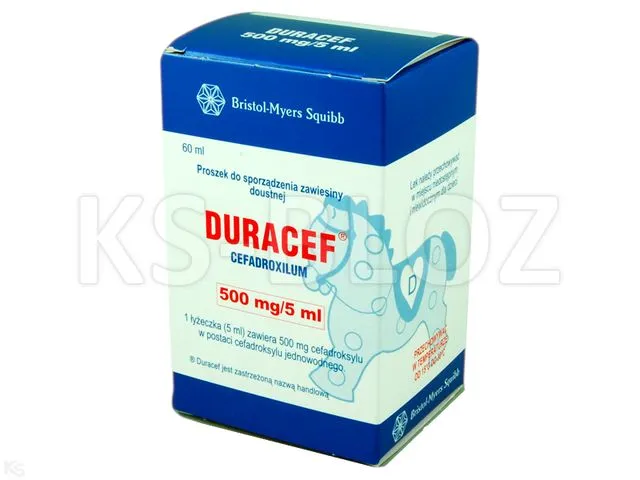
Table of Contents
Patient Information Leaflet
DURACEF 250 mg/5 ml powder for oral suspension
DURACEF 500 mg/5 ml powder for oral suspension
Cefadroxil
Please read this leaflet carefully before using this medicine, as it contains
important information for you.
- Keep this leaflet. You may need to read it again.
- If you have any further questions, please ask your doctor or pharmacist.
- This medicine has been prescribed for a specific individual. Do not pass it on to others. It may harm them, even if their symptoms are the same.
- If you experience any side effects, including any not listed in this leaflet, tell your doctor or pharmacist. See section 4.
Leaflet Contents:
- What Duracef is and what it is used for
- What you need to know before taking Duracef
- How to take Duracef
- Possible side effects
- How to store Duracef
- Contents of the pack and other information
1. What Duracef is and what it is used for
Duracef contains cefadroxil, an antibiotic belonging to the cephalosporin group, which acts bactericidally against many Gram-positive and Gram-negative bacteria. Its mechanism of action involves inhibition of bacterial cell wall synthesis.
Cefadroxil is indicated for the treatment of the following infections, provided they are caused by susceptible bacterial strains:
- Upper and lower respiratory tract infections, particularly pharyngitis and tonsillitis caused by beta-haemolytic streptococci of group A,
- Urinary tract infections caused by E. coli, P. mirabilis, and Klebsiella spp.,
- Skin and soft tissue infections caused by staphylococci and/or streptococci,
- Osteomyelitis,
- Bacterial arthritis.
(It has been shown that intramuscular penicillin is effective in the prevention of rheumatic fever. Duracef is generally effective in eliminating streptococci from the mouth and throat. However, there are no data on the effectiveness of Duracef in preventing recurrences of rheumatic fever.)
2. Important information before using Duracef
When not to use Duracef
- if the patient is allergic to cefadroxil, other cephalosporins, or any of the other ingredients of this medicine (listed in section 6).
Warnings and precautions
Before starting treatment with Duracef, discuss this with your doctor or pharmacist.
If Duracef is to be used in patients hypersensitive to penicillins, it should be borne in mind
that individuals hypersensitive to one beta-lactam antibiotic may also be allergic to other
antibiotics in this group (so-called cross-hypersensitivity). Such reactions may occur in up to 10%
of patients who have ever experienced hypersensitivity to penicillin.
If an allergic reaction to Duracef occurs, treatment should be discontinued.
In the event of severe, acute hypersensitivity symptoms, prompt administration of specific treatment may be necessary.
Due to the use of most antibacterial medicines, including Duracef, cases of diarrhoea associated with Clostridium difficile infection have been reported, ranging from mild diarrhoea to fatal colitis. Therefore, if a patient develops diarrhoea during or after treatment with Duracef, the doctor should be informed. The doctor may decide to discontinue the use of the medicine if diarrhoea occurs during treatment and, if necessary, recommend appropriate treatment.
Caution should be exercised when using Duracef in patients with renal impairment.
In patients with confirmed or suspected renal impairment, careful monitoring and appropriate laboratory tests are necessary before and during treatment with Duracef.
Prolonged use of Duracef may lead to the development of resistant bacterial flora. Close monitoring of the patient is required. If additional infection occurs during treatment with Duracef, the patient should consult a doctor, who will take appropriate measures.
During treatment with cephalosporin antibiotics, Coombs test results may be positive.
Haematological tests, antiglobulin tests, and Coombs test used for cross-matching in transfusion medicine may yield positive results in newborns whose mothers were treated with cephalosporin antibiotics before delivery.
The medicine should be used with caution in patients with a history of gastrointestinal disorders, especially colitis.
Duracef with other medicines
Tell your doctor about all medicines the patient is currently taking or has recently taken, as well as any medicines the patient plans to take.
Probenecid (used in gout) may increase cefadroxil plasma concentrations.
Duracef with food and drink
Duracef can be administered independently of meals, as food does not affect its bioavailability.
Administration with food reduces nausea without impairing absorption.
Pregnancy and breastfeeding
If the patient is pregnant or breastfeeding, suspects she may be pregnant, or is planning to have a child, she should consult her doctor or pharmacist before using this medicine.
Animal studies have not shown harmful effects on fetal development. However, due to the lack of adequately documented and controlled studies in pregnant women, Duracef should be used during pregnancy only if clearly necessary.
Cefadroxil passes into human milk; therefore, caution is required when administering Duracef to breastfeeding mothers.
Driving and operating machinery
Duracef has no effect on the ability to drive or operate machinery.
Duracef contains sucrose.
Duracef 250 mg/5 ml contains 2433.7 mg of sucrose in each 5 ml. Duracef 500 mg/5 ml contains 2185.75 mg of sucrose in each 5 ml. This should be taken into account in patients with diabetes. If a patient has previously been diagnosed with intolerance to certain sugars, the patient should consult a doctor before taking the medicine.
Duracef contains sodium benzoate (E 211).
Duracef 250 mg/5 ml contains 4.5 mg of sodium benzoate in each 5 ml, equivalent to 0.9 mg/ml.
Benzoic acid salts may increase the risk of jaundice (yellowing of the skin and whites of the eyes) in newborns (up to 4 weeks of age).
Duracef 500 mg/5 ml contains 4 mg of sodium benzoate in each 5 ml, equivalent to 0.8 mg/ml.
Benzoic acid salts may increase the risk of jaundice (yellowing of the skin and whites of the eyes) in newborns (up to 4 weeks of age).
Duracef contains sodium.
Duracef 250 mg/5 ml contains 0.72 mg of sodium (0.03 mmol) in each 5 ml.
Duracef 250 mg/5 ml contains less than 1 mmol (23 mg) of sodium per 5 ml, meaning the medicine is considered "sodium-free".
Duracef 500 mg/5 ml contains 0.64 mg of sodium (0.028 mmol) in each 5 ml.
Duracef 500 mg/5 ml contains less than 1 mmol (23 mg) of sodium per 5 ml, meaning the medicine is considered "sodium-free".
3. How to use Duracef
This medicine should always be used according to the doctor's instructions. If in doubt, consult
your doctor or pharmacist.
Duracef should be taken once or twice daily, depending on the type and severity of the infection.
The medicine should be taken for at least 48–72 hours after clinical symptoms have subsided
or eradication of microorganisms has been confirmed. Treatment of infections caused by
beta-hemolytic streptococci should last for at least 10 days. In severe infections (e.g. bone marrow),
administration of the medicine may be necessary for at least 4–6 weeks.
Duracef may be taken regardless of meals, as food does not affect the absorption of the active substance.
Adults and adolescents over 12 years of age (with body weight above 40 kg)
| Indication | Daily dose | Dosing Suspension, 500 mg/5 ml |
| Uncomplicated lower urinary tract infections | 1 to 2 g | 1 to 2 teaspoons* twice daily 2 to 4 teaspoons once daily |
| All other urinary tract infections | 2 g | 2 teaspoons twice daily |
| Skin and soft tissue infections | 1 g | 2 teaspoons once daily or 1 teaspoon twice daily |
| Streptococcal pharyngitis and tonsillitis caused by beta-hemolytic group A streptococci | 1 g | 2 teaspoons once daily or 1 teaspoon twice daily for at least 10 days |
Upper and lower respiratory tract infections
| 1 g 1 to 2 g | 1 teaspoon twice daily 1 to 2 teaspoons twice daily |
| Osteomyelitis and bacterial arthritis | 2 g | 2 teaspoons twice daily |
*Measuring spoon with a capacity of 5 ml
Use in children
Children are usually given a daily dose of 25 to 50 mg/kg b.w. (in osteomyelitis and bacterial
arthritis - 50 mg/kg b.w. per day) in two equal doses (every 12 hours), and in pharyngitis, tonsillitis, and erysipelas - as a single daily dose**.
| Body weight (kg) | Oral suspension | |
| 250 mg/5 ml | 500 mg/5 ml | |
| 5 - 10 kg | 1 teaspoon once daily | |
| 10 - 20 kg | 1 teaspoon twice daily | 1 teaspoon once daily |
| 20 - 40 kg | 2 teaspoons twice daily | 1 teaspoon twice daily |
*Measuring spoon with a capacity of 5 ml
In the treatment of infections caused by beta-hemolytic streptococci, therapeutic doses of
Duracef should be administered for at least 10 days.
Patients with impaired renal function
In patients with renal insufficiency, the physician will determine the dosage of Duracef based on
creatinine clearance.
| Creatinine clearance (in ml/min/1.73 m2 BSA) | Serum creatinine concentration (mg/dl) | Initial dose | Maintenance dose | Dosing interval |
| 50-25 | 14-25 | 1 g | 500 mg | 12 h |
| 10-25 | 25-56 | 1 g | 500 mg | 24 h |
| 0-10 | >56 | 1 g | 500 mg | 36 h |
Patients with a creatinine clearance above 50 ml/min/1.73 m² may be treated as patients with normal renal function.
Instructions for preparing the oral suspension from the powder for oral suspension
Duracef (60 ml and 100 ml bottles)
Shake the bottle to loosen the powder.
Then add water in two portions (shake after adding the first portion of water; complete with the second portion of water up to the level indicated on the label). After each addition of water, invert the bottle and shake thoroughly.
5 ml of the prepared suspension contains, depending on the preparation, 250 mg or 500 mg of cefadroxil as the monohydrate.
The prepared oral suspension is stable at room temperature for 7 days and in the refrigerator for 14 days.
Before use, shake the bottle contents well. The bottle should be tightly closed.
After 7 days of storage at room temperature or 14 days of storage in the refrigerator, any unused suspension is no longer suitable for use.
Use of a higher than recommended dose of Duracef
Symptoms of overdose have not been observed after ingestion of cefadroxil at doses up to 250 mg/kg body weight (patient observation and symptomatic treatment if necessary are recommended). In case of ingestion of cefadroxil at doses exceeding 250 mg/kg body weight, gastric emptying (induction of emesis or gastric lavage) is recommended.
4. Possible adverse reactions
Like all medicines, this medicine can cause adverse reactions, although not everyone will experience them.
Adverse reactions observed with cefadroxil are similar to those observed with other cephalosporins.
If any of the following adverse reactions occur, stop taking the medicine immediately and contact your doctor without delay:
- Allergic reaction with swelling localized in the face, lips, mouth, tongue, and/or throat (angioedema). This may cause a sensation of tightness in the throat, difficulty swallowing and breathing.
- Sudden, life-threatening systemic allergic reactions (anaphylactic reactions).
- Severe skin reactions, such as erythema multiforme, toxic epidermal necrolysis, Stevens-Johnson syndrome, characterized by widespread rash with blisters on the skin and mucous membranes, extensive necrosis and detachment of the epidermis.
- Serum sickness-like illness characterized by fever, itchy rash, joint pain, and enlarged lymph nodes.
- Severe, persistent diarrhea, sometimes with blood or mucus, sometimes accompanied by fever and abdominal pain (pseudomembranous colitis).
The frequency of the above-mentioned severe adverse reactions is unknown (cannot be estimated based on available data).
Additionally, during clinical trials and after marketing of the medicine, the following adverse reactions have been reported:
Common (occurring in less than 1 in 10 people):
- fever,
- diarrhea, indigestion, nausea, vomiting.
Rare (occurring in less than 1 in 1,000 people):
- vaginal infection,
- urticaria, rash, itching.
Unknown (frequency cannot be estimated from available data):
- fungal infections of the genital organs,
- genital itching,
- agranulocytosis, neutropenia (marked decrease in the number of white blood cells called granulocytes),
- low platelet count (thrombocytopenia),
- other hypersensitivity reactions not described above,
- liver failure, impaired bile flow (cholestasis), liver function disorders,
- joint pain,
- increased liver enzyme activity (aminotransferases).
Reporting of adverse reactions
If any adverse reactions occur, including any adverse reactions not listed in this leaflet, inform your doctor or pharmacist. Adverse reactions can be reported directly to the Department of Monitoring Adverse Drug Reactions of the Office for Registration of Medicinal Products, Medical Devices and Biocidal Products:
Al. Jerozolimskie 181C, 02-222 Warsaw
Tel.: 22 49-21-301,
Fax: 22 49-21-309,
Website: https://smz.ezdrowie.gov..
Adverse reactions can also be reported to the marketing authorization holder.
Reporting adverse reactions helps to provide more information on the safety of the medicine.
5. How to store Duracef
Store below 25°C.
The prepared suspension can be stored for 7 days at a temperature below 25°C or for 14 days
in the refrigerator, i.e. at 2°C to 8°C.
Keep the medicine out of sight and reach of children.
Do not use this medicine after the expiry date stated on the carton after: EXP. The expiry date refers to the last day of the stated month.
Medicines must not be disposed of via wastewater or household waste. Ask your pharmacist
how to dispose of medicines no longer required. This will help protect the environment.
6. Contents of the package and other information
What Duracef contains
- The active substance in Duracef is cefadroxil in the form of cefadroxil monohydrate.
Oral suspension powder, 250 mg/5 ml: 5 ml of reconstituted suspension contains 250 mg of cefadroxil in the form of cefadroxil monohydrate.
Oral suspension powder, 500 mg/5 ml: 5 ml of reconstituted suspension contains 500 mg of cefadroxil in the form of cefadroxil monohydrate. - Other components of the medicine are: sodium benzoate (E 211), sucrose, titanium dioxide, xanthan gum, Tween 40 (1% dispersion with sucrose), lemon flavour, strawberry flavour, raspberry flavour, Refrachissment flavour.
What Duracef looks like and contents of the pack
Duracef, as a powder for oral suspension, is available in HDPE bottles with a polyethylene cap, containing powder for preparing 60 ml or 100 ml of suspension, packed in a cardboard box with a dosing spoon.
Marketing Authorisation Holder:
Bausch Health Ireland Limited
3013 Lake Drive
Citywest Business Campus
Dublin 24, D24PPT3
Ireland
Manufacturer:
PenCef Pharma GmbH
Schützenanger 9
37081 Göttingen
Lower Saxony
Germany