Doxar
Poland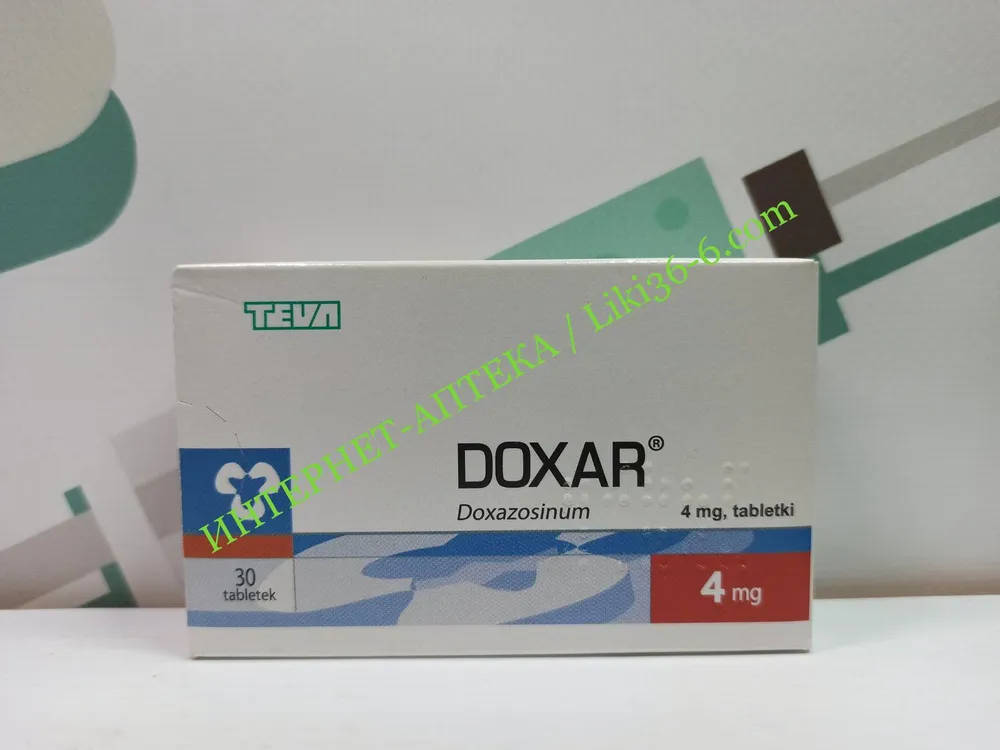
Table of Contents
Patient Information Leaflet
DOXAR, 1 mg, tablets
DOXAR, 2 mg, tablets
DOXAR, 4 mg, tablets
(Doxazosinum)
Please read this leaflet carefully before taking this medicine, as it contains important information for you.
- Keep this leaflet, as you may need to read it again.
- If you have any further questions, please ask your doctor or pharmacist.
- This medicine has been prescribed for a specific individual. Do not share it with others. This medicine may harm other people, even if their symptoms are the same.
- If you experience any side effects, including any not listed in this leaflet, please inform your doctor or pharmacist. See section 4.
Leaflet Contents:
- What Doxar is and what it is used for
- What you need to know before taking Doxar
- How to take Doxar
- Possible side effects
- How to store Doxar
- Contents of the pack and other information
1. What Doxar is and what it is used for
Doxar belongs to a group of medicines called alpha-adrenergic blocking agents (alpha-blockers). It works by dilating blood vessels, reducing peripheral resistance, which leads to a decrease in arterial blood pressure.
Doxar is also an antagonist of alpha1-adrenergic receptors located in the prostate gland and urinary bladder. It reduces symptoms related to urinary outflow obstruction and improves urodynamic test results (tests assessing urine flow).
Doxar is indicated for the treatment of:
- essential hypertension,
- clinical symptoms of benign prostatic hyperplasia (BPH).
2. Important Information Before Using Doxar
When not to use Doxar
- If the patient is allergic to the active substance or to quinazoline derivatives (e.g. prazosin, terazosin), or to any of the other ingredients of this medicine (listed in section 6).
- If the patient has ever experienced orthostatic hypotension.
- If the patient has benign prostatic hyperplasia with concomitant congestion of the upper urinary tract; chronic urinary tract infections or bladder stones.
- If the patient has arterial hypotension.
- In breastfeeding women (only for the indication: hypertension).
Doxar is contraindicated as monotherapy in patients with urinary retention or anuria, with or without progressive renal failure.
Warnings and precautions
Before starting treatment with Doxar, discuss this with your doctor or pharmacist.
Before initiating Doxar therapy, the doctor may perform tests to exclude other diseases, including prostate cancer, which may cause symptoms similar to those of benign prostatic hyperplasia.
At the beginning of treatment, orthostatic hypotension may occur, manifesting as dizziness, feeling of weakness, or rarely, loss of consciousness (fainting). The doctor may recommend monitoring of blood pressure at the beginning of treatment.
Patients with the following severe heart conditions should exercise caution when using doxazosin:
- Pulmonary edema caused by aortic stenosis or mitral valve stenosis,
- Heart failure with high cardiac output,
- Right-sided heart failure due to pulmonary embolism or pericardial effusion,
- Left-sided heart failure with low filling pressure.
Rapid and significant reduction in blood pressure may exacerbate angina symptoms.
Administration of doxazosin is not recommended in patients with severe hepatic impairment.
In patients concurrently taking PDE-5 inhibitors (e.g. sildenafil, vardenafil, and tadalafil – drugs used for erectile dysfunction), symptomatic arterial hypotension may occur.
Prolonged, painful erections may very rarely occur. In such a case, immediate medical attention is required.
Use in patients undergoing cataract surgery
During cataract surgery, "intraoperative floppy iris syndrome" (a variant of small pupil syndrome) has been observed in some patients currently or previously taking tamsulosin. Before surgery, inform the ophthalmologist about the use of alpha-adrenergic blocking agents.
Consult your doctor, even if the above warnings refer to conditions occurring in the past.
Children and adolescents
Use of Doxar is not recommended in children and adolescents under 18 years of age, as safety and efficacy have not yet been established in this age group.
Doxar and other medicines
Inform your doctor about all medicines currently used, recently used, or planned for use.
Ask your doctor or pharmacist before taking Doxar if you are using any of the following medicines, as they may alter the effect of Doxar:
Blood pressure-lowering effects may be enhanced by:
- PDE-5 inhibitors used in the treatment of erectile dysfunction, e.g. sildenafil, tadalafil, vardenafil (see section "Warnings and precautions").
- Medicines that reduce blood pressure,
- Medicines used to treat bacterial or fungal infections, e.g. clarithromycin, itraconazole, ketoconazole, telithromycin, voriconazole,
- Medicines used to treat HIV infection, e.g. indinavir, nelfinavir, ritonavir, saquinavir,
- Nefazodone, an antidepressant,
- Vasodilators or nitrates (medicines used in heart diseases).
Doxar enhances the blood pressure-lowering effects of other alpha-adrenergic blockers and antihypertensive medicines.
Blood pressure-lowering effects may be weakened by:
- Non-steroidal anti-inflammatory drugs (NSAIDs),
- Estrogens,
- Sympathomimetic agents.
Doxazosin may reduce the effectiveness of the following medicines: dopamine, ephedrine, epinephrine, phenylephrine (cough and cold medicines may contain phenylephrine or ephedrine), metaraminol (a medicine used to treat arterial hypotension), methoxamine on blood pressure, and vessels.
Particular caution is advised when using doxazosin concomitantly with medicines affecting hepatic metabolism, e.g. cimetidine.
In vitro studies have not shown that doxazosin affects the plasma protein binding of digoxin (a medicine used in heart failure and cardiac arrhythmias), warfarin (an anticoagulant), phenytoin (an anticonvulsant and antiarrhythmic), or indomethacin (a medicine used in rheumatoid arthritis).
During clinical trials with Doxar, no interactions were observed with thiazide diuretics, furosemide (an antihypertensive and diuretic), beta-blockers (medicines used in ischemic heart disease, cardiac arrhythmias, and hypertension), non-steroidal anti-inflammatory drugs (NSAIDs, e.g. ibuprofen), antibiotics, oral hypoglycemic agents (used in diabetes), uricosuric agents, or anticoagulants. Doxazosin may increase plasma renin activity and urinary excretion of vanillylmandelic acid. This should be taken into account when interpreting laboratory test results.
Doxar enhances the blood pressure-lowering effect of other alpha-adrenergic blockers and other antihypertensive medicines.
Clinical studies have shown that doxazosin has a beneficial effect on lipids, significantly reducing total triglyceride, total cholesterol, and LDL cholesterol fractions in plasma. Treatment with doxazosin favorably affects hypertension and lipid levels, thereby reducing the risk of coronary artery disease.
Some patients taking alpha-adrenergic blockers for high blood pressure or enlarged prostate may experience dizziness or a sensation of emptiness in the head, which may be caused by a sudden drop in blood pressure due to rapid change in body position when sitting or standing up. Some patients experienced these symptoms while taking alpha-adrenergic blockers together with medicines used for erectile dysfunction (impotence). To reduce the likelihood of these symptoms, it is recommended to establish a regular daily dosing regimen of alpha-adrenergic blockers before starting treatment with erectile dysfunction medicines.
Inform your doctor or pharmacist about all medicines currently used, recently used, or planned for use.
Pregnancy and breastfeeding
If the patient is pregnant, breastfeeding, suspects she may be pregnant, or plans to become pregnant, she should consult her doctor or pharmacist before using this medicine.
Pregnancy
Treatment of hypertension
The medicine may be used during pregnancy only if, in the opinion of the doctor, the benefit to the mother outweighs the potential risk to the fetus.
Breastfeeding
Doxazosin passes into human milk in small amounts.
The use of doxazosin during breastfeeding is contraindicated.
Driving and operating machinery
Due to individual responses to doxazosin, the ability to drive vehicles and operate machinery or perform specific types of work requiring maintenance of balance may be impaired, especially at the beginning of treatment, after dose increase, switching to another medicine, or when consuming alcohol.
Doxar contains anhydrous lactose
If the patient has previously been diagnosed with intolerance to certain sugars, the patient should consult a doctor before taking the medicine.
Doxar contains sodium
The medicine contains less than 1 mmol (23 mg) of sodium per tablet; therefore, the medicine is considered "sodium-free".
3. How to use Doxar
This medicine should always be used exactly as prescribed by your doctor. If in doubt, consult your doctor or pharmacist.
Method of administration
The medicine is taken orally. Tablets should be swallowed whole with water.
Essential hypertension
Treatment with Doxar should be initiated at a starting dose of 1 mg once daily. Depending on the response, after 1 to 2 weeks, your doctor may increase the dose to 2 mg of doxazosin once daily, then to 4 mg of doxazosin once daily, and finally to 8 mg of doxazosin once daily.
The usual maintenance dose is 2 mg to 4 mg of doxazosin once daily.
The maximum recommended daily dose is 16 mg of doxazosin.
The following dosing schedule is recommended when starting treatment:
- Day 1–8: 1 mg of doxazosin in the morning
- Day 9–14: 2 mg of doxazosin in the morning
Then the dose should be increased to the maintenance dose as appropriate.
Benign prostatic hyperplasia (BPH)
Treatment with Doxar should be initiated at a starting dose of 1 mg once daily. If necessary, after one week, your doctor may increase the dose to 2 mg of doxazosin once daily, and subsequently to 4 mg of doxazosin once daily.
The maximum recommended dose is 8 mg of doxazosin once daily.
The following dosing schedule is recommended when starting treatment:
- Day 1–8: 1 tablet of Doxar 1 mg (1 mg of doxazosin) once daily
- Day 9–14: 2 tablets of Doxar 1 mg (2 mg of doxazosin) once daily
Then the dose may be individually increased to the maintenance dose.
Elderly patients
There is no need to adjust the dose in elderly patients.
The dose should be kept as low as possible, and any dose increase should be performed under strict medical supervision.
Patients with renal impairment
There is no need to adjust the dose in patients with impaired renal function.
The dose should be kept as low as possible, and any dose increase should be performed under strict medical supervision.
Patients with hepatic impairment
There is limited clinical experience in patients with severe hepatic impairment. Extreme caution should be exercised when administering Doxar to patients with impaired liver function.
Children and adolescents
Doxar is not recommended for use in children and adolescents under 18 years of age.
Taking more Doxar than recommended
If you take more Doxar than prescribed, contact your doctor or pharmacist immediately.
In case of overdose leading to hypotension (systolic blood pressure below 100 mmHg and diastolic blood pressure below 60 mmHg), the patient should be placed on their back with legs elevated. Depending on the symptoms, the doctor will initiate appropriate treatment.
Due to the high degree of plasma protein binding of doxazosin, dialysis is not indicated.
Missed dose of Doxar
Do not take a double dose to make up for a missed dose.
If you feel the medicine is too strong or too weak in its effect, consult your doctor.
If you have any doubts about how to use this medicine, consult your doctor or pharmacist.
4. Possible adverse reactions
Like all medicines, this medicine can cause adverse reactions, although not everyone experiences
them.
You must stop taking Doxar and contact emergency medical services immediately if any of the
following adverse symptoms occur:
- heart attack,
- weakness in the limbs or speech disturbances, which may be signs of stroke,
- swelling of the face, tongue or throat, which may be signs of an allergic reaction to the medicine.
You should contact your doctor immediately if any of the following adverse symptoms occur:
- chest pain (angina pectoris),
- rapid breathing, difficulty breathing,
- rapid, slow or irregular heartbeat,
- palpitations,
- fainting,
- yellowing of the whites of the eyes and skin (jaundice),
- decreased number of white blood cells or platelets, which may increase the risk of bleeding or bruising.
The following adverse reactions have been reported in patients taking doxazosin:
Common adverse reactions (occurring in 1 to 10 out of 100 patients):
- respiratory tract infections,
- urinary tract infections, cystitis, urinary incontinence,
- labyrinthine vertigo, headache, accommodation disorders,
- drowsiness, dizziness,
- hypotension, orthostatic hypotension, oedema,
- palpitations, increased heart rate, chest pain,
- bronchitis, cough, dyspnoea, rhinitis (nasal catarrh),
- abdominal pain, dyspepsia, dry mouth, nausea,
- itching,
- back pain, muscle pain, weakness,
- cystitis, urinary incontinence, increased frequency of urination,
- pollakiuria,
- chest pain,
- influenza-like symptoms,
- generalized oedema, peripheral oedema.
Uncommon adverse reactions (occurring in 1 to 10 out of 1,000 patients):
- allergic reactions,
- increased appetite, thirst, loss of appetite (anorexia),
- joint pain, gout,
- restlessness, anxiety, depression, insomnia, nervousness, emotional lability,
- stroke, hypotension,
- fainting, tremor, apathy,
- lacrimation, photophobia,
- tinnitus,
- peripheral ischaemia,
- angina pectoris, myocardial infarction,
- epistaxis, pharyngitis,
- constipation, diarrhoea, flatulence and passage of wind, vomiting, gastritis and enteritis,
- increased liver enzyme activity, abnormal liver function test results,
- rash,
- difficulty in urination, haematuria, changes in frequency of urination, impotence,
- pain, facial swelling, fever, chills, hot flushes, pallor,
- hypokalaemia (decreased potassium levels in blood), weight gain.
Rare adverse reactions (occurring in fewer than 1 out of 10,000 patients):
- muscle cramps, muscle weakness,
- laryngeal oedema,
- polyuria,
- hypoglycaemia (low blood sugar levels).
Very rare adverse reactions (occurring in fewer than 1 out of 100,000 patients):
- low white blood cell count (leukopenia), low platelet count (thrombocytopenia),
- hypersensitivity, muscle stiffness, taste disturbances, nightmares, memory loss,
- orthostatic dizziness (when standing up from sitting or lying down),
- numbness, tingling in the limbs (paraesthesia),
- blurred vision,
- flushing (sensation of blood rushing to the head),
- slow heartbeat, irregular heartbeat (arrhythmia),
- bronchospasm,
- cholestasis, hepatitis, jaundice,
- alopecia, urticaria, purpura (red spots on the skin),
- urinary disorders, nocturia, increased diuresis (production and excretion of urine),
- increased creatinine levels in urine and serum,
- breast enlargement in men (gynaecomastia),
- painful, prolonged penile erection (priapism) – urgent medical advice should be sought,
- fatigue, malaise,
- decreased body temperature in elderly patients.
Adverse reactions with unknown frequency (frequency cannot be estimated from the available
data):
- intraoperative floppy iris syndrome,
- retrograde ejaculation.
Reporting of adverse reactions
If any adverse reactions occur, including any adverse reactions not listed in this leaflet, inform your
doctor, pharmacist or nurse. Adverse reactions can be reported directly to the Department of
Monitoring Adverse Reactions to Medicinal Products at the Office for Registration of Medicinal
Products, Medical Devices and Biocidal Products, Al. Jerozolimskie 181C, 02-222 Warsaw,
Tel.: +48 22 49 21 301, Fax: +48 22 49 21 309. Website: https://smz.ezdrowie.gov.pl
Adverse reactions can also be reported to the marketing authorization holder.
Reporting adverse reactions helps provide more information on the safety of this medicine.
5. How to store Doxar
Store below 25°C.
Keep out of sight and reach of children.
Do not use this medicine after the expiry date stated on the packaging. The expiry date refers to the last day of the specified month.
Medicines should not be disposed of via wastewater or household waste. Ask your pharmacist how to dispose of medicines no longer in use. This will help protect the environment.
6. Package contents and other information
What Doxar contains
The active substance is doxazosin mesilate, equivalent to 1 mg, 2 mg or 4 mg of doxazosin.
Other components of the medicine are: microcrystalline cellulose, anhydrous lactose, sodium carboxymethyl starch,
magnesium stearate, sodium lauryl sulfate.
What Doxar looks like and contents of the pack
White, round, biconvex tablets with a uniform surface.
Doxar 1 mg tablets – 30 tablets in a cardboard box.
Doxar 2 mg tablets – 30 tablets in a cardboard box.
Doxar 4 mg tablets – 30 or 120 tablets in a cardboard box.
Marketing Authorisation Holder
Teva Pharmaceuticals Polska Sp. z o.o.
ul. Emilii Plater 53
00-113 Warsaw
tel. (22) 345 93 00
Poland
Manufacturer
Teva Operations Poland Sp. z o.o.
ul. Mogilska 80
31-546 Kraków
Poland