Cogiton 5
Poland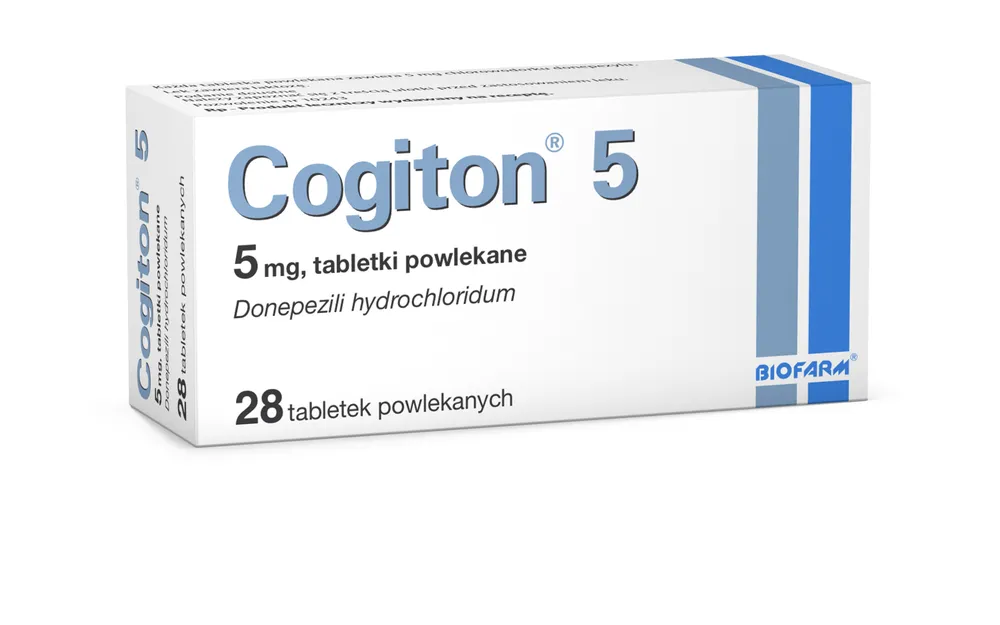
Table of Contents
Package leaflet: Information for the user
COGITON 5
5 mg, film-coated tablets
COGITON 10
10 mg, film-coated tablets
Donepezili hydrochloridum
Please read all of this leaflet carefully before taking this medicine, because it contains
important information for you.
- Keep this leaflet, as you may need to read it again.
- If you have any further questions, ask your doctor or pharmacist.
- This medicine has been prescribed for a specific individual. Do not pass it on to others. It may harm them even if their symptoms are the same.
- If you experience any adverse reactions, including any not listed in this leaflet, inform your doctor or pharmacist. See section 4.
Contents of the leaflet
- What Cogiton is and what it is used for
- What you need to know before taking Cogiton
- How to take Cogiton
- Possible side effects
- How to store Cogiton
- Contents of the pack and other information
1. What Cogiton is and what it is used for
Cogiton contains donepezil hydrochloride as the active substance, which belongs to a group of medicines known as acetylcholinesterase inhibitors.
Indication:
Symptomatic treatment of mild to moderate dementia in Alzheimer's disease.
Symptoms of the disease include memory loss, disorientation, and changes in behaviour. As a result, individuals with Alzheimer's disease increasingly struggle with normal daily activities.
Treatment with donepezil leads to improvement in cognitive abilities and general intellectual functions, thereby enhancing the individual's social functioning in Alzheimer's disease.
2. Important information before using Cogiton
When not to use Cogiton
- if the patient is allergic to donepezil hydrochloride, other piperidine derivatives, or any of the other ingredients of this medicine (listed in section 6),
- in pregnant women.
Warnings and precautions
Before starting treatment with Cogiton, discuss with your doctor:
- if the patient has or has previously had heart disorders (such as irregular or very slow heartbeat, heart failure, myocardial infarction), sick sinus syndrome, sinoatrial block, atrioventricular block, because donepezil may slow down heart rate,
- if the patient has a heart condition called "prolonged QT interval" or has previously experienced a certain type of arrhythmia called torsade de pointes, or if there is a history of "prolonged QT interval",
- if the patient has or has previously had low blood levels of magnesium or potassium,
- if the patient frequently takes painkillers,
- if the patient has ever been diagnosed with a stomach or duodenal ulcer,
- if the patient has difficulty urinating or mild kidney disease,
- if the patient has ever had a seizure, because donepezil may provoke further seizures,
- if the patient has bronchial asthma or chronic lung disease (e.g. chronic obstructive pulmonary disease),
- if the patient has ever been diagnosed with liver disease.
You should consult your doctor, even if the above warnings refer to conditions from the past.
Treatment with donepezil should only be initiated when continuous supervision of the patient's medication intake is possible.
Cogiton and other medicines
Tell your doctor or pharmacist about all medicines the patient is currently taking or has recently taken, as well as any medicines the patient plans to take.
In particular, inform your doctor if the patient is taking any of the following medicines:
- medicines used to treat heart rhythm disorders (e.g. amiodarone, sotalol),
- medicines used to treat depression (e.g. citalopram, escitalopram, amitriptyline, fluoxetine),
- antipsychotic medicines, e.g. pimozide, sertindole, ziprasidone,
- medicines used to treat bacterial infections (e.g. clarithromycin, erythromycin, levofloxacin, moxifloxacin, rifampicin),
- antifungal medicines, e.g. ketoconazole, itraconazole,
- medicines used for heart conditions (e.g. quinidine, beta-blockers, others),
- painkillers and anti-inflammatory medicines (e.g. acetylsalicylic acid, non-steroidal anti-inflammatory drugs such as ibuprofen or diclofenac),
- medicines used in epilepsy (e.g. phenytoin, carbamazepine),
- medicines with muscle relaxant effects (e.g. diazepam, succinylcholine),
- other medicines used in Alzheimer's disease,
- medicines affecting the cholinergic system (used, among others, to relieve stomach spasms, in Parkinson's disease, locomotor disease, and other disorders).
If a surgical procedure requiring general anaesthesia (general anaesthetic) is planned, the patient should inform the doctor about taking donepezil, as this medicine may enhance the effects of drugs used during anaesthesia.
Cogiton with food, drink and alcohol
Eating and drinking do not affect the absorption of Cogiton, so it may be taken with food and drink.
Alcohol must not be consumed during treatment with Cogiton. Alcohol may alter the effect of the medicine.
Pregnancy and breastfeeding
If the patient is pregnant, breastfeeding, suspects she may be pregnant, or is planning to have a child, she should consult a doctor or pharmacist before using this medicine.
Cogiton is contraindicated during pregnancy.
Cogiton should not be used during breastfeeding.
Driving and using machines
Cogiton has a minor or moderate influence on the ability to drive or operate machinery.
Dementia in Alzheimer's disease may impair the ability to drive or operate machinery. In addition, Cogiton may cause fatigue, dizziness, and muscle cramps, especially at the beginning of treatment or after a dose increase. The doctor will assess whether patients with Alzheimer's disease taking Cogiton can continue to drive or operate machinery.
Cogiton contains lactose. If the patient has previously been diagnosed with intolerance to certain sugars, the patient should contact the doctor before taking this medicine.
3. How to use Cogiton
This medicine should always be taken exactly as your doctor has told you. If you are unsure, consult
your doctor or pharmacist.
Dosage
Adults/elderly patients:
The starting dose is 5 mg once daily for at least one month. The 5 mg daily dose should be continued for at least one month, allowing your doctor to assess the effectiveness of treatment. If necessary, your doctor may increase the dose to the maximum recommended dose.
The maximum recommended daily dose is 10 mg.
If you feel that the effect of Cogiton is too strong or too weak, consult your doctor.
Patients with liver disease
In patients with mild or moderate liver disease, your doctor will adjust the dose according to individual tolerance. Cogiton should not be used in patients with severe liver disease due to lack of data on use in this patient group.
Patients with renal impairment
No dosage adjustment is necessary in patients with renal impairment.
Use in children
Cogiton is not recommended for use in children.
Method of administration
Cogiton tablets should be taken orally, in the evening, just before bedtime.
If unusual dreams, nightmares or difficulty sleeping occur (see section 4), your doctor may recommend taking Cogiton in the morning.
The Cogiton 10 tablet may be divided into two equal doses.
Duration of treatment
The duration of treatment will be determined by your doctor, who should periodically review your condition and the severity of symptoms.
Taking more Cogiton than you should
Do not take more than the dose recommended by your doctor.
Overdose of Cogiton may lead to cholinergic crisis (excessive acetylcholine activity), which may manifest as severe nausea, vomiting, excessive salivation, sweating, bradycardia, hypotension, respiratory depression, collapse and convulsions. Progressive muscle weakness may also occur, which may be fatal if respiratory muscles are affected.
If an overdose of donepezil is taken or if Cogiton is accidentally ingested by another adult or child, seek immediate medical advice from a doctor or go to hospital. Bring the tablets and the cardboard pack with you to show to the doctor.
If you forget to take Cogiton
Do not take a double dose to make up for a missed dose.
Continue treatment according to the prescribed dosing schedule for Cogiton.
Stopping Cogiton
If you have any further questions about the use of this medicine, consult your doctor or pharmacist.
After stopping Cogiton, the beneficial effects of treatment gradually diminish. Do not discontinue Cogiton without consulting your doctor.
4. Possible adverse reactions
Like all medicines, this medicine can cause adverse reactions, although not everyone will experience them.
The frequency of adverse reactions is defined below as:
- very common (may occur in more than 1 in 10 patients)
- common (may occur in up to 1 in 10 patients)
- uncommon (may occur in up to 1 in 100 patients)
- rare (may occur in up to 1 in 1000 patients)
- frequency not known (frequency cannot be estimated from the available data)
Serious adverse reactions:
If any of the following serious adverse reactions occur in the patient, you should inform the doctor immediately. Immediate treatment may be necessary.
- liver damage (e.g. hepatitis). Symptoms include: feeling unwell or nausea, loss of appetite, general weakness, fever, itching, yellowing of the skin and whites of the eyes, and dark-coloured urine (rare);
- stomach or duodenal ulcers. Symptoms include: stomach pain, discomfort (indigestion) in the area between the navel and the breastbone (uncommon);
- bleeding from the stomach or intestines. This may present as black, tarry stools or bleeding from the rectum (uncommon);
- seizures (uncommon);
- fever with muscle stiffness, sweating, or reduced level of consciousness (a condition known as neuroleptic malignant syndrome);
- muscle weakness, tenderness or pain, especially occurring together with feeling unwell, high fever or dark urine. This may be due to abnormal muscle breakdown, which can be life-threatening and lead to kidney problems (a condition called rhabdomyolysis);
- fast or irregular heartbeat, fainting, which may be symptoms of a potentially life-threatening condition called torsade de pointes (frequency not known).
The following adverse reactions have also been observed during treatment with donepezil:
Very common:
- diarrhoea,
- nausea,
- headache.
Common:
- cold symptoms,
- loss of appetite,
- hallucinations (seeing or hearing things that are not real), unusual dreams including nightmares, agitation, aggressive behaviour,
- fainting, dizziness, insomnia (difficulty sleeping),
- vomiting, stomach discomfort,
- rash, itching,
- muscle cramps,
- urinary incontinence,
- fatigue, pain,
- increased risk of accidents, including falls.
Uncommon:
- slow heart rate,
- slight increase in blood activity of an enzyme called creatine kinase.
Rare:
- muscle stiffness, tremor, involuntary movements, particularly of the face and tongue, as well as hands and feet (extrapyramidal symptoms),
- heart rhythm disorders (sinoatrial block, atrioventricular block).
Frequency not known:
- Changes in heart function seen on ECG known as "prolonged QT interval",
- Increased libido, hypersexuality,
- Pisa syndrome (a condition characterized by involuntary muscle contractions causing abnormal sideways bending of the body and head).
Reporting of adverse reactions
If any adverse reactions occur, including any not listed in this leaflet, inform your doctor or pharmacist. Adverse reactions can be reported directly to the Department of Monitoring of Adverse Drug Reactions, Office for Registration of Medicinal Products, Medical Devices and Biocidal Products
Al. Jerozolimskie 181 C
02-222 Warsaw
Tel.: +48 22 49 21 301
Fax: +48 22 49 21 309
Website: https://smz.ezdrowie.gov.pl
Adverse reactions can also be reported to the marketing authorization holder.
Reporting adverse reactions helps provide more information on the safety of this medicine.
5. How to store Cogiton
Keep this medicine out of sight and reach of children.
Store below 25°C.
Do not use this medicine after the expiry date stated on the blister and carton.
The expiry date refers to the last day of the stated month.
Medicines must not be disposed of via wastewater or household waste. Ask your pharmacist how to dispose of medicines you no longer use. This will help protect the environment.
6. Contents of the pack and other information
What Cogiton contains
Cogiton 5
- The active substance is donepezil hydrochloride.
Each tablet contains 5 mg of donepezil hydrochloride, equivalent to 4.56 mg of donepezil.
- The other ingredients are: tablet core: lactose monohydrate, pregelatinized starch, microcrystalline cellulose, hydroxypropylcellulose, magnesium stearate. tablet coating: hypromellose, polyethylene glycol 400, titanium dioxide (E 171).
Cogiton 10
- The active substance is donepezil hydrochloride. Each tablet contains 10 mg of donepezil hydrochloride, equivalent to 9.12 mg of donepezil.
- The other ingredients are: tablet core: lactose monohydrate, pregelatinized starch, microcrystalline cellulose, hydroxypropylcellulose, magnesium stearate. tablet coating: hypromellose, polyethylene glycol 400, titanium dioxide (E 171), yellow iron oxide (E 172).
What Cogiton looks like and contents of the pack
Cogiton 5
Film-coated tablets, round, biconvex, white in colour, with a smooth surface, free from spots and chips.
Cogiton 10
Film-coated tablets, round, biconvex, with a break line on one side, light beige in colour, with a smooth surface, free from spots and chips.
The tablets are packed in PVC/Aluminium blisters, placed in a cardboard box.
Pack sizes:
Cogiton 5
28 or 56 film-coated tablets
Cogiton 10
14, 28, 56 or 84 film-coated tablets
Not all pack sizes may be marketed.
Marketing Authorisation Holder and Manufacturer
Biofarm Sp. z o.o.
Wałbrzyska Street 13
60-198 Poznań
Poland
Tel.: +48 61 66 51 500
Fax: +48 61 66 51 505
E-mail: [email protected]
{Farmakod}