Cefox
Poland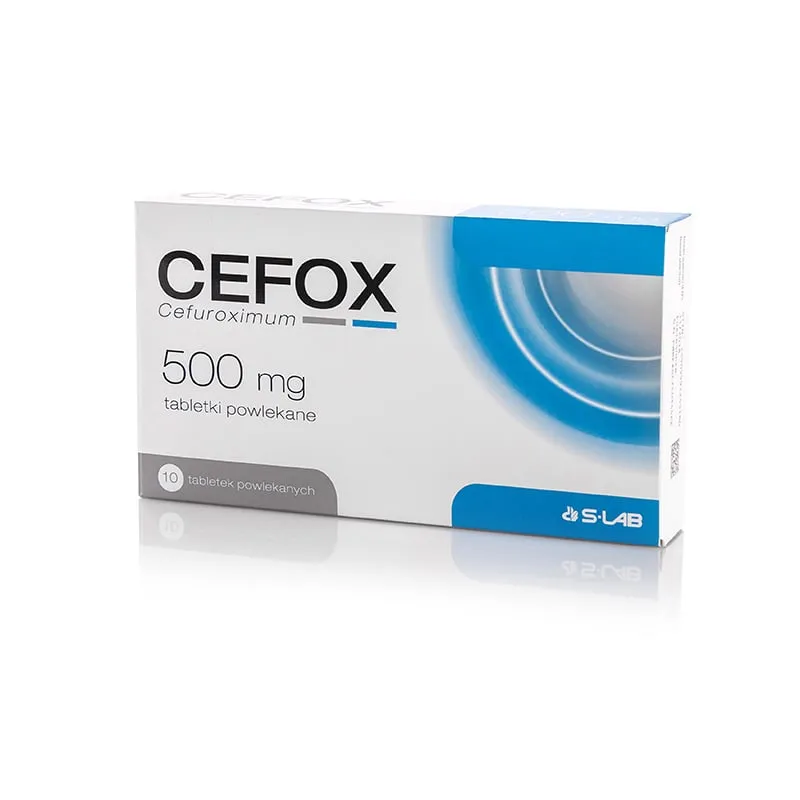
Instructions for Use
Package leaflet: Information for the patient
Cefox, 250 mg, film-coated tablets
Cefox, 500 mg, film-coated tablets
(Cefuroximum)
Please read all of this leaflet carefully before taking this medicine, because it contains
important information for the patient.
- Keep this leaflet. You may need to read it again.
- If you have any further questions, please ask your doctor or pharmacist.
- This medicine has been prescribed for a specific individual. Do not pass it on to others. It may harm them, even if their symptoms are the same.
- If you experience any adverse effects, including any not listed in this leaflet, tell your doctor or pharmacist. See section 4.
Contents of the leaflet
- What Cefox is and what it is used for
- What you need to know before taking Cefox
- How to take Cefox
- Possible side effects
- How to store Cefox
- Contents of the pack and other information
1. What Cefox is and what it is used for
Cefox is an antibiotic used in adults and children. The medicine works by killing the bacteria that cause infections. It belongs to a group of medicines called cephalosporins.
Cefox is used to treat infections of:
- throat
- sinuses
- middle ear
- lungs or chest
- urinary tract
- skin and soft tissues
Cefox may also be used:
- in the treatment of early-stage Lyme disease (borreliosis – an infection transmitted by ticks).
Your doctor may test which type of bacteria caused the infection and may also check during treatment whether the bacteria are sensitive to Cefox.
2. Information before using Cefox
When not to use Cefox:
- if the patient is allergic (hypersensitive) to cephalosporin antibiotics or to any of the other ingredients of Cefox (listed in section 6);
- if the patient has ever experienced a severe allergic reaction (hypersensitivity) to any other type of beta-lactam antibiotics (penicillins, monobactams or carbapenems).
If any of the above conditions apply to the patient, Cefox must not be taken without consulting a doctor.
Warnings and precautions
Cefox is not recommended for use in children under 3 months of age, as the safety and efficacy of the medicine in this age group have not been established.
During treatment with Cefox, attention should be paid to the occurrence of the following conditions:
allergic reactions, fungal infections (e.g. candidiasis), and severe diarrhoea (pseudomembranous colitis). This may reduce the risk of complications. See "Side effects that require attention" in section 4.
Blood tests
Cefox may affect the results of blood glucose tests and a blood test known as the Coombs test.
If the patient is due to have blood tests, he or she should inform the person taking the sample that Cefox is being taken.
Cefox and other medicines
Tell the doctor about all medicines currently taken or recently taken, as well as any medicines the patient plans to take. This includes medicines available without a prescription.
- Medicines that reduce stomach acid (e.g. antacids used to treat heartburn) may affect the action of Cefox.
- Probenecid (a medicine used for gout and other conditions).
- Oral anticoagulant medicines (anticoagulants, medicines that reduce blood clotting).
If the patient is taking any of the above (or similar) medicines, he or she should inform the doctor.
Oral contraceptives
Cefox may reduce the effectiveness of oral contraceptives. If the patient is taking oral contraceptives while using Cefox, additional mechanical methods of contraception (e.g. condoms) should be used. If in doubt, consult the doctor.
Pregnancy, breastfeeding and fertility
Inform the doctor before taking Cefox:
- if the patient is pregnant, suspects she may be pregnant, or is planning to become pregnant;
- if the patient is breastfeeding.
The doctor will assess whether the benefits to the patient from using Cefox during pregnancy and breastfeeding outweigh the risks to the child.
Driving and operating machinery
Cefox may cause dizziness and other adverse effects which may impair the patient's alertness.
The patient should not drive or operate machinery if he or she does not feel well.
3. How to use Cefox
This medicine should always be taken as directed by a doctor or pharmacist. If in doubt,
consult a doctor or pharmacist.
Cefox should be taken after a meal. This will help increase the effectiveness of treatment.
Cefox tablets should be swallowed whole with water.
Do not chew, crush or split the tablets – this may reduce the effectiveness of treatment.
Usual dose
Adults
The usual dose of Cefox is 250 mg to 500 mg twice daily, depending on the severity and type of infection.
Children
The usual dose of Cefox is 10 mg/kg body weight (not exceeding 125 mg) to 15 mg/kg body weight (not exceeding 250 mg) twice daily, depending on:
- the severity and type of infection.
Cefox is not recommended for use in children under 3 months of age, as the safety and efficacy of the medicine have not been established in this age group. For children who cannot swallow tablets, cefuroxime in the form of an oral suspension should be used.
Depending on the disease and the patient's response to treatment, the initial dose may be adjusted or more than one treatment course may be required.
Duration of treatment
The duration of treatment will be determined by the doctor depending on the severity and type of infection. Follow the doctor's instructions.
Patients with kidney problems
If a patient has impaired kidney function, the doctor may adjust the dosage of the medicine.
If this applies, the patient should inform the doctor.
Taking a higher than recommended dose of Cefox
If a patient takes more than the recommended dose of Cefox, neurological disturbances may occur, particularly an increased risk of seizures (epileptic fits).
Seek immediate medical attention or call emergency services. If possible, show the Cefox packaging to the healthcare provider.
Missing a dose of Cefox
Do not take a double dose to make up for a missed dose. Take the next dose at the usual time.
Stopping Cefox treatment prematurely
It is important not to shorten the prescribed duration of Cefox treatment. Do not stop treatment without the doctor's instruction, even if the patient feels better. Shortening the recommended treatment period may lead to recurrence of the disease.
4. Possible adverse reactions
Like any medicine, this medicine can cause adverse reactions, although they do not occur in everyone.
Symptoms to be aware of
In a small number of people taking Cefox, an allergic reaction or potentially severe skin reaction has been reported. Symptoms may include:
- Severe allergic reaction; symptoms include raised, itchy rash, swelling, sometimes of the face or lips, which may make breathing difficult;
- Skin rash that may develop into blisters and look like small rings (a dark spot in the centre surrounded by a lighter ring with a dark edge around the perimeter);
- widespread skin lesions with blisters and peeling skin (this may be a sign of Stevens-Johnson syndrome or toxic epidermal necrolysis - Lyell's syndrome).
Other symptoms to be aware of during treatment with Cefox:
- Fungal infections; medicines such as Cefox may cause overgrowth of yeast fungi (Candida) in the body, which may lead to fungal infection (e.g. candidiasis); the risk of this adverse reaction is higher if Cefox is used for a prolonged period;
- Severe diarrhoea (pseudomembranous colitis); medicines such as Cefox may cause inflammation of the colon (large intestine), leading to severe diarrhoea, usually with blood and mucus, abdominal pain and fever;
- Jarisch-Herxheimer reaction; during treatment with Cefox for Lyme disease (borreliosis), some patients may experience high fever, chills, muscle and headache, and skin rash; this is known as Jarisch-Herxheimer reaction; these symptoms usually last from several hours to one day.
If any of these symptoms occur in the patient, contact a doctor or nurse immediately.
Common adverse reactions
May occur in no more than 1 in 10 patients:
- fungal infections (e.g. candidiasis),
- headache,
- dizziness,
- diarrhoea,
- nausea,
- stomach pain.
Common adverse reactions that may be revealed in blood test results:
- increased number of white blood cells (eosinophilia),
- increased liver enzyme activity.
Uncommon adverse reactions
May occur in no more than 1 in 100 patients:
- vomiting,
- skin rashes.
Uncommon adverse reactions that may be revealed in blood test results:
- decreased number of platelets (cells involved in blood clotting),
- decreased number of white blood cells (leukopenia),
- positive Coombs test result.
Other adverse reactions
Other adverse reactions occur in a very small number of patients, but the exact frequency is unknown:
- severe diarrhoea (pseudomembranous colitis),
- allergic reactions,
- skin reactions (including severe),
- high temperature (fever),
- yellowing of the whites of the eyes or skin,
- hepatitis.
Adverse reactions that may be revealed in blood test results:
- excessive breakdown of red blood cells (haemolytic anaemia).
Reporting of adverse reactions
If any adverse reactions occur, including any not listed in this leaflet, inform your doctor, pharmacist or nurse. Adverse reactions can be reported directly to the Department of Monitoring Adverse Drug Reactions of the Office for Registration of Medicinal Products, Medical Devices and Biocidal Products
Al. Jerozolimskie 181C, 02-222 Warsaw, Tel.: + 48 22 49 21 301, Fax: + 48 22 49 21 309,
e-mail: [email protected].
Adverse reactions can also be reported to the responsible entity.
By reporting adverse reactions, additional information on the safety of the medicine can be collected.
5. How to store Cefox
Keep the medicine out of the sight and reach of children.
There are no special requirements regarding storage temperature. Store in the original
packaging to protect from light.
Do not use this medicine after the expiry date stated on the packaging. The expiry date refers to the last day of the stated month.
Medicines must not be disposed of via wastewater or household waste. Ask your pharmacist how to dispose of medicines no longer in use. This will help protect the environment.
6. Contents of the package and other information
What Cefox contains
The active substance is cefuroxime (as cefuroxime axetil).
Cefox 250 mg - one coated tablet contains 250 mg of cefuroxime in the form of cefuroxime axetil.
Cefox 500 mg - one coated tablet contains 500 mg of cefuroxime in the form of cefuroxime axetil.
Other components of the medicine are:
Core ingredients - microcrystalline cellulose, sodium croscarmellose (PH-102), sodium lauryl sulfate, colloidal anhydrous silica, hydrogenated vegetable oil;
Coating ingredients - hypromellose (5cP), titanium dioxide (E 171), macrogol 400.
What Cefox looks like and contents of the pack
Cefox 250 mg: white or almost white, elongated coated tablets, smooth on one side and marked with "A33" on the other.
Cefox 500 mg: white or almost white, elongated coated tablets, smooth on one side and marked with "A34" on the other.
Blister packs made of PA/Aluminium/PVC/Aluminium, in a cardboard box.
Pack sizes contain 10, 14, 20 or 28 tablets.
Marketing Authorisation Holder and Importer
Marketing Authorisation Holder:
S-LAB Sp. z o.o.
ul. Kiełczowska 2
55-095 Mirków
Tel.: 71 330 50 80
Importer:
APL Swift Services (Malta) Limited
HF 26, Hal Far Industrial Estate, Hal Far, Birzebbugia
BBG 3000
Malta
Similar Medications
-
Bioracef
Form: tablets, film-coated
Active substance Dosage cefuroxime axetil 125 mg Manufacturer: POLPHARMA S.A. Pharmaceutical Works Production Plant in Duchnice
-
Bioracef
Form: tablets, film-coated
Active substance Dosage cefuroxime axetil 250 mg Manufacturer: POLPHARMA S.A. Pharmaceutical Works Production Plant in Duchnice
-
Bioracef
Form: tablets, film-coated
Active substance Dosage Cefuroxime axetil 601.44 mg Manufacturer: POLPHARMA S.A. Pharmaceutical Works Production Plant in Duchnice
-
Cefox
Form: tablets, film-coated
Active substance Dosage cefuroxime 500 mg Manufacturer: APL Swift Services (Malta) Ltd.
-
Cefuroxime aristo
Form: tablets, film-coated
Active substance Dosage cefuroxime 250 mg Manufacturer: Aristo Pharma GmbH
-
Cefuroxime aristo
Form: tablets, film-coated
Active substance Dosage cefuroxime 500 mg Manufacturer: Aristo Pharma GmbH
-
Cefuroxime axetil aurovitas
Form: tablets, film-coated
Active substance Dosage cefuroxime axetil 500 mg Manufacturer: APL Swift Services (Malta) Ltd.
-
Cefuroxime genoptim
Form: tablets, film-coated
Active substance Dosage Cefuroxime axetil 300.715 mg Manufacturer: Ascend GmbH
-
Cefuroxime genoptim
Form: tablets, film-coated
Active substance Dosage Cefuroxime axetil 601.43 mg Manufacturer: Ascend GmbH
-
Ceroxim
Form: tablets, film-coated
Active substance Dosage cefuroxime 250 mg Manufacturer: Alkaloida Chemical Co. Zrt. Sun Pharmaceutical Industries Europe B.V. Terapia SA, a Ranbaxy company
-
Ceroxim
Form: tablets, film-coated
Active substance Dosage cefuroxime axetil 500 mg Manufacturer: Alkaloida Chemical Co. Zrt. Sun Pharmaceutical Industries Europe B.V. Terapia SA, a Ranbaxy company
-
Furocef
Form: tablets, film-coated
Active substance Dosage cefuroxime 250 mg Manufacturer: Krka, d.d., Novo mesto
This page has been machine-translated and may contain inaccuracies. The original data is available in the manufacturing country's language.
Last data check: June 04, 2026 · Data source: Rejestr Produktów Leczniczych (URPL)