Cardura xl
Poland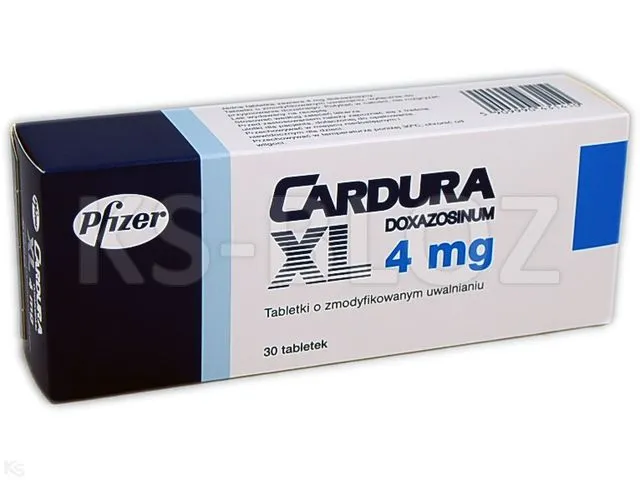
Table of Contents
Patient Information Leaflet
CARDURA XL, 4 mg, modified-release tablets
CARDURA XL, 8 mg, modified-release tablets
(Doxazosinum)
Please read all of this leaflet carefully before taking this medicine, because it contains
important information for you.
- Keep this leaflet. You may need to read it again.
- If you have any further questions, please ask your doctor or pharmacist.
- This medicine has been prescribed for you personally. Do not pass it on to others. It may harm them even if their symptoms are the same as yours.
- If you experience any side effects, including any not listed in this leaflet, tell your doctor or pharmacist. See section 4.
Leaflet Contents
- What CARDURA XL is and what it is used for
- What you need to know before taking CARDURA XL
- How to take CARDURA XL
- Possible side effects
- How to store CARDURA XL
- Contents of the pack and other information
1. What CARDURA XL is and what it is used for
Doxazosin, the active substance in CARDURA XL, belongs to a group of medicines called alpha-blockers. It works by dilating blood vessels, reducing peripheral resistance, which leads to a decrease in blood pressure.
CARDURA XL is also an antagonist of alpha-adrenergic receptors located in the prostate gland and bladder neck (outlet region). It reduces symptoms related to urinary obstruction and improves urodynamic test results (related to urine flow).
CARDURA XL is indicated for the treatment of:
- Essential hypertension,
- Clinical symptoms of benign prostatic hyperplasia (BPH).
2. Important information before taking CARDURA XL
When not to use CARDURA XL
if the patient is allergic to the active substance or to quinazoline derivatives (such as
prazosin, terazosin), or to any of the other ingredients of this medicine (listed in
section 6),
in patients with a history of orthostatic hypotension,
in patients with mild benign prostatic hyperplasia associated with congestion of the
upper urinary tract, chronic urinary tract infections, or bladder stones,
in patients with a history of gastrointestinal obstruction, oesophageal obstruction,
or any degree of gastrointestinal lumen narrowing,
in patients with arterial hypotension.
CARDURA XL is contraindicated as monotherapy in patients with bladder overdistension,
anuria without progressive renal failure or with it.
Warnings and precautions
Before starting treatment with CARDURA XL, discuss this with your doctor or pharmacist.
At the beginning of treatment, orthostatic hypotension may occur, manifesting as dizziness,
a feeling of weakness, and rarely fainting. Your doctor may recommend monitoring blood
pressure at the start of therapy.
In patients with severe heart disease (pulmonary edema caused by aortic stenosis or mitral
valve sten游戏副本
3. How to use CARDURA XL
This medicine should always be taken as directed by your doctor. If in doubt, consult your doctor or pharmacist.
The tablets should be swallowed whole; do not chew, divide, or crush them. The active substance in CARDURA XL tablets is contained within an inert, non-absorbable coating that allows controlled, slow release of the medicine from the tablet. After passing through the gastrointestinal tract, the empty tablet shell is excreted. The presence in the stool of residue resembling a tablet should not be a cause for concern.
Essential hypertension
In most patients, normalization of blood pressure occurs with a dose of 4 mg once daily. Optimal effect may take up to 4 weeks. Afterwards, if necessary and depending on the patient's response, your doctor may increase the dose to 8 mg of doxazosin per day. The maximum recommended dose is 8 mg of doxazosin per day.
Benign prostatic hyperplasia (BPH)
Treatment should be initiated at a dose of 4 mg once daily. Depending on the patient's response, the doctor may increase the dose to 8 mg of doxazosin once daily. The maximum recommended dose is 8 mg of doxazosin once daily.
CARDURA XL may be used in patients with benign prostatic hyperplasia regardless of whether they have hypertension or not. Changes in blood pressure values in patients with normal blood pressure and benign prostatic hyperplasia are generally very small. The use of CARDURA XL as monotherapy (as the only medicine) is effective in treating patients with both benign prostatic hyperplasia and hypertension.
Taking CARDURA XL with food and drink
CARDURA XL may be taken with food or on an empty stomach.
Use in children and adolescents
CARDURA XL is not recommended for use in children and adolescents under 18 years of age.
Patients with renal impairment
There is no need to adjust the dose in patients with impaired kidney function. However, the dose should be kept as low as possible, and any dose increase should be carried out under strict medical supervision.
Patients with hepatic impairment
Extreme caution is required. Administration of doxazosin is not recommended in patients with documented liver impairment (see section 2).
Elderly patients
There is no need to adjust the dose in elderly patients.
Taking more CARDURA XL than recommended
Hypotension may occur after overdose.
If you take more CARDURA XL than recommended, contact your doctor immediately.
Depending on the symptoms present, the doctor will initiate appropriate treatment. Since doxazosin is 98% protein-bound, dialysis is not indicated as a treatment method for overdose.
Missed dose of CARDURA XL
If you forget to take a dose, take it as soon as possible, unless it is almost time for your next dose. In that case, take the next dose at the scheduled time. Do not take a double dose to make up for a missed dose.
4. Possible adverse reactions
Like all medicines, this medicine can cause adverse reactions, although they do not occur in everyone.
Common adverse reactions (may occur in more than 1 in 100 patients)
Respiratory tract infections, urinary tract infections, dizziness, headache, somnolence,
vertigo, palpitations, tachycardia, hypotension,
orthostatic hypotension, bronchitis, cough, dyspnoea, nasopharyngitis, abdominal pain,
dyspepsia, dry mouth, nausea, pruritus, back pain, muscle pain, cystitis,
urinary incontinence, asthenia, chest pain, influenza-like symptoms, peripheral oedema.
Uncommon adverse reactions (may occur in more than 1 in 1000 patients)
Allergic reactions, anorexia, gout, increased appetite, anxiety, depression, insomnia,
cerebrovascular accident, hypoaesthesia, syncope, tremor, tinnitus, angina pectoris, myocardial infarction,
epistaxis, constipation, diarrhoea, flatulence and increased flatus, vomiting, gastritis and enteritis,
abnormal liver function test results, skin rash, arthralgia, dysuria, haematuria, urinary frequency disorders,
impotence, pain, facial oedema, weight gain.
Rarely reported adverse reactions (may occur in more than 1 in 10,000 patients)
Gastrointestinal obstruction.
Very rarely reported adverse reactions (may occur in less than 1 in 10,000 patients)
Leukopenia, thrombocytopenia, agitation, nervousness, orthostatic dizziness, paresthesia,
blurred vision, bradycardia, cardiac arrhythmias, flushing, bronchospasm, cholestasis,
hepatitis, jaundice, alopecia, purpura, urticaria, muscle cramps, muscle weakness,
urinary retention, nocturia, polyuria, increased diuresis,
gynaecomastia, fatigue, malaise.
Prolonged, painful erection. Immediate medical advice should be sought.
Frequency not known (cannot be estimated from the available data)
Intraoperative floppy iris syndrome, retrograde ejaculation.
Reporting of adverse reactions
If any adverse reactions occur, including any not listed in this leaflet, inform your doctor or pharmacist. Adverse reactions can be reported directly to the Department of Monitoring Adverse Drug Reactions at the Office for Registration of Medicinal Products, Medical Devices and Biocidal Products
Al. Jerozolimskie 181C
02-222 Warsaw
Phone: +48 22 49 21 301
Fax: +48 22 49 21 309
Website: https://smz.ezdrowie.gov.pl
Adverse reactions may also be reported to the marketing authorisation holder or its representative.
Reporting adverse reactions helps provide more information on the safety of the medicine.
5. How to store the medicine CARDURA XL
Keep the medicine out of sight and reach of children.
Store below 30°C and protect from moisture.
Do not use this medicine after the expiry date stated on the packaging following: EXP.
The expiry date refers to the last day of the stated month.
6. Contents of the pack and other information
What Cardura XL contains
The active substance is doxazosin in the form of doxazosin mesylate.
The other ingredients are:
active layer: polyethylene oxide, hypromellose, iron oxide red (E 172), magnesium stearate;
osmotic layer: polyethylene oxide, sodium chloride, hypromellose, iron oxide red (E 172),
magnesium stearate;
membrane coating: cellulose acetate, macrogol 3350;
outer coating: Opadry White YS-2-7063 (hypromellose, macrogol 3350, titanium dioxide);
printing ink: Black Ink S-1-17823 (pharmaceutical glaze, iron oxide black (E 172)).
What Cardura XL looks like and contents of the pack
Modified-release tablets.
Cardura XL 4 mg: round, biconvex, film-coated white tablets with a hole and printed with "CXL 4" on one side.
Cardura XL 8 mg: round, biconvex, film-coated white tablets with a hole and printed with "CXL 8" on one side.
Pack contains 30 or 100 tablets in Al/PVC/PVDC or Al/Al blisters, packed in a cardboard box.
Marketing Authorisation Holder and Manufacturer
Marketing Authorisation Holder
Viatris Healthcare Limited
Damastown Industrial Park
Mulhuddart
Dublin 15
DUBLIN
Ireland
Manufacturers
Pfizer Manufacturing Deutschland GmbH, Mooswaldallee 1, 79108 Freiburg Im Breisgau, Germany
Klocke Verpackungs-Service GmbH, Max-Becker-Strasse 6, 76356 Weingarten (Baden), Germany
For further information, please contact the Marketing Authorisation Holder's representative:
Viatris Healthcare Sp. z o.o.
tel. 22 546 64 00