Biosotal 40
Poland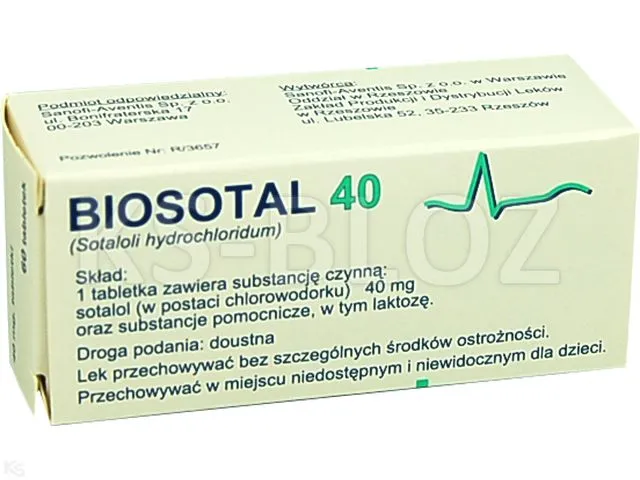
Table of Contents
Package leaflet: Information for the patient
BIOSOTAL 40, 40 mg, tablets
BIOSOTAL 80, 80 mg, tablets
Sotaloli hydrochloridum
Please read this leaflet carefully before taking this medicine, as it contains important information for you.
- Keep this leaflet, as you may need to read it again.
- If you have any further questions, please ask your doctor or pharmacist.
- This medicine has been prescribed for a specific individual. Do not pass it on to others. It may harm someone else, even if their symptoms are the same.
- If you experience any adverse effects, including any not listed in this leaflet, tell your doctor or pharmacist. See section 4.
Contents of the leaflet
- What Biosotal is and what it is used for
- Important information before taking Biosotal
- How to take Biosotal
- Possible side effects
- How to store Biosotal
- Contents of the pack and other information
1. What Biosotal is and what it is used for
Biosotal 40 and Biosotal 80 are available as tablets and contain the active substance sotalol. Sotalol
belongs to a group of non-selective β-adrenolytic agents. Sotalol is used in cardiac arrhythmias and exhibits antiarrhythmic properties characteristic of both Class II and Class III antiarrhythmic drugs.
Sotalol slows down an abnormally fast heart rate, reduces the oxygen demand of the heart muscle, and lowers arterial blood pressure.
Biosotal is used in the treatment of:
- life-threatening ventricular arrhythmias,
- supraventricular arrhythmias: atrial fibrillation and atrial flutter, supraventricular tachycardia, atrioventricular nodal and atrioventricular reentrant tachycardia,
- arrhythmias associated with Wolff-Parkinson-White syndrome.
2. Important information before taking Biosotal
When not to take Biosotal:
- if you are allergic to sotalol or any of the other ingredients of this medicine (listed in section 6),
- if you have untreated pheochromocytoma,
- if you have experienced cardiac arrhythmias of the torsade de pointes type,
- if you have hypotension not caused by arrhythmia,
- if you have bronchial asthma or chronic obstructive pulmonary disease (COPD),
- if you have sick sinus syndrome (including sinoatrial block), in patients without a pacemaker,
- if you have bradycardia (heart rate below 45–50 beats per minute),
- if you have second- or third-degree atrioventricular block (in patients without a pacemaker),
- if you have congenital or acquired QT interval prolongation,
- if you have experienced cardiogenic shock,
- if you have Raynaud's syndrome or severe peripheral circulatory disorders,
- if you have metabolic acidosis,
- if you have severe renal impairment (creatinine clearance <10 ml/min),
- if you have uncompensated heart failure,
- if you have Prinzmetal's angina,
- if you are undergoing anaesthesia that may suppress myocardial function,
- if you are taking medicines that may cause torsade de pointes, such as:
- Class Ia antiarrhythmics (hydroquinidine, quinidine, disopyramide),
- Class III antiarrhythmics (amiodarone, dronedarone),
- antidepressants and anxiolytics, e.g. citalopram, escitalopram,
- other medicines such as: difemanil, intravenous erythromycin, mizolastine, intravenous spiramycin, intravenous vinpocetine, intravenous dolasetron, domperidone, hydroxyzine, mequitazine, arsenic, moxifloxacin, piperaquine, prucalopride, toremifene, vandetanib (see section "Biosotal with other medicines").
Warnings and precautions
Before starting treatment with Biosotal, discuss this with your doctor or pharmacist.
Do not abruptly stop taking Biosotal, especially if you have ischaemic heart disease. Abrupt discontinuation may worsen ischaemic heart disease, cause arrhythmias, or even lead to myocardial infarction or death. Contact your doctor before stopping treatment.
During long-term treatment, ECG and serum electrolyte levels should be monitored every 1–2 months.
The most dangerous adverse effect of antiarrhythmic drugs is the worsening of pre-existing arrhythmias or the induction of new arrhythmias.
Medicines that prolong the QT interval, including Biosotal, may cause torsade de pointes arrhythmias. The incidence of torsade de pointes is dose-dependent. It usually occurs at the beginning of treatment or during dose escalation and is more common in women.
In patients with hypokalaemia or hypomagnesaemia (low potassium or magnesium levels), appropriate electrolyte levels should be corrected before initiating Biosotal.
Use Biosotal with caution in patients with congestive heart failure. Treatment should be initiated at the lowest possible dose, with careful dose escalation.
Use caution when treating patients with a history of myocardial infarction or impaired left ventricular function.
If bradycardia (slowed heart rate) occurs during treatment, contact your doctor.
Use caution in patients with first-degree atrioventricular block.
β-adrenolytic agents may exacerbate anaphylactic reactions. Patients may not respond to usual doses of adrenaline used in the treatment of allergic reactions.
In unstable diabetes, Biosotal may mask early symptoms of hypoglycaemia, such as tachycardia (rapid heartbeat), palpitations, and excessive sweating. Blood glucose should be monitored more frequently at the beginning of treatment.
Biosotal may mask cardiovascular symptoms of hyperthyroidism.
Dosage should be appropriately reduced in patients with impaired renal function.
Before undergoing general anaesthesia, inform the anaesthesiologist that you are taking Biosotal.
β-adrenolytic agents may exacerbate psoriasis; therefore, consult your doctor before using Biosotal.
In elderly patients, contraindications must be strictly observed. Treatment should begin with a low dose, and close monitoring of the patient's condition is essential.
Biosotal contains an active substance that may lead to positive results in doping control tests performed on athletes.
Children and adolescents
The safety and efficacy of Biosotal in children have not been established.
Biosotal with other medicines
Tell your doctor about all medicines you are currently taking or have recently taken, as well as any medicines you plan to take.
Concomitant use of sotalol is contraindicated with:
- medicines causing torsade de pointes, such as amiodarone, disopyramide, quinidine (except antiparasitic agents, neuroleptics, methadone, hydroxychloroquine)
Concomitant use with sotalol is not recommended with:
- fingolimod (an immunomodulatory agent used in multiple sclerosis),
- neuroleptics that may cause torsades de pointes, such as amisulpride, haloperidol,
- calcium channel blockers, e.g. verapamil and diltiazem (used in the treatment of arrhythmias),
- antiparasitic agents that may cause torsades de pointes, such as chloroquine, halofantrine (used in the treatment of malaria), pentamidine (used in the treatment of pneumonia), hydroxychloroquine (used in musculoskeletal disorders),
- methadone (used in the treatment of cough, pain, and heroin addiction).
Use caution when using sotalol concomitantly with the following medicines:
- inhaled halogenated anaesthetics (used in general anaesthesia); inform the anaesthesiologist that you are taking Biosotal,
- azithromycin (an antibiotic),
- medicines causing bradycardia,
- propafenone (an antiarrhythmic agent),
- centrally acting antihypertensives (clonidine, methyldopa, moxonidine, rilmenidine): abrupt discontinuation of centrally acting antihypertensives may lead to a significant increase in blood pressure. Avoid abrupt discontinuation of these agents,
- potassium-depleting agents, such as diuretics, stimulant laxatives, intravenous amphotericin B (used in fungal infections), systemic corticosteroids (anti-inflammatory agents),
- insulin and oral antidiabetic agents,
- intravenous lidocaine,
- fluoroquinolones (ciprofloxacin, levofloxacin, norfloxacin),
- β-adrenolytics used in heart failure (bisoprolol, carvedilol, metoprolol, nebivolol),
- ondansetron (an antiemetic), anagrelide (used in thrombocythemia), clarithromycin, roxithromycin (antibiotics).
Consider concomitant use of sotalol with:
- non-steroidal anti-inflammatory drugs (NSAIDs),
- dihydropyridine derivatives, such as amlodipine, felodipine,
- intravenous dipyridamole,
- α-adrenolytic agents used in urology, such as alfuzosin, tamsulosin,
- antihypertensive agents blocking α-adrenergic receptors (urapidil),
- medicines causing orthostatic hypotension.
Pregnancy and breastfeeding
Pregnancy
If you are pregnant, think you may be pregnant, plan to become pregnant, or are breastfeeding, consult your doctor before taking this medicine. Biosotal should only be used if the expected benefit to the mother outweighs the potential risk to the foetus.
Breastfeeding
Consult your doctor before taking this medicine. Breastfeeding is not recommended during treatment with sotalol.
Driving and operating machinery
In some individuals, this medicine may cause dizziness or vertigo, especially at the beginning of treatment. This may temporarily impair the ability to drive or operate machinery.
Biosotal contains lactose
If you have been diagnosed with an intolerance to certain sugars, consult your doctor before taking this medicine.
3. How to use Biosotal
This medicine should always be taken exactly as prescribed by the doctor. If in doubt, consult your doctor.
Tablets should be swallowed whole.
Treatment is initiated at a dose of 80 mg daily, increasing the daily dose by 40 mg every 2-3 days (serum concentration reaches steady state after 5-6 doses).
The daily dose of sotalol in the treatment of cardiac arrhythmias ranges from 120 mg to 480 mg.
The daily dose is usually divided into two divided doses: it is best to take the medicine in the morning and in the evening, 1 hour before meals.
Dosage in renal impairment:
Dose reduction is recommended by extending the intervals between doses. In cases of creatinine clearance of 30–60 ml/min, omit one daily dose. In cases of creatinine clearance of 10–30 ml/min, administer doses every 36–48 hours.
The drug should not be used if creatinine clearance is below 10 ml/min.
Liver disease does not require dosage adjustment.
In elderly patients, the elimination half-life of the drug may be prolonged, leading to increased plasma concentration.
The drug should be discontinued gradually, with a slow reduction in dose (abrupt discontinuation may be dangerous).
If you feel that the effect of Biosotal is too strong or too weak, consult your doctor.
Overdose of Biosotal
Most commonly observed symptoms include: bradycardia (slowing of heart rate), congestive heart failure, hypotension, bronchospasm, hypoglycemia (reduced blood glucose concentration), and seizures (including seizures caused by low blood sugar).
In case of overdose, seek immediate medical advice from a doctor or go to the nearest hospital emergency department.
In cases of significant overdose, the following have been observed: bradycardia, QT interval prolongation*, torsade de pointes*, ventricular tachycardia, and cardiac arrest.
Treatment of overdose: Sotalol administration should be stopped immediately and the patient must remain under strict medical supervision. Sotalol is not protein-bound and can be removed from the bloodstream by hemodialysis.
Close monitoring of the patient is required until QT interval normalizes and heart rate returns to >50 beats per minute.
Missed dose of Biosotal
If a dose is missed, it should be taken as soon as possible, unless the next scheduled dose is approaching. Do not take a double dose to make up for a missed dose. If in doubt, consult your doctor.
If you have any further questions about the use of this medicine, consult your doctor.
4. Possible side effects
Like all medicines, this medicine can cause side effects, although not everybody will experience them.
Side effects are usually transient and do not require discontinuation of treatment; they usually resolve after dose reduction.
The most serious side effect of sotalol is the induction of arrhythmias, including torsade de pointes type ventricular arrhythmias.
Common (not more frequent than in 1 out of 10 people):
- swelling, fatigue, asthenia (chronic fatigue)
- dizziness, headache, insomnia, paresthesia (partial paralysis of part of the body or skin surface), taste disturbances
- muscle cramps
- nausea, vomiting, diarrhoea, indigestion, abdominal pain, bloating
- proarrhythmic effect, torsade de pointes, heart failure, bradycardia (slowing of heart rate), chest pain, palpitations, fainting, pre-syncope
- hypotension, Raynaud's syndrome, worsening of peripheral vascular disease
- depression, anxiety disorders
- skin changes resembling psoriasis or exacerbation of existing psoriasis symptoms
- shortness of breath
- changes in ECG findings.
Frequency not known (frequency cannot be estimated from the available data):
- abnormally low number of thrombocytes (also known as platelets) in the blood
- excessive hair loss
- excessive sweating
- fever
- sexual dysfunction
- visual disturbances.
In rare cases, development of antinuclear antibodies has been reported, which only exceptionally were associated with clinical symptoms of lupus-like syndrome, resolving after discontinuation of treatment.
Laboratory tests
The presence of sotalol in urine may falsely elevate urinary metanephrine levels when measured by photometric methods. In patients suspected of having a pheochromocytoma of the adrenal gland who are receiving sotalol, the physician will order metanephrine measurement using liquid chromatography.
Reporting of side effects
If any side effects occur, including any not listed in this leaflet, inform your doctor, pharmacist, or nurse. Side effects can be reported directly to the Department of Monitoring Adverse Drug Reactions at the Office for Registration of Medicinal Products, Medical Devices and Biocidal Products.
Al. Jerozolimskie 181C, 02-222 Warsaw, Tel.: +48 22 49 21 301, Fax: +48 22 49 21 309, website: https://smz.ezdrowie.gov.pl
Side effects can also be reported to the Marketing Authorisation Holder or its representative in Poland.
Reporting side effects helps provide more information on the safety of this medicine.
5. How to store Biosotal
Keep this medicine out of the sight and reach of children.
Do not use this medicine after the expiry date stated on the packaging after "Expiry date (EXP)". The expiry date refers to the last day of the stated month.
There are no special storage instructions for this medicine.
Medicines must not be disposed of via wastewater or household waste. Ask your pharmacist how to dispose of medicines no longer required. Such measures help protect the environment.
6. Contents of the packaging and other information
What the medicine contains
- The active substance is sotalol. Each tablet of Biosotal 40 contains 40 mg of sotalol (as hydrochloride). Each tablet of Biosotal 80 contains 80 mg of sotalol (as hydrochloride).
- The excipients are: monohydrate lactose, potato starch, microcrystalline cellulose, povidone (K-25), magnesium stearate, talc.
What the medicine looks like and contents of the pack
Biosotal 40: tablet, round, 6 mm in diameter, biconvex, white or almost white
Biosotal 80: tablet, round, 8 mm in diameter, biconvex, white or almost white
Packaging contains 60 tablets of Biosotal 40 or 30 tablets of Biosotal 80, packed in PVC/Al blisters with 10 tablets per blister, in a cardboard carton.
Marketing Authorisation Holder and Manufacturer
Marketing Authorisation Holder:
CHEPLAPHARM Arzneimittel GmbH
Ziegelhof 24
17489 Greifswald
Germany
Manufacturers:
Opella Healthcare Poland Sp. z o.o.
Branch in Rzeszów
ul. Lubelska 52
35-233 Rzeszów, Poland
Temmler Pharma GmbH
Temmlerstrasse 2
35039 Marburg, Germany
For further information, please contact:
Komtur Polska Sp. z o.o.
[email protected]