Baclofen accord
Poland
Table of Contents
Package leaflet: Information for the patient
Baclofen Accord, 50 micrograms/mL solution for injection
Baclofen Accord, 0.5 mg/mL solution for infusion
Baclofen Accord, 2 mg/mL solution for infusion
Baclofenum
Please read all of this leaflet carefully before taking this medicine, because it contains
important information for you.
- Keep this leaflet, as you may need to read it again.
- If you have any further questions, ask your doctor, pharmacist, or nurse.
- If you experience any side effects, including any side effects not listed in this leaflet, tell your doctor or pharmacist.
Contents of the leaflet
- What Baclofen Accord is and what it is used for
- Important information before using Baclofen Accord
- How to use Baclofen Accord
- Possible side effects
- How to store Baclofen Accord
- Contents of the pack and other information
1. What Baclofen Accord is and what it is used for
Baclofen Accord is administered by injection or continuous infusion into the spinal canal directly into the cerebrospinal fluid (intrathecal administration). It relieves severe muscle stiffness (spasticity). The first dose is given as a bolus injection, followed by continuous infusion.
Baclofen Accord is used to treat severe, chronic muscle spasticity occurring in various conditions such as:
- injuries or diseases of the brain or spinal cord,
- multiple sclerosis, a progressive disease of the brain and spinal cord causing physical and mental symptoms.
Baclofen Accord is used in adults and children aged 4 years and older. It is used when other orally administered medicines, including baclofen, have proven ineffective or caused unacceptable side effects.
2. Important information before using Baclofen Accord
When not to use Baclofen Accord
- If the patient is allergic to baclofen or any of the other ingredients of Baclofen Accord (listed in section 6).
- If the patient has epilepsy resistant to treatment.
- When administered by any route other than intrathecal (into the spinal canal).
Warnings and precautions
Before starting treatment with Baclofen Accord, discuss this with your doctor, pharmacist, or
nurse:
- if the patient has any infection,
- if the patient has sustained a head injury. In patients with spasticity caused by head trauma, initiation of intrathecal treatment with Baclofen Accord is not recommended until symptoms of spasticity have stabilised and can be reliably assessed.
- if the patient has experienced autonomic dysreflexia, i.e. a nervous system reaction to excessive stimulation causing sudden, very high blood pressure,
- if the patient has impaired circulation of fluid in the brain and spinal cord due to obstructed flow, for example caused by inflammation or injury,
- if the patient has treatable epilepsy,
- if the patient has had stomach or intestinal ulcers,
- if the patient has overactive bladder sphincter muscle,
- if the patient has acute or chronic confusion,
- if the patient has psychotic disorders or schizophrenia (mental illness),
- if the patient has Parkinson's disease,
- if the patient has impaired kidney function or liver disease,
- if the patient has insufficient blood flow to the brain (cerebral vascular insufficiency),
- if the patient has heart or breathing difficulties. Monitoring of heart and respiratory function is essential during the initial phase of treatment, especially if the patient has heart or breathing problems.
Contact your doctor immediately if any of the following symptoms occur during treatment with Baclofen Accord:
- If the patient experiences back, neck or buttock pain (this may be a symptom of a spinal deformity called scoliosis).
If the patient feels that Baclofen Accord is not working as well as usual, contact your doctor immediately. It is important to ensure that there are no problems with the pump.
The patient will be closely monitored in a setting with full equipment and staff support during the screening and dose-escalation phase immediately after pump implantation.
The patient will be regularly assessed for dosing requirements, possible adverse effects or signs of infection. The functioning of the delivery system will also be checked.
Do not suddenly stop treatment with Baclofen Accord due to the risk of withdrawal symptoms. Ensure that the patient does not miss a hospital visit scheduled for pump refill.
Children and adolescents
Baclofen Accord is not recommended for children under 4 years of age. Older children must have sufficient body weight to accommodate the implanted pump. Clinical data on the use of the medicine in children under four years of age are limited.
Elderly patients
Some patients over 65 years of age were treated without particular problems with intrathecal baclofen during clinical trials. However, experience with oral baclofen tablets shows that this patient group may be more susceptible to adverse effects. Therefore, elderly patients should be carefully monitored for adverse effects.
Baclofen Accord and other medicines
Tell your doctor or nurse about all medicines the patient is currently taking or has recently taken, as well as any medicines the patient plans to take.
If the patient is taking any of the following medicines, discuss this with your doctor, as they may interact with Baclofen Accord or Baclofen Accord may interact with these medicines:
- Other medicines used to treat muscle spasms. If possible, the doctor may gradually discontinue other muscle spasm treatments.
- Medicines used to treat depression.
- Medicines used to treat high blood pressure.
- Levodopa, carbidopa: medicines used to treat Parkinson's disease.
- Strong painkillers, such as morphine.
- Medicines that depress the central nervous system, e.g. sleeping pills.
- Other medicines administered into the spinal canal.
- Concomitant administration of other medicines into the spinal canal during treatment with Baclofen Accord is not recommended.
Concomitant use of general anaesthetics may increase the risk of cardiac disturbances and seizures.
Baclofen Accord and alcohol
Avoid consuming alcohol during treatment with Baclofen Accord, as this may lead to undesirable intensification or unpredictable changes in the medicine's effects.
Pregnancy and breastfeeding
If the patient is pregnant or breastfeeding, suspects she may be pregnant, or is planning to have a child, she should consult her doctor or pharmacist before using this medicine.
Pregnancy
Experience with intrathecal baclofen use during pregnancy is limited.
Baclofen Accord should not be used during pregnancy unless the expected benefit to the mother outweighs the potential risk to the foetus.
Breastfeeding
Baclofen Accord passes into breast milk, but after intrathecal administration, low concentrations are expected. Therefore, Baclofen Accord may be used during breastfeeding.
Driving and operating machinery
During treatment with Baclofen Accord, the ability to drive and operate machinery may be significantly impaired. Some patients may experience drowsiness, dizziness, double vision, difficulty controlling movements, or hallucinations during treatment with Baclofen Accord. Do not drive or perform tasks requiring alertness (such as operating tools or machinery) until these symptoms have resolved, if they affect the patient. Consult your doctor before driving or operating machinery.
Baclofen Accord contains sodium chloride:
Baclofen Accord 50 micrograms/mL injection contains less than 1 mmol of sodium (23 mg) per 1 mL, meaning the medicine is essentially "sodium-free".
Baclofen Accord: Infusion 0.5 mg/mL contains 70.78 mg of sodium in 20 mL, corresponding to 3.5% of the WHO recommended maximum daily sodium intake of 2 g for an adult.
Baclofen Accord: Infusion 2 mg/mL contains less than 1 mmol of sodium (23 mg) in 5 mL, meaning the medicine is essentially sodium-free.
Baclofen Accord: Infusion 2 mg/mL contains 70.78 mg of sodium in 20 mL, corresponding to 3.5% of the WHO recommended maximum daily sodium intake of 2 g for an adult.
3. How to use Baclofen Accord
This medicine should always be used exactly as prescribed by the doctor or pharmacist. If in doubt, consult your doctor or pharmacist. Only a doctor may change the dose of the medicine.
Baclofen Accord may be administered only by a specially trained doctor.
Usual dose
The dose depends on the patient's condition. The doctor will determine the dose after evaluating the patient's response to the medicine.
First, the doctor will administer a single dose of Baclofen Accord to assess whether it is suitable for the patient. During this period, heart and lung function will be closely monitored. If symptoms improve, a special pump will be implanted in the chest or abdominal wall, which continuously delivers Baclofen Accord. The doctor will provide the patient with all necessary instructions on pump use and dosing information. Ensure that everything is clearly understood.
The dose depends on the patient's response to the medicine. Treatment starts with a low dose, which is gradually increased over several days under medical supervision until the target dose is reached.
Adverse effects are more likely if the initial dose is too high or if the dose is increased too quickly. To avoid these potentially serious reactions, it is essential that the pump does not run dry. Ensure that scheduled hospital visits are not missed.
Regular visits to the doctor for pump refills are extremely important.
Otherwise, muscle spasms may return due to insufficient Baclofen Accord dosage. As a result, muscle spasms may worsen.
If muscle spasticity does not improve or if spasms reappear gradually or suddenly, contact your doctor immediately.
Discontinuation of Baclofen Accord
It is very important that the patient and caregivers are able to recognise withdrawal symptoms of Baclofen Accord.
These may appear suddenly or gradually, for example due to pump malfunction caused by battery problems, catheter issues, or alarm dysfunction.
Withdrawal symptoms include:
- Increased spasticity, excessive muscle tension
- Difficulty moving muscles
- Increased heart rate or pulse
- Itching, tingling, burning, or numbness (paresthesia) in hands or feet
- Palpitations
- Anxiety
- High body temperature
- Low blood pressure
- Mental disturbances, e.g. agitation, confusion, hallucinations, disturbances in thinking and behaviour, seizures
- Persistent painful erection (priapism)
If any of the above symptoms occur, inform the doctor immediately. If the patient is not treated promptly, more serious adverse effects may follow.
Route of administration
Baclofen Accord may be administered only intrathecally (into the spinal canal).
Duration of treatment
To be determined by the doctor.
In some patients, Baclofen Accord may become less effective during long-term treatment. To prevent this, the doctor may recommend occasional treatment breaks.
Overdose of Baclofen Accord
It is very important that the patient and caregivers are able to recognise symptoms of overdose.
This may occur if the pump is not functioning properly.
Contact your doctor immediately if any of the following symptoms occur:
- Unusual muscle weakness
- Drowsiness, altered or loss of consciousness
- Dizziness, faintness
- Excessive salivation, abnormally low body temperature
- Nausea or vomiting
- Breathing difficulties, respiratory arrest
- Seizures
Stopping treatment with Baclofen Accord
If treatment discontinuation is necessary, this must be done only by a doctor who will gradually reduce the dose to avoid adverse effects. Sudden interruption of intrathecal Baclofen Accord may cause withdrawal symptoms, which in some cases have been fatal.
If you have any further questions about the use of this medicine, consult your doctor or nurse.
4. Possible adverse reactions
Like all medicines, this medicine can cause adverse reactions, although not everybody will experience them.
It is also known that many of these adverse reactions are related to the underlying medical condition
for which the patient is being treated.
Adverse reactions may occur with the following frequency:
Very common (may occur in more than 1 in 10 people)
- drowsiness
- reduced muscle tone
Common (may occur in up to 1 in 10 people)
- seizures
- sedation, dizziness, feeling of emptiness in the head
- pain, fever, chills
- abnormal skin sensations such as tingling or numbness (paraesthesiae)
- visual disturbances such as blurred or double vision
- slurred speech
- lethargy (feeling of extreme tiredness and lack of energy), weakness
- breathing difficulties (respiratory depression, shortness of breath, slow breathing), pneumonia (aspiration pneumonia)
- insomnia
- confusion, disorientation, anxiety, restlessness, depression
- sudden drop in blood pressure when changing position from lying down to sitting or from sitting to standing (orthostatic hypotension)
- constipation, diarrhoea
- dry mouth, decreased appetite, excessive salivation
- rash, itching
- swelling of the tissues of the face, hands or feet
- urinary incontinence
- increased muscle tone, muscle weakness
- sexual dysfunction, such as impotence
- seizures
- headache
- nausea
- vomiting
- difficulty passing urine
The following adverse reactions occur more frequently in patients with cerebral origin spasticity:
seizures, headache, nausea, vomiting and difficulty passing urine
Uncommon (may occur in up to 1 in 100 people)
excessive cold sensation
involuntary eye movements (nystagmus)
difficulty controlling movements (ataxia)
memory impairment
mood disturbances, euphoria, paranoia, hallucinations, suicidal thoughts and suicide attempts
intestinal obstruction, difficulty swallowing, loss of taste, dehydration
high blood pressure, slow heart rate
deep vein thrombosis
red or pale skin, excessive sweating
hair loss
Rare (may occur in 1 in 1,000 people)
life-threatening withdrawal symptoms due to problems with drug administration
Frequency not known (frequency cannot be estimated from the available data)
worsening of spinal curvature (scoliosis)
inability to achieve or maintain an erection (erectile dysfunction)
For a description of withdrawal symptoms, see "Discontinuation of Baclofen Accord".
For a description of overdose symptoms, see "Taking more Baclofen Accord than you should".
There have been reports of problems related to the pump and delivery system, such as infections,
meningitis, or inflammation at the catheter tip site.
Reporting of adverse reactions
If any adverse reactions occur in a patient, including any adverse reactions not listed in this leaflet,
the patient should inform their doctor, pharmacist or nurse.
Adverse reactions can also be reported directly to the Department of Monitoring Adverse Drug Reactions
of the Office for Registration of Medicinal Products, Medical Devices and Biocidal Products:
Al. Jerozolimskie 181C
02-222 Warsaw
Phone: 22 49-21-301, Fax: 22 49-21-309
Website: https://smz.ezdrowie.gov.pl
Adverse reactions can also be reported to the marketing authorization holder.
Reporting adverse reactions helps provide more information on the safety of the medicine.
5. How to store Baclofen Accord
Keep this medicine out of the sight and reach of children.
No special storage conditions are required for this medicine.
Do not use this medicine after the expiry date stated on the carton and vial/ampoule after EXP.
The expiry date refers to the last day of the stated month.
After opening/dilution: Use immediately.
Since the use of this medicine is limited to hospital use, unused medicine is disposed of directly by the hospital.
6. Contents of the package and other information
What Baclofen Accord contains
- The active substance is baclofen.
Baclofen Accord, 50 micrograms/mL solution for injection:
- 1 ampoule with 1 mL of solution for injection contains 0.05 mg of baclofen.
Baclofen Accord, 0.5 mg/mL solution for infusion:
- 1 mL of solution for infusion contains 0.5 mg of baclofen.
- 1 vial with 20 mL of solution for infusion contains 10 mg of baclofen.
Baclofen Accord, 2 mg/mL solution for infusion:
- 1 mL of solution for infusion contains 2.0 mg of baclofen.
- 1 ampoule with 5 mL of solution for infusion contains 10 mg of baclofen.
- 1 vial with 20 mL of solution for infusion contains 40 mg of baclofen.
The other ingredients are: sodium chloride, water for injections.
What Baclofen Accord looks like and contents of the pack
Baclofen Accord is available in four different pack sizes containing baclofen in the amounts of
50 micrograms in 1 mL, 10 mg in 20 mL, 10 mg in 5 mL, and 40 mg in 20 mL.
Baclofen Accord, 50 micrograms/mL solution for injection:
Baclofen Accord is a clear, colourless solution in a 1 mL ampoule made of clear type I glass.
Each pack contains 1 or 5 ampoules.
Baclofen Accord, 0.5 mg/mL solution for infusion:
Baclofen Accord is a clear, colourless solution in a 20 mL vial made of colourless type I glass, with a bromobutyl rubber stopper and grey aluminium flip-off seal.
Each pack contains 1 vial.
Baclofen Accord, 2 mg/mL solution for infusion:
Baclofen Accord is a clear, colourless solution in a 5 mL ampoule made of clear type I glass.
Each pack contains 1, 5 or 10 ampoules.
Baclofen Accord is a clear, colourless solution in a 20 mL vial made of colourless type I glass, with a bromobutyl rubber stopper and green aluminium flip-off cap.
Each pack contains 1 vial.
Not all pack sizes may be marketed.
Marketing Authorisation Holder and Manufacturer
Marketing Authorisation Holder
Accord Healthcare Polska Sp. z o.o.
Taśmowa Street 7
02-677 Warsaw
Tel: +48 22 577 28 00
Manufacturer/Importer
Accord Healthcare Polska Sp. z o.o.
Lutomierska Street 50
95-200 Pabianice
This medicinal product is authorised for marketing in the European Economic Area countries under the following names:
| Member State | Medicinal Product Name |
| Denmark | Baclofen Accord |
| Norway | Baclofen Accord |
| Poland | Baclofen Accord |
| Sweden | Baclofen Accord |
The following information is intended for healthcare professionals only.
7. INFORMATION FOR HEALTHCARE PROFESSIONALS ON
DILUTION OF BACLOFEN ACCORD FOR INJECTION AND INFUSION
Baclofen Accord is intended for administration into the intrathecal (intraspinal) space or for continuous infusion.
Baclofen Accord must not be mixed with other infusion or injection solutions.
Ampoules are for single use only. Any unused solution should be discarded.
After opening and/or dilution: use immediately.
Only a clear, colourless solution free from particles should be used.
Dosage, administration and other information are provided in the Summary of Product Characteristics and the Package Leaflet supplied with the pack.
The medicine must not be administered by any route other than intrathecally (into the intrathecal space). Baclofen Accord must not be administered intravenously, intramuscularly, subcutaneously or epidurally.
Only pumps made of materials compatible with the product and equipped with an integrated antibacterial filter should be used.
Testing, implantation and dose titration procedures during intrathecal (intraspinal) administration
must be performed in hospital settings within centres with specific expertise, under close medical supervision by appropriately qualified physicians. Due to the possibility of life-threatening events or serious adverse reactions, immediate intensive medical care must be available.
Instructions for dilution
For patients requiring concentrations other than 50 micrograms/mL, 0.5 mg/mL and 2 mg/mL, Baclofen Accord should be diluted with sterile isotonic sodium chloride injection solution without preservatives. Dilution must be performed under aseptic conditions.
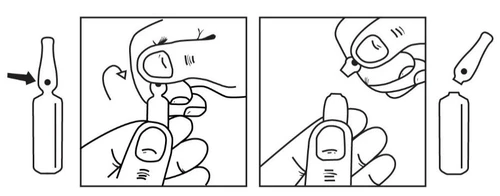
How to open the ampoules
Place your thumb on the blue dot and snap off (the break point is located below the blue dot)