Ampicillin tzf
Poland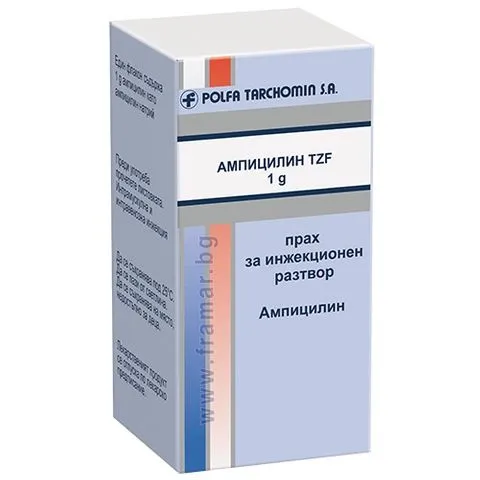
Table of Contents
- Package leaflet: Information for the patient
- 1. What Ampicillin TZF is and what it is used for
- 2. Important information before using Ampicillin TZF
- 4. Possible adverse effects
- 5. How to store Ampicillin TZF
- 6. Contents of the pack and other information
- Information intended exclusively for healthcare professionals
Package leaflet: Information for the patient
Ampicillin TZF, 500 mg, powder for solution for injection
Ampicillin TZF, 1 g, powder for solution for injection
Ampicillin TZF, 2 g, powder for solution for injection
Ampicillinum
Please read this leaflet carefully before using this medicine, as it contains
important information for the patient.
- Keep this leaflet, so you can read it again if necessary.
- If you have any further questions, please consult your doctor or pharmacist.
- This medicine has been prescribed for a specific individual. Do not pass it on to others. It may harm someone else, even if their symptoms are the same.
- If any adverse reactions occur in the patient, including any adverse reactions not listed in this leaflet, inform your doctor or pharmacist. See section 4.
Table of contents of the leaflet:
- What Ampicillin TZF is and what it is used for
- Important information before using Ampicillin TZF
- How to use Ampicillin TZF
- Possible side effects
- How to store Ampicillin TZF
- Contents of the pack and other information
1. What Ampicillin TZF is and what it is used for
Ampicillin TZF contains ampicillin as the active substance, which is a semi-synthetic penicillin.
Ampicillin exerts bactericidal activity against many species of Gram-negative and Gram-positive bacteria.
Ampicillin TZF is indicated for the treatment of the following infections caused by bacteria
susceptible to ampicillin:
- acute and chronic urinary tract infections;
- respiratory tract infections;
- gastrointestinal tract infections;
- meningitis;
- endocarditis;
- use in perinatal prophylaxis.
2. Important information before using Ampicillin TZF
When not to use Ampicillin TZF
- if the patient is allergic to ampicillin or other beta-lactam antibiotics (penicillins, cephalosporins);
- if the patient has infectious mononucleosis or lymphocytic leukemia – in such cases the risk of rash is increased.
In case of doubts, consult a doctor or pharmacist.
Warnings and precautions
Before taking the medicine, inform the doctor:
-
if the patient has previously experienced an allergic reaction to any antibiotic;
-
if the patient has previously experienced any other allergic reaction. Hypersensitivity reactions to
ampicillin may occur more frequently in individuals with a predisposition to allergic reactions to
various substances. These reactions may vary in symptoms and severity – from skin rashes to
anaphylactic shock (a severe allergic reaction); -
if the patient has been diagnosed with renal impairment. The doctor will adjust the dose according to the degree of renal impairment;
-
if the patient has previously suffered from gastrointestinal disorders, particularly colitis;
-
if the patient suffers from myasthenia gravis (a disease characterized by rapid muscle fatigue and weakness).
If the patient develops diarrhea during or after treatment with ampicillin, this should be reported to the doctor. It may be a symptom of pseudomembranous colitis – a complication associated with antibiotic use. If diarrhea occurs, the drug should be discontinued and appropriate treatment initiated in more severe cases. Medications inhibiting intestinal peristalsis or other constipating agents should not be used.
During prolonged use of ampicillin, particularly in chronically ill patients and patients with renal impairment, overgrowth of resistant bacterial or fungal strains may occur. If new bacterial or fungal infections develop during ampicillin treatment, the antibiotic should be discontinued immediately and medical advice sought.
Ampicillin TZF and other medicines
Inform the doctor or pharmacist about all medicines currently or recently taken, as well as any medicines the patient intends to take.
In particular, inform the doctor if the patient is taking:
- probenecid – when administered concomitantly with Ampicillin TZF, it increases its blood concentration and prolongs its duration of action;
- other antibiotics with bacteriostatic activity;
- allopurinol – when administered concomitantly with Ampicillin TZF, it increases the risk of skin allergic reactions;
- oral contraceptives, as ampicillin may reduce their effectiveness.
In patients treated with ampicillin, urine glucose tests may yield false-positive results; therefore, if such testing is necessary, enzymatic tests are recommended.
Pregnancy and breastfeeding
If the patient is pregnant or breastfeeding, suspects she may be pregnant, or is planning to become pregnant, she should consult a doctor before using this medicine.
If the patient is pregnant or suspects she may be pregnant
Ampicillin TZF should be avoided during pregnancy unless the doctor considers its use absolutely necessary.
If the patient is breastfeeding
Ampicillin TZF may be used during breastfeeding with caution. Apart from the risk of sensitization in infants due to small amounts of the drug passing into human milk, no other adverse effects have been observed in breastfed infants.
Driving and operating machinery
Ampicillin TZF does not affect the ability to drive motor vehicles or operate machinery. However, if adverse effects impairing concentration occur (e.g. drowsiness, see section 4. Possible side effects), driving or operating machinery is not recommended.
Ampicillin TZF contains sodium
This should be taken into account in patients controlling sodium intake in their diet.
Ampicillin TZF 500 mg contains 35.1 mg of sodium (main component of table salt) per vial.
This corresponds to 1.76% of the maximum recommended daily sodium intake in adults.
Ampicillin TZF 1 g contains 70.2 mg of sodium (main component of table salt) per vial.
This corresponds to 3.51% of the maximum recommended daily sodium intake in adults.
Ampicillin TZF 2 g contains 140.4 mg of sodium (main component of table salt) per vial.
This corresponds to 7.02% of the maximum recommended daily sodium intake in adults.
Considering the dosing regimen described in section 3, the maximum amount of sodium (main component of table salt) that may be administered to a patient at a single maximum dose is 140.4 mg (corresponding to 7.02% of the maximum recommended daily sodium intake in adults), and at the maximum daily dose is 982.8 mg (corresponding to 49.14% of the maximum recommended daily sodium intake in adults).
3. How to use Ampicillin TZF
Ampicillin TZF should always be used according to the doctor's instructions. In case of doubts, consult the doctor.
Ampicillin TZF is administered by a doctor or nurse. The dose depends on the severity of infection, the causative microorganism, the patient's age and body weight.
Adults and children with body weight ≥ 40 kg
- Urinary tract infections: 500 mg every 6 hours.
- Gonococcal urethritis: two doses of 500 mg given 12 hours apart.
- Community-acquired pneumonia in adults: 1–2 g every 6 hours.
- Community-acquired pneumonia in children with body weight > 40 kg: 1–2 g every 6 hours.
- Gastrointestinal tract infections: 500 mg every 6 hours.
- Meningitis: 2 g every 4 hours.
- Infective endocarditis and enterococcal bacteremia: 2 g every 4 hours.
The maximum daily dose for adults is 14 g.
Children with body weight up to 40 kg
Most bacterial infections: usually 12.5 mg/kg body weight every 6 hours.
Community-acquired pneumonia: 25–50 mg/kg body weight every 6 hours.
Early-onset infections in newborns
Dosing depends on the newborn's age and body weight: usually 100–200 mg/kg body weight per day divided into 2–4 doses.
Meningitis
Newborns
0–7 days of life: 150–300 mg/kg body weight per day in 3 divided doses.
8–28 days of life: 300–400 mg/kg body weight per day in 3–4 divided doses.
Infants and children: 300–400 mg/kg body weight per day in 4–6 divided doses.
The maximum daily dose in children is 12 g.
Prophylactic use of ampicillin
For perinatal prophylaxis of S. agalactiae infections (as an alternative to penicillin): initial dose 2 g iv, followed by 1 g every 4 hours until delivery.
In preterm premature rupture of membranes: in combination with erythromycin; administered at 2 g iv every 4 hours for the first 48 hours, followed by transition to amoxicillin.
Patients with renal impairment
In patients with severe renal impairment (creatinine clearance <10 mL/min), the doctor may consider reducing the dose or increasing the interval between doses.
For patients undergoing dialysis, the doctor will recommend administering a supplementary dose after dialysis.
Duration of treatment
The duration of treatment depends on the severity and type of infection.
The doctor will determine the appropriate treatment duration, which must be strictly followed.
Instructions for preparing solutions are provided at the end of the leaflet, in the section "Information intended exclusively for healthcare professionals".
Use of a higher than recommended dose of Ampicillin TZF
Since Ampicillin TZF will be administered by a doctor or nurse, administration of an incorrect dose is unlikely. However, if the patient suspects that an excessive dose has been given, he or she should immediately inform the doctor or go to the nearest hospital emergency department.
Missed dose of Ampicillin TZF
Do not take a double dose to make up for a missed dose.
Stopping Ampicillin TZF treatment
It is important that the medicine is used according to the recommended treatment course. Do not stop treatment just because the patient feels better. Premature discontinuation of treatment may result in recurrence of infection.
If the patient feels worse during treatment or does not feel well after completing the recommended treatment course, he or she should consult the doctor.
In case of any further doubts regarding the use of the medicine, consult the doctor.
4. Possible adverse effects
Like all medicines, Ampicillin TZF can cause adverse effects, although not everyone will experience them.
If any of the following serious adverse effects occur, seek immediate medical attention or go directly to hospital.
The following serious adverse effects occur rarely (less frequently than in 1 out of 1,000 people):
- sudden difficulty in breathing, speaking, or swallowing;
- painful swelling of the lips, tongue, face, or neck;
- severe dizziness or collapse;
- severe or itchy skin rashes, especially with blister formation and pain in the eyes, mouth, or genital organs;
- severe, prolonged, or bloody diarrhoea: this may be a sign of serious intestinal inflammation;
- yellowing of the skin or whites of the eyes, dark urine, or pale stools: these may be symptoms of liver dysfunction.
Other adverse effects that may occur during treatment
The following adverse effects occur uncommonly (less frequently than in 1 out of 100 people):
- changes in white and red blood cell counts (reduction in red blood cells, white blood cells, or platelets), abnormal breakdown of red blood cells (haemolytic anaemia);
- skin rashes, urticaria, itching.
The following adverse effects occur rarely (less frequently than in 1 out of 1,000 people):
- slight, transient increase in liver enzyme activity;
- interstitial nephritis.
Additionally, the following adverse effects may occasionally occur:
- feeling of fatigue, insomnia, excessive restlessness, convulsions. Convulsions may occur in patients with renal impairment and (or) those receiving high doses of the drug;
- diarrhoea, nausea, vomiting (these symptoms most commonly occur in patients receiving ampicillin);
- skin redness, pain at the site of administration.
Reporting of adverse effects
If any adverse effects occur, including those not listed in this leaflet, inform your doctor, pharmacist, or nurse. Adverse effects can be reported directly to the Department of Monitoring Adverse Drug Reactions at the Office for Registration of Medicinal Products, Medical Devices and Biocidal Products
Al. Jerozolimskie 181C, 02-222 Warsaw
Tel.: +48 22 4921 301; fax: +48 22 4921 309
Website: https://smz.ezdrowie.gov.pl
Adverse effects can also be reported to the marketing authorisation holder.
Reporting adverse effects helps to provide more information on the safety of the medicine.
5. How to store Ampicillin TZF
Store below 25°C. Protect from light.
Keep the medicine out of sight and reach of children.
Do not use this medicine after the expiry date (EXP) stated on the packaging. The expiry date refers to the last day of the stated month.
Medicines must not be disposed of via wastewater or household waste. Ask your pharmacist how to dispose of medicines no longer required. These measures help protect the environment.
6. Contents of the pack and other information
What Ampicillin TZF contains
The active substance is ampicillin (in the form of sodium ampicillin).
Ampicillin TZF, 500 mg
Each vial contains 500 mg of ampicillin ( Ampicillinum ) in the form of sodium ampicillin.
Ampicillin TZF, 1 g
Each vial contains 1 g of ampicillin ( Ampicillinum ) in the form of sodium ampicillin.
Ampicillin TZF, 2 g
Each vial contains 2 g of ampicillin ( Ampicillinum ) in the form of sodium ampicillin.
The medicine does not contain any other ingredients.
What Ampicillin TZF looks like and contents of the pack
White or almost white powder. After dissolution, a clear, opalescent solution is formed.
Packaging: 1 vial in a cardboard box.
Marketing Authorisation Holder and Manufacturer
Tarchomin Pharmaceutical Works "Polfa" Joint Stock Company
A. Fleminga 2 Street
03-176 Warsaw
Phone number: 22 811-18-14
For further information on this medicine, please contact the Marketing Authorisation Holder.
Information intended exclusively for healthcare professionals
Please refer to the detailed information about this medicinal product available on the website of the Office for Registration of Medicinal Products, Medical Devices and Biocidal Products (www.urpl.gov.pl).
After reconstitution, the powder forms a clear, opalescent solution.
Before administration, the appearance of the solution should be inspected. The solution may be administered only if it is clear and practically free from visible particles.
Any unused portions of the medicinal product or waste materials should be disposed of in accordance with local regulations.
Preparation and administration of the solution
Intramuscular injections
Reconstitute the contents of the 500 mg vial with 2 ml of water for injections.
Reconstitute the contents of the 1 g vial with 4 ml of water for injections.
When administering intramuscularly, standard volume limitations should be observed.
The solution should be administered by deep intramuscular injection. Doses exceeding 1 g should be administered at two separate injection sites.
Intravenous injections
Reconstitute the contents of the 500 mg vial with 5 ml of water for injections.
Reconstitute the contents of the 1 g vial with 10 ml of water for injections.
Reconstitute the contents of the 2 g vial with 20 ml of water for injections.
Inject slowly over approximately 3 to 10 minutes.
Intermittent infusion
Dissolve 500 mg of ampicillin powder in 50 ml of isotonic sodium chloride solution (0.9%). The solution should be prepared in polyolefin containers.
Dissolve 1 g of ampicillin powder in 100 ml of isotonic sodium chloride solution (0.9%). The solution should be prepared in polyolefin containers.
Dissolve 2 g of ampicillin powder in 100 ml of isotonic sodium chloride solution (0.9%) or water for injections. The solution should be prepared in a polyolefin container.
Ampicillin TZF solution may be administered as an intravenous infusion at a rate of 100 mg/min.
Continuous infusion
Dissolve 2 g of ampicillin powder in 15 ml of water for injections, then add to 500 ml of 0.9% sodium chloride solution or to 500 ml of glucose solution at a concentration of 50 mg/ml.
Solutions prepared with 0.9% sodium chloride solution may be stored in polyolefin or polyvinyl chloride containers.
Solutions prepared with glucose solution must be stored in polyolefin containers.
The concentration of the prepared solution should not exceed 30 mg/ml.
Warning! Ampicillin solutions for intramuscular or intravenous administration should be prepared immediately before use.
From a microbiological standpoint, the product should be used immediately. If not used immediately, the responsibility for storage conditions and duration prior to use lies with the user.
Ampicillin solutions should not be mixed with other medicinal products due to the risk of inactivation.
Pharmaceutical incompatibilities
Ampicillin should not be administered with blood products or other protein-containing fluids (e.g., protein hydrolysates), or with lipid emulsions for intravenous administration.
Ampicillin solutions should not be mixed with other medicinal products in the same syringe or infusion bottle due to the risk of inactivation.