Amisan
Poland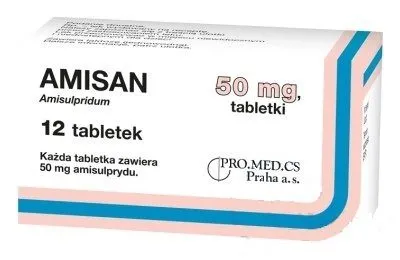
Table of Contents
Package leaflet: information for the user
Amisan, 50 mg, tablets
Amisan, 200 mg, tablets
Amisulpridum
Please read carefully the entire leaflet before taking the medicine, as it contains
important information for the patient.
- Keep this leaflet, so you can read it again if necessary.
- If you have any doubts, please consult your doctor or pharmacist.
- This medicine has been prescribed for a specific individual. Do not pass it on to others. The medicine may harm another person, even if their symptoms are similar.
- If you experience any adverse effects, including any not listed in this leaflet, inform your doctor or pharmacist. See section 4.
Table of contents:
- What Amisan is and what it is used for
- Important information before taking Amisan
- How to take Amisan
- Possible side effects
- How to store Amisan
- Contents of the pack and other information
1. What Amisan is and what it is used for
Amisan affects the function of nerve cells that operate via dopamine.
Dopamine is an important substance regulating nervous system activity, which is disturbed in many
mental disorders, such as schizophrenia. Amisan acts on dopamine, particularly in those areas of the brain
directly associated with mental illnesses. Amisan does not affect other substances regulating brain function,
which is especially beneficial due to the low frequency of adverse effects.
Amisan is used in the treatment of both acute and chronic schizophrenia. The medicine effectively
alleviates positive symptoms (delusions, hallucinations, thought disorders, anxiety, mistrust, etc.)
and predominant negative symptoms (emotional blunting, anxiety, social and emotional withdrawal,
feelings of guilt, etc.). Amisan also exerts a highly beneficial effect on secondary negative symptoms
and mood disorders such as depression, which may occur in schizophrenia with positive symptoms.
This medicine is intended for use in adults.
2. Important information before using Amisan
When not to use Amisan
- If the patient is allergic to amisulpride or to any of the other ingredients of this medicine (listed in section 6);
- If the patient has a specific type of cancer causing disorders in prolactin hormone secretion (e.g. pituitary adenoma or breast cancer);
- If the patient has an adrenal gland tumour, so-called chromaffinoma;
- If the patient is taking levodopa for the treatment of Parkinson's disease;
- In children before puberty;
Warnings and precautions
Before starting treatment with Amisan, discuss the following with your doctor:
When higher doses of Amisan than those recommended for the treatment of schizophrenia are used, in rare cases, a condition called neuroleptic malignant syndrome may occur, characterized by unexplained increase in body temperature, muscle rigidity and disturbances of the autonomic nervous system, which may sometimes lead to death. In such a case, contact your doctor immediately and discontinue the medicine;
If during treatment the patient develops muscle rigidity or muscle weakness associated with muscle breakdown (rhabdomyolysis), rapid breathing, sweating, disturbances of consciousness (drowsiness), and unexplained fever: treatment should be stopped immediately and urgent medical advice sought, as these may be symptoms of a rare condition called neuroleptic malignant syndrome, which may lead to death (see section 4);
Treatment with Amisan in patients with Parkinson's disease must be justified by existing, significant reasons, as symptoms of the disease may worsen;
If the patient has a slow heart rate or if the patient is taking medicines that may slow heart function, the doctor will regularly monitor the patient's condition;
If the patient has been diagnosed with heart or vascular disease, the doctor will regularly monitor the patient's condition;
Caution should be exercised when treating elderly patients with severe mental illness associated with dementia;
Inform your doctor if the patient or anyone in their family has ever had blood clots (blockage of blood vessels, thromboembolism), as use of similar medicines is associated with formation of blood clots;
In patients with diabetes or risk factors for diabetes, starting treatment with Amisan requires regular monitoring of blood glucose levels by the doctor;
In patients with epilepsy, Amisan may increase the frequency of seizures;
In elderly patients, a drop in blood pressure and excessive sedation may occur;
When discontinuing treatment with Amisan, the medicine should be withdrawn gradually. Abrupt discontinuation may cause withdrawal symptoms (e.g. involuntary movements);
During treatment with Amisan, the number of certain white blood cells may decrease, which may manifest as infection or unexplained fever;
If the patient or anyone in their family has breast cancer, the doctor should monitor the patient more closely;
During treatment with Amisan, a benign pituitary gland tumour may develop, associated with visual field disturbances and headaches. In such a case, the doctor will perform a head examination.
Severe liver function disorders associated with the use of amisulpride have been reported. Contact your doctor immediately if fatigue, loss of appetite, nausea, vomiting, abdominal pain, or yellowing of the eyes or skin occur.
Amisan with other medicines
Tell your doctor or pharmacist about any medicines the patient is currently taking, has recently taken, or plans to take.
Amisan must not be used with the following medicines:
- Levodopa, used in the treatment of Parkinson's disease;
- Medicines called dopamine receptor agonists (e.g. ropinirole, bromocriptine).
Extreme caution is required when using Amisan together with the following medicines:
- Medicines containing substances that affect the central nervous system (painkillers, certain antihistamines, sleeping pills, sedatives, anxiolytics, clonidine used to treat high blood pressure and its derivatives);
- Medicines that lower blood pressure;
- Medicines affecting heart function (e.g. antiarrhythmics of class IA and class III, such as amiodarone, sotalol);
- Certain antihistamines;
- Certain other medicines used to treat psychiatric disorders (antipsychotics);
- Certain antimalarial medicines.
Taking Amisan with food, drink and alcohol
Alcohol must not be consumed during treatment with Amisan, as the medicine may intensify the effect of alcohol on the central nervous system.
Pregnancy, breastfeeding and fertility
If the patient is pregnant or breastfeeding, suspects she may be pregnant, or is planning to have a child, she should consult her doctor or pharmacist before using this medicine.
Pregnancy
Use of Amisan is not recommended during pregnancy or in women of childbearing potential who are not using effective contraception.
Newborns whose mothers took Amisan during the third trimester (last 3 months of pregnancy) may experience the following symptoms: involuntary tremors, increased muscle tension, drowsiness, agitation, breathing difficulties, and feeding problems. If such symptoms are observed in your child, contact your doctor.
Breastfeeding
Breastfeeding is not recommended during treatment with Amisan. Discuss with your doctor the best way to feed your baby if you are taking Amisan.
Driving and operating machinery
Amisan may adversely affect attention and motor coordination (driving and operating machinery). These activities should only be undertaken after consulting your doctor.
Amisan contains lactose
If the patient has previously been diagnosed with intolerance to certain sugars, the patient should consult their doctor before taking this medicine.
3. How to use Amisan
This medicine should always be used as directed by the physician. In case of doubt, consult your
doctor or pharmacist.
Amisan at a dose of up to 400 mg may be taken once daily. Higher doses should be administered
in two divided doses. The exact dosage and duration of treatment will be determined by the physician.
The usual dose is 400–800 mg per day. The physician may increase the dose up to 1200 mg per
day. Doses higher than this are not recommended.
Dosage should be individually adjusted according to the patient's response, and maintenance therapy
should be continued using the lowest effective dose.
In conditions associated with apathy and tendency towards social withdrawal, the recommended
dose is 50 mg to 300 mg per day. Doses should be individually adjusted.
Elderly patients
Amisan should be used with particular caution in elderly patients due to the possible risk of reduced
blood pressure or excessive drowsiness.
In patients with renal impairment, the physician may reduce the dose of the medicine.
Use in children and adolescents
Use of Amisan is not recommended in children and adolescents from puberty up to 18 years of age.
This medicine must not be used in children before puberty, as safety of use has not yet been established
in this age group.
Patients with renal impairment
The physician will reduce the dose depending on the severity of renal impairment.
Patients with hepatic impairment
Dosage adjustment is not necessary in these patients.
Method of administration
Tablets should be taken without chewing, with a large amount of water.
Duration of treatment
Treatment is usually long-term.
Use of a higher than recommended dose of Amisan
Experience regarding overdose is limited. Increased effects of the drug have been reported, including
drowsiness and excessive sedation, disturbances of consciousness, decreased blood pressure,
involuntary movements, and coma. In case of overdose or accidental ingestion by a child, contact
a doctor immediately for close monitoring of vital functions.
Missed dose of Amisan
If a dose is missed, it should be taken as soon as possible. However, if it is almost time for the next
dose, the missed dose should be skipped. Do not take a double dose to make up for a missed dose.
Continue taking the medicine at the usual times.
Stopping Amisan treatment
The physician will decide how long Amisan should be taken. Do not stop taking the tablets just
because the patient feels better.
Stopping Amisan treatment may cause the illness to worsen or return. Do not abruptly discontinue
taking Amisan unless otherwise directed by the physician. Sudden discontinuation may cause
withdrawal symptoms such as nausea or vomiting, insomnia, sweating, extreme anxiety, muscle
stiffness, unusual body movements, or recurrence of the illness.
If you have any further questions about the use of this medicine, consult your doctor or pharmacist.
4. Possible side effects
Like all medicines, this medicine can cause side effects, although not everybody will get them.
Seek medical help immediately if the patient experiences any of the following
side effects:
Not common (may occur in up to 1 in 100 people)
- Allergic reactions such as skin rash, itching or swelling, difficulty swallowing or breathing, swelling of the lips, face, throat or tongue;
- Seizure (epileptic fit);
Rare (may occur in up to 1 in 1,000 people)
- Blood clots in the veins, especially in the legs (symptoms include swelling, pain and redness in the limbs), which may travel through blood vessels to the lungs, causing chest pain and difficulty breathing;
Unknown frequency (frequency cannot be estimated from the available data)
- High fever, sweating, muscle stiffness, rapid heartbeat, fast breathing, confusion, drowsiness or agitation. These may be symptoms of a serious but rare side effect called neuroleptic malignant syndrome;
- Irregular heartbeat, rapid heartbeat or chest pain, which may lead to heart attack or life-threatening heart disease.
The following side effects have also been reported:
Very common (may occur in more than 1 in 10 people)
- Tremor, muscle stiffness or cramps, slowed movements, increased salivation or inability to stay still. These symptoms usually resolve if the doctor reduces the dose of Amisan or prescribes an additional medicine.
Common (may occur in up to 1 in 10 people)
- Acute dystonia (involuntary muscle contractions). This is reversible with anti-Parkinson medication, without the need to discontinue amisulpride;
- Difficulty falling asleep (insomnia), anxiety, agitation (restless movements), orgasm disorders;
- Feeling sleepy or drowsiness;
- Constipation, nausea, vomiting, dry mouth;
- Weight gain;
- Abnormal production and secretion of milk in women and men, breast pain;
- Menstrual disorders, such as absence of menstrual bleeding;
- Breast enlargement in men;
- Difficulty achieving or maintaining erection or ejaculation disorders;
- Low blood pressure;
- Blurred vision.
Not common (may occur in up to 1 in 100 people)
- Decrease in white blood cell count (leukopenia or neutropenia);
- Confusion;
- Uncontrollable movements, mainly of hands, feet, face and tongue;
- Slowed heart rate;
- Increased blood pressure;
- Nasal mucosa swelling or congestion;
- Accidental entry of food or stomach contents into the airways, with risk of aspiration pneumonia (lung infection) (mainly when used with other medicines belonging to the group of central nervous system depressants and antipsychotic medicines used to treat disorders of thought and perception);
- Osteopenia (reduced bone density) and osteoporosis (bone thinning);
- Urinary retention in the bladder;
- Increased blood sugar levels (hyperglycaemia);
- Increased levels of fats (triglycerides) and cholesterol in the blood;
- Increased liver enzyme activity in the blood;
- Liver tissue damage.
Rare (may occur in up to 1 in 1,000 people)
- More frequent infections, possibly due to blood disorder (agranulocytosis);
- Benign pituitary tumour;
- Decreased sodium levels in the blood;
- A group of symptoms called syndrome of inappropriate antidiuretic hormone secretion (characterised by water retention in the body and swelling);
- Swelling, hives;
- Changes in ECG recording (heart rhythm disturbances).
Unknown frequency (frequency cannot be estimated from the available data)
- In newborns whose mothers took Amisan during pregnancy, withdrawal syndrome may occur;
- Restless legs syndrome (uncomfortable sensation in the legs temporarily relieved by movement, symptoms worsening towards the end of the day);
- Increased skin sensitivity to sunlight and ultraviolet radiation;
- Falls due to impaired body balance, which may lead to fractures;
- Rhabdomyolysis (muscle breakdown with accompanying muscle pain);
- Increased creatine phosphokinase activity (a blood test indicating muscle damage).
Reporting of side effects
If any side effects occur, including any not listed in this leaflet, tell your doctor or pharmacist. Side effects can be reported directly to the Department of Monitoring Adverse Drug Reactions of the Office for Registration of Medicinal Products, Medical Devices and Biocidal Products, Al. Jerozolimskie 181 C, 02-222 Warsaw, Tel.: +48 22 49 21 301, Fax: +48 22 49 21 309, Website: https://smz.ezdrowie.gov.pl
Side effects can also be reported to the marketing authorisation holder.
Reporting side effects helps provide more information on the safety of the medicine.
5. How to store Amisan
Keep this medicine out of sight and reach of children.
No special precautions for storage are required.
Do not use this medicine after the expiry date stated on the blister or carton under
"Expiry date (EXP)". The expiry date refers to the last day of the stated month.
Medicines should not be disposed of via wastewater or household waste. Ask your
pharmacist how to dispose of medicines no longer required. These measures will help
protect the environment.
6. Contents of the pack and other information
What Amisan contains
The active substance is amisulpride.
Each Amisan 50 mg tablet contains 50 mg of amisulpride.
Each Amisan 200 mg tablet contains 200 mg of amisulpride.
The other ingredients are: pregelatinized starch, corn starch, monohydrate lactose, methylcellulose 400 cP,
colloidal anhydrous silica, magnesium stearate.
What Amisan looks like and contents of the pack
Amisan 50 mg: White or almost white, round tablets with a score line on one side,
7.0 mm in diameter. The tablet can be divided into equal doses.
Amisan 200 mg: White or almost white, round tablets with a score line on one side,
12.5 mm in diameter. The tablet can be divided into equal doses.
Pack sizes
PVC/Aluminum blisters in a cardboard box.
50 mg: 12 tablets (1 blister with 12 tablets) and 60 tablets (5 blisters with 12 tablets each).
200 mg: 30 tablets (3 blisters with 10 tablets each), 60 tablets (6 blisters with 10 tablets each), and 150 tablets (15 blisters with 10 tablets each).
Marketing Authorisation Holder and Manufacturer
PRO.MED.CS Praha a.s., Telčská 377/1, Michle, 140 00 Prague 4, Czech Republic
For further information about this medicinal product, please contact the local representative of the Marketing Authorisation Holder:
PRO.MED.PL Sp. z o.o.
[email protected]
This medicinal product is authorised in the European Economic Area countries under the following names:
| Czech Republic | AMILIA |
| Estonia | AMISAN 50 mg tablets AMISAN 200 tablets |
| Lithuania | AMISAN 50 mg tablets AMISAN 200 mg tablets |
| Latvia | AMISAN 200 mg tablets |
| Poland | Amisan |