Actilyse 50
Poland
Table of Contents
- Package leaflet: Information for the user
- 1. What Actilyse is and what it is used for
- 2. Important information before using Actilyse
- 3. How to use Actilyse
- 4. Possible adverse reactions
- 5. How to store Actilyse
- 6. Contents of the pack and other information
- Information intended exclusively for medical professionals:
Package leaflet: Information for the user
Actilyse 10, 10 mg, powder and solvent for solution for infusion
Actilyse 20, 20 mg, powder and solvent for solution for infusion
Actilyse 50, 50 mg, powder and solvent for solution for infusion
Alteplasum
Please read all of this leaflet carefully before this medicine is administered, because it contains
important information for the patient.
- Keep this leaflet, as you may need to read it again.
- If you have any further questions, please ask your doctor, pharmacist, or nurse.
- This medicine has been prescribed for a specific patient only. Do not pass it on to others. This medicine may harm other people, even if their symptoms are the same.
- If the patient experiences any adverse reactions, including any adverse reactions not listed in this leaflet, inform your doctor, pharmacist, or nurse. See section 4.
Leaflet contents
- What Actilyse is and what it is used for
- Important information before using Actilyse
- How to use Actilyse
- Possible side effects
- How to store Actilyse
- Contents of the pack and other information
1. What Actilyse is and what it is used for
The active substance in Actilyse is alteplase. It belongs to a group of medicines called thrombolytic agents. These medicines work by dissolving blood clots that have formed in blood vessels.
Actilyse 10, 20, or 50 are used in the treatment of several conditions caused by blood clots in blood vessels, including:
- heart attack caused by blood clots in the coronary arteries (acute myocardial infarction)
- blood clots in the pulmonary arteries (acute massive pulmonary embolism)
- stroke caused by blood clots in the cerebral artery (acute ischaemic stroke).
2. Important information before using Actilyse
When not to use Actilyse
- if the patient is allergic to the active substance alteplase or to any of the other ingredients of this medicine (listed in section 6).
- if the patient currently has or has recently had a disease increasing the risk of bleeding, including:
- bleeding disorders or tendency to bleed
- severe or life-threatening bleeding in any part of the body
- intracranial haemorrhage or bleeding into the brain
- uncontrolled, very high blood pressure
- bacterial infections or inflammation of the heart (endocarditis), or inflammation of the membranes surrounding the heart (pericarditis)
- acute pancreatitis
- peptic ulcer of the stomach or intestines
- oesophageal varices
- blood vessel disorders, such as localized enlargement of an artery (aneurysm)
- certain tumours
- severe liver disease
- if the patient is taking blood-thinning medicines (oral anticoagulants), unless appropriate tests have confirmed no clinically significant anticoagulant activity
- if the patient has ever undergone brain or spinal surgery
- if the patient has undergone major surgery within the past 3 months
- if the patient has recently undergone procedures involving puncture of large blood vessels
- if the patient has received external cardiac massage within the past 10 days
- if the woman has given birth within the past 10 days.
Additionally, Actilyse must not be used in the treatment of heart attack or blood clots in the
pulmonary arteries:
- if the patient has ever had a stroke caused by bleeding into the brain (haemorrhagic stroke)
- if the patient has ever had a stroke of unknown cause
- if the patient has recently (within the past 6 months) had a stroke caused by a blood clot in a brain artery (ischaemic stroke), unless this is the stroke currently being treated.
Additionally, Actilyse must not be used in the treatment of stroke caused by blood clots in the
cerebral artery (acute ischaemic stroke):
- if the onset of ischaemic stroke symptoms occurred more than 4.5 hours ago, or if it is possible that symptoms began more than 4.5 hours ago, because the exact time of onset is unknown
- if the stroke causes only mild symptoms
- if symptoms of bleeding into the brain are present
- if the patient has had a stroke within the past 3 months
- if symptoms have improved rapidly before administration of Actilyse
- if the patient has had a very severe stroke
- if the patient experienced seizures (fits) at the time of stroke onset
- if the activated partial thromboplastin time (aPTT) (a blood test measuring blood clotting) is abnormal. This test may be abnormal if the patient has received heparin (a medicine used to "thin" the blood) within the past 48 hours
- if the patient has diabetes and has ever had a stroke
- if the number of platelets (thrombocytes) in the blood is very low
- if the patient has very high blood pressure (above 185/110 mmHg), which can only be reduced by intravenous medication
- if the blood sugar (glucose) level is very low (below 50 mg/dl, equivalent to < 2.8 mmol/l)
- if the blood sugar (glucose) level is very high (above 400 mg/dl, equivalent to > 22.2 mmol/l)
- if the patient is under 16 years of age (patients aged ≥ 16 years, see section Warnings and precautions).
Warnings and precautions
- if the patient has had an allergic reaction other than a sudden, life-threatening allergic reaction (severe hypersensitivity reaction) to the active substance alteplase or to any of the other ingredients of this medicine (listed in section 6)
- if the patient currently has or has recently had any other conditions increasing the risk of bleeding, such as:
- minor injuries
- biopsy (a procedure to obtain a tissue sample)
- puncture of large blood vessels
- intramuscular injections
- external cardiac massage
- if the patient has previously received Actilyse
- if the patient is over 65 years of age
- in elderly patients (over 80 years of age), treatment outcomes may be somewhat poorer regardless of treatment, and the risk of intracranial haemorrhage during thrombolytic therapy may be higher compared to younger patients. Overall, the benefit-risk ratio in elderly patients remains positive. Thrombolytic treatment in patients with acute ischaemic stroke should be evaluated based on individual benefit-risk assessment.
- in children aged ≥ 16 years, individual benefit-risk assessment should be carefully performed. Children aged ≥ 16 years should be treated according to adult guidelines after confirmation of ischaemic arterial thromboembolic stroke (exclusion of stroke-mimicking conditions).
Actilyse and other medicines
Tell your doctor about all medicines the patient is currently taking, has recently taken, or plans to
take. In particular, inform your doctor if the patient is currently taking or has recently taken:
- any medicines used to "thin" the blood, including:
- acetylsalicylic acid
- warfarin
- coumarins
- heparin
- certain medicines used to treat high blood pressure (ACE inhibitors).
Pregnancy, breastfeeding and fertility
If the patient is pregnant or breastfeeding, suspects she might be pregnant, or is planning to become
pregnant, she should consult her doctor or pharmacist before using this medicine. The doctor will
use Actilyse only if the expected benefit of treatment outweighs the potential risk to the unborn or
nursing child.
3. How to use Actilyse
Actilyse must always be prepared and administered according to the doctor's instructions. The medicine is not intended for self-administration.
Administration of Actilyse should begin as soon as possible after the first symptoms appear.
Three indications for which this medicine may be administered:
Heart attack (myocardial infarction)
The dose used depends on body weight. The maximum dose of Actilyse is 100 mg, but it is lower in patients with body weight below 65 kg.
The medicine may be administered using two different dosing regimens:
a) 90-minute dosing regimen in patients in whom treatment can be initiated within 6 hours of symptom onset
Administration consists of:
- an initial intravenous bolus injection of part of the Actilyse dose
- infusion of the remaining portion over the following 90 minutes
b) 3-hour dosing regimen in patients in whom treatment can be initiated between 6 and 12 hours after symptom onset
Administration consists of:
- an initial intravenous bolus injection of part of the Actilyse dose
- infusion of the remaining portion over the following 3 hours
Additionally, the doctor will administer another medicine to reduce blood clot formation. This medicine will be given as soon as possible after the onset of chest pain.
Blood clots in the pulmonary arteries (pulmonary embolism)
The dose used depends on body weight. The maximum dose of Actilyse is 100 mg, but it is lower in patients with body weight below 65 kg.
The medicine is usually administered as:
- an initial intravenous bolus injection of part of the dose
- infusion of the remaining portion over the following 2 hours
After treatment with Actilyse, the doctor will start (or resume) treatment with heparin (a medicine used to "thin" the blood).
Stroke caused by blood clots in the brain artery (acute ischaemic stroke)
Actilyse must be administered within 4.5 hours of the onset of the first symptoms. The sooner Actilyse is given, the greater the benefit from treatment and the lower the risk of adverse effects. The maximum dose of the medicine is 90 mg, but it is lower in patients with body weight below 100 kg.
Actilyse is administered as:
- an initial intravenous bolus injection of part of the dose
- infusion of the remaining portion over the following 60 minutes
Acetylsalicylic acid should be avoided during the first 24 hours after administration of Actilyse for stroke treatment. If necessary, the doctor may decide to administer heparin.
Administration of a higher than recommended dose of Actilyse
If the maximum recommended dose is exceeded, the risk of intracranial bleeding increases.
In cases of severe bleeding, transfusion of fresh frozen plasma is recommended. Synthetic antifibrinolytic medicines may also be administered.
If you have any further questions about the use of this medicine, consult your doctor.
4. Possible adverse reactions
Like any medicine, this medicine may cause adverse reactions, although not everyone will experience them.
Below are the adverse reactions reported in people who have been treated with Actilyse:
Very common (occur in more than 1 in 10 patients receiving the medicine)
- heart failure – treatment discontinuation may be necessary
- bleeding into the brain following treatment for stroke caused by a blood clot in a cerebral artery (acute ischaemic stroke) – treatment discontinuation may be necessary
- presence of fluid in the lungs (pulmonary oedema)
- bleeding from a damaged blood vessel (such as haematoma)
- low blood pressure (hypotension)
- chest pain (angina)
Common (occur in less than 1 in 10 patients receiving the medicine)
- recurrent heart attack
- bleeding into the brain following treatment for heart attack (myocardial infarction) – treatment discontinuation may be necessary
- cardiac arrest (circulatory arrest) – treatment discontinuation may be necessary
- shock (very low blood pressure) due to heart failure – treatment discontinuation may be necessary
- bleeding into the throat
- bleeding into the stomach or intestines, including vomiting blood or blood in stool, rectal bleeding, bleeding from gums
- bleeding into tissues causing purple bruises (purpura)
- bleeding into the urinary tract or reproductive organs, which may lead to presence of blood in urine (haematuria)
- bleeding or bruising (haematoma) at the injection site
Uncommon (occur in less than 1 in 100 patients receiving the medicine)
- blood-stained sputum (haemoptysis)
- nosebleed
- irregular heartbeat following restoration of blood flow to the heart
- damage to heart valves (mitral regurgitation) or to the wall separating the heart chambers (ventricular septal defect) – treatment discontinuation may be necessary
- sudden blockage of an artery in the lungs (pulmonary embolism), brain (cerebral embolism), or in any other part of the body (peripheral embolism)
- bleeding from the ear
- decreased blood pressure
Rare (occur in less than 1 in 1000 patients receiving the medicine)
- bleeding from the lungs
- bleeding into the pericardium – the membranous sac surrounding the heart (pericardial haematoma) – treatment discontinuation may be necessary
- internal bleeding into the retroperitoneal space (retroperitoneal haematoma) – treatment discontinuation may be necessary
- formation of blood clots in blood vessels, which may travel to other organs (embolism). Symptoms depend on the organs affected.
- allergic reactions, e.g. urticaria and rash, breathing difficulties associated with asthma (bronchospasm), fluid under the skin and mucous membranes (angioedema), low blood pressure or shock – treatment discontinuation may be necessary
- bleeding into the eye
- nausea
Very rare (occur in less than 1 in 10,000 patients receiving the medicine)
- severe allergic reaction (e.g. life-threatening anaphylactic reaction) – treatment discontinuation may be necessary
- neurological events such as:
- seizures (convulsions, epileptic fits)
- speech disturbances
- confusion or delirium (very severe confusion)
- anxiety with agitation
- depression
- cognitive disturbances (psychosis). These disorders often occur in association with stroke caused by blood clots or bleeding in the brain.
Frequency not known (frequency cannot be estimated from available data)
- bleeding in internal organs, e.g. bleeding in the liver – treatment discontinuation may be necessary
- formation of cholesterol emboli, which may travel to other organs (cholesterol embolism). Symptoms depend on the organs affected – treatment discontinuation may be necessary
- bleeding requiring blood transfusion
- vomiting
- elevated body temperature (fever)
Death or permanent disability may occur as a result of bleeding into the brain or other serious bleeding.
Reporting of adverse reactions
If any adverse reactions occur, including any not listed in this leaflet, inform your doctor, pharmacist, or nurse. Adverse reactions can be reported directly to the Department of Monitoring Adverse Drug Reactions at the Office for Registration of Medicinal Products, Medical Devices and Biocidal Products: Al. Jerozolimskie 181C, 02-222 Warsaw, tel.: +48 22 49-21-301, fax: +48 22 49-21-309, website: https://smz.ezdrowie.gov.pl. Adverse reactions can also be reported to the marketing authorisation holder. Reporting adverse reactions helps to provide more information on the safety of this medicine.
5. How to store Actilyse
It is usually not necessary for the patient to store Actilyse, as it is administered by a healthcare professional.
The medicine should be kept out of the sight and reach of children.
Do not store above 25 °C. Keep in the outer packaging to protect from light.
Do not use Actilyse after the expiry date stated on the container. The expiry date refers to the last day of the month indicated.
Chemical and physical stability after preparation
The prepared solution has been shown to be stable for 24 hours at a temperature of 2 °C to 8 °C and for up to 8 hours at a temperature below 25 °C.
Microbiological stability after preparation
From a microbiological standpoint, the medicinal product should be used immediately after preparation. If not used immediately, the duration and conditions of storage prior to use are the responsibility of the user and should not exceed 24 hours when stored in a refrigerator at 2 °C to 8 °C.
6. Contents of the pack and other information
What Actilyse contains
- The active substance is alteplase. One vial contains 10 mg (5,800,000 IU Actilyse 10), 20 mg (11,600,000 IU Actilyse 20) or 50 mg (29,000,000 IU Actilyse 50) of alteplase.
- The other components are: L-arginine, phosphoric acid (for pH adjustment), polysorbate 80.
- The solvent is water for injections.
What Actilyse looks like and contents of the pack
Actilyse is a powder and solvent for solution for infusion.
Each pack contains one vial of powder and one vial of solvent.
Vials made of type I glass with bromobutyl rubber stoppers, packed in a cardboard box.
Type and pack sizes:
Actilyse 10 1 vial containing 10 mg alteplase
1 vial of solvent – water for injections 10 ml
Actilyse 20 1 vial containing 20 mg alteplase
1 vial of solvent – water for injections 20 ml
Actilyse 50 1 vial containing 50 mg alteplase
1 vial of solvent – water for injections 50 ml
Not all pack sizes may be marketed.
Marketing Authorisation Holder:
Boehringer Ingelheim International GmbH
Binger Strasse 173
D-55216 Ingelheim/Rhein
Germany
Manufacturer:
Boehringer Ingelheim Pharma GmbH & Co. KG
Birkendorfer Strasse 65
88397 Biberach/Riss
Germany
Boehringer Ingelheim France
100-104 avenue de France
75013 Paris
France
For further information about this medicinal product, please contact the local representative of the Marketing Authorisation Holder:
Poland
Boehringer Ingelheim Sp. z o.o.
Tel. + 48 22 699 0 699
Information intended exclusively for medical professionals:
Identifiability
To improve the traceability of medicinal biological products, the name and batch number of the administered product should be clearly documented.
Reconstitution
To obtain a final concentration of 1 mg alteplase per 1 mL, transfer the entire volume of the provided solvent into the vial containing the powder. For the 20 mg and 50 mg medicinal products, a solvent transfer device (cannula) is included for this purpose. For the 10 mg medicinal product, a syringe should be used.
To obtain a final concentration of 2 mg alteplase per 1 mL, transfer only half of the solvent volume (as indicated in the table below). To do this, use a syringe to transfer the appropriate amount of solvent into the vial with the powder.
Following aseptic techniques, dissolve the powder (10 mg alteplase, 20 mg alteplase, or 50 mg alteplase) in Water for Injections according to the scheme below, to achieve a concentration of either 1 mg alteplase per 1 mL or 2 mg alteplase per 1 mL:
| Actilyse powder | 10 mg | 20 mg | 50 mg |
| (a) Volume of water for injections added to the powder | 10 ml | 20 ml | 50 ml |
| Final concentration: | 1 mg alteplase/ml | 1 mg alteplase/ml | 1 mg alteplase/ml |
| (b) Volume of water for injections added to the powder | 5 ml | 10 ml | 25 ml |
| Final concentration: | 2 mg alteplase/ml | 2 mg alteplase/ml | 2 mg alteplase/ml |
The prepared solution should be administered intravenously. The prepared 1 mg/mL solution may be further diluted with sterile sodium chloride 9 mg/mL (0.9%) solution for injection to a minimum concentration of 0.2 mg/mL, because formation of turbidity cannot be excluded. Further dilution of the prepared 1 mg/mL solution with sterile water for injection or the use of carbohydrate infusion solutions, such as glucose, is not recommended due to increased turbidity. Actilyse must not be mixed with other medicinal products in the same infusion vial (this also applies to heparin).
Storage conditions – see section 5 of the package leaflet.
The prepared solution is for single use only. Any unused portions of the medicinal product or waste material should be disposed of in accordance with local regulations.
Instructions for reconstitution of Actilyse medication
| 1 | Reconstitution must be performed immediately before administration.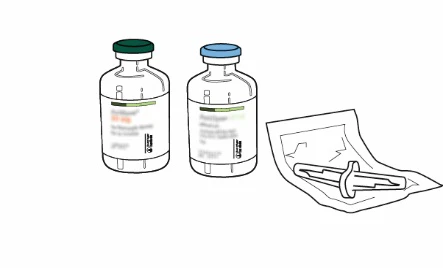 | |
| 2 | Remove by prying with the thumb the protective caps from both vials containing Water for Injections and Actilyse powder.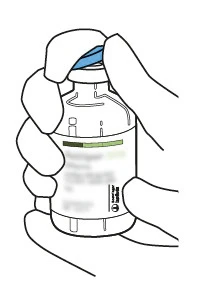 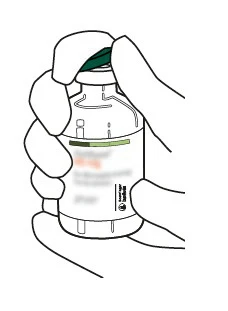 | |
| 3 | Wipe the rubber stopper of each vial with an alcohol swab.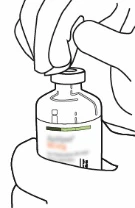 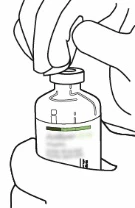 | |
| 4 | Remove the cannula* from its packaging. Do not disinfect or sterilize the cannula; it is sterile. Remove one cap.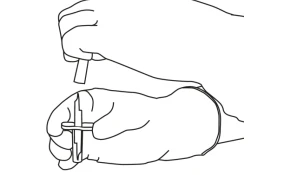 | |
| 5 | Place the vial of Water for Injections upright on a stable surface. Using the cannula, pierce vertically from above in the center of the rubber stopper with gentle but firm pressure, without twisting.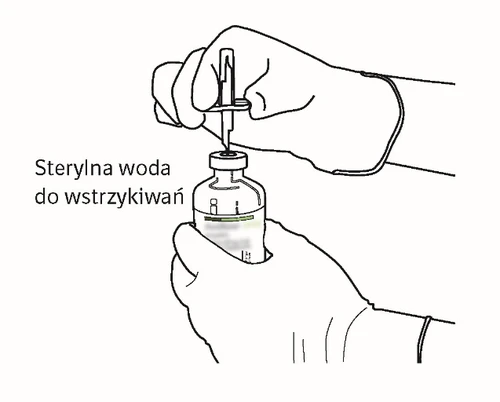 | |
| 6 | Hold the vial of Water for Injections and the cannula with one hand using the bidirectional wings. Remove the remaining cap from the top of the cannula.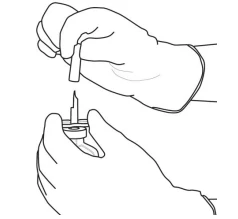 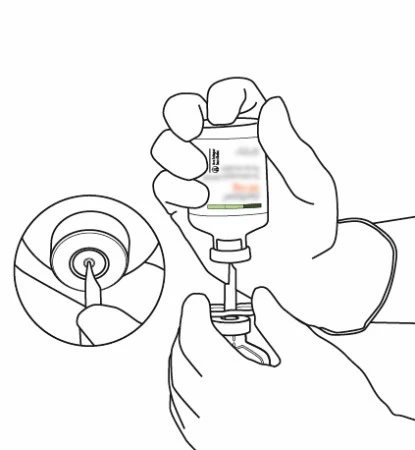 | |
| 7 | Hold the vial of Water for Injections and the cannula with one hand using the bidirectional wings. Holding the vial with powder upright above the cannula, place the tip of the cannula in the center of the stopper. Press the vial of powder from above onto the cannula, piercing the rubber stopper vertically, gently but firmly, without twisting.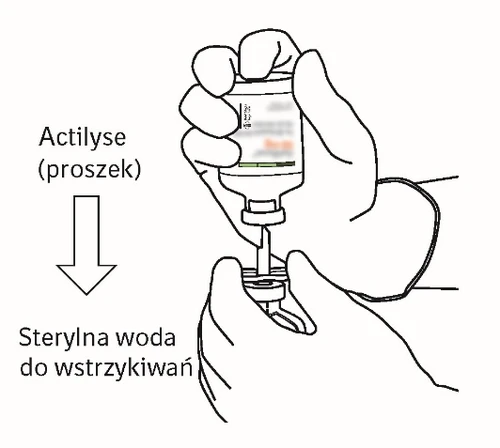 | |
| 8 | Invert both vials and allow the water to flow completely into the vial containing the powder.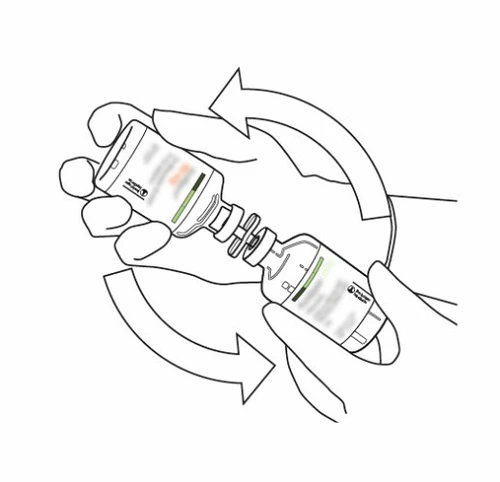 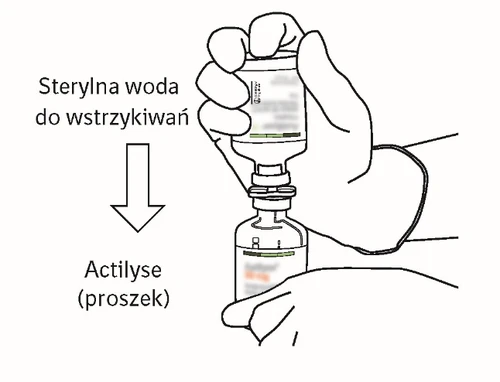 | |
| 9 | Remove the empty vial together with the cannula. These components may be discarded.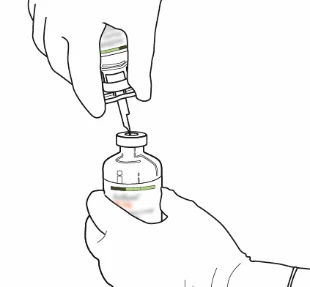 | |
| 10 | Take the reconstituted Actilyse vial and gently swirl to dissolve any remaining powder, but do not shake, as this may cause foaming. If bubbles appear, let the solution stand undisturbed for a few minutes until they disappear.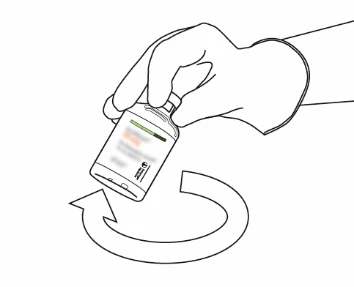 | |
| 11 | The reconstituted solution contains 1 mg/ml Actilyse. It should be clear, colorless to pale yellow, and should not contain any particles.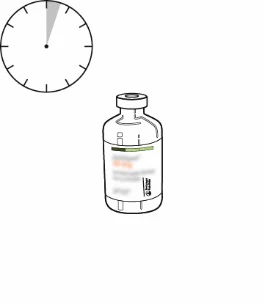 | |
| 12 | Withdraw the appropriate amount using only a needle and syringe. To avoid leakage, do not use the puncture site left by the cannula. | |
| 13 | Use immediately. Discard any unused solution.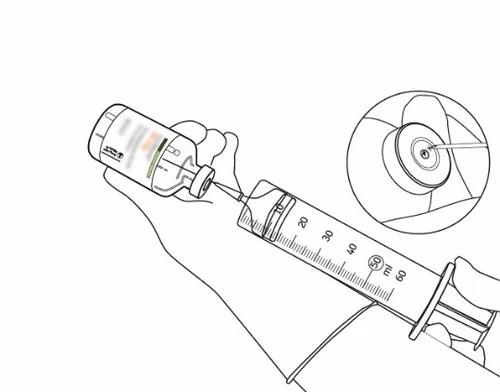 | |
(* if the cannula is attached to the set. Reconstitution can also be performed using a needle and syringe.)
Dosage and administration
Acute myocardial infarction
Dosage
a) 90-minute (accelerated) dosage regimen in patients with acute myocardial infarction, in whom treatment can be initiated within 6 hours of symptom onset
In patients with body weight ≥ 65 kg:
| Alteplase concentration | ||
| 1 mg/ml | 2 mg/ml | |
| ml | ml | |
| 15 mg administered as a rapid intravenous injection (bolus), immediately followed by: | 15 | 7.5 |
| 50 mg administered as an intravenous infusion over the first 30 minutes, immediately followed by: | 50 | 25 |
| 35 mg administered as a continuous intravenous infusion over 60 minutes, up to a maximum total dose of 100 mg | 35 | 17.5 |
For patients with body weight < 65 kg, the dose should be appropriately adjusted according to the following scheme:
| Alteplase concentration | ||
| 1 mg/ml | 2 mg/ml | |
| ml | ml | |
| 15 mg as a rapid intravenous injection (bolus), immediately followed by: | 15 | 7.5 |
| ml/kg body weight | ml/kg body weight | |
| 0.75 mg/kg body weight as an intravenous infusion over the first 30 minutes (maximum 50 mg), immediately followed by: | 0.75 | 0.375 |
| 0.5 mg/kg body weight as a continuous intravenous infusion over 60 minutes (maximum 35 mg) | 0.5 | 0.25 |
b) 3-hour dosing regimen in patients with acute myocardial infarction, in whom treatment can be initiated within 6 to 12 hours from symptom onset:
In patients with body weight ≥ 65 kg:
| Alteplase concentration | ||
| 1 mg/ml | 2 mg/ml | |
| ml | ml | |
| 10 mg as a rapid intravenous injection (bolus), immediately followed by: | 10 | 5 |
| 50 mg as an intravenous infusion over the first hour, then immediately followed by: | 50 | 25 |
| ml/2 hours | ml/2 hours | |
| 40 mg as a continuous 2-hour intravenous infusion, up to a maximum total dose of 100 mg | 40 | 20 |
In patients with body weight < 65 kg:
| Alteplase concentration | ||
| 1 mg/ml | 2 mg/ml | |
| ml | ml | |
| 10 mg administered as a rapid intravenous bolus injection, immediately followed by: | 10 | 5 |
| a 3-hour continuous intravenous infusion up to a maximum dose of 1.5 mg/kg body weight | ||
Supportive treatment:
Supportive anticoagulant therapy is recommended in accordance with current guidelines for
patients with ST-segment elevation myocardial infarction.
Method of administration
The reconstituted solution should be administered intravenously. The solution is intended for immediate
use.
Acute massive pulmonary embolism
Dosing
In patients with body weight ≥ 65 kg:
A total dose of 100 mg should be administered over 2 hours. The greatest experience has been obtained using the following dosing regimen:
| Alteplase concentration | ||
| 1 mg/ml | 2 mg/ml | |
| ml | ml | |
| 10 mg administered as a rapid intravenous bolus injection over 1-2 minutes, immediately followed by: | 10 | 5 |
| 90 mg administered as a continuous intravenous infusion over 2 hours, up to a maximum total dose of 100 mg | 90 | 45 |
For patients with body weight < 65 kg:
| Alteplase concentration | ||
| 1 mg/ml | 2 mg/ml | |
| ml | ml | |
| 10 mg as a rapid intravenous injection (bolus) over 1–2 minutes, immediately followed by: | 10 | 5 |
| a 2-hour continuous intravenous infusion up to a maximum dose of 1.5 mg/kg body weight | ||
Supportive treatment:
After thrombolytic treatment with Actilyse, heparin therapy should be initiated (or resumed) if
the APTT value does not exceed twice the upper limit of normal.
Treatment should be monitored by measuring APTT (an APTT prolonged 1.5 to 2.5 times the
baseline value indicates an appropriate heparin dose).
Method of administration
The reconstituted solution must be administered intravenously. The solution is intended for
immediate use.
Acute ischaemic stroke
Treatment may only be carried out under the supervision of physicians trained and experienced
in neurology (see sections 4.3 and 4.4 of the Summary of Product Characteristics).
Treatment must be initiated as early as possible within 4.5 hours of symptom onset (see section
4.4 of the Summary of Product Characteristics). After 4.5 hours from symptom onset, the benefit-risk
ratio of using Actilyse is unfavourable; therefore, the medicinal product should not be administered
(see section 5.1 of the Summary of Product Characteristics).
Dosing
The recommended total dose is 0.9 mg alteplase/kg body weight (maximum 90 mg), with 10% of
the total dose given as an initial intravenous bolus injection, followed immediately by the
remaining portion as an intravenous infusion over 60 minutes.
Dosing table for the treatment of acute ischaemic stroke
| Body weight (kg) | Total dose (mg) | Bolus dose (mg) | Infusion dose (mg)* |
|------------------|-----------------|-----------------|---------------------|
| 40 | 36.0 | 3.6 | 32.4 |
| 42 | 37.8 | 3.8 | 34.0 |
| 44 | 39.6 | 4.0 | 35.6 |
| 46 | 41.4 | 4.1 | 37.3 |
| 48 | 43.2 | 4.3 | 38.9 |
| 50 | 45.0 | 4.5 | 40.5 |
| 52 | 46.8 | 4.7 | 42.1 |
| 54 | 48.6 | 4.9 | 43.7 |
| 56 | 50.4 | 5.0 | 45.4 |
| 58 | 52.2 | 5.2 | 47.0 |
| 60 | 54.0 | 5.4 | 48.6 |
| 62 | 55.8 | 5.6 | 50.2 |
| 64 | 57.6 | 5.8 | 51.8 |
| 66 | 59.4 | 5.9 | 53.5 |
| 68 | 61.2 | 6.1 | 55.1 |
| 70 | 63.0 | 6.3 | 56.7 |
| 72 | 64.8 | 6.5 | 58.3 |
| 74 | 66.6 | 6.7 | 59.9 |
| 76 | 68.4 | 6.8 | 61.6 |
| 78 | 70.2 | 7.0 | 63.2 |
| 80 | 72.0 | 7.2 | 64.8 |
| 82 | 73.8 | 7.4 | 66.4 |
| 84 | 75.6 | 7.6 | 68.0 |
| 86 | 77.4 | 7.7 | 69.7 |
| 88 | 79.2 | 7.9 | 71.3 |
| 90 | 81.0 | 8.1 | 72.9 |
| 92 | 82.8 | 8.3 | 74.5 |
| 94 | 84.6 | 8.5 | 76.1 |
| 96 | 86.4 | 8.6 | 77.8 |
| 98 | 88.2 | 8.8 | 79.4 |
| 100+ | 90.0 | 9.0 | 81.0 |
*administered at a concentration of 1 mg/ml over 60 minutes
Supportive treatment
There have been insufficient studies on the safety and efficacy of using the above regimen in
combination with concomitant administration of heparin or platelet aggregation inhibitors such
as acetylsalicylic acid within the first 24 hours after onset of ischaemic stroke symptoms.
Intravenous heparin or platelet aggregation inhibitors such as acetylsalicylic acid should be
avoided during the first 24 hours after administration of Actilyse due to the increased risk of
bleeding.
If heparin treatment is required for other indications (e.g. prevention of deep vein thrombosis),
the dose of subcutaneously administered heparin should not exceed 10,000 IU per day.
Method of administration
The reconstituted solution must be administered intravenously. The solution is intended for
immediate use.