Vitango
Italy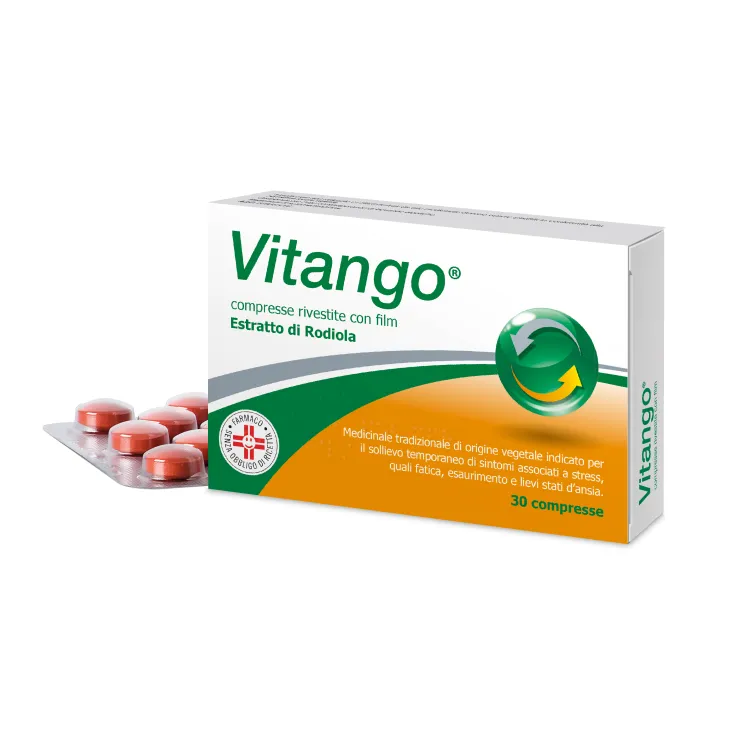
Table of Contents
Patient Information Leaflet
VITANGO film-coated tablets
Rhodiola extract
Please read this leaflet carefully before taking this medicine because it contains important information for you.
Always take this medicine exactly as described in this leaflet or as your doctor or pharmacist has told you to do.
- Keep this leaflet. You may need to read it again.
- If you need more advice or information, consult your pharmacist.
- If you experience any side effects, including those not listed in this leaflet, consult your doctor or pharmacist. See section 4.
- Consult your doctor if you do not notice any improvement or if your symptoms worsen after 14 days.
Contents of this leaflet:
- What Vitango is and what it is used for
- What you need to know before taking Vitango
- How to take Vitango
- Possible side effects
- How to store Vitango
- Contents of the pack and other information
1. What VITANGO is and what it is used for
VITANGO contains the active substance dry extract of rhizome and root of Rhodiola.
VITANGO is a traditional herbal medicinal product indicated for the temporary relief of
symptoms associated with stress, such as fatigue, exhaustion, and mild states of anxiety.
The use of this traditional herbal medicinal product for the specified therapeutic indications
is based exclusively on long-standing use.
Consult a doctor if you do not feel better or if you feel worse after 14 days.
2. What you need to know before taking VITANGO
Do not take VITANGO
- if you are allergic to Rodiola rosea or to any of the other ingredients of this medicine (listed in section 6).
- if you have kidney or liver problems (renal or hepatic insufficiency).
Warnings and precautions
Talk to your doctor or pharmacist before taking VITANGO.
If you suffer from mood disorders such as depression, inform your doctor, who will take appropriate measures.
Other medicines and VITANGO
Inform your doctor or pharmacist if you are currently taking, have recently taken, or might take any other medicines.
No interactions are known.
Avoid simultaneous use of other medicinal products containing alcohol or acting on the central nervous system.
Pregnancy and breastfeeding
If you are pregnant, suspect you may be pregnant, planning a pregnancy, or breastfeeding, consult your doctor or pharmacist before taking this medicine.
The safety of VITANGO during pregnancy and breastfeeding has not been established.
Your doctor will prescribe VITANGO only if strictly necessary.
Driving and using machines
No studies have been conducted on the effects on the ability to drive vehicles or operate machinery.
3. How to take VITANGO
Take this medicine exactly as stated in this leaflet or as directed by your doctor or pharmacist. If you have any doubts, consult your doctor or pharmacist.
Adults and adolescents over 12 years of age:
The recommended dose is 2 tablets per day.
Children
The safety and efficacy of VITANGO in children under 12 years of age have not yet been established.
The maximum duration of treatment is 14 days. If symptoms worsen or persist during treatment, contact a doctor.
Method of administration
The tablet should be taken with a glass of water, preferably 30 minutes before eating.
If you take more VITANGO than you should
Cases of overdose have not been reported.
In case of accidental ingestion of an excessive dose of VITANGO, inform your doctor immediately or go to the nearest hospital.
If you forget to take VITANGO
Do not take a double dose to make up for the missed dose.
Continue treatment with VITANGO as indicated in this patient information leaflet.
If you have any doubts about the use of this medicine, consult your doctor or pharmacist.
4. Possible side effects
Like all medicines, this medicine can cause side effects, although not everybody gets them.
Reported side effects include: allergic reactions (hypersensitivity reactions) and decreased levels of
sugar in the blood (hypoglycaemia).
Reporting of side effects
If you experience any side effect, including those not listed in this leaflet, talk to your doctor, pharmacist or nurse. You can also report side effects directly via the national reporting system at the website
www.agenziafarmaco.gov.it/content/come-segnalare-una-sospetta-reazione-avversa.
By reporting side effects, you can help provide more information on the safety of this medicine.
5. How to store VITANGO
Keep this medicine out of the sight and reach of children.
Do not use this medicine after the expiry date stated on the packaging.
The expiry date refers to the last day of that month.
Do not dispose of any medicine via wastewater or household waste. Ask your pharmacist how to
dispose of medicines you no longer use. This will help protect the environment.
6. Package contents and other information
What VITANGO contains
- The active substance is dry extract of Rhodiola rosea L., rhizoma et radix (Rhodiola rhizome and root) (1.5 - 5:1) (WS 1375). The extraction solvent is ethanol 67.7% (v/v). One film-coated tablet contains 200 mg of Rhodiola extract.
- The other ingredients are: microcrystalline cellulose, sodium croscarmellose, precipitated silica, magnesium stearate, hypromellose, stearic acid, iron oxide red E172, titanium dioxide E171, antifoaming emulsion.
Description of the appearance of Vitango and package contents
Film-coated tablets
in blisters of 30 tablets.
Marketing Authorization Holder and Manufacturer
Dr. Willmar Schwabe GmbH & Co. KG
Willmar-Schwabe-Str. 4
D-76227 Karlsruhe (Germany)
Selling Agent
Schwabe Pharma Italia S.r.l.
Via Silvio Menestrina 1
39044 Egna-Neumarkt (BZ)