Slinda
Italy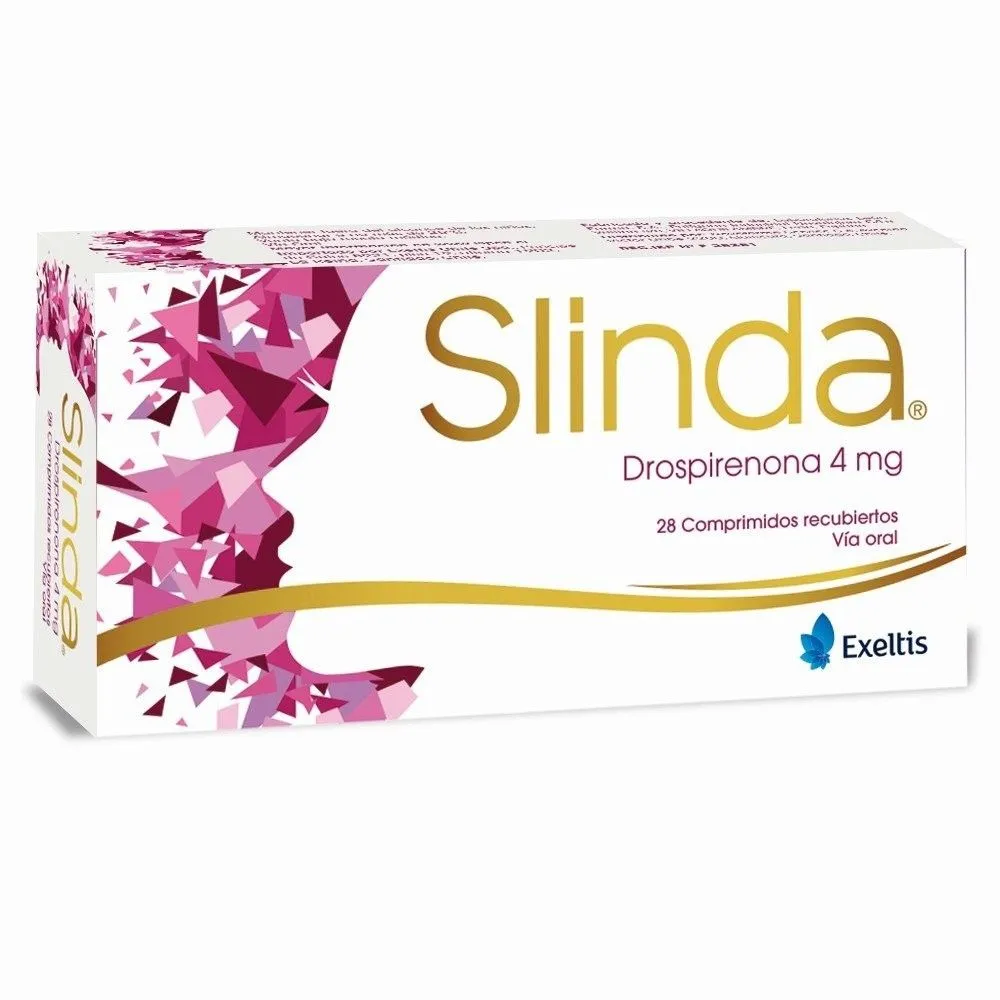
Table of Contents
PACKAGE LEAFLET
Package leaflet: information for the user
Slinda 4 mg film-coated tablets
drospirenone
Please read this leaflet carefully before taking this medicine because it contains
important information for you.
- Keep this leaflet. You may need to read it again.
- If you have any questions, ask your doctor or pharmacist.
- This medicine has been prescribed for you only. Do not give it to other people, even if their symptoms are the same as yours, as it may be harmful.
- If you experience any side effect, including those not listed in this leaflet, contact your doctor or pharmacist. See section 4.
Contents of this leaflet
- What Slinda is and what it is used for
- What you need to know before taking Slinda
- How to take Slinda
- Possible side effects
- How to store Slinda
- Contents of the pack and other information
1. What Slinda is and what it is used for
Slinda is a contraceptive pill used to prevent pregnancy. Each Slinda blister pack contains 24 white tablets, also called active tablets, and 4 green tablets, also called placebo tablets, which do not contain any active substance. The tablets of the two different colours are arranged in a specific order.
Each of the 24 white active tablets contains a small amount of a type of female sex hormone, the progestogen drospirenone. For this reason, Slinda is known as a progestogen-only pill (POP). Unlike combined pills, POPs do not contain oestrogen hormones in addition to the progestogen. For this reason, Slinda can be used by women who do not tolerate oestrogens.
Slinda provides high contraceptive efficacy. The contraceptive effect of Slinda is based on the inhibition of ovulation, changes in cervical mucus, and effects on the endometrium, which becomes thinner.
A disadvantage is that irregular vaginal bleeding may occur during use of Slinda. It is also possible to have no bleeding at all.
2. What you should know before taking Slinda
Do not take Slinda:
- if you are allergic to drospirenone or to any of the other ingredients of this medicine (listed in section 6);
- if you have a blood clot in a blood vessel, for example in the legs (deep vein thrombosis) or in the lungs (pulmonary embolism);
- if you have or have ever had liver disease and liver function has not yet returned to normal;
- if your kidneys are not working properly (renal impairment);
- if you have or are suspected of having a cancer sensitive to sex steroids, such as certain types of breast cancer;
- if you have any unexplained vaginal bleeding.
If any of these conditions occur while you are using Slinda, stop taking this medicine immediately and contact your doctor.
Warnings and precautions
Slinda, like other hormonal contraceptives, does not protect against HIV (AIDS) and other sexually transmitted infections.
Talk to your doctor before starting to use Slinda if any of the following conditions apply to you:
- if you have had thrombosis (formation of a blood clot in a blood vessel);
- if you have liver tumour, jaundice (yellowing of the skin) or liver disease and liver function has not yet returned to normal;
- if you have had breast cancer;
- if you have or have had chloasma (yellow-brown skin pigmentation, especially on the face); in this case, avoid direct sunlight or ultraviolet light during treatment with Slinda;
- Diabetes;
- if you have high blood pressure;
- if your kidneys are not working properly, during the first cycle your doctor will perform a blood test to check potassium levels.
If any of these conditions worsens or occurs for the first time, contact your doctor. Your doctor will decide whether you should stop taking Slinda and may advise you to use a non-hormonal contraceptive method.
Breast cancer
Regularly examine your breasts and contact your doctor as soon as possible if you feel lumps in your breast.
Breast cancer has been found to occur slightly more frequently in women taking combined oral contraceptives compared to women of the same age not taking combined oral contraceptives. If a woman stops taking the combined oral contraceptive, the risk gradually decreases, so that 10 years after stopping, the risk is the same as in women who have never taken the combined oral contraceptive.
Breast cancer is rare under the age of 40. Breast cancers detected in women taking combined oral contraceptives appear less likely to spread than those detected in women not taking combined oral contraceptives. It is not known whether the difference in breast cancer risk is caused by the combined oral contraceptive. It is possible that women are examined more frequently, so that breast cancer is detected earlier.
It is believed that the risk of breast cancer in women using progestogen-only preparations such as Slinda is similar to that in women using combined oral contraceptives, but the evidence is less conclusive.
Thrombosis (formation of a blood clot in a blood vessel).
Contact your doctor immediately if you notice possible signs of thrombosis (see also 'Regular checks').
Thrombosis is the formation of a blood clot, which can block a blood vessel. Thrombosis sometimes occurs in the deep veins of the leg (deep vein thrombosis). If this clot detaches from the veins where it formed, it can travel to and block the arteries of the lungs, causing what is known as a "pulmonary embolism". As a result, life-threatening situations may occur.
There may be a slightly increased risk of thrombosis with a progestogen-only preparation. The risk of thrombosis is higher if a family member (a sibling or parent) has had thrombosis at a relatively young age, with increasing age, in case of obesity, prolonged immobilisation, following major surgery or major trauma.
With a progestogen-only preparation, there is no apparent risk of heart attack or stroke (a blood clot in the brain). The risk is rather associated with increasing age, increasing blood pressure and smoking.
The risk of stroke may be slightly increased in women with high blood pressure when taking progestogen-only preparations.
Psychiatric disorders:
Some women using hormonal contraceptives, including Slinda, have reported depression or depressed mood. Depression can be severe and sometimes may lead to suicidal thoughts. If you experience mood changes or depressive symptoms, consult your doctor as soon as possible for further medical advice.
Medical examination:
Before starting to take Slinda for the first time or if you restart treatment after a period without taking the medicine, your doctor will ask you questions about your health and perform a complete physical examination, including blood pressure measurement. Your doctor will tell you how often you should have follow-up check-ups.
Children and adolescents
Slinda is used after menarche (a woman's first menstrual period).
Other medicines and Slinda
Tell your doctor or pharmacist if you are taking, have recently taken or might take any other medicines. They will advise you whether you need to take additional contraceptive precautions (e.g. condoms) and, if so, for how long, or whether the use of another medicine you need should be adjusted.
Some medicines:
- may affect the levels of Slinda in your blood;
- may make it less effective in preventing pregnancy;
- may cause unexpected bleeding.
These include medicines used to treat:
- epilepsy (e.g. primidone, phenytoin, barbiturates, carbamazepine, oxcarbazepine, felbamate or topiramate);
- tuberculosis (e.g. rifampicin);
- HIV infections (e.g. ritonavir, nelfinavir, nevirapine, efavirenz);
- hepatitis C virus infections (e.g. boceprevir, telaprevir);
- other infections (griseofulvin);
- high blood pressure in the blood vessels of the lungs (bosentan);
- depressed mood (the herbal remedy St John's wort);
- certain bacterial infections (e.g. clarithromycin, erythromycin);
- fungal infections (e.g. fluconazole, itraconazole, ketoconazole, voriconazole);
- high blood pressure (hypertension), angina or certain heart rhythm disorders (e.g. diltiazem).
If you are taking medicines in a short-term treatment that may reduce the effectiveness of Slinda, you must also use a barrier contraceptive method. Since the effect of another medicine on Slinda may last up to 28 days after stopping the medicine, you must use the additional barrier contraceptive method throughout this period. Your doctor can advise you whether you need additional contraceptive precautions and, if so, for how long. If you are taking medicines or herbal products beyond the end of the active white tablets, discard the green placebo tablets and start the new pack immediately.
If you are taking medicines in a long-term treatment that may reduce the effectiveness of Slinda, your doctor will advise you to use a non-hormonal contraceptive method.
Slinda may also interfere with the way other medicines work, for example:
- cyclosporine, used to prevent rejection of transplanted organs (the effect may be increased);
- lamotrigine, used for epilepsy (the effect may be decreased);
- certain diuretics (aldosterone antagonists, potassium-sparing diuretics). Your doctor may recommend a blood test to check potassium levels during the first treatment cycle with Slinda.
Slinda with food and drink
While taking Slinda, avoid grapefruit or grapefruit juice.
Pregnancy and breastfeeding
Pregnancy
Do not use Slinda if you are pregnant or think you may be pregnant.
Use of Slinda before or during pregnancy has not been shown to increase the risk of birth defects.
However, adverse effects cannot be ruled out.
Breastfeeding
Slinda can be used while breastfeeding.
No effects are expected on breastfed newborns/infants. However, very small amounts of drospirenone are excreted in breast milk.
Driving and using machines
No effects on the ability to drive and use machines have been observed in users of oral hormonal contraceptives, although no studies have been conducted with Slinda.
Slinda contains lactose
If your doctor has diagnosed you with an intolerance to certain sugars, contact them before taking this medicine.
Regular checks
While using Slinda, your doctor will advise you to return for regular check-ups. In general, the frequency and type of these checks will depend on your individual circumstances.
Contact your doctor as soon as possible in the following cases:
- if you have severe pain or swelling in one leg, unexplained chest pain, shortness of breath, unusual cough, especially if with blood (possible signs of thrombosis);
- if you have sudden severe stomach pain or appear jaundiced (you may notice yellowing of the skin and whites of the eyes or dark urine, possible signs of liver problems);
- if you feel a lump in your breast (possible sign of breast cancer);
- if you have sudden or severe pain in the lower abdomen or stomach area (possible sign of an ectopic pregnancy, i.e. a pregnancy outside the uterus);
- if you need to remain immobile or undergo surgery (consult your doctor at least four weeks in advance);
- if you have unusual heavy vaginal bleeding;
- if you suspect you are pregnant.
3. How to take Slinda
Always take this medicine exactly as instructed by your doctor. If you have any doubts, consult your
doctor or pharmacist.
Each Slinda blister contains 24 white active tablets and 4 green placebo tablets. The tablets of different
colours are arranged in a specific order.
Take one tablet of Slinda every day with a little water, if necessary. You may take the tablets with or
without food (see section "Use of Slinda with food and drink"). You must take the tablets every day at
approximately the same time, so that the interval between two tablets is always 24 hours.
Do not confuse the tablets: Because of the different composition of the tablets, you must start with the
first white tablet in the top left corner and take the tablets every day. To take them in the correct order,
follow the direction of the arrows and the sequence of numbers on the blister.
The first tablet of treatment should be taken on the first day of menstrual bleeding. After that, continue
taking the tablets without interruption. Take one white active tablet for the first 24 days, followed by one
green placebo tablet for the last 4 days. Start a new pack immediately, without any break in daily
administration. Therefore, there is no interruption between two packs.
You may experience some bleeding while using Slinda, or you may not bleed at all, but you must continue
taking the tablets as usual without interruption.
If you use Slinda in this way, you will be protected against pregnancy even during the 4 days when you
take the placebo tablets.
Blister preparation
To help you keep track, 7 weekly stickers are provided in each pack, each printed with the 7 days of the
week. Choose the weekly sticker that starts with the day on which you begin taking the tablets (for example,
if you start on Thursday, use the sticker starting with "THU") and apply it to the blister where it says
"Apply daily label here", so that the first day is above the tablet marked "START". Now each tablet has a day
indicated above it, and you can see whether you have already taken a particular tablet. The arrows and
consecutive numbers indicate the order in which you should take the tablets.
When to start the first pack of Slinda
- If you have not used a hormonal contraceptive in the previous month Start taking Slinda on the first day of your menstrual period. By doing so, you are immediately protected against pregnancy and do not need to use additional protective measures, such as a condom.
- Switching from a combined oral contraceptive, vaginal ring, or transdermal patch You must start Slinda the day after the last active tablet (the last tablet containing active ingredients) of your previous pill, or on the day of removal of the vaginal ring or transdermal patch (this means there is no break without tablets, ring, or patch). If you follow these instructions, no additional contraceptive precautions are necessary.
You may also start taking Slinda no later than the day after the usual tablet-free, ring-free, patch-free, or placebo period of your previous contraceptive. In this case, make sure to use an additional barrier contraceptive method during the first 7 days of taking Slinda.
- Switching from a progestogen-only pill (progestin-only pill) You may switch from another progestogen-only pill on any day and start taking Slinda the following day. No additional contraceptive precautions are necessary.
- Switching from a progestogen-only injection or implant or from a progestogen-releasing intrauterine device (IUD) You may start Slinda on the day when the next injection is due, or on the day of removal of the implant or IUD. No additional contraceptive precautions are necessary.
- After childbirth You may start Slinda any day between 21 and 28 days after delivery. If you start later than day 28, but before your menstrual periods have resumed, make sure you are not pregnant and use a barrier method, such as a condom, until you have completed the first 7 days of tablet intake.
Information for breastfeeding women can be found in section 2 (Pregnancy and breastfeeding).
- After miscarriage or induced abortion Follow your doctor's advice.
Ask your doctor what to do if you are still unsure about when to start.
If you take more Slinda than you should
There are no reports of serious harmful effects due to taking too many Slinda tablets at once. Symptoms that
may occur include nausea, vomiting, and slight vaginal bleeding.
However, in case of overdose, consult your doctor, as blood tests may be required.
If you forget to take Slinda
You must take the tablets every day at approximately the same time, so that the interval between two
tablets is always 24 hours. If you are less than 24 hours late in taking a single tablet, take the missed tablet
as soon as you remember and take the next tablet at your usual time, even if this means taking two tablets
at the same time. If you are more than 24 hours late in taking any white active tablet, take the missed tablet
as soon as you remember, even if this means taking two tablets at the same time, and use an additional
contraceptive method (such as a condom) for the next 7 days. Afterwards, continue taking the tablets at
your usual time. The risk that contraceptive effectiveness is reduced increases with the number of
consecutive missed tablets.
If you forgot to take a tablet during the first week of starting the tablets and had sexual intercourse in the
week before you missed the tablet, you should be aware that there is a risk of pregnancy. In this case,
contact your doctor.
If you forgot to take a tablet between day 15 and day 24 (third or fourth row), take the missed tablet as
soon as you remember, even if this means taking two tablets at the same time. Continue taking the white
active tablets at your usual time. Instead of taking the green placebo tablets from this blister, discard them
and start the next blister (the starting day will be different). By skipping the placebo interval, contraceptive
protection is maintained.
The last 4 green tablets in the fourth row of the blister are the placebo tablets. If you forget to take one of
these tablets, this will not affect the reliability of Slinda. Discard the missed placebo tablet.
What to do in case of vomiting or severe diarrhoea
If you vomit or have severe diarrhoea, there is a risk that the active ingredient in the tablet has not been
fully absorbed by your body. This situation is similar to forgetting a tablet. In such cases, an additional
contraceptive method may be necessary; consult your doctor.
If you vomit or have severe diarrhoea within 3–4 hours of taking a white active tablet of Slinda, take another
white tablet from another blister as soon as possible. If possible, take it within 24 hours of your usual pill-
taking time. No additional contraceptive precautions are necessary. If this is not possible or if 24 hours
have passed, follow the advice given in the section "If you forget to take Slinda".
If you stop taking Slinda
You may stop taking Slinda at any time. From the day you stop taking it, you are no longer protected against
pregnancy.
If you have any further questions about the use of this medicine, consult your doctor, pharmacist, or
nurse.
4. Possible side effects
Like all medicines, this medicine can cause side effects, although not everyone gets them.
Serious side effects associated with the use of Slinda are described in the sections 'Breast cancer' and 'Thrombosis' in section 2, 'What you should know before taking Slinda'. Please read this section for further information and consult your doctor immediately if appropriate.
You may experience vaginal bleeding at irregular intervals while using Slinda. This may be light spotting, which does not require a sanitary pad, or heavier bleeding that resembles a light menstrual period and requires the use of a sanitary pad. Alternatively, you may have no bleeding at all. Irregular bleeding is not a sign that the contraceptive protection provided by Slinda has decreased. In general, you will not need to take any action; simply continue taking Slinda as directed. However, if the bleeding is heavy or prolonged, you should consult your doctor.
If bleeding is very frequent and irregular, consideration should be given to switching to another contraceptive method. If you do not have vaginal bleeding during treatment, you may need to perform a pregnancy test if you have not taken the tablets in accordance with the instructions in section 3, "How to take Slinda".
The following side effects have been associated with the use of Slinda:
Common: may affect up to 1 in 10 women
- headache
- nausea, abdominal pain
- changes in sexual desire, altered mood
- acne
- breast discomfort, painful menstruation, bleeding and irregular periods
- weight gain
Uncommon: may affect up to 1 in 100 women
- anaemia (decrease in the number of red blood cells), fatigue (tiredness), fluid retention
- dizziness
- vomiting, diarrhoea, constipation
- vaginal infections
- increased levels, as shown by blood tests, of: potassium, liver enzymes (ALT, AST, GGT), bilirubin, creatine phosphokinase, triglycerides
- changes in appetite
- uterine leiomyoma (benign tumour of the uterus)
- depressed mood, depression, anxiety
- absence of menstruation, altered menstrual bleeding, pelvic pain, ovarian cysts, vaginal discharge and vaginal dryness
- hair loss, increased sweating, itching, skin rashes, seborrhoea (oily skin), dermatitis (skin inflammation)
- high blood pressure, hot flushes
- hypersensitivity
Rare: may affect up to 1 in 1,000 women:
- intolerance to contact lenses
- weight loss
- excessive urine production
- breast cysts, breast discharge, abnormal cervical smear, genital itching
Reporting of side effects
If you experience any side effect, including those not listed in this leaflet, talk to your doctor or pharmacist. You can also report side effects directly via the national reporting system at https://www.aifa.gov.it/content/segnalazioni-reazioni-avverse. By reporting side effects, you can help provide more information on the safety of this medicine.
5. How to store Slinda
Keep this medicine out of the sight and reach of children.
Do not use this medicine after the expiry date stated on the carton and blister after "EXP".
The expiry date refers to the last day of that month.
Store below 25°C.
Do not dispose of medicines via wastewater or household waste. Ask your pharmacist how to dispose of medicines you no longer use. This will help protect the environment.
6. Package contents and other information
What Slinda contains
White active film-coated tablets:
- The active substance is drospirenone. Each white active film-coated tablet contains 4 mg of drospirenone.
- The other components are: Tablet core: microcrystalline cellulose; lactose; colloidal silicon dioxide (E551); magnesium stearate (E470b)
Film coating: polyvinyl alcohol; titanium dioxide (E171); Macrogol; talc (E553b)
Green placebo film-coated tablets:
The green placebo film-coated tablets do not contain any active substance.
Tablet core: monohydrate lactose; maize starch; povidone; colloidal silicon dioxide (E551); magnesium stearate (E470b)
Film coating: hypromellose (E464); triacetin; polysorbate 80 (E433); titanium dioxide (E171); indigo carmine aluminium lake (E132); yellow iron oxide (E172)
Description of the appearance of Slinda and package contents
Each Slinda blister pack contains 24 active film-coated tablets and 4 placebo film-coated tablets.
The active tablets are white, round, with the letters “E” and “D” imprinted on opposite sides, 5 mm in diameter.
The placebo tablets are round, green, with the letter “E” and the number “4” imprinted on opposite sides, 5 mm in diameter.
In addition to the cardboard carton, a cardboard box for the blister is included.
Slinda is available in calendar packs containing 1, 3, 6 and 13 blisters, each with 28 tablets.
Not all pack sizes may be marketed.
Marketing Authorization Holder
Exeltis Healthcare S.L.
Av. Miralcampo 7 - Poligono Ind. Miralcampo
19200 Azuqueca de Henares – Guadalajara
Spain
Manufacturer
Laboratorios León Farma, S.A.
C/ La Vallina s/n.
Polígono Industrial Navatejera
Villaquilambre, 24193 León
Spain
This medicinal product is authorized in the European Economic Area countries under the following names:
Sweden: Nusvelta
Italy: Slinda