Pursennid
Italy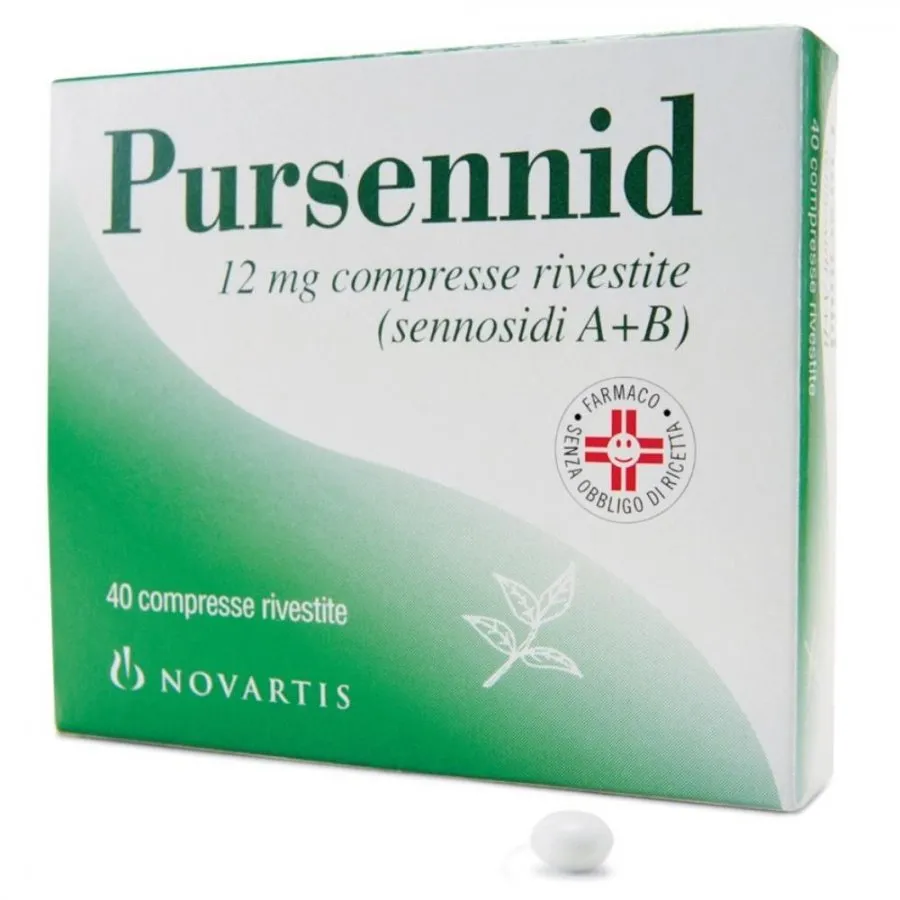
Table of Contents
Patient Information Leaflet
Pursennid 12 mg coated tablets
sennosides A+B
Please read this leaflet carefully before taking this medicine because it contains important information for you.
Always take this medicine exactly as described in this leaflet or as your doctor or pharmacist has instructed you to do.
- Keep this leaflet. You may need to read it again.
- If you need more information or advice, contact your pharmacist.
- If you experience any side effects, including those not listed in this leaflet, contact your doctor or pharmacist. See section 4.
- Contact your doctor if you do not notice improvement or if you experience worsening of symptoms after 7 days.
Contents of this leaflet:
- What Pursennid is and what it is used for
- What you need to know before taking Pursennid
- How to take Pursennid
- Possible side effects
- How to store Pursennid
- Contents of the pack and other information
1. What Pursennid is and what it is used for
Pursennid contains the active plant ingredient Senna, which belongs to a group of medicines that stimulate intestinal movements.
Pursennid is indicated for the short-term treatment of occasional constipation. Pursennid works by stimulating intestinal movements within 6–12 hours. For this reason, it is preferable to take it in the evening.
Consult your doctor if you do not feel better or if you feel worse after 7 days.
2. What you need to know before taking Pursennid
Do not take Pursennid
- if you are allergic to sennosides A+B or to any of the other ingredients of this medicine (listed in section 6);
- if your doctor or pharmacist has advised you not to take laxatives;
- if you suffer from an inflammatory bowel disease (for example Crohn's disease or ulcerative colitis);
- if you have nausea, diarrhoea, vomiting, or stomach cramps;
- if you have acute, severe, or persistent stomach pain, or if your abdomen is soft to the touch and hurts when you move. In these cases, inform your doctor, as you may have an undiagnosed intestinal disorder;
- if you have been diagnosed with severe dehydration with loss of water and salts (for example low potassium levels);
- if the patient is a child under 10 years of age.
Warnings and precautions
Talk to your doctor or pharmacist before taking Pursennid.
Persistent constipation should first be managed by adopting a diet rich in fibre such as fruit, vegetables, and cereals, by drinking sufficient fluids, and by engaging in physical activity.
Exercise particular caution and inform your doctor:
- if you have not observed any positive effect after taking Pursennid;
- if you need to take the medicine for more than 7 days. Prolonged use may lead to dependence and may impair intestinal function;
- if symptoms persist or worsen during use of Pursennid;
- if you suffer from an inflammatory bowel disease;
- if skin rashes, nausea, or vomiting occur;
- if you have recently undergone abdominal surgery.
Children and adolescents
Pursennid must not be administered to children under 10 years of age. In children aged between 10 and 12 years, Pursennid may be used only under medical supervision.
Other medicines and Pursennid
Inform your doctor or pharmacist if you are taking, have recently taken, or might take any other medicines, including those without a prescription.
Inform your doctor if you are taking:
- diuretics (medicines that increase urine production);
- adrenocorticosteroids (hormone-type medicines);
- digitalis and other medicines of the glycoside class (medicines used to treat heart problems);
- quinidine (medicines used to treat heart rhythm disorders).
Pursennid with food
Do not take Pursennid with liquorice root, as it may alter the body's salt balance.
Pregnancy, breastfeeding, and fertility
If you are pregnant, think you may be pregnant, are planning to become pregnant, or are breastfeeding, consult your doctor or pharmacist before taking this medicine.
Pregnancy
Do not take Pursennid during pregnancy unless advised by your doctor.
Breastfeeding
Do not take Pursennid while breastfeeding unless advised by your doctor.
Fertility
Pursennid does not appear to pose specific risks to fertility when taken at therapeutic doses.
Driving and using machines
Pursennid does not affect the ability to drive or operate machinery.
Pursennid contains lactose, sucrose, and glucose
This medicine contains lactose, sucrose, and glucose. If your doctor has diagnosed you with an intolerance to certain sugars, contact your doctor before taking this medicine.
3. How to take Pursennid
Take this medicine exactly as stated in this leaflet or as instructed by your doctor or pharmacist. If you have any doubts, consult your doctor or pharmacist.
Take the lowest effective dose that produces soft, easy bowel movements.
Initially, take the minimum recommended dose. If necessary, you may gradually increase the dose, but always take care not to exceed the maximum recommended dose.
Do not exceed the recommended dose without first consulting your doctor.
Swallow the Pursennid tablets whole with an adequate amount of water (a full glass) or other liquid. Remember that a diet rich in fluids helps enhance the effect of the medicine.
Take Pursennid preferably in the evening. The effect of the medicine occurs within 6–12 hours. When taken in the evening, the medicine will take effect the following morning.
Remember to use laxatives as little as possible and for no longer than seven days. Contact your doctor if you do not feel better, if you feel worse, or if the condition recurs repeatedly or if you have noticed a recent change in its characteristics.
Adults
The recommended dose is 2–4 coated tablets per day.
Children over 12 years of age
The recommended dose is 2–4 coated tablets per day.
Children aged between 10 and 12 years
The recommended dose is 1–2 coated tablets per day.
If you take more Pursennid than you should
If you accidentally take too much Pursennid, contact your doctor immediately or go to the nearest hospital.
If you take an excessive dose of Pursennid, you may experience stomach pain, nausea, and diarrhoea.
If you have accidentally taken too many tablets and have diarrhoea, drink large amounts of fluid, especially fruit juices, and consult your doctor or pharmacist.
If you forget to take Pursennid
Take the next dose as normally recommended. Do not take a double dose to make up for the missed dose.
If you stop taking Pursennid
If you have any questions about the use of this medicine, consult your doctor or pharmacist.
4. Possible side effects
Like all medicines, this medicine can cause side effects, although not everyone gets them.
Stop treatment and consult your doctor immediately if you or your child
- experiences typical symptoms of an allergic reaction: severe itching of the skin with redness or swelling/wheals
- experiences persistent abdominal pain, nausea and diarrhoea with excessive fluid loss
- experiences constipation that continues or worsens during treatment with Pursennid.
Side effects with unknown frequency (frequency cannot be estimated from the available data):
- allergic reactions (severe itching of the skin with redness or swelling/wheals)
- colon disorders leading to constipation or increased abdominal volume (megacolon), abdominal pain, inflammation of gastric and rectal mucosa, cramps, nausea, diarrhoea
- fatigue, drug dependence
- muscle cramps and weakness (myopathy)
- kidney problems, yellowish-brown discoloration of the urine (chromaturia)
- increased activity of the adrenal glands (hyperaldosteronism), deficiency of calcium and magnesium, excessive fluid loss (dehydration), loss of sodium (hyponatraemia), loss of potassium (hypokalaemia) from the body, loss of salts from the body
- low blood pressure (hypotension)
Reporting of side effects
If you experience any side effect, including those not listed in this leaflet, talk to your doctor or pharmacist. You can also report side effects directly via the national reporting system at https://www.aifa.gov.it/content/segnalazioni-reazioni-avverse.
By reporting side effects, you can help provide more information on the safety of this medicine.
5. How to store Pursennid
Keep in the original packaging.
This medicine does not require any special storage conditions.
Keep this medicine out of the sight and reach of children.
Do not use this medicine after the expiry date stated on the pack after Exp.: The expiry date refers to the last day of that month.
Do not dispose of medicines via wastewater or household waste. Ask your pharmacist how to dispose of medicines you no longer use. This will help protect the environment.
It is important to always keep the medicine information available; therefore, keep both the carton and the leaflet.
6. Contents of the pack and other information
What Pursennid contains
- The active substance is sennosides A+B. Each coated tablet contains 12 mg of sennosides A+B.
- The other components are monohydrate lactose, stearic acid, talc, maize starch, anhydrous glucose, sucrose, gum arabic, anhydrous colloidal silica, titanium dioxide, cetostearyl alcohol.
Description of the appearance of Pursennid and contents of the pack
Pursennid is presented as round, biconvex, whitish coated tablets, packed in a blister.
Each pack of Pursennid 12 mg coated tablets contains 30 or 40 coated tablets.
Marketing Authorization Holder
Haleon Italy S.r.l. - Via Monte Rosa 91 - 20149 Milan, Italy
Manufacturer
Famar Italia S.p.A.,
Via Zambeletti n. 25,
Baranzate (MI) – Italy