Mag 2
Italy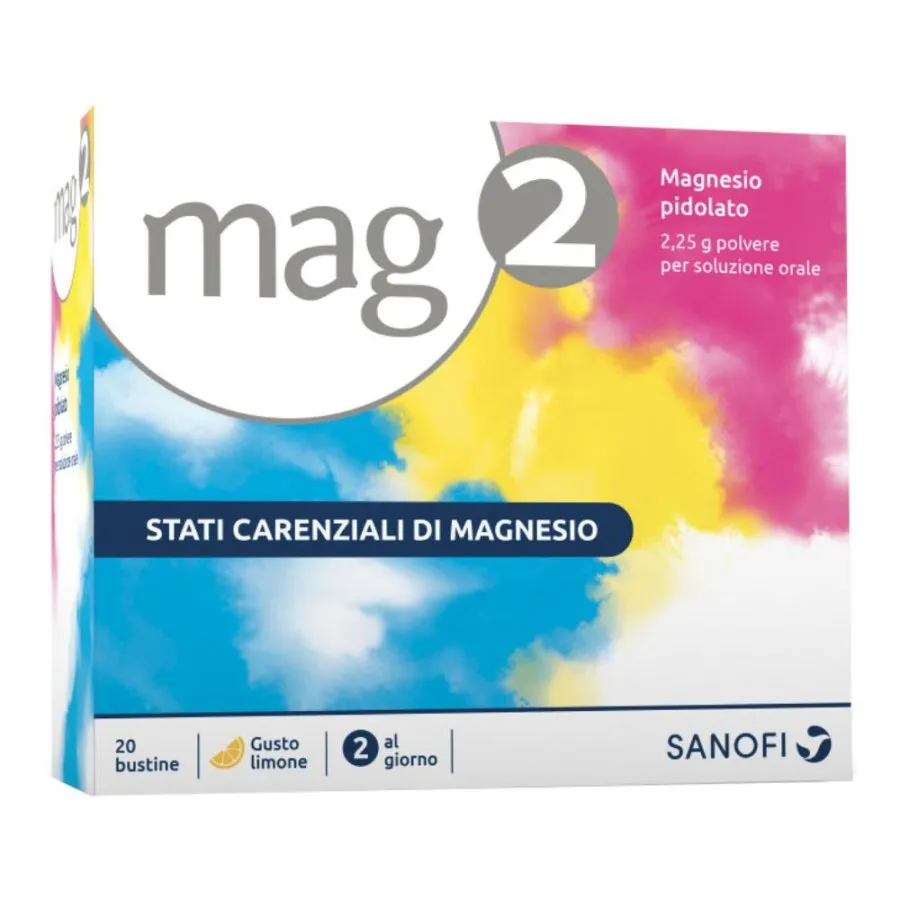
Table of Contents
- Package leaflet: Information for the patient
- 1. What MAG2 is and what it is used for
- 2. What you should know before taking MAG2
- 3. How to take MAG2
- 4. Possible side effects
- 5. How to store MAG2
- 6. Package contents and other information
- Patient Information Leaflet
- 1. What MAG2 is and what it is used for
- 2. What you need to know before taking MAG2
- 3. How to take MAG2
- 4. Possible side effects
- 5. How to store MAG2
- 6. Package contents and other information
Package leaflet: Information for the patient
MAG2 1.5 g/10 ml oral solution
MAG2 2.25 g powder for oral solution
Magnesium pidolate
Please read this leaflet carefully before taking this medicine because it contains important information for you.
Always take this medicine exactly as described in this leaflet or as your doctor or pharmacist has instructed.
- Keep this leaflet. You may need to read it again.
- If you need more information or advice, consult your pharmacist.
- If you experience any side effects, including those not listed in this leaflet, contact your doctor or pharmacist. See section 4.
- Contact your doctor if you do not notice improvement or if your symptoms worsen after a short period of treatment.
Contents of this leaflet:
- What MAG2 is and what it is used for
- What you need to know before taking MAG2
- How to take MAG2
- Possible side effects
- How to store MAG2
- Contents of the pack and other information
1. What MAG2 is and what it is used for
MAG2 is an oral medicine containing magnesium pidolate as the active substance.
This medicine is used to treat symptoms of magnesium deficiency, such as fatigue, muscle weakness, and cramps, which may be caused by various conditions including stress, unbalanced diet, or pregnancy. MAG2 enables a rapid restoration of the body's required magnesium levels (physiological magnesium levels), ensuring effective treatment of magnesium deficiency.
Other disorders caused by magnesium deficiency may include irritability, nervousness, gastrointestinal disturbances, and irregular heartbeat.
In all these cases, magnesium supplementation is necessary to improve symptoms.
For further information, see the section "Health education notes".
Contact your doctor if you do not feel better or if you feel worse after a short period of treatment.
2. What you should know before taking MAG2
Do not take MAG2
- if you are allergic to magnesium pidolate or to any of the other ingredients of this medicine (listed in section 6);
- if you suffer from severe renal failure (severe reduction in kidney function);
- if you are taking certain medicines to treat impaired heart function (digitalis therapy for heart failure).
Warnings and precautions
Talk to your doctor before taking MAG2, especially if you are in any of the following situations
or suffer from any of the following conditions:
- if you also have calcium deficiency, since magnesium deficiency should be corrected before taking supplemental calcium;
- if you are pregnant (see "Pregnancy and breastfeeding");
- if you need to administer MAG2 to children (see "Use in children");
- if your kidney function is reduced (renal insufficiency), as it may be necessary to reduce the dose and perform checks of kidney function and blood magnesium levels (magnesemia) (see "Use in patients with impaired renal function"). Consult your doctor also if you have previously experienced such a condition. Please note that during treatment, a slowing down (depression) of cardiovascular activity may occur.
Other medicines and MAG2
Inform your doctor or pharmacist if you are taking, have recently taken, or might take any other medicines.
Oral administration of magnesium may reduce the absorption of tetracyclines
(antibiotics); therefore, it is recommended not to administer MAG2 and tetracycline-containing medicines at the same time, but to maintain at least a 3-hour interval between administrations.
Quinolones (antibiotics) should be administered at least 2 hours before or 6 hours after taking medicines containing magnesium, such as MAG2, to avoid interference with their absorption.
When magnesium is taken concomitantly with colecalciferol (vitamin D), monitoring of blood calcium levels (calcemia) is recommended to prevent possible excess calcium in the blood (hypercalcemia).
Do not take products containing calcium salts or phosphates at the same time, as these products prevent intestinal absorption of magnesium.
Concomitant intake of magnesium with medicines acting on the central nervous system (CNS), or with alcohol (ethanol), may enhance the effects of magnesium on the central nervous system. In such cases, take MAG2 only under medical supervision and when strictly necessary.
Pregnancy and breastfeeding
If you are pregnant, suspect you may be pregnant, are planning a pregnancy, or are breastfeeding, consult your doctor or pharmacist before taking this medicine.
MAG2 may be used during pregnancy only if the potential benefits to the mother outweigh the potential risks, including those to the fetus.
Magnesium is considered compatible with breastfeeding.
Driving and using machines
No special recommendations.
MAG2 oral solution contains:
- sucrose: if your doctor has diagnosed you with an intolerance to certain sugars, contact him/her before taking this medicine;
- parahydroxybenzoates (sodium methyl parahydroxybenzoate E219 and sodium propyl parahydroxybenzoate E217): may cause allergic reactions (including delayed reactions);
- sodium: this medicine contains less than 1 mmol (23 mg) per dose, i.e. it is essentially "sodium-free";
- ethanol: this medicine contains 18 mg of alcohol (ethanol) per vial or sachet, equivalent to 1.8 mg/ml. The amount in each dose of this medicine is equivalent to less than 0.2 ml of wine or 0.5 ml of beer. The small amount of alcohol in this medicine will not produce significant effects.
MAG2 powder for oral solution contains:
- sucrose: if your doctor has diagnosed you with an intolerance to certain sugars, contact him/her before taking this medicine;
- sodium: this medicine contains less than 1 mmol (23 mg) of sodium per dose, i.e. it is essentially "sodium-free".
3. How to take MAG2
Take this medicine exactly as stated in this leaflet or as directed by your doctor or pharmacist. If you have any doubts, consult your doctor or pharmacist.
The recommended doses are:
Adults: 3 vials or 3 single-dose sachets of solution, or 2 powder sachets per day. Take MAG2 at regular intervals throughout the day.
Use in children: The correct dose will be individually determined by the doctor according to the child's condition.
Use in patients with impaired renal function: Your doctor may prescribe you a lower dose and monitor your kidney function and magnesium levels in the blood (magnesemia). Do not take MAG2 if you suffer from severe renal failure.
Warning: Do not exceed the recommended doses without medical advice. Use only for short-term treatment.
- Solution vials: Shake before use. To open the vial, twist the top part and pull it off. Take the contents of the vial undiluted or diluted in water.
- Single-dose solution sachets: Take the contents of the sachet undiluted or diluted in water.
- Powder sachets: Dissolve the contents of one sachet in water.
Consult your doctor if symptoms recur repeatedly or if you notice any recent changes in their characteristics.
If you take more MAG2 than you should
Oral magnesium overdose generally does not cause toxic effects in individuals with normal kidney function. Cases of hypermagnesemia (excess magnesium in the blood) have been reported only after administration of large amounts of magnesium during treatment of patients with severely impaired kidney function (severe renal failure). Possible symptoms include low blood pressure, nausea, vomiting, depression of the Central Nervous System, reduced reflexes, abnormalities in the electrocardiogram (e.g. irregular heartbeat), onset of respiratory depression, coma, cardiac arrest, respiratory paralysis, lack of urine production (anuric syndrome), and muscle function disorders. In such cases, seek medical attention immediately. The doctor will initiate appropriate treatment, which may include rehydration, forced diuresis, and, in certain cases (renal failure), dialysis (blood or peritoneal).
In case of accidental ingestion/overdose of this medicine, contact your doctor immediately or go to the nearest hospital.
If you forget to take MAG2
Do not take a double dose to make up for the missed dose. Resume taking the medicine as soon as possible.
If you stop taking MAG2
No effects.
If you have any doubts about the use of this medicine, consult your doctor or pharmacist.
4. Possible side effects
Like all medicines, this medicine can cause side effects, although not everyone experiences them.
The possible side effects are listed below according to the following frequency:
Frequency not known (frequency cannot be determined from the available data)
- gastrointestinal disorders;
- diarrhoea;
- abdominal pain;
- skin reactions;
- hypersensitivity. In rare cases, episodes of allergy (individual intolerance) to magnesium have been observed: in such cases, consult your doctor who will provide appropriate treatment.
Reporting of side effects
If you experience any side effect, including those not listed in this leaflet, talk to your doctor or pharmacist. You may also report side effects directly through the national reporting system at the following website: https://www.aifa.gov.it/content/segnalazioni-reazioni-avverse.
By reporting side effects, you can help provide more information on the safety of this medicine.
5. How to store MAG2
Keep this medicine out of the sight and reach of children.
Do not use this medicine after the expiry date stated on the packaging after "Exp.". The expiry
date refers to the last day of that month.
The expiry date applies to the product in its original, unopened packaging, when stored
correctly. Do not use this medicine if you notice any visible signs of deterioration in the
packaging.
Oral solution vials and sachets: store below 25°C.
Oral solution powder sachets: this medicine requires no special storage conditions.
Do not dispose of medicines via wastewater or household waste. Ask your pharmacist how to
dispose of medicines no longer in use. This will help protect the environment.
6. Package contents and other information
What MAG2 contains
Oral solution vials and sachets
- The active substance is magnesium pidolate. Each vial contains 1,500 g of magnesium pidolate (equivalent to 122 mg of Mg ion).
- The other components are: sucrose, orange flavour (containing ethanol), sodium methyl para-hydroxybenzoate E219, sodium propyl para-hydroxybenzoate E217, purified water.
Powder for oral solution sachets
- The active substance is magnesium pidolate. Each sachet contains 2,250 g of magnesium pidolate (equivalent to 184 mg of Mg ion).
- The other components are: sodium saccharin, citric acid monohydrate, sucrose, lemon flavour.
Description of the appearance of MAG2 and contents of the pack
MAG2 oral solution is available in single-dose vials or sachets. The pack contains 20 single-dose vials or sachets.
MAG2 powder for oral solution is available in single-dose sachets. The pack contains 20 or 40 sachets.
Marketing Authorisation Holder
Opella Healthcare Italy S.r.l. - Viale L. Bodio, 37/B - IT - 20158 Milan
Manufacturer
Oral solution vials and sachets:
Unither Liquid Manufacturing - Colomiers (France)
Powder for oral solution sachets:
Fine Foods & Pharmaceuticals N.T.M. S.p.A. - Brembate BG (Italy)
or
A. Nattermann & Cie GmbH - DE-50829 Cologne (Germany)
Health education notes
-
The importance of magnesium Magnesium is an essential mineral for body function. The human body contains approximately 24 grams of magnesium, 99% of which is located within cells. Magnesium is involved in numerous bodily activities, such as energy and protein production, and in nerve impulse transmission. As a regulator of the nervous system, magnesium plays a fundamental role in nerve impulse transmission, which may be altered in certain conditions (e.g. stress, unbalanced diet, or pregnancy).
-
Magnesium in the diet Magnesium is present in many foods, especially cocoa, almonds, fresh green vegetables, nuts, unrefined wheat germ, corn, soy, figs, apples, fish, shellfish and seafood. The amount of magnesium ingested through food is usually sufficient to meet the body's needs. However, magnesium deficiency may develop in certain individuals (elderly people, alcoholics, those with inadequate diets), in certain disease conditions (diabetes, malabsorption syndromes, kidney diseases, chronic diarrhoea, profuse vomiting, excessive sweating), or as a result of certain medications, primarily those that increase urine production (diuretics).
Patient Information Leaflet
MAG2 2.25 g effervescent tablets
Magnesium pidolate
Please read this leaflet carefully before taking this medicine because it contains important information for you.
Always take this medicine exactly as described in this leaflet or as your doctor or pharmacist has instructed you.
- Keep this leaflet. You may need to read it again.
- If you need more information or advice, consult your pharmacist.
- If you experience any side effects, including those not listed in this leaflet, contact your doctor or pharmacist. See section 4.
- Contact your doctor if you do not notice any improvement or if your symptoms worsen after a short period of treatment.
Contents of this leaflet:
- What MAG2 is and what it is used for
- What you need to know before taking MAG2
- How to take MAG2
- Possible side effects
- How to store MAG2
- Contents of the pack and other information
1. What MAG2 is and what it is used for
MAG2 is an oral medicine containing magnesium pidolate as the active ingredient.
This medicine is used to treat symptoms of magnesium deficiency, such as:
fatigue, muscle weakness and cramps, which may be caused by various conditions,
such as stress, unbalanced diet or pregnancy. MAG2 allows a rapid restoration of the body's required magnesium levels (physiological magnesium levels), ensuring effective treatment of magnesium deficiency.
Other disorders caused by lack of magnesium may include: irritability, nervousness, gastrointestinal disturbances, irregular heartbeat.
In all these cases, taking magnesium is necessary to improve symptoms.
For further information, see the section "Health education notes".
Consult your doctor if you do not feel better or if you feel worse after a short period of treatment.
2. What you need to know before taking MAG2
Do not take MAG2
- if you are allergic to magnesium pidolate or to any of the other ingredients of this medicine (listed in section 6);
- if you suffer from severe renal insufficiency (severely reduced kidney function);
- if you are taking certain medicines used to treat impaired heart function (digitalis therapy for heart failure).
Warnings and precautions
Talk to your doctor before taking MAG2, particularly if you are in any of the following situations or suffer from any of the following conditions:
- if you also have calcium deficiency, since magnesium deficiency should be corrected before taking supplemental calcium;
- if you are pregnant (see "Pregnancy and breastfeeding");
- if you need to administer MAG2 to children (see "Use in children");
- if your kidney function is reduced (even mild renal insufficiency), as it may be necessary to reduce the dose and monitor kidney function and magnesium blood levels (magnesemia) (see "Use in patients with impaired renal function"). Consult your doctor also if you have previously experienced such a condition. Please note that during treatment, a slowing down (depression) of cardiovascular activity may occur.
Other medicines and MAG2
Tell your doctor or pharmacist if you are taking, have recently taken, or might take any other medicines.
Oral administration of magnesium may reduce the absorption of tetracyclines (antibiotics); therefore, it is recommended not to take MAG2 at the same time as tetracycline-containing medicines, but to maintain at least a 3-hour interval between administrations.
Quinolones (antibiotics) should be administered at least 2 hours before or 6 hours after taking medicines containing magnesium, such as MAG2, to avoid interference with their absorption.
When magnesium is taken concomitantly with colecalciferol (vitamin D), monitoring of blood calcium levels (calcemia) is advised to prevent possible excess calcium in the blood (hypercalcemia).
Do not take products containing calcium salts or phosphates at the same time, as these products prevent intestinal absorption of magnesium.
Concomitant intake of magnesium with medicines acting on the central nervous system (CNS), or with alcohol (ethanol), may enhance the effects of magnesium on the central nervous system. In such cases, take MAG2 only under medical supervision and when strictly necessary.
Pregnancy and breastfeeding
If you are pregnant, suspect you may be pregnant, plan to become pregnant, or are breastfeeding, consult your doctor or pharmacist before taking this medicine.
MAG2 may be used during pregnancy only if the potential benefits to the mother outweigh the potential risks, including those to the fetus.
Magnesium is considered compatible with breastfeeding.
Driving and using machines
No special recommendations.
MAG2 contains:
- Sorbitol (E420): this medicine contains 615 mg of sorbitol per effervescent tablet. Sorbitol is a source of fructose. If your doctor has informed you (or the child) that you have an intolerance to certain sugars, or if you have been diagnosed with hereditary fructose intolerance, a rare genetic disorder in which patients cannot metabolize fructose, speak with your doctor before you (or the child) take this medicine;
- Sodium: the maximum recommended daily dose of this medicinal product contains 1032 mg of sodium (the main component of table salt). This corresponds to 52% of the maximum recommended daily dietary intake for an adult. Speak with your doctor or pharmacist if you require daily use of MAG2 over a prolonged period, especially if you have been advised to follow a low-sodium diet;
- Benzyl alcohol: this medicine contains 0.015 mg of benzyl alcohol per effervescent tablet. Benzyl alcohol may cause allergic reactions. Do not use for more than one week in young children (under 3 years of age) unless otherwise recommended by your doctor or pharmacist. Consult your doctor or pharmacist if you are pregnant or breastfeeding, or if you have liver or kidney disease. This is because large amounts of benzyl alcohol may accumulate in the body and cause adverse effects (such as metabolic acidosis).
3. How to take MAG2
Take this medicine exactly as stated in this leaflet or as directed by your doctor or pharmacist. If you have any doubts, consult your doctor or pharmacist.
The recommended doses are:
Adults: 2 effervescent tablets per day. Take MAG2 at regular intervals throughout the day.
Use in children: the correct dose will be individually determined by the doctor according to the child's condition.
Use in patients with impaired renal function: your doctor may prescribe you a lower dose and monitor kidney function and blood magnesium levels (magnesemia). Do not take MAG2 if you suffer from severe renal insufficiency.
Caution: do not exceed the recommended doses without medical advice. Use only for short treatment periods.
Dissolve one effervescent tablet in water.
Consult your doctor if symptoms recur repeatedly or if you notice any recent changes in their characteristics.
If you take more MAG2 than you should
Oral magnesium overdose generally does not cause toxic effects in individuals with normal kidney function.
Cases of hypermagnesemia (excess blood magnesium) have been reported only after administration of large amounts of magnesium in the treatment of patients with severely reduced kidney function (severe renal failure). Possible symptoms include low blood pressure, nausea, vomiting, depression of the Central Nervous System, reduced reflexes, abnormalities in the electrocardiogram (e.g. irregular heartbeat), onset of respiratory depression, coma, cardiac arrest, respiratory paralysis, lack of urine production (anuric syndrome), and disturbances in muscle function. In such cases, seek medical attention immediately. The doctor will provide appropriate treatment, which may include rehydration, forced diuresis, and, in certain cases (renal failure), dialysis (blood or peritoneal).
In case of accidental ingestion/overdose of this medicine, contact your doctor immediately or go to the nearest hospital.
If you forget to take MAG2
Do not take a double dose to make up for the missed dose. Resume taking the medicine as soon as possible.
If you stop taking MAG2
No effects.
If you have any questions about the use of this medicine, consult your doctor or pharmacist.
4. Possible side effects
Like all medicines, this medicine can cause side effects, although not everybody gets them.
The possible side effects are listed below according to the following frequency:
Frequency not known (frequency cannot be estimated from the available data)
- gastrointestinal disorders;
- diarrhoea;
- abdominal pain;
- skin reactions;
- hypersensitivity. In rare cases, episodes of allergy (individual intolerance) to magnesium have been observed: in such cases, consult your doctor, who will provide appropriate treatment.
Reporting of side effects
If you experience any side effect, including those not listed in this leaflet, please inform your doctor or pharmacist.
You can also report side effects directly via the national reporting system at: https://www.aifa.gov.it/content/segnalazioni-reazioni-avverse.
By reporting side effects, you can help provide more information on the safety of this medicine.
5. How to store MAG2
Keep this medicine out of the sight and reach of children.
Do not use this medicine after the expiry date stated on the pack after "Exp.".
The expiry date refers to the last day of that month.
The expiry date refers to the product kept in its original, undamaged packaging and stored correctly.
Do not use this medicine if you notice any visible signs of deterioration in the packaging.
Store in the original packaging to protect the medicine from moisture.
Do not dispose of any medicine via wastewater or household waste. Ask your pharmacist how to dispose of medicines no longer in use. This will help protect the environment.
6. Package contents and other information
What MAG2 contains
- The active substance is magnesium pidolate. Each effervescent tablet contains 2,250 g of magnesium pidolate (equivalent to 184 mg of Mg ion).
- The other components are: anhydrous citric acid, sodium bicarbonate, sorbitol (E420), anhydrous sodium carbonate, lemon flavor, orange flavor (containing benzyl alcohol), acesulfame potassium, anhydrous colloidal silica.
Description of the appearance of MAG2 and contents of the pack
MAG2 is presented as effervescent tablets contained in two tubes of 10 tablets each.
The total pack content is 20 effervescent tablets.
Marketing Authorization Holder
Opella Healthcare Italy S.r.l. - Viale L. Bodio, 37/B - IT - 20158 Milan
Manufacturer
E-Pharma Trento S.p.A. - Via Provina, 2 - IT - 38123 Trento (Italy)
Health education notes
- The importance of magnesium Magnesium is an essential mineral for the body's functioning. The human body contains about 24 grams, of which 99% is located inside cells. Magnesium is involved in numerous bodily activities, such as energy and protein production, and nerve impulse transmission. As a regulator of the nervous system, magnesium plays a fundamental role in the transmission of nerve impulses, which may be altered in certain conditions (e.g. stress, unbalanced diet, or pregnancy).
- Magnesium in the diet Magnesium is present in many foods, especially cocoa, almonds, fresh green vegetables, nuts, unrefined wheat germ, corn, soy, figs, apples, fish, crustaceans, and shellfish. The amount of magnesium ingested through food is usually sufficient to meet the body's requirements. However, magnesium deficiency may develop in certain individuals (elderly people, alcoholics, those with inadequate diets), in certain medical conditions (diabetes, malabsorption syndromes, kidney diseases, chronic diarrhea, profuse vomiting, excessive sweating), or as a result of certain medicinal treatments, primarily those increasing urine production (diuretics).