Aminoven
Italy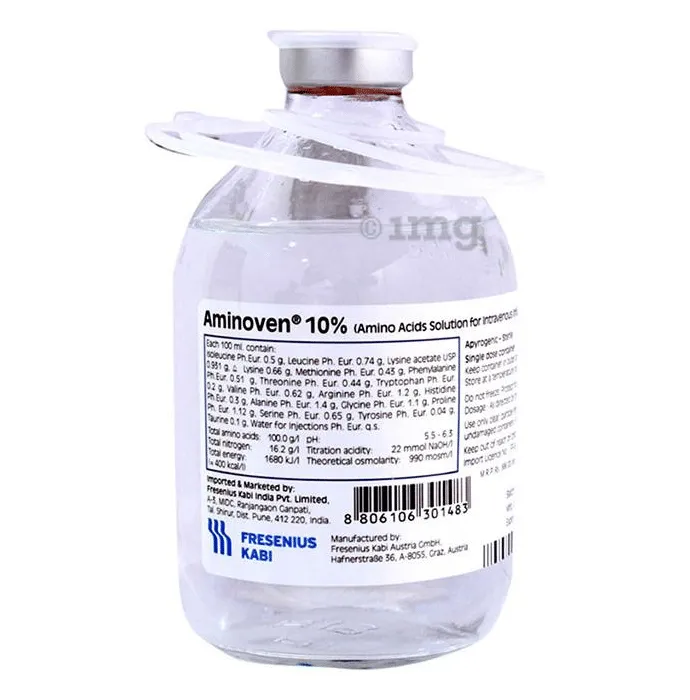
Table of Contents
- Package leaflet: Information for the user
- Aminoven 5% Solution for infusion, 10% Solution for infusion, 15% Solution for infusion
- 1. What Aminoven is and what it is used for
- 2. What you need to know before receiving Aminoven
- 3. How to use Aminoven
- 4. Possible side effects
- 5. How to store Aminoven
- 6. Package contents and other information
Package leaflet: Information for the user
Aminoven 5% Solution for infusion, 10% Solution for infusion, 15% Solution for infusion
Read this leaflet carefully before receiving this medicine because it contains important information for you.
- Keep this leaflet. You may need to read it again.
- If you have any questions, ask your doctor, pharmacist, or nurse.
- If you experience any side effects, including those not listed in this leaflet, inform your doctor, pharmacist, or nurse. See section 4.
Contents of this leaflet:
- What Aminoven is and what it is used for
- What you need to know before receiving Aminoven
- How to use Aminoven
- Possible side effects
- How to store Aminoven
- Contents of the pack and other information
1. What Aminoven is and what it is used for
Aminoven provides nutrition directly into the bloodstream when normal eating is not possible. It supplies amino acids, which your body will use to produce proteins (to build and repair muscles, organs, and other body structures).
Aminoven is typically mixed in the pharmacy with lipids, carbohydrates, salts, and vitamins, which together provide your complete nutritional requirements.
This leaflet covers 3 products:
- Aminoven 5% Solution for infusion
- Aminoven 10% Solution for infusion
- Aminoven 15% Solution for infusion
In this leaflet, the term Aminoven refers to all three solutions.
2. What you need to know before receiving Aminoven
Do not receive Aminoven if you have or have had any of the following conditions
Do not use Aminoven:
- If you have a condition in which your body has problems using proteins or amino acids
- If you have metabolic acidosis (the acidity levels in your body's fluids and tissues become too high)
- If you have reduced renal function without undergoing dialysis or another form of blood filtration treatment
- If you have severely reduced liver function
- If you have fluid retention
- If you are suffering from shock
- If you have hypoxia (low oxygen levels)
- If you have decompensated heart failure
Aminoven 5% and 10% must not be used in children under 2 years of age.
Aminoven 15% must not be used in children.
For children under 2 years of age, pediatric amino acid preparations
formulated to meet their different metabolic requirements should be used.
Warnings and precautions
Tell your doctor if you have:
- Low potassium levels (hypokalemia);
- Low sodium levels (hyponatremia);
- Folate deficiency;
- Heart failure.
Before use, the doctor or nurse will check that the solution is free from visible particles.
Other medicines and Aminoven
Tell your doctor or pharmacist if you are taking or have recently taken any other
medicines, including those not requiring a prescription.
Pregnancy and breastfeeding
If you are pregnant, think you may be pregnant, or are breastfeeding, you must inform your doctor.
Your doctor will decide whether you should receive Aminoven.
Driving and using machines
Infusion of Aminoven has no effect on the ability to drive vehicles or operate machinery.
3. How to use Aminoven
You will receive the medicine by infusion (drop by drop).
The amount and rate of infusion depend on your needs.
Your doctor will decide the correct dose you should receive.
You may be monitored during treatment.
If you use more Aminoven than you should
It is unlikely that you will receive more infusion than required, as your doctor or nurse will monitor you during treatment. Effects of an overdose may include nausea, vomiting, and chills. If you experience these symptoms or think you have received too much Aminoven, inform your doctor or nurse immediately.
If you have any doubts about how to use this medicine, consult your doctor or pharmacist.
4. Possible side effects
Like all medicines, Aminoven can cause side effects, although not everybody gets them.
The following side effects have been observed when the infusion was administered too
rapidly:
- loss of potassium or sodium from the blood
- folate deficiency.
The following side effects may occur at the injection site:
- irritation and sensitivity of the vein
- thrombosis (clot formation) in the injected vein.
Reporting of side effects
If you experience any side effect, including those not listed in this leaflet, talk to your doctor or pharmacist. You can also report side effects directly
through the national reporting system at
www.agenziafarmaco.gov.it/it/responsabili. By reporting side effects, you can help provide more information on the safety of this medicine.
5. How to store Aminoven
Keep this medicine out of the reach and sight of children.
The physician or hospital pharmacist is responsible for the proper storage, use, and disposal of Aminoven.
Do not freeze and always store the container in its outer packaging.
Do not use Aminoven after the expiry date stated on the label.
Any unused solution remaining after treatment must be disposed of according to approved hospital procedures.
6. Package contents and other information
What AMINOVEN infusion solution contains
1000 ml of Aminoven contain the following active substances:
| Active ingredients | Quantity (g) | ||
| Aminoven 5% | Aminoven 10% | Aminoven 15% | |
| Isoleucine | 2.50 | 5.00 | 5.20 |
| Leucine | 3.70 | 7.40 | 8.90 |
| Lysine acetate | 4.655 | 9.31 | 15.66 |
| Methionine | 2.15 | 4.30 | 3.80 |
| Phenylalanine | 2.55 | 5.10 | 5.50 |
| Threonine | 2.20 | 4.40 | 8.60 |
| Tryptophan | 1.00 | 2.00 | 1.60 |
| Valine | 3.10 | 6.20 | 5.50 |
| Arginine | 6.00 | 12.00 | 20.00 |
| Histidine | 1.50 | 3.00 | 7.30 |
| Alanine | 7.00 | 14.00 | 25.00 |
| Glycine | 5.50 | 11.00 | 18.50 |
| Proline | 5.60 | 11.20 | 17.00 |
| Serine | 3.25 | 6.50 | 9.60 |
| Tyrosine | 0.20 | 0.40 | 0.40 |
| Taurine | 0.50 | 1.00 | 2.00 |
Aminoven 5% and Aminoven 10% also contain glacial acetic acid and water for injections.
Aminoven 15% also contains glacial acetic acid, water for injections, and malic acid.
Description of the appearance of Aminoven and contents of the pack
Aminoven 5% and Aminoven 10% are available in colorless glass bottles with a rubber stopper and aluminium seal, containing 500 ml or 1000 ml of solution.
Aminoven 15% is available in colorless glass bottles with a rubber stopper and aluminium seal, containing 250 ml, 500 ml, or 1000 ml of solution.
Aminoven 5% is also available in infusion bags containing 500 ml of solution.
Aminoven 10% and Aminoven 15% are available in infusion bags containing 500 ml or 1000 ml of solution.
It is possible that not all pack sizes are marketed.
Marketing Authorization Holder and Manufacturer
Marketing Authorization Holder
Fresenius Kabi Italia S.r.l.
Via Camagre, 41
37063 Isola della Scala (Verona)
Italy
Manufacturer
Aminoven in glass bottles is manufactured by:
Fresenius Kabi Austria GmbH
Hafnerstrasse 36
A-8055 Graz
Austria
Aminoven in bags is manufactured by:
Fresenius Kabi AB Uppsala
Rapsgatan 7
S-75174 Uppsala Sweden
The following information is intended exclusively for healthcare professionals:
Dosage and method of administration:
The daily requirement of amino acids depends on body weight and the metabolic condition of the patient.
The maximum daily dose varies according to the patient's clinical condition and may change from day to day.
The recommended infusion time is that required to provide continuous infusion for at least 14 hours up to 24 hours, depending on the clinical situation. Bolus administration is not recommended.
The solution is administered as long as parenteral nutrition is required.
Aminoven 5%
For administration as continuous infusion through a peripheral or central vein.
The usual daily dose of Aminoven 5% is 16–20 ml per kg of body weight (equivalent to 0.8–1.0 g of amino acids per kg of body weight), corresponding to 1120–1400 ml of Aminoven 5% for a body weight of 70 kg.
The maximum infusion rate is 2.0 ml of Aminoven 5% per kg of body weight per hour (equivalent to 0.1 g of amino acids per kg of body weight per hour).
Maximum daily dose for adults
20 ml of Aminoven 5% per kg of body weight/day (equivalent to 1.0 g of amino acids per kg of body weight), corresponding to 70 g of amino acids for a body weight of 70 kg.
For higher amino acid dosages, suitable preparations are available.
Maximum daily dose for children and adolescents (2–18 years)
40 ml of Aminoven 5% per kg of body weight/day (equivalent to 2.0 g of amino acids per kg of body weight/day), but the total daily fluid intake must be considered.
Aminoven 10%
For administration as continuous infusion through a central vein.
The usual daily dose of Aminoven 10% is 10–20 ml per kg of body weight (equivalent to 1.0–2.0 g of amino acids per kg of body weight), corresponding to 700–1400 ml of Aminoven 10% for a body weight of 70 kg.
The maximum infusion rate is 1.0 ml of Aminoven 10% per kg of body weight per hour (equivalent to 0.1 g of amino acids per kg of body weight per hour).
Maximum daily dose for adults, adolescents and children (from 2 years):
20 ml of Aminoven 10% per kg of body weight/day (equivalent to 2.0 g of amino acids per kg of body weight), corresponding to 1400 ml of Aminoven 10% or 140 g of amino acids for a body weight of 70 kg.
Aminoven 15%
For administration as continuous infusion via central vein.
The usual daily dose of Aminoven 15% is 6.7–13.3 ml per kg of body weight (equivalent to 1.0–2.0 g of amino acids per kg of body weight), corresponding to 470–930 ml of Aminoven 15% for a body weight of 70 kg.
The maximum infusion rate is 0.67 ml of Aminoven 15% per kg of body weight per hour (equivalent to 0.1 g of amino acids per kg of body weight per hour).
Maximum daily dose for adults
13.3 ml of Aminoven 15% per kg of body weight (equivalent to 2.0 g of amino acids per kg of body weight), corresponding to 140 g of amino acids for a body weight of 70 kg.
Aminoven 15% is contraindicated in children.
Overdose (symptoms, emergency procedures, antidotes)
As with other amino acid solutions, in case of overdose with Aminoven or exceeding the recommended infusion rate, symptoms such as chills, vomiting, nausea, and increased renal excretion of amino acids may occur. In such cases, the infusion must be immediately stopped. It may be resumed at a reduced dose.
Too rapid infusion may cause fluid overload and electrolyte disturbances.
Emergency procedures should consist of general supportive measures, with particular attention to the respiratory and cardiovascular systems. Careful biochemical monitoring may be essential, and specific abnormalities should be appropriately managed.
There are no specific antidotes for overdose.
Storage
Keep out of the reach and sight of children.
Store the container in the outer carton. Do not store above 25°C.
Do not freeze.
Use only clear solutions free from particles and in intact containers.
Do not use Aminoven after the expiry date stated on the label after "Expiry date". The expiry date refers to the last day of that month.
Aminoven must be used immediately after opening with a sterile transfer set. Unused solution must be discarded.
Aminoven may be aseptically mixed with other nutrients such as lipid emulsions, carbohydrates, and electrolytes. Chemical and physical stability data for many mixtures stored at 4°C for up to 9 days are available from the manufacturer upon request.
From a microbiological standpoint, total parenteral nutrition solutions mixed with other compounds under uncontrolled or non-validated conditions should be used immediately. If not used immediately, the storage time for use and conditions prior to use are the responsibility of the user and normally should not exceed 24 hours between 2 and 8°C, unless the mixing was carried out under controlled and validated aseptic conditions.