Zilbrysq 32.4 mg, solution for injection in pre-filled syringe
Spain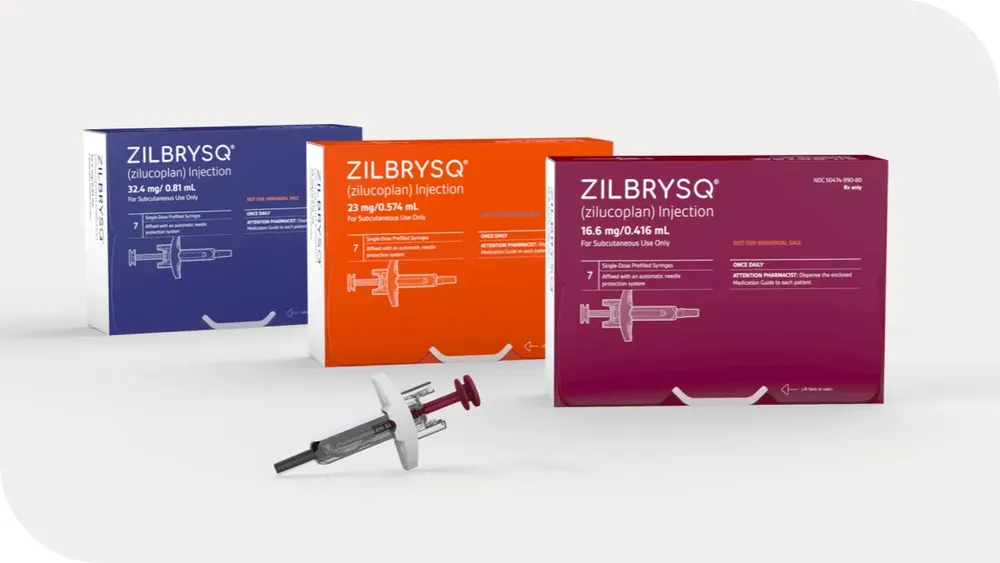
Table of Contents
Patient Information Leaflet
Introduction
Package Leaflet: Information for the Patient
Zilbrysq 16.6 mg, solution for injection in pre-filled syringe
Zilbrysq 23 mg, solution for injection in pre-filled syringe
Zilbrysq 32.4 mg, solution for injection in pre-filled syringe
zilucoplan
This medicinal product is subject to additional monitoring, which will allow rapid identification of new safety information. You can help by reporting any side effects you may experience. Information on how to report side effects is included at the end of section 4.
Read the entire leaflet carefully before you start using this medicine, as it contains important information for you.
- Keep this leaflet, as you may need to read it again.
- If you have any questions, consult your doctor, pharmacist, or nurse.
- This medicine has been prescribed for you only and must not be given to other people, even if they have the same symptoms as you, as it may harm them.
- If you experience any side effects, consult your doctor, pharmacist, or nurse, even if they are side effects not listed in this leaflet. See section 4.
Leaflet Contents
- What Zilbrysq is and what it is used for
- What you need to know before using Zilbrysq
- How to use Zilbrysq
- Possible side effects
- How to store Zilbrysq
- Contents of the pack and other information
1. What Zilbrysq is and what it is used for
Zilbrysq contains the active substance zilucoplan. Zilucoplan binds to a protein in the body that causes inflammation, blocking it. This protein is known as complement protein C5, which is part of the immune system (the body's natural defenses). By blocking this protein, zilucoplan prevents the body's immune system from attacking and destroying the connections between nerves and muscles, thereby improving disease symptoms.
Zilbrysq is used in combination with standard treatment to treat adult patients with generalized myasthenia gravis (gMG), an autoimmune disease that causes muscle weakness. It is used in adults whose immune system produces antibodies against a protein called the acetylcholine receptor, located on muscle cells. In patients with gMG, the immune system may attack and damage the muscles, leading to severe muscle weakness, impaired mobility, shortness of breath, extreme fatigue, difficulty swallowing, and functional decline in performing daily activities.
Zilbrysq can reduce disease symptoms and improve quality of life.
2. What you need to know before using Zilbrysq
Do not use Zilbrysq
- if you are allergic to zilucoplan or to any of the other ingredients of this medicine (listed in section 6).
- if you have not been vaccinated against meningococcal infection. See section Warnings and precautions.
- if you currently have a meningococcal infection
Warnings and precautions
Alert about meningococcal infections and other Neisseria infections
Because Zilbrysq inhibits the body's natural defenses against infections, its use may increase the risk of infections caused by Neisseria meningitidis, such as meningococcal infection (a serious infection of the membranes covering the brain and spinal cord and/or bloodstream infection), as well as other infections caused by the bacterium Neisseria, such as gonorrhoea.
Consult your doctor before using Zilbrysq to ensure you are vaccinated against Neisseria meningitidis, the microorganism that causes meningococcal infections, at least 2 weeks before starting treatment. If you cannot be vaccinated at least 2 weeks in advance, your doctor will prescribe antibiotics to reduce the risk of infection for up to 2 weeks after receiving your first vaccine dose. Make sure your meningococcal vaccinations are up to date.
You should be aware that vaccination does not always prevent this type of infection.
If you are at risk of gonorrhoea (a sexually transmitted bacterial infection), speak with your doctor before starting this medicine.
Symptoms of meningococcal infection
Due to the importance of promptly identifying and treating meningococcal infections in patients receiving Zilbrysq, you will be given a card to carry with you at all times, listing specific signs and symptoms of possible meningococcal infection. It also contains information for healthcare professionals who may not be familiar with Zilbrysq. This card is called the “Patient Alert Card”. You will also receive a patient/caregiver guide containing additional information about Zilbrysq.
Contact your doctor immediately if you experience any of the following symptoms:
- Headache accompanied by additional symptoms such as nausea (feeling sick), vomiting, fever, and neck or back stiffness
- Fever with or without a skin rash
- Sensitivity of the eyes to light
- Confusion/drowsiness
- Muscle pain with flu-like symptoms
Treatment of meningococcal infections while travelling
If you travel to an area where you cannot contact your doctor or where you cannot access medical treatment promptly, your doctor may prescribe an antibiotic against Neisseria meningitidis for you to carry with you. If you experience any of the symptoms listed above, you must take the prescribed antibiotic treatment as instructed. Note that you must see a doctor as soon as possible, even if you feel better after taking the antibiotic treatment.
Children and adolescents
Do not give this medicine to children under 18 years of age. Zilbrysq has not been studied in this age group.
Other medicines and Zilbrysq
Inform your doctor or pharmacist if you are taking, have recently taken, or might need to take any other medicines.
Pregnancy, breast-feeding and fertility
If you are pregnant or breast-feeding, think you might be pregnant, or plan to become pregnant, consult your doctor or pharmacist before using this medicine.
There is uncertainty about the effects Zilbrysq may have on the fetus; therefore, do not use this medicine if you are pregnant or think you might be, unless specifically recommended by your doctor.
It is not known whether Zilbrysq passes into breast milk. There may be a risk to newborns/infants.
A decision on whether to discontinue breastfeeding or Zilbrysq therapy should be made, taking into account the benefit of breastfeeding for the child and the benefit of treatment for the woman.
Driving and using machines
It is unlikely that Zilbrysq will affect your ability to drive or use machines.
Zilbrysq contains sodium
This medicine contains less than 1 mmol (23 mg) of sodium per pre-filled syringe; this is essentially “sodium-free”.
3. How to use Zilbrysq
At least 2 weeks before starting treatment with Zilbrysq, your doctor will administer a meningococcal infection vaccine if you have not previously received it or if your vaccination needs to be renewed. If you cannot be vaccinated at least 2 weeks before starting treatment with Zilbrysq, your doctor will prescribe antibiotics to reduce the risk of infection for up to 2 weeks after receiving your first vaccine dose.
Before starting treatment, you should also consult your doctor to determine if you need any other vaccines.
After proper training, your doctor will allow you to self-inject Zilbrysq. Always follow your doctor's exact instructions for administering this medicine. If in doubt, consult your doctor again.
The dose you receive will depend on your body weight. Always administer your daily dose at approximately the same time each day.
The following table indicates the total daily dose of Zilbrysq based on your body weight:
Body weight | Dosage | Number of prefilled syringes by color |
<56 kg | 16.6 mg | 1 (FUCHSIA) |
From ≥56 to <77 kg | 23 mg | 1 (ORANGE) |
≥77 kg | 32.4 mg | 1 (DARK BLUE) |
How Zilbrysq is administered
You and your doctor or nurse will decide whether you can inject this medicine yourself. Do not self-inject this medicine unless a healthcare professional has trained you to do so. Another person may also administer the injections after receiving proper training.
Zilbrysq will be given as a subcutaneous injection (an injection under the skin) once daily. It may be injected into the abdominal area, the front of the thighs, or the outer side of the upper arm. Injections into the outer side of the upper arms should only be administered by another person. The injection site should be rotated each time, avoiding areas where the skin is tender, bruised, red, hard, or has scars or stretch marks.
It is important that you read the instructions for use at the end of this leaflet for detailed information on how to use Zilbrysq.
If you use more Zilbrysq than you should
If you suspect you have accidentally received a higher dose of Zilbrysq than prescribed, seek advice from your doctor.
If you forget to use Zilbrysq
If you have not injected the dose at the usual time or have missed a dose, take it as soon as you remember, then continue with your next dose at the usual time the following day. Do not administer more than one dose per day.
If you stop using Zilbrysq
Stopping or interrupting treatment with Zilbrysq may cause your symptoms to return. Talk to your doctor before stopping Zilbrysq. Your doctor will explain the possible adverse effects and risks. Your doctor may also wish to monitor you closely.
If you have any further questions about the use of this medicine, ask your doctor, pharmacist, or nurse.
4. Possible adverse effects
Like all medicines, this medicine may cause adverse effects, although not everybody gets them.
Very common (may affect more than 1 in 10 people)
- Reactions at the injection site, such as bruising, pain, itching, and lump formation.
- Nasal and throat infections.
Common (may affect up to 1 in 10 people)
- Diarrhea
- Increased levels of pancreatic enzymes (amylase, lipase) in blood tests.
- Morphea (a condition causing localized skin discoloration and hardening)
Uncommon (may affect up to 1 in 100 people)
- Increased eosinophils (a type of white blood cell) in blood tests.
Reporting of adverse effects
If you experience any type of adverse effect, consult your doctor or nurse, even if it is a possible adverse effect not listed in this leaflet. You can also report them directly through the national reporting system included in Appendix V. By reporting adverse effects, you can help provide more information on the safety of this medicine.
5. Zilbrysq Storage
Keep this medicine out of the sight and reach of children.
Do not use this medicine after the expiry date which is stated on the label of the syringe and on the carton after EXP/CAD. The expiry date refers to the last day of the month indicated.
Store in the refrigerator (between 2 °C and 8 °C).
Do not freeze.
Keep the pre-filled syringe in its outer packaging to protect it from light.
The pre-filled syringe of Zilbrysq may be stored at room temperature, in its original carton, at a maximum temperature of 30 °C, for a single period of up to 3 months. Once Zilbrysq has been removed from the refrigerator, it must not be returned to the refrigerator. The product must be discarded if not used within 3 months, or upon reaching the expiry date, whichever occurs first.
Medicines should not be disposed of via wastewater or household waste. Ask your pharmacist how to properly dispose of any unused medicines and their packaging. This will help protect the environment.
6. Contents of the pack and other information
Composition of Zilbrysq
- The active substance is: zilucoplan.
- The other components are: monosodium dihydrogen phosphate monohydrate, disodium phosphate (anhydrous), sodium chloride, water for injections. (see section 2, “Zilbrysq contains sodium”).
Appearance of Zilbrysq and contents of the pack
Zilbrysq is an injectable solution in a pre-filled syringe and is between transparent and slightly opalescent and colourless, without visible particles.
Zilbrysq 16.6 mg, solution for injection in pre-filled syringe
Each pre-filled syringe with a FUCHSIA plunger contains sodium zilucoplan equivalent to 16.6 mg of zilucoplan in 0.416 ml.
Zilbrysq 23 mg, solution for injection in pre-filled syringe
Each pre-filled syringe with an ORANGE plunger contains sodium zilucoplan equivalent to 23 mg of zilucoplan in 0.574 ml.
Zilbrysq 32.4 mg, solution for injection in pre-filled syringe
Each pre-filled syringe with a DARK BLUE plunger contains sodium zilucoplan equivalent to 32.4 mg of zilucoplan in 0.810 ml.
Pack size: 7 pre-filled syringes for 16.6 mg, 23 mg and 32.4 mg of injectable solution.
Multiple pack of 28 (4 packs of 7) pre-filled syringes.
Only certain pack sizes may be marketed.
Marketing Authorisation Holder
UCB Pharma S.A., Allée de la Recherche 60, B-1070 Brussels, Belgium
Manufacturer
UCB Pharma S.A., Chemin du Foriest, B-1420 Braine-l’Alleud, Belgium.
For further information about this medicinal product, you may contact the local representative of the Marketing Authorisation Holder:
Belgium/Belgium/Belgium UCB Pharma S.A./NV Tel/Tel: + 32 / (0)2 559 92 00 | Lithuania UAB Medfiles Tel: + 370 5 246 16 40 |
| Luxembourg/Luxembourg UCB Pharma SA/NV Tél/Tel: + 32 / (0)2 559 92 00 (Belgium/Belgium) |
Czech Republic UCB s.r.o. Tel: + 420 221 773 411 | Hungary UCB Magyarország Kft. Tel.: + 36-(1) 391 0060 |
Denmark UCB Nordic A/S Tlf.: + 45 / 32 46 24 00 | Malta Pharmasud Ltd. Tel: + 356 / 21 37 64 36 |
Germany UCB Pharma GmbH Tel: + 49 /(0) 2173 48 4848 | Netherlands UCB Pharma B.V. Tel: + 31 / (0)76-573 11 40 |
Estonia OÜ Medfiles Tel: + 372 730 5415 | Norway UCB Nordic A/S Tlf: + 47 / 67 16 5880 |
Greece UCB A.E. Tel: + 30 / 2109974000 | Austria UCB Pharma GmbH Tel: + 43-(0)1 291 80 00 |
Spain UCB Pharma, S.A. Tel: + 34 / 91 570 34 44 | Poland UCB Pharma Sp. z o.o. / VEDIM Sp. z o.o. Tel: + 48 22 696 99 20 |
France UCB Pharma S.A. Tél: + 33 / (0)1 47 29 44 35 | Portugal UCB Pharma (Pharmaceutical Products), Lda Tel: + 351 21 302 5300 |
Croatia Medis Adria d.o.o. Tel: +385 (0) 1 230 34 46 | Romania UCB Pharma Romania S.R.L. Tel: + 40 21 300 29 04 |
Ireland UCB (Pharma) Ireland Ltd. Tel: + 353 / (0)1-46 37 395 | Slovenia Medis, d.o.o. Tel: + 386 1 589 69 00 |
Iceland Vistor hf. Phone: + 354 535 7000 | Slovakia UCB s.r.o., organizational unit Tel: + 421 (0) 2 5920 2020 |
Italy UCB Pharma S.p.A. Tel: + 39 / 02 300 791 | Finland/Suomi UCB Pharma Oy Finland Puh/Tel: + 358 9 2514 4221 |
Cyprus Lifepharma (Z.A.M.) Ltd Tel: + 357 22 056300 | Sweden UCB Nordic A/S Tel: + 46 / (0) 40 294 900 |
Latvia Medfiles SIA Tel: + 371 67 370 250 | United Kingdom (Northern Ireland) UCB (Pharma) Ireland Ltd. Tel : + 353 / (0)1-46 37 395 |

Date of the most recent review of this leaflet:
Other sources of information
Detailed information on this medicine is available on the website of the European Medicines Agency: http://www.ema.europa.eu. There are also links to other websites about rare diseases and orphan medicinal products.
Instructions for Use of Zilbrysq, Injectable Solution in a Prefilled Syringe
Read ALL of the following instructions before using Zilbrysq
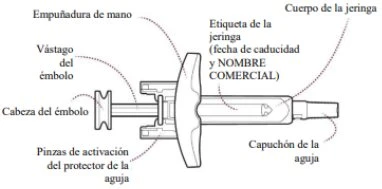
Before use
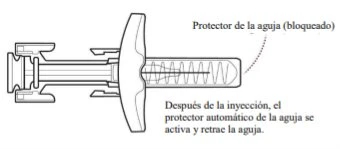
After use
Important information:
-
Your healthcare provider must train you on how to properly prepare and inject Zilbrysq before you do it for the first time.
-
Contact your healthcare provider if you or your caregiver have any questions about how to correctly inject Zilbrysq.
Do not use this medicine and return it to the pharmacy if:
- The prefilled syringe has been dropped.
Follow these steps each time you use Zilbrysq
-
Step 1: Prepare the injection
-
If the prefilled syringes are stored in the refrigerator, for a more comfortable injection: Remove 1 prefilled syringe of Zilbrysq from the refrigerator and leave it on a clean, flat surface at room temperature for 30 to 45 minutes before injecting. Do not warm it in any other way. Return the remaining syringes in the pack to the refrigerator and proceed to the next step b below.
If the prefilled syringes are stored at room temperature: Remove 1 prefilled syringe of Zilbrysq from the carton. The remaining syringes in the carton must not be placed back into the refrigerator once stored at room temperature.
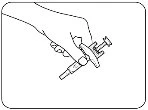
When removing a syringe from the outer carton, hold the syringe by the barrel (Figure A). Do not touch the plunger rod or the needle cap. Do not touch the needle shield activation clips at any time, as this could cause premature activation of the needle shield.
Figure A
- Place the following items on a clean, flat, and well-lit surface, such as a table:
- 1 prefilled syringe of Zilbrysq
- 1 alcohol swab (not included)
- 1 cotton ball or gauze pad (not included)
- 1 adhesive bandage (not included)
- 1 sharps or puncture-resistant container (not included). See Step 4 for instructions on how to dispose of the empty syringe.
- Inspect the prefilled syringe.
-
Check the prefilled syringe for any damage (see figure “Before use”).
-
Do not use the prefilled syringe if any part appears cracked, leaking, or broken.
-
Do not use it if the needle cap is cracked, broken, missing, or not securely attached to the prefilled syringe.
-
Do not remove the needle cap from the prefilled syringe until you are ready to inject.
-
Do not use it if the liquid has ever been frozen (even if it has been thawed).
-
Check the expiration date on the syringe label.
-
Examine the medication inside the prefilled syringe. The solution should be transparent to slightly opalescent and colorless. It is normal to see air bubbles in the syringe. Do not use it if the solution is cloudy, has changed color, or contains floating particles.
-
Check the dose shown on the label. Do not use it if the dose does not match the one prescribed to you.
-
Step 2: Choose and prepare the injection site.
-
Choose the injection site.
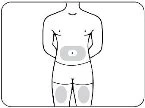
Select an injection site from the following areas (Figure B):
- The stomach (abdomen), except for the area within 5 cm around the navel.
- The front of the thighs.
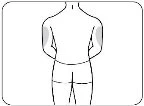
- The outer side of the upper arms.
Figure B
- Abdomen and thighs.
- Outer side of the upper arms (only if someone else administers the injection).
Choose a different site for each injection. If you wish to use the same general area again, ensure the new site is at least 2.5 cm away from the previous one.
Do not inject Zilbrysq into an area that is tender, red, damaged, hardened, or has scars or stretch marks.
-
Wash your hands thoroughly with soap and water, and dry them with a clean towel.
-
Prepare the skin.
- Clean the injection site with an alcohol swab.
- Allow the skin to dry for 10 seconds before injecting.
- Do not touch the injection site again after cleaning.
-
Step 3: Inject Zilbrysq
-
Remove the needle cap.
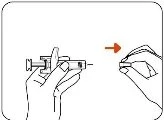
Hold the prefilled syringe of Zilbrysq by the barrel with one hand and pull the needle cap straight off with the other hand (Figure C).
Dispose of the needle cap in household waste or a sharps container (see Step 4).
- Do not touch the needle or let it touch anything.
- To avoid injury, do not recap the needle at any time.
- Do not attempt to remove air bubbles from the syringe. Air bubbles will not affect your dose and will not cause harm. This is normal. You may proceed with the injection.
Figure C
- Pinch the injection site.
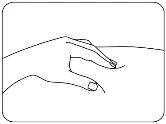
With your other hand, pinch the cleaned area of skin and hold it firmly (Figure D).
Figure D
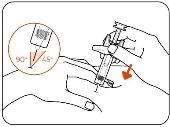
- Insert the needle.
Insert the entire needle into the pinched skin at an angle of 45º to 90º (Figure E).
- Do not pull back on the plunger at any time, as this may break the syringe.
- Do not touch the needle shield activation clips.
Figure E
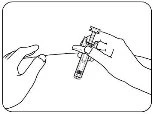
- Release the pinched skin.
Once the needle is fully inserted, keep holding the prefilled syringe in place and release the skin pinch (Figure F).
- Do not reinsert the needle into the skin if it comes out when releasing the pinch, as the needle may bend or break, causing tissue damage. If this occurs, safely dispose of the syringe in a sharps container and use a new syringe for the injection.
Figure F
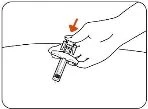
- Inject the medication.
Push the plunger all the way down while holding the grip wings to inject the full dose (Figure G). The medication is fully injected when you can no longer push the plunger head.
Figure G
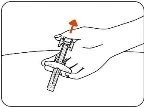
- Release the plunger.
Slowly release the plunger by lifting your thumb. At the end of the injection, the needle shield will automatically cover the needle, and you may hear a click (Figure H).
Figure H
- Examine the injection site.
Press a cotton ball or gauze pad over the injection site and maintain pressure for 10 seconds.
Do not rub the injection site. Minor bleeding may occur; this is normal. Apply an adhesive bandage if needed.
Step 4: Immediately dispose of the used syringe in a sharps or puncture-resistant container.
Always keep the sharps container out of the reach of children.