Xenetix 350 mg iodine/ml solution for injection
Spain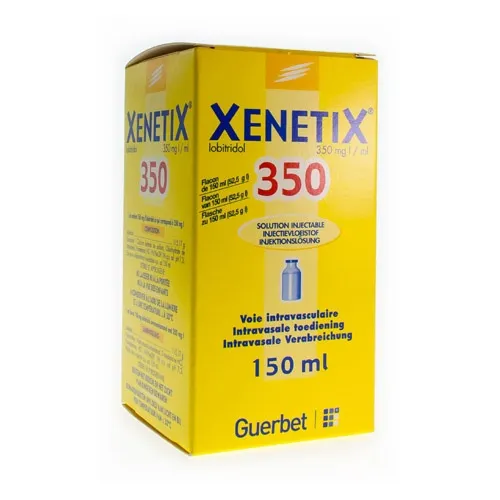
Table of Contents
Package leaflet: Information for the user
Introduction
Package leaflet: information for the user
XENETIX 300 mg Iodine/ml injectable solution
XENETIX 350 mg Iodine/ml injectable solution
Iobitridol
Read the entire leaflet carefully before you start using this medicine, because it contains important information for you.
- Keep this leaflet, as you may need to read it again.
If you have any questions, consult your doctor or pharmacist.
- If you experience any adverse reactions, consult your doctor or pharmacist, even if they are adverse reactions not listed in this leaflet. See section 4.
Leaflet contents
- What XENETIX is and what it is used for
- What you need to know before using XENETIX
- How to use XENETIX
- Possible adverse effects
- How to store XENETIX
Pack contents and other information
1. What XENETIX is and what it is used for
XENETIX is an iodinated radiological contrast medium (opaque properties), water-soluble, non-ionic, low-osmolality, used for radiological examinations of the kidneys and urinary tract (urography), of the whole body and brain (computed tomography), of the heart (angiocardiography), of venous blood vessels (angiography) or arterial vessels (arteriography), and of the breasts (contrast-enhimed mammography).
This medicinal product is intended for diagnostic use only.
2. What you need to know before using XENETIX
Do not use Xenetix:
- If you have previously experienced a severe skin rash, skin peeling, blisters, and/or mouth sores after receiving Xenetix.
- If you are allergic to the active substance (iobitridol) or to any of the other components of this medicine (listed in section 6).
- If you have had a significant allergic skin reaction, immediate or delayed, following previous administration of XENETIX during imaging procedures (see section 4. Possible Adverse Effects).
- If you have excess thyroid hormones (manifest thyrotoxicosis).
Warnings and precautions
Consult your doctor or pharmacist before starting to use XENETIX.
As with all iodinated contrast agents, regardless of the route of administration or dose, iodinated contrast media may induce mild, severe, or even fatal reactions. These reactions may occur within the first hour or, more rarely, within 7 days after administration. These reactions are unpredictable and more likely if you have previously experienced a reaction after receiving an iodinated contrast agent (see section 4. Possible adverse effects). Therefore, you must inform the radiologist performing the examination if you have ever had an allergic reaction during a previous imaging procedure with an iodinated contrast agent.
Inform the doctor performing the examination if you have any medical condition so appropriate precautions can be taken, especially:
- If you have previously had reactions to an iodinated contrast agent during imaging procedures.
- If you have previously experienced a severe skin rash or skin peeling, blisters, and/or mouth sores after receiving Xenetix or another iodinated contrast agent.
- If you have renal insufficiency (impaired kidney function), diabetes, or are undergoing dialysis, as iodinated contrast agents may cause transient kidney function impairment or worsen pre-existing renal insufficiency.
- If you have both renal and hepatic insufficiency (impaired kidney and liver function), as this increases the risk of contrast retention.
- If you have asthma and/or have had an asthma attack within the 8 days prior to the examination, as this increases the risk of bronchospasm (involuntary contraction of bronchial muscles).
- If you have a thyroid disorder or a history of thyroid disease, as hyperthyroidism may be exacerbated or hypothyroidism may develop. Also inform your doctor if you are scheduled for a future thyroid examination or radioactive iodine treatment.
- If you have heart failure (impaired heart function), coronary insufficiency, or any other serious cardiovascular disease, as the risk of certain adverse reactions increases.
- If you have neurological disorders, cerebral edema, recent history of intracranial hemorrhage, acute cerebral infarction, transient ischemic attacks, epilepsy, or are addicted to alcohol or medications, as the benefit-risk ratio of undergoing the procedure must be evaluated.
- If you have pheochromocytoma (elevated hormone secretion causing severe hypertension), as you should be monitored to prevent hypertensive crisis.
- If you have myasthenia gravis (an autoimmune muscle disease), as symptoms may worsen.
- If you feel anxious, agitated, or fearful about the examination, please inform your doctor, as adverse effects may be intensified in such situations.
- If you have pancreatic disease (acute pancreatitis).
- If you have bone marrow disorders (monoclonal gammopathy, multiple myeloma, or Waldenström macroglobulinemia).
Take special care with Xenetix
Severe cutaneous reactions, including drug reaction with eosinophilia and systemic symptoms (DRESS), Stevens-Johnson syndrome (SJS), toxic epidermal necrolysis (Lyell syndrome or TEN), and acute generalized exanthematous pustulosis (AGEP), which may be fatal, have been reported with the use of Xenetix.
During or shortly after the imaging procedure, you may experience a transient brain disorder known as encephalopathy. Seek immediate medical attention if you experience any of the symptoms related to this condition described in section 4.
Children
Thyroid disorders may occur after administration of Xenetix. Special attention should be given to newborns, including those whose mothers received Xenetix during pregnancy, and to premature and young children. Physicians should monitor the child's thyroid gland function.
Use of XENETIX with other medicines
Please inform your doctor or pharmacist if you have any other medical conditions or:
- If you are taking Metformin (a medication for the treatment of diabetes), as lactic acidosis may occur.
- If you are taking beta-blockers, vasoactive drugs, ACE inhibitors (angiotensin-converting enzyme), or angiotensin receptor antagonists, as these drugs reduce the cardiovascular compensatory mechanisms that activate during hemodynamic disturbances.
- If you are being treated with diuretics, as there is a risk of dehydration, and the doctor should perform saline rehydration before contrast administration.
- If you have recently received intravenous interleukin-2, as this increases the risk of developing a reaction to contrast agents.
- If you are scheduled for tests with radiopharmaceuticals where iodine could interfere.
- If you are scheduled for blood or urine tests.
- If you are taking, have recently taken, or may need to take any other medicines, even if they do not require a prescription, inform your doctor or pharmacist.
Use of XENETIX with food, drinks, and alcohol
Ask your doctor or pharmacist whether you need to refrain from eating or drinking before the examination.
Inform your doctor if you consume large amounts of alcohol (see section 2. Warnings and precautions).
Pregnancy and breastfeeding
Pregnancy
If you are pregnant or have missed your menstrual period, inform your doctor before undergoing radiological examination.
Exposure to X-rays during pregnancy should be avoided, although it may be justified after careful assessment by the doctor weighing the expected benefit of the examination against the potential risk.
Consult your doctor or pharmacist before taking any medicine.
If this medicine is administered to a pregnant woman or a newborn, the doctor should check the newborn's thyroid gland function, as they may temporarily have reduced thyroid activity (hypothyroidism).
Breastfeeding
It is recommended to suspend breastfeeding for at least 24 hours after administration of the iodinated contrast agent.
Consult your doctor or pharmacist before taking any medicine.
Driving and use of machines
The effect of this medicine on the ability to drive vehicles and operate machinery is unknown.
If you do not feel well after the examination, you should not drive or operate machinery.
XENETIX contains sodium
This medicinal product contains less than 1 mmol of sodium (23 mg) per 100 ml, and is therefore considered essentially "sodium-free".
3. How to use XENETIX
Follow exactly the instructions given by your doctor for administering this medicine. If in doubt, consult your doctor again.
Recommended doses should be adjusted according to the examination and the areas to be opacified, as well as to the patient's weight and renal function, especially in children.
Your doctor will determine the injected dose, which may vary depending on the type of examination, the technique used, your weight, cardiac output, and your overall health.
Xenetix is an injectable solution. The product must be administered intravenously or intraarterially.
If you use more Xenetix than you should
Iobitridol is mainly eliminated unchanged by the kidneys. Iobitridol is dialyzable.
In case of overdose or accidental ingestion, contact the Toxicology Information Service. Telephone: 91 562 04 20.
4. Possible adverse effects
Like all medicines, XENETIX may cause adverse effects, although not everyone experiences them.
Most adverse effects occur during or within the first hour after administration. Some effects may occur several days after injection of Xenetix.
Adverse effects with Xenetix are generally mild or moderate and temporary.
There is a small risk of allergic reactions (rare), which may occasionally be severe and very rarely lead to shock (in very rare cases, an allergic reaction may be life-threatening).
Any of the symptoms listed below may be early signs of shock. Inform your doctor or healthcare professional immediately if you experience any of the following:
- Swelling of the face, mouth, or throat that may cause difficulty swallowing or breathing
- Low blood pressure (hypotension)
- Difficulty breathing
- Wheezing
- Cough
- Itching
- Nasal inflammation (rhinitis)
- Sneezing
- Skin redness
- Itching (localized or widespread urticaria)
- Hives
- Severe and intense skin reactions with blisters over the entire body (Lyell syndrome or Stevens-Johnson syndrome), widespread red and scaly rash with skin nodules and blisters accompanied by fever at the beginning of treatment (acute generalized exanthematous pustulosis), or widespread rash, high body temperature, elevated liver enzymes, blood abnormalities (eosinophilia), enlarged lymph nodes, and involvement of other organs (drug reaction with eosinophilia and systemic symptoms, also known as DRESS syndrome or drug hypersensitivity syndrome). See also section 2).
- Effects on the heart and blood vessels: low blood pressure (hypotension), dizziness, lightheadedness, cardiac rhythm disturbances, bluish discoloration of the skin due to low oxygen levels in the blood (cyanosis), cardiac arrest.
The adverse effects reported with Xenetix are as follows:
- Uncommon (may affect up to 1 in 100 people): nausea and sensation of warmth
- Rare (may affect up to 1 in 1,000 people): swelling of various body parts including the face and throat, low blood pressure (hypotension), high blood pressure, difficulty breathing, wheezing, cough, sneezing, eye irritation, dizziness (sensation of lightheadedness or vertigo), malaise (feeling of discomfort or uneasiness), vomiting, heart rhythm disturbances (tachycardia), hives (skin redness and intense itching), other skin reactions, injection site pain, chills, tremor, presyncope (lightheadedness), paresthesia (tingling or prickling sensation in a limb)
- Very rare (may affect up to 1 in 10,000 people): thyroid disorders, coma*, seizures*, confusion*, visual disturbances*, memory loss*, photophobia* (fear of light), transient blindness*, drowsiness*, agitation*, sensation of restlessness*, headache, hearing difficulties, cardiac arrest, increased creatinine in blood, heart rhythm disturbances, angina or cardiac arrest (severe chest pain radiating to the left arm), impaired heart and blood vessel function, myocardial infarction, abdominal pain, kidney dysfunction, breathing difficulty due to airway muscle constriction or pulmonary edema, throat swelling, eczema, severe skin allergic reactions including blistering. If Xenetix is accidentally injected outside the vein, pain at the injection site with swelling, inflammation, and local redness or necrosis (tissue degeneration) may occur, as well as abnormal heartbeats (torsades de pointes), transient discomfort or pain due to transient spasm (contraction) of one or more coronary arteries of the heart.
*If there is a high concentration of iodinated contrast medium in the blood
Frequency not known (cannot be estimated from available data): transient neonatal hypothyroidism, hypothyroidism*, dizziness in cases of hypersensitivity, bluish discoloration of the skin due to low oxygen levels in the blood (cyanosis), transient brain disorders (encephalopathy) that may cause headache, confusion, visual disturbances, vision loss, seizures, loss of coordination, weakness on one side of the body, speech disturbances, and loss of consciousness.
Additional side effects in children
- Cases of short-term low thyroid gland activity (transient hypothyroidism) have been reported in young children following exposure to similar iodinated contrast media.
Reporting of adverse effects
If you experience any type of adverse effect, consult your doctor or nurse, even if it is a possible adverse effect not listed in this leaflet. You may also report them directly through the Spanish Pharmacovigilance System for Human Medicines:
www.notificaRAM.es. By reporting adverse effects, you can help provide more information on the safety of this medicine.
5. Storage of XENETIX
Keep this medicine out of the sight and reach of children.
Do not use this medicine after the expiry date stated on the vial or bag after EXP. The expiry date refers to the last day of the month indicated.
Protect from light.
For presentations in vials, do not store above 30 °C. However, stability tests have shown that the product may be stored at temperatures below 35 °C.
Do not use Xenetix after the expiry date indicated on the packaging.
Do not use this medicine if you notice any visible signs of deterioration.
Medicines must not be disposed of via wastewater or household waste. Ask your pharmacist how to dispose of unused containers and materials. This will help protect the environment.
6. Contents of the pack and other information
Composition of XENETIX
- The active substance is: iobitridol
XENETIX 300 mg Iodine/ml injectable solution
1 ml of injectable solution contains 658.1 mg of iobitridol/ml, equivalent to 300 mg of iodine.
100 ml of injectable solution contains 65.81 g of iobitridol, equivalent to 30 g of iodine.
XENETIX 350 mg Iodine/ml injectable solution
1 ml of injectable solution contains 767.8 mg of iobitridol/ml, equivalent to 350 mg of iodine.
100 ml of injectable solution contains 76.78 g of iobitridol, equivalent to 35 g of iodine.
- The other components are: calcium sodium edetate, trometamol, trometamol hydrochloride, sodium hydroxide or hydrochloric acid (to adjust pH), nitrogen, and water for injections.
Nature of the product and contents of the pack
XENETIX is an iodinated radiological contrast medium (opaque properties), water-soluble, non-ionic, low osmolality, for radiological examinations.
XENETIX injectable solution is a clear, colourless or slightly yellow solution containing iodine.
Pack sizes:
XENETIX 300 mg Iodine/ml injectable solution is available in 50 ml, 100 ml (single-dose), and 500 ml (multi-dose) vials, or polypropylene bags of 100 ml, 150 ml, 200 ml (single-dose), and 500 ml (multi-dose).
XENETIX 350 mg Iodine/ml injectable solution is available in 50 ml, 100 ml, 150 ml, 200 ml (single-dose), and 500 ml (multi-dose) vials, or polypropylene bags of 100 ml, 150 ml, 200 ml (single-dose), and 500 ml (multi-dose).
Only certain pack sizes may be commercially available.
Marketing Authorization Holder and Manufacturer
Guerbet
BP 57400
95943 ROISSY CDG Cedex - France
Local representative of the Marketing Authorization Holder:
Laboratorios Farmacéuticos Guerbet, S.A.
Pº de la Castellana, 91, 3rd floor
28046 Madrid
- (34) 91 504 50 00
Date of the most recent revision of this summary: May 2025
Other sources of information
Detailed and up-to-date information on this medicinal product is available on the website of the Spanish Agency of Medicines and Medical Devices (AEMPS) http://www.aemps.gob.es/.
This information is intended for healthcare professionals only:
Instructions for filling syringes of the injector: A specific transfer or filling device intended for this purpose must be used, together with appropriate disposable materials, which should be discarded appropriately, strictly following the manufacturer's instructions.
Specific precautions for the use of 500 ml containers: It is recommended that the contrast medium be withdrawn after puncturing the stopper with an appropriate device. The instructions for use provided by the manufacturer of all disposable materials must be followed. At the end of the day, any unused product or leftover product should be disposed of in accordance with local regulations.
Instructions for administration when using single-dose vials:
- The product should be drawn into the syringe immediately before use.
- After disinfecting the stopper, the solution should be withdrawn through the stopper using a single-use syringe and sterile, single-use needles.
- Any unused amount of contrast medium remaining in the single-dose vial must be discarded after each examination.
Instructions for administration when using multi-dose vials:
- Multi-dose vials should only be used when connected to automatic injectors/pumps.
- Automatic injectors/pumps must not be used in young children.
- Only a single puncture should be performed.
- The connection line may only remain in place for one working day (8 hours), provided that the instructions for use allow it, and the patient connection tubing must be changed after each patient, in accordance with the manufacturer's instructions.
- Any remaining contrast medium in the vial, as well as the connecting tubes and all disposable components of the injection system, must be discarded at the end of the working day.
- It is essential to strictly follow the additional instructions provided by the manufacturer of the automatic injector/pump and of the disposable components.